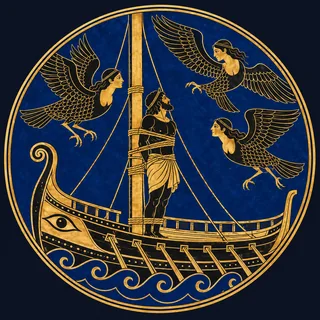
Odysseus
Ulysses
ὈδυσσεύςUlixesUlixes
- cunning
- endurance
- homecoming
- euhemerism
Son of Laertes and king of Ithaca, 'known among all men for my wiles': he devised the suitors' oath, feigned madness to avoid the war, won Achilles' arms and built the wooden horse, then took ten years to come home past the Cyclops, Circe, the dead, the Sirens, Scylla and Charybdis and Calypso before killing the suitors. Accounts of his end diverge: a gentle death 'from the sea' in old age (Tiresias), death at the hands of Telegonus, his son by Circe, or exile and old age in Aetolia; Tacitus even reports a belief that he reached Germany.
See Odysseus in the interactive atlas
First attested
c. 750-700 BCE · Od. 9.19-20
In the texts
εἴμʼ Ὀδυσεὺς Λαερτιάδης, ὃς πᾶσι δόλοισιν ἀνθρώποισι μέλω, καί μευ κλέος οὐρανὸν ἵκει.
I am Odysseus son of Laertes, known among all men for my wiles, and my fame reaches heaven. AI translation
Od. 9.19-20 Read the full text ↗
ἄνδρα μοι ἔννεπε, μοῦσα, πολύτροπον, ὃς μάλα πολλὰ πλάγχθη, ἐπεὶ Τροίης ἱερὸν πτολίεθρον ἔπερσεν·
Tell me, Muse, of the man of many turns, who wandered far and wide after he sacked the holy citadel of Troy. AI translation
Od. 1.1-2 Read the full text ↗
καὶ Ὀδυσσέα βοηθοῦντα τῷ μετὰ χεῖρας δόρατι Τηλέγονος τρυγόνος κέντρον τὴν αἰχμὴν ἔχοντι τιτρώσκει, καὶ Ὀδυσσεὺς θνήσκει.
and when Odysseus came to defend the flock, Telegonus wounded him with the spear in his hand, which was tipped with a stingray's spine, and Odysseus died. AI translation
Apollod. Epit. 7.36 Read the full text ↗
ceterum et Ulixen quidam opinantur longo illo et fabuloso errore in hunc Oceanum delatum adisse Germaniae terras
Some also think that Ulysses, carried into this Ocean on his long and fabled wanderings, reached the lands of Germany. AI translation
Tac. Germ. 3 Read the full text ↗
Lineage
- Consorts
- PenelopeApollod. 3.10.9
- Children
- TelemachusOd. 16.188TelegonusApollod. Epit. 7.16
Ties
- Created
- The Wooden HorseApollod. Epit. 5.14
- Defeated
- PolyphemusApollod. Epit. 7.7AjaxOd. 11.543-545The SirensApollod. Epit. 7.19
- Dwells in
- IthacaOd. 9.21
- Enemies
- PoseidonApollod. Epit. 7.9ScyllaHom. Od. 12.245The LaestrygoniansApollod. Epit. 7.13CharybdisApollod. Epit. 7.23
- Helped by
- AeolusApollod. Epit. 7.10HermesHom. Od. 10.302CirceApollod. Epit. 7.17The PhaeaciansApollod. Epit. 7.25TiresiasOd. 11.134-136TelemachusApollod. Epit. 7.32
- Killed
- Suitors of PenelopeApollod. Epit. 7.33
- Killed by
- TelegonusApollod. Epit. 7.36
- Punished
- PhiloctetesSoph. Phil. 4-6
- Punished by
- ZeusApollod. Epit. 7.22
- Visited
- TroyHom. Od. 9.39IsmarusHom. Od. 9.40Land of the Lotus-eatersHom. Od. 9.84Land of the CyclopesHom. Od. 9.106AeoliaHom. Od. 10.1Telepylus of the LaestrygoniansHom. Od. 10.81AeaeaHom. Od. 10.135The House of HadesHom. Od. 10.491Island of the SirensHom. Od. 12.167Strait of Scylla and CharybdisHom. Od. 12.260ThrinaciaApollod. Epit. 7.22OgygiaApollod. Epit. 7.23ScheriaApollod. Epit. 7.24IthacaApollod. Epit. 7.26
- Wields
- MolyApollod. Epit. 7.16
The reference after a name is the passage the tie rests on.
In the myths
- The Voyage of Odysseus, as a map
- The Geography of the Underworld
- The Trojan War
- The Returns: the house of Atreus and the wanderings of Odysseus
- The gods turned into men: euhemerism from Lactantius to Snorri and Holinshed
- The Matter of Troy in the Middle Ages
- The Æsir come north: Troy, the Vanir war and Óðinn's kingdom
Passages in the library
Passages of the original-language texts that name Odysseus, counted by a word index.