Contents
- Five minutesThe five-minute version
- IntroductionWhat counts as magic, and what this library can tell us
- TimelineFour thousand years at a glance
- Chapter IEgypt: the power that gods and kings could eat
- Chapter IIMesopotamia: the exorcist, the witch and the written sky
- Chapter IIIIsrael: forbidden arts and sanctioned signs
- Chapter IVArchaic and Classical Greece: drugs, songs and a borrowed word
- Chapter VThe Hellenistic and Imperial Greek world
- Chapter VIRome: the law of the evil song
- Chapter VIIEarly Christianity: miracle, magic and the demons
- Chapter VIIIThe North: seiðr, galdr and the runes
- Chapter IXMedieval Europe: blessings, fairies and frauds
- Chapter XRenaissance England: witches, conjurers and the art laid down
- Chapter XIHow magic differs across the cultures
- Chapter XIIDid any of it work?
- Chapter XIIIThe tricks, and the ancients who exposed them
- Chapter XIVThe numbers: the vocabulary of magic across time
- ConclusionWhat the texts tell us about magic
- MethodHow this report was made
- AppendixEvery passage cited
The five-minute version
What the texts say about magic
Every culture in the library practised something we would call magic, and most of them reserved the word for other people. Here is the report in brief: eight findings, the verdicts on whether any of it worked, and where to read on.
Written by AI agents from the library's texts. Scripts checked the chapters' block quotations and references against the library, and AI reviewers checked this summary against the chapters and the passages it cites. No specialist has reviewed it. How it was made · Download the data
-
"Magic" was a word for other people's rites
The English word comes from the Magi, whom Herodotus lists as a tribe of the Medes (Hdt. 1.101), some of them dream-readers at the Median court (Hdt. 1.107.1). Greek turned their title into a word for a quack: Sophocles' Oedipus throws it at the prophet Teiresias, who is telling the truth (Soph. OT 387–389). Rome wrote veneficium, poisoning or sorcery, into its criminal law, and Isidore of Seville says the magi are commonly called malefici, evil-doers (Isid. Etym. 8.9.9). Most cultures kept one word for their own powerful rites and another for everyone else's.
-
In the oldest texts, from Egypt and Mesopotamia, it was the work of kings and scholars
The Pyramid Texts, carved inside royal tombs from about 2350 BCE, have the dead king eat the gods' heka (PT 274 §403c, §411b), and a spell for Pepi I says simply "Pepi is heka", or "is the god Heka" (PT 472 §924). In Mesopotamia the exorcist was a temple scholar who declared "I am Ea's man" (GAAL 2 pl. 24–25, 15–22), and the witch was his enemy. In these royal and temple texts the licensed ritual was not shameful. It belonged to gods, kings and their experts. Egypt's later medical papyri carry such spells to private patients (Chapter I).
-
Israel forbade the diviners and kept its own signs
The law condemns the sorceress (Exod. 22.18) and the medium, and a prophet mocks the star-gazers of Babylon (Isa. 47.13). Yet the high priest carried a sacred lot, the Urim and Thummim, on his breastpiece (Exod. 28.30), and Moses and Aaron outdo Pharaoh's magicians (Exod. 8.18). What divides the sanctioned sign from the forbidden art is mostly whose power it serves and who performs it, not what is done.
-
Rome made it a crime, and the Church made it demonic
Pliny reads the Twelve Tables as a law against "whoever has chanted an evil charm" (Pliny NH 28.17–18), and whether spells fell under Sulla's law on poisoners was still a classroom question in Quintilian's day (Quint. Inst. 7.3.7). Augustine gave the Christian test: a herb crushed and drunk is medicine, but the same herb hung round the neck is a superstitious sign (Aug. Doctr. chr. 2.29.45), of the kind he traced to pacts with demons (Aug. Doctr. chr. 2.20.30). Even he allowed that a tied-on remedy without incantations might work by nature.
-
The North shamed seiðr in men, and German scribes blessed their charms
Snorri Sturluson says seiðr carried the greatest power, but brought such ergi, unmanliness, that men shunned it (Yng. 7). In his sagas of the Norwegian kings, Haraldr Fairhair's son Eiríkr burns his brother and eighty seiðmenn (HHárf. 34), and Óláfr Tryggvason burns sorcerers in a hall (ÓT 62) and drowns others on a tidal skerry (ÓT 63). In medieval Germany clerics copied charms into Latin books, and some of the charms call themselves segen, "blessings" (Münchener Wundsegen). One commands a worm by the life of Christ, and its Latin note calls it a medicine (Contra vermem edentem).
-
Magic is a woman's art mainly in the poets
Where the surveyors recorded the practitioner's sex, 606 passages have male practitioners and 247 female ones. The female practitioner is commonest in the poets and almost vanishes from the working texts: women are 65 per cent of the practitioners recorded as male or female in Latin poetry, goddesses included, against 5 per cent in the Mesopotamian tablets, where the one woman recorded is the witch the exorcist fights. The working texts were written by temple scholars, monks and physicians, so the gap says more about who could write than about who used charms. The practitioners' own texts, added to the library since, show women mostly as clients: a woman commissions the oldest prayer for justice among the Greek papyri (PGM XL 1–10), and in one Babylonian rite for a pregnancy the woman performs part of the rite herself, at the expert's direction (CMAwR 5.5.1:13).
Women's share of practitioners recorded as male or female, by collection -
The techniques outlived the cultures
Binding, figurines, love charms, consulting the dead and the logic of "as this wax melts, so may he melt" recur from one culture to the next. The Assyrian exorcist made a clay figure of the witch and poured kiln slag and ashes over its head (KAR 94 37'–40'), and more than two thousand years later Holinshed's witches roast a wax image of King Duff (Holinshed, Duff). The figurine survived. What changed was who was allowed to use it.
-
The practitioners' own texts, added since, mostly bear this out
Since the report was written the library has gained the texts practitioners wrote for themselves: Greek and Latin curse tablets, Greek and Coptic spell-books, the Egyptian Book of the Dead and medical papyri, and the Babylonian anti-witchcraft series Maqlû. They mostly keep the hostile words for other people. The Maqlû speaker turns the witch's own sorcery back on her: "The sorcery that you have performed against me I perform against you" (Maqlû VII 69). The curse tablets avoid almost every word for magic, and the Coptic spells name sorcery as something done to the client. There are exceptions. One Greek handbook hails its user as an initiate τῆς ἱερᾶς μαγείας, of the sacred magic (PGM I 127), and Egypt used one word, ḥkꜣ,w, both for a household's own magician (Tübingen 460, TLA 1.3–1.6) and for the hostile magicians a protective book cuts off (pChester Beatty VIII, TLA 8.105–108).
Did any of it work?
Panels of AI agents judged 283 claims of efficacy one by one against modern evidence; in each panel one agent challenged the verdicts it thought too generous and another those it thought too dismissive. Only 18 were judged to describe an effect that really happens much as stated, most of them drugs and poisons. Choose a verdict to see its claims, or search them.
The verdicts are judgments by AI models weighing ancient and modern evidence, not experiments. The ancients exposed many of the tricks themselves: the Hippocratic author of On the Sacred Disease and Pliny attack the magi as frauds, and Lucian and Hippolytus explain how the tricks were staged (Chapter XIII). Chapter XII discusses the verdicts, and the data gives every one with its reasoning. Sixty further verdicts, on claims from the practitioners' own texts added to the library since, are reported separately in Chapter XII and are not in this explorer.
Where to read on
By culture
- Egypt
- Mesopotamia
- Israel
- Archaic and Classical Greece
- The Hellenistic world
- Rome
- Early Christianity
- The North
- Medieval Europe
- Renaissance England
By question
Explore
The data behind the report, free under CC BY-SA 4.0: 1,343 passages (JSON) and 283 verdicts (JSON).
Introduction
What counts as magic, and what this library can tell us
The ancient words for magic were mostly names for other people's rites, so this report follows each culture's own vocabulary through 1,343 verified passages in one digital library, and is plain about what that library cannot show.
The words were accusations
The English word "magic" comes from a people. Herodotus, writing around 430 BCE, knows the Magi as one of the tribes of the Medes, some of whom read dreams at the Median court. King Astyages takes a frightening dream to them, and when their later judgement that its danger had passed proves wrong he punishes them as experts who got it wrong (Hdt. 1.107.1). A dialogue transmitted under Plato's name, of disputed authorship, glosses μαγεία (mageia), the teaching of Zoroaster, as "the worship of the gods", a subject for Persian princes ([Pl.] Alc. 1, 122a). Around 100 CE Dio Chrysostom complains that Greek ignorance of the word has turned the Persians' word for men skilled in serving the divine into a word for γόητες (goētes), sorcerers (Dio Chrys. Or. 36.41).
That shift happened early. In Sophocles' Oedipus the King (probably c. 429 BCE) Oedipus abuses the prophet Teiresias as a scheming μάγος and a begging priest with eyes only for profit, and the irony of the scene is that the "quack" is telling the truth (Soph. OT 387–389). A Hippocratic doctor of the same period blames the notion of a "sacred disease" on "magoi, purifiers, begging priests and charlatans" who pretend to special piety (Hippoc. Morb. Sacr. 1). The sophist Gorgias sets the two Greek words side by side as "two arts of sorcery and magic", which he calls "errors of the soul and deceptions of opinion" (Gorg. Hel. 10; see chapter IV).
The native Greek word, γοητεία (goēteia), belongs to the γόης, a figure many modern scholars connect with γόος, ritual lament for the dead. That etymology is an inference. In the texts the goēs can be a foreign charmer, as when Pentheus in the Bacchae calls the disguised Dionysus a "goēs and enchanter" who offers secret rites to women (Eur. Bacch. 233–238). Plato's Laws separates poison, which harms bodies by bodily means, from a second kind of φαρμακεία worked by trickery, incantations and "so-called bindings". He describes this second kind as working on the belief of attacker and victim alike, and declines to say whether it really works (Pl. Leg. 933a–b).
Latin took its words from law. Pliny the Elder quotes two clauses of the Twelve Tables, Rome's earliest code, against "whoever has charmed away crops" and "whoever has chanted an evil charm" (Pliny NH 28.17–18). Magic would later be prosecuted under Sulla's law of 81 BCE on assassins and venefici, which as Cicero quotes it orders an inquiry into poison (Cic. Clu. 148). Veneficium, from venenum, "drug" or "poison", could cover both, and Quintilian uses the question whether the spells of magi count as veneficium as a textbook dispute over definition (Quint. Inst. 7.3.7). The Hebrew law of Exodus 22.18 condemns a feminine mĕkaššēpâ, which the library's English renders "You shall not allow a sorceress to live" (Exod. 22.18). The library's Greek translation reads Φαρμακοὺς οὐ περιποιήσετε, "you shall not keep drug-makers alive", turning a feminine singular into a masculine plural and the crime into a matter of drugs (Exod. 22.18 LXX).
The clearest witness to how the label worked is a man tried under it. Apuleius, philosopher and novelist, was accused around 158 CE of winning a rich widow by spells, and his defence speech survives. He offers the court two definitions (see chapter VI).
Nam si, quod ego apud plurimos lego, Persarum lingua magus est qui nostra sacerdos, quod tandem est crimen, sacerdotem esse et rite nosse atque scire atque callere leges cerimoniarum, fas sacrorum, ius religionum
For if, as I read in a great many authors, a magus in the Persian tongue is what we call a priest, what crime is it, I ask, to be a priest, and to know properly, to understand and to be expert in the rules of ceremonies, the proper forms of rites and the law of religion?
The second, "vulgar" definition makes the magus a man who talks with the gods and can do anything he likes by the force of his chants. Apuleius turns it on his accusers, who would never dare to prosecute such a man if they believed it (Apul. Apol. 26.6–9). Four and a half centuries later Isidore of Seville closes the gap. His magi "are commonly called malefici because of the enormity of their crimes", and they kill by the force of a spell without any poison (Isid. Etym. 8.9.9). The Persian priest has become the evil-doer.
Words that were not accusations
Other cultures in the library had words for powerful ritual that carried no blame. In the Pyramid Texts, carved inside royal tombs from about 2350 BCE, Egyptian ḥkꜣ (heka) is a force that gods possess and that the dead king can eat.
Wnꞽś pꞽ wnm ḥkꜣ(.w) ⸗śn ꞽ:ꜥm ꜣḫ(.w) ⸗śn … ꞽw ḥkꜣ(.w) ⸗śn m ẖ.t ⸗f
Unas is the one who eats their heka and swallows their spirit-power … their heka is in his belly.
A spell for Pepi I simply says "Pepi is heka", or "is the god Heka" (PT 472 §924). In Mesopotamia the line ran between two figures. The āšipu, or exorcist, was a temple scholar whose incantations have him declare "I am Ea's man … the hand of Ea is in my hand" (GAAL 2 pl. 24–25, 15–22). Against him stood the witch, in Akkadian usually kaššāptu and here elēnītu, who in a commentary on the anti-witchcraft series Maqlû binds her victim while her kind pluck his hair and gather the dust of his footprints (KAR 94 7'–11'). Snorri Sturluson, writing in Iceland around 1230, calls seiðr the art "which carries the greatest power" and says Óðinn practised it, though it brought such ergi, unmanliness, that men shunned it and it passed to priestesses (Yng. 7). A German worm charm in a twelfth-century manuscript commands the worm by the life of Christ, and a Latin note calls it a medicina that loses its power for people once it is used on a beast of burden (Contra vermem edentem). An Old French epic of the late thirteenth century puts nigromance last among the arts a clerk learns, the most hated and the devil's own, and then lets the barons wish the clerk were on their side (Anseïs de Metz U 33r).
The report uses these words wherever it can and explains each when it first appears. "Magic" here is a finding-term, a net for collecting passages, and makes no claim that everything in the net is one thing.
How scholars have framed it
Modern theories began with the Victorian anthropologists. Edward Tylor and then James Frazer, in The Golden Bough (1890, much enlarged in later editions), treated magic as mistaken science, built on two laws Frazer called similarity (like produces like) and contagion (things once in contact go on acting on each other), and placed it at the foot of a ladder that climbed through religion to science. Marcel Mauss and Henri Hubert (1902–3) moved the question from logic to society. Religion for them was public and approved, magic private, secret and unofficial; Émile Durkheim put it as "there is no church of magic". Bronisław Malinowski stressed use, with Trobriand gardeners and sailors turning to spells where skill ran out. E. E. Evans-Pritchard showed in 1937 that Azande witchcraft belief formed a coherent system, answering the question "why me, why now?" that physical causes leave open.
Each frame catches something real in the ancient texts, and each has been criticised. Frazer's ladder does not fit cultures where the most "magical" acts belong to kings and gods, and the line between public and private fails for Egyptian heka and the Assyrian court's exorcists. Since the 1990s many historians of antiquity, among them Fritz Graf, Matthew Dickie and Kimberly Stratton, have preferred to ask who called whom a magician, and why. J. Z. Smith proposed dropping the term from scholarship. Bernd-Christian Otto and Michael Stausberg keep it as a loose heuristic category while tracing the history of the word itself. This report takes a middle course. It records each culture's own categories first (the "emic" view) and uses the modern word only to set them side by side (the "etic" view).
Why the line keeps moving
The passages draw the boundary against medicine, religion and science, and draw it differently each time. Pliny thought magic began inside medicine, "creeping in under the guise of healing as a loftier and holier medicine", then absorbed religion and astrology to become "the most fraudulent of the arts" (Pliny NH 30.1–2). Augustine, in the 390s, offered a test that sounds almost experimental.
Aliud est enim dicere, Tritam istam herbam si biheris, venter non dolebit; et aliud est dicere, Istam herbam collo si suspenderis, venter non dolebit.
It is one thing to say, "If you crush this herb and drink it, your stomach will not hurt", and another to say, "If you hang this herb round your neck, your stomach will not hurt."
The first acts by nature and is medicine. The second acts through a sign agreed with demons and is superstition, like the amulets and tied-on charms that, Augustine notes, "the discipline of physicians also condemns" (Aug. Doctr. chr. 2.20.30). Plotinus drew the line in the opposite place. For him "the true magic" is the love and strife that run through the cosmos, itself "the first sorcerer and drug-maker", so a human practitioner only borrows a power already in nature (Plot. Enn. 4.4.40).
Science moves the line as well. Pliny praises the astronomers whose predictions freed people from blaming eclipses on witches' drugs (Pliny NH 2.53–55), and complains that many of the common people still think eclipses are forced by drugs and herbs, "this one science of women" (Pliny NH 25.9–11). Hippolytus, in the early third century, explains a sorcerer's oracle as chemistry and stagecraft, down to the oak-gall fumes that make invisible ink appear (Hippol. Ref. 4.28). Philostratus explains why belief survives failure. When a love affair succeeds the art is praised as all-powerful, and when it fails the blame falls on some step left out (Philostr. VA 7.39). Chapters XII and XIII take up these questions.
What the library holds
Classica Codex is a reading library of texts in their original languages, with translations where they exist and a catalogue of Greek and Roman objects. It was not built to study magic, so its coverage is uneven. The table lists the fifteen collections surveyed, the rough span of the passages found, and the number of verified entries each contributed.
| Collection | Approximate dates | Entries | What it contributes |
|---|---|---|---|
| Egypt | c. 2350–2200 BCE (Pyramid Texts); Greek, Latin and medieval reports c. 700 BCE–1380 CE | 84 | Royal tomb spells in transliteration and hieroglyphs, with no translation; heka, snake spells; Egypt as others saw it |
| Mesopotamia | tablets c. 735–100 BCE, some copying 2nd-millennium works | 63 | Exorcists' commentaries, bilingual incantations, Assyrian royal inscriptions, glass-furnace rituals; Akkadian, when surveyed, with word-by-word glosses only |
| Bible | c. 800 BCE–120 CE | 122 | Septuagint Greek and English (WEB) Old Testament, Greek New Testament; prophets against diviners, Endor, exorcism |
| Greek poetry | c. 725 BCE–500 CE | 89 | Homer's Circe, tragedy, Theocritus' love spell, Apollonius' Medea, Nicander's poisons |
| Greek classical prose | c. 430–250 BCE | 92 | Herodotus on the Magi, Hippocratic medicine, Plato's laws on binding spells, Theophrastus on plants |
| Greek imperial prose | c. 150 BCE–450 CE | 106 | Plutarch, Lucian, Philostratus' Apollonius, Galen, Josephus, the novels, Hero's automata |
| Greek philosophy and Christian Greek | c. 50–460 CE | 93 | Plotinus, Porphyry, Iamblichus on theurgy; Origen against Celsus, Hippolytus, Eusebius |
| Latin poetry | c. 200 BCE–500 CE | 99 | Virgil, Horace's Canidia, Ovid's Medea, Lucan's Erictho, Juvenal, Christian verse |
| Latin classical prose | c. 160 BCE–400 CE | 109 | Cato's charms, Pliny's history of magic, Apuleius on trial, Tacitus and Ammianus on magic trials |
| Latin Christian | c. 200–730 CE | 98 | Tertullian, Augustine, church councils, Gregory of Tours, Isidore, Bede |
| Old Norse and Nordic | poems from the 10th century; manuscripts c. 1270–1500, some later copies | 94 | Völuspá, Heimskringla, family sagas, laws, Old Swedish and Old Danish texts |
| Medieval German | c. 1050–1350 | 83 | Blood, worm and fever charms, medical books, Kaiserchronik, courtly romance |
| Medieval Romance | c. 850–1500, mostly 12th–14th c. | 69 | Old French epic (Huon de Bordeaux), Dante, single manuscript lines |
| Objects | c. 600 BCE–250 CE | 72 | Vases with Medea and Circe, the Glykon snake, healing reliefs, with companion texts |
| Renaissance England | c. 1557–1611 | 70 | Shakespeare's witches and Prospero, Holinshed, the English Faust Book |
The evidence is lopsided in one important way. Most of these texts were written about magic by people who did not practise it, usually educated men. In the collections surveyed, the practitioners' own words survive in only a few places, chiefly the Pyramid Texts, the Mesopotamian exorcists' commentaries, the German charms and a handful of recipes in Cato and the medical writers; the library has since gained many more (see below). In tone the survey is more balanced. Of all the entries, 303 tell of magic as something that happens, 151 condemn it, 142 use it in fiction and 82 expose a trick; the rest instruct, mock or simply mention it.
The library has since gained much of what was missing, and the chapters now draw on it in passages marked as additions. It holds 841 curse tablets: every Attic tablet of IG II/III³ 8, 1, the tablets of Sicily and those of the Roman provinces (IG II/III³ 8, 1, 301). It holds 151 Greek magical papyri, among them PGM I complete (PGM I 127), and 353 Coptic magical texts with the Kyprianos project's English (KYP T15). Egypt's own language is now represented by 2,332 texts of the Thesaurus Linguae Aegyptiae with its German translations, among them 22 Book of the Dead manuscripts and the medical papyri (BD 64 (pJuja)). Maqlû is there in Abusch's edition and translation (Maqlû I 62), with the three volumes of the Corpus of Mesopotamian Anti-witchcraft Rituals and the scholars' tablets of Sultantepe, Nimrud and Uruk, which include Šurpu (SpTU 2 14). The Hebrew Bible is there with its Aramaic chapters, so the sorceress of Exodus can be read as she is written, מְכַשֵּׁפָ֖ה (Exod 22.17, Hebrew), and so are Daemonologie (Daemonologie I.1) and both texts of Doctor Faustus. Still missing are the magical gems and binding figurines, the great Greek handbooks (PGM IV, V, XII and XIII, and all of PGM VII but eleven lines), the Coffin Texts, any Demotic text, the scholars' letters to the Assyrian kings, the substitute-king ritual, the Old High German Merseburg charms and the Malleus maleficarum.
Some texts are stored in ways a reader should know about. The Septuagint and some patristic and Greek editions are raw scans with recognition errors, and quotations keep those errors as stored. Several editions number passages their own way, so the library's reference can differ from the conventional one. Some passages carry a flag marking them as spurious that the researchers found to be an artefact of the encoding, and the report does not treat those passages as doubtful on that ground. A few volumes filed under ancient names hold early-modern Latin, and these were set aside.
How the research was done
The work had four stages. AI agents did the research and the writing, and scripts did the checking (How this report was made sets out who did what, and what the checks can and cannot show). First, an AI agent surveyed each collection, sweeping it for that culture's own vocabulary (heka, kišpū, φάρμακον, carmen, seiðr, segen and many more), checking leads from earlier scholarship and opening each passage before recording it, with its edition, reference, original excerpt, translation, claimed effect, practitioner and the author's stance. Second, a script checked every entry against the library. The edition and reference had to exist and the quoted excerpt had to be found there. The scripts found 1,277 excerpts at their references (21 of them only after a second script undid the first run's wrong corrections) and 3 beginning at a neighbouring passage, whose references were corrected; an AI agent confirmed 6 more where the transcription defeated the script, and for the 57 museum objects the script confirmed only that the catalogue entry exists. Third, the surveyors flagged 351 claims that could be tested against modern knowledge. Seven panels of AI agents took the 339 from fourteen of the surveys (the Renaissance English survey's 12 were never sent to them), merged them into 260 and returned 283 verdicts. In each panel one agent researched the evidence and drafted the verdicts, two others challenged the drafts they thought too generous or too dismissive (95 of the 260 were challenged), and a fourth answered the challenges and gave each verdict, from "real physical effect", "real effect by a different mechanism" and "knowledge presented as magic" through "psychological" and "trick or fraud" to "implausible", with "insufficient evidence" where the panel could not decide. Fourth, AI writing agents drafted each chapter from the verified entries and from passages they opened in the library, and AI fact-checkers then read each chapter.
Dates are approximate throughout and many are disputed, among them saga composition dates, the age of a charm copied into a later manuscript and the authorship of works such as the Alcibiades. The text says so where it matters. Translations are the AI authors' own and have not been checked by a specialist.
The material added in October 2026 was gathered the same way. Surveys of the new collections recorded passages, each checked mechanically against the library, and adversarial reviewers then tried to break the surveys and the notes drawn from them; their corrections were adopted. Three further plausibility panels judged 55 claims from the new texts and gave 60 verdicts (chapter XII). In the added passages translations are the library's where it has one (among them Abusch's for Maqlû, the editors' for the curse tablets and the Kyprianos project's for the Coptic texts) and otherwise the authors' own; Egyptian is translated with the TLA's German as a guide.
How to read the citations
Every reference printed in red names a passage in the library. Its label gives the conventional citation, such as Hdt. 1.107.1 or PT 274 §403. Clicking it copies the library's own identifier for the passage, which may be numbered differently, so that it can be opened in Classica Codex. Original-language quotations are copied exactly as the library stores them, scribal spellings and scanning errors included, and are kept short. Objects are cited by museum number. Where a statement rests on modern scholarship and not on a passage, the text says so.
The chapters that follow go culture by culture, from Egypt to Renaissance England. Chapter XI compares them, chapter XII asks which claims could have worked, chapter XIII turns to the tricks and the people who exposed them, chapter XIV counts the vocabulary across time, and the Conclusion draws the threads together.
Timeline
Four thousand years at a glance
Each mark is a passage in the library. Hover or tap one to read it; the list below holds every event.
The scale changes twice, at 1000 BCE and at 600 CE, so the crowded classical centuries get room. Break marks show where.
Choose a mark to read about it.
All events as a list
Chapter I
Egypt: the power that gods and kings could eat
In the Pyramid Texts heka is a force that gods carry in their bellies, kings swallow and priests speak into being, and it was only in Greek, Jewish, Roman and Christian eyes that Egypt became the homeland of magicians.
A king at a feast of gods
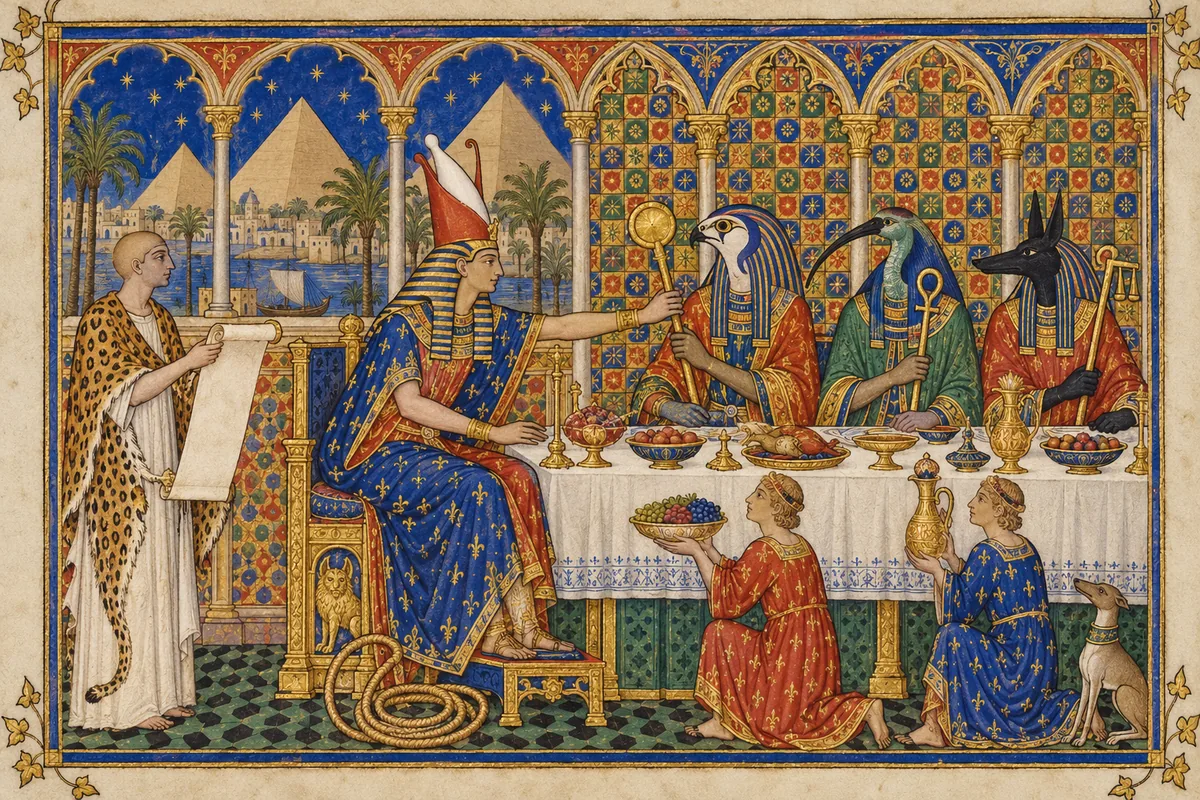
Around 2350 BCE the burial chamber of King Unas at Saqqara was covered from floor to ceiling with columns of hieroglyphs. They are the oldest large body of religious writing to survive from Egypt, and modern scholars call them the Pyramid Texts. Most of the spells feed, purify, protect and raise the dead king. One of them, now numbered 273–274 and known as the Cannibal Hymn, does something stranger. It shows Unas hunting the gods across the sky, cooking them and eating them.
Wnꞽś pꞽ kꜣ p.t nhṭ m ꞽb ⸗f ꜥnḫ m ḫpr(.w) n(.ꞽ) nčr nb wnm(.w) wsm.w ⸗śn ꞽw.w mḥ ẖ.t ⸗śn m ḥkꜣ.w m Ꞽw-nśꞽśꞽ
Unas is the bull of the sky, raging in his heart, who lives on the being of every god and eats their entrails, when they come with their bellies full of heka from the Island of Flame.
The hymn goes on to say plainly why the king eats. A few lines later he is "the one who eats their heka and swallows their akh-power", and "their heka is in his belly" (PT 274 §403, §411). What Greeks and Romans would later call Egyptian magic appears here, at the start of the written record, as a substance inside divine bodies that a king can take by force. Nothing in the text treats this as wrong.
This chapter follows heka through the Pyramid Texts and the later Egyptian books in the library, and then follows the much longer story, from Homer to a medieval Swedish poet, in which outsiders turned the land of heka into the land of sorcerers.
The words for it
The Egyptian word is ḥkꜣ, conventionally pronounced heka. (The library's transliteration writes č̣ where Egyptologists usually write ḏ, and ꞽ for j.) It occurs in 23 lines across the pyramids in the library, and every one describes a power belonging to someone with a right to it.
Gods have heka in measurable amounts. The sky goddess Nut is told that she has "taken Horus, his great heka" and "taken Seth, his great heka" (PT 443 §823), though the two are rivals in myth. The red crown and the cobra on the king's brow are addressed as a goddess called Wr.t-ḥkꜣ.w, "Great of Magic", and asked to give Unas her power to strike terror (PT 221 §196). As the dead king rises, "his ba has brought him, his heka has equipped him" (PT 245 §250), and another sets "his heka at his feet" (PT 306 §477). In the pyramid of Pepi I the identification is complete.
č̣(ṭ) mṭw ꜣwꞽ p.t śṭꜣ tꜣ ṭp-ꜥw(.wꞽ) Ppy pn / Ppy pw ḥkꜣ.w / Ppy pw ẖr(.ꞽ) ḥkꜣ
Words to be spoken. The sky stretches, the earth trembles before this Pepi. Pepi is heka. Pepi is the one who holds heka.
"Pepi is heka" can also be read "Pepi is Heka", the god of that name known from other Egyptian sources. The library's Egyptian word list now also has Heka as a god's name, and a New Kingdom healing book calls on him beside Horus, Re, Shu, Geb, Osiris and Nun (London Medical Papyrus, TLA 1.393), but the line itself cannot settle the question. Either way the king is not asking for magic. He is it.
Several other words do the work that "magic" does in English. ꜣḫ (akh) means effective, radiant, a spirit transfigured into its full power; its causative ś:ꜣḫ means "to make someone akh". An ointment is told to "make him akh" (PT 77 §52). The rubric č̣(ṭ) mṭw (djed medu), "words to be spoken", opens most spells and appears in 412 lines. A spell is rʾ, "mouth" or "utterance", and a name, rn, carries much of the weight. Egyptologists debate whether "magic" translates heka at all, since nothing here sets it against religion, medicine or kingship.
Who wielded heka
In the Pyramid Texts the practitioners are gods and kings. The king is the one whose heka matters, and he acquires it by eating, by inheritance and by identity. Gods hold it too, and so do the goddesses who protect him: the crown goddess, Nut, and Mafdet, a cat-like or mongoose-like huntress whose claws kill snakes.
Someone had to speak the words, and the texts never name him. Many spells have a first-person speaker: "Osiris Unas, I have given you the Eye of Horus" (PT 25 §18), and in the Opening of the Mouth, "I am Horus … I am your beloved son" (PT 20 §11, Pepi II). Egyptologists identify this voice, on evidence from outside the pyramids, with the lector priest who read the sacred book in temple and funeral rites. The title is not in the library's Pyramid Texts, but it is in temple papyri of the same century (see 'Lector priests and magicians' below). He spoke as a god (Horus) to a god (the dead king as Osiris).
The library adds one detail about women. Queen Neith, a wife of Pepi II, received the same offering spells as the kings. In her copies she is addressed as "Osiris Neith", but in the lines I opened the word for "you" keeps its masculine form: "Osiris Neith, take for yourself the Eye of Horus" (PT 58, Neith). The spells were made for kings and passed on with their grammar unchanged.
The rite could pass to others in another way too. A spell in Pepi I's pyramid, repeated in Pepi II's, promises its reward to anyone who knows it.
rḫ św rr(ꞽ) rʾ pn n(.ꞽ) Rꜥw ꞽr ⸗f śn ḥkꜣ(.w) ꞽpn n.(ꞽ)w Ḥr.w-ꜣḫ.tꞽ wnn ⸗f rr(ꞽ) m rḫ.ꞽ n(.ꞽ) Rꜥw wnn ⸗f m śmr n(.ꞽ) Ḥr.w-ꜣḫ.tꞽ
Whoever knows this spell of Ra and performs these heka of Horakhty will be one whom Ra knows, will be a companion of Horakhty.
The next line restates the promise in the king's own voice (PT 456 §856). Here heka is plural and countable, "these heka", a set of acts that can be learned and done. The clause anticipates the "whoever knows this spell" rubrics of the Book of the Dead (see 'Rubrics, finds and foreign tongues' below). In the Old Kingdom the knower in practice was still the king.
Lector priests and magicians
The Pyramid Texts never name the man who spoke them, but the office Egyptologists give him was on duty in the same century. In the Fifth Dynasty papyri from the royal mortuary temples at Abusir, the lector priest (ẖr,j-ḥꜣb,t) appears in 28 lines as ordinary temple staff. A duty roster names a lector priest on each line (pCairo 58063 fr. 10, TLA 1.1–5). Another is present while the statues are dressed (pBM 10735 fr. 7, TLA 1.19), and a third is named in the inspection of a column removed for an offering feast (pLouvre E 25416, TLA 2.2). The papyri show him as staff of the royal cult, not as a reciter, but they put the title in the temples that served the kings of the pyramids.
By the time of Papyrus Westcar, a manuscript of about 1600 BCE, the office had a literary reputation. The tales are set at the courts of the Old Kingdom, and the first wonder-workers in what survives are chief lector priests; the title is in 14 of the papyrus's lines. Webaoner models a crocodile of wax and has it thrown into his garden lake behind the man who meets his wife there, and it becomes a real crocodile seven cubits long that seizes him (pWestcar, TLA 1.49–51). Djadjaemankh, chief lector and scribe of the book, recovers a rower's fish amulet for King Sneferu by laying one half of the palace lake on the other (TLA 1.145–146). Hearing each tale, Khufu orders offerings for the old king and for his lector (TLA 1.83; 1.156). The last wonder-worker is no priest. Prince Hordjedef (Djedefhor) tells Khufu of a commoner of 110, Djedi, who knows how to rejoin a severed head (TLA 1.167–170), and at court Djedi sets the limit of his own art.
jmi̯ jnt.[t]w n =j ḫnrj n,tj m ḫnr,t wdi̯ nkn =f / ḏd.jn Ḏdj / n-js n r[m]t.pl j [j]ty ꜥnḫ-[w]ḏꜣ-s[nb] nb =⸢j⸣ / m =k n wḏ.tw jri̯.t mn,t jr,j n tꜣ ꜥw,t šps.t / ꜥḥꜥ.n jni̯ n =f smn wḏꜥ tp =f … ꜥḥꜥ.n ḏd.n Ḏdj ḏd.t.pl =f m ḥkꜣ.pl / wn.jn pꜣ smn ꜥḥꜥ ḥr ḥbꜣbꜣ ḏꜣḏꜣ =f m-mj,tt
‘Have a prisoner who is in the prison brought to me, so that his execution may be carried out.’ Then Djedi said: ‘But not on a human being, O sovereign, life, prosperity, health, my lord! See, it has never been permitted to do such a thing to the noble flock.’ Then a goose was brought to him and its head was cut off. … Then Djedi said what he used to say as heka, and the goose stood up and began to waddle, and its head likewise.
Heka is also the practitioner's own word. A Middle Kingdom stela lists, among the household of a royal sealer, Iku, magician (ḥkꜣ,w) of the steward (Tübingen 460, TLA 1.6), the only person the TLA texts name with that title. Physicians claim their power from a god. The opening spell of the Ebers papyrus, of about 1550 BCE, says that Thoth makes writing speak, compiles the books, and gives akh-power to the learned and to the physicians in his following, to release the one whom the god wishes the healer to keep alive (pEbers, TLA 1.8–11).
The clients are private. Medical and protective books name the patient as mn msi̯.n mn,t, NN whom NN bore, in 67 lines of six texts, the oldest the London Medical Papyrus of the late Eighteenth Dynasty (London Medical Papyrus, TLA 1.2). Naming by the mother was, though, the ordinary way to name a person on Middle Kingdom stelae, and Iku's stela names its owner, It, as the son whom the lady of the house Taau bore (Tübingen 460, TLA 1.3). Fifteen of the 28 medical texts contain spells. One obstetric book has words spoken over a falcon, a cat and, probably, an udjat eye of faience on a cord of red linen, put on the woman in labour and then hung at her newborn son's neck (pBrooklyn 47.218.2, TLA 1.103–105). The Book of the Dead papyri name their owners, and one of them, challenged at the ferry of the dead, answers in the words the Pyramid Texts gave to Pepi: jnk ḥkꜣ, I am heka (BD 99A (pNeferubenef); compare PT 472 §924).
What they did with it
Snakes
No danger fills the Pyramid Texts like snakes. A block of spells (PT 226–244) runs around Unas's sarcophagus chamber, and another series guards the antechamber. They are short, direct and unpleasant for the snake.
č̣(ṭ) mṭw šn(.w) nꜥw ꞽn nꜥw šn(.w) bḥs ḫꜣb.w pr m ḥsp … ḥfꜣ.w pnꜥ mꜣ čw Rꜥw
Words to be spoken. The serpent is coiled round by the serpent; the toothless calf that came out of the garden is coiled round … Snake, turn on your back! Ra sees you.
There is no prayer and no offering. The command does the work, with the sun god as witness. Other spells chain powers together. "Your mouth is closed by the šmś.t; the mouth of the šmś.t is closed by Mafdet" (PT 230 §230); the meaning of šmś.t is unknown. In another, the sun's cobra rears against a snake that rises from the earth under the king's fingers, Mafdet's claw takes its head, and the spell ends with a stock cry, "Hiu-snake, lie down!" (PT 298 §442). In Teti's pyramid Horus shuts the snake's mouth with his sandal (PT 388 §681), and in Pepi I's Mafdet's claw blinds it (PT 501C, Pepi I).
Some of Unas's snake spells cannot be read as Egyptian at all.
č̣(ṭ) mṭw kbb hꞽ tꞽtꞽ bꞽtꞽ šś sꜣ ḥꞽfg.t rn ⸗k pw
Words to be spoken. Kbb hi titi biti šś sꜣ ḥifget: that is your name.
Another begins "m(ꞽ)tꞽ m(ꞽ)tꞽ mꞽtꞽ mꞽtꞽ" (PT 232 §236). The Semitist Richard Steiner has argued that several of these lines are early Canaanite snake charms written down in hieroglyphs, which would make them among the oldest Semitic texts known. Others read them as sound-play meant to seem foreign. The reading is disputed. On either view the oldest Egyptian spells already use words that are opaque on purpose, and the "barbarous names" Greek philosophers defended two and a half thousand years later had a long past.
Threatening the gods
The most surprising acts in the Pyramid Texts, to a modern reader, are the threats. The dead king needs a place among the gods, and if he is refused he promises cosmic damage.
ꞽr tm ⸗k ꞽr(.w) ś.t n Wnꞽś ꞽr.kꜣ Wnꞽś fꜣ.t m ꞽt(ꞽ) ⸗f Gbb / tꜣ nꞽ mṭw.n ⸗f / Gbb nꞽ wꜣ.n ⸗f
If you do not make a place for Unas, Unas will lay a curse on his father Geb. The earth will not speak. Geb will not be able to …
The word rendered "curse", fꜣ.t, is uncertain; it may mean a lifting or a carrying-off. The threat is addressed to the Lord of the Horizon, and Geb is the earth itself. The next spell goes further: if the god does not leave his seat and lay his dignity on the ground, Unas will come with the face of the Great One, set the fire of his eye round the gods, and break the arms of Shu that hold up the sky (PT 255 §297–299). Teti's pyramid carries the same threats. For a dead king, forcing a god was a proper act, carved beside hymns of praise. It would scandalise a Greek philosopher in the third century CE.
Names, known and hidden
Names give power over their bearers, so the king's must be safe. Unas is "the lord of …, whose name his mother does not know", and he "judges together with him whose name is hidden" (PT 273 §394, §399). The other side of this is knowledge. "Unas knows him, knows his name: Neh is his name, Neh-lord-of-the-year is his name" (PT 301 §449). A recurring formula, "in this your name of X", ties a god's name by a pun to the act in hand. The library's Unas edition opens against "all who hate Unas, who speak evil against his name", whom Osiris is told to seize and "not let go", the words to be said four times (PT 23 §16). To slander the name was to attack the person.
Substances, gestures and tools
Much of the Unas text (PT 23–171) is an offering ritual in which speech and matter work together. Each offering is declared to be the Eye of Horus, the god's wounded and restored eye, with the stage direction beside the words: "Osiris Unas, I have given you the Eye of Horus; your face is equipped with it … Words to be spoken four times. Incense, fire" (PT 25 §18). Purification with natron, the salt of embalming, rests on a pun between two words for natron and specifies the dose: "southern natron, five pellets, from Nekheb" (PT 34 §26). Teti's copy of an offering line that in Unas has no rubric adds "words to be spoken four times … lifting, four times" (PT 155 §93, Teti). These are scripts, with gestures, counts and materials.
The rite of Opening the Mouth, which restored the senses of the dead, used a real tool.
[hꜣ] [Nfr]-[kꜣ]-[Rꜥw] [wp.n] [(⸗ꞽ)] [<n>] [⸗k] [rʾ] [⸗k] m nwꜣ Wp-wꜣ.wt mśḫt.w bꞽꜣ wp rʾ n(.ꞽ) nčr(.w)
O Neferkare, I have opened your mouth for you with the adze of Wepwawet, the "foreleg" adze of bia-metal that opens the mouth of the gods.
Most of this line is a modern restoration, marked by the brackets, and only the end is read from the wall. bꞽꜣ is the metal word Egyptologists associate with meteoric iron, so a rare substance from the sky sat at the centre of the rite. In these texts natron, iron and incense work because they are named, counted and spoken over.
Rubrics, finds and foreign tongues
The Pyramid Texts give a king's words with brief stage directions. The Book of the Dead, written for private owners from the New Kingdom on, tells its user much more. Its rubric ḏd-mdw ḥr, to be spoken over, names an object in 49 lines of 32 spells in six of the 22 manuscripts. The heart-scarab spell is to be said over the scarab as heka (BD 30B (pNu)), and a late copy adds what the scarab is: a stone overlaid with gold, placed inside the heart of a man whose mouth has been opened (BD 30 (pTurin 1791)). The judgement spell ends with instructions for its performance and a promise of what it brings.
ḏd =tw rʾ pn wꜥb[.w] twr{j}[.w] wnḫ.w m ḥbs,w ṯb.w m ḥḏ,t.j sdm.w m msdm,t wrḥ.w m ꜥntj,w / wdn n =f jḥ.pl ꜣpd.pl snṯr tʾ ḥnq,t sm,w / jsk jri̯.n =k sšm,w pn n,tj m zẖꜣ ḥr zꜣt,w wꜥb[.w] m ztj sẖr.w m ꜣḥ,t n,tj n ḫnd šꜣj ꜥw,t ḥr =f / jr jrr! mḏꜣ,t tn ḥr =f wnn =f wꜣḏ[.w] … šs-mꜣꜥ ḥḥ n zp
This spell is to be said pure and clean, wrapped in a garment, shod in white sandals, painted with eye-paint and anointed with myrrh. Offer him cattle, fowl, incense, bread, beer and vegetables, when you have made this image painted on the ground, purified, in ochre, coated with earth on which no pig or small cattle has trodden. Whoever performs this writing over him will prosper. … Truly effective, a million times.
The promise of PT 456 returns as a rubric. Whoever knows this spell goes out by day (BD 86 (pNu)), and in the late Turin papyrus whoever knows this book on earth, when it is made in writing or on his coffin, goes out by day in any form he wishes and enters his house without being turned back (BD 72 (pTurin 1791)). Such rubrics are in 30 lines, about 21 spells, in six manuscripts. Other rubrics pull the other way. In at least eight spells the book is secret, to be used for no one but its owner, his father and son, his own flesh, a confidant or the one who taught him (BD 133 (pTurin 1791); BD 148), and one copy lets no one watch but the king and the lector priest (BD 148 (pTurin 1791)).
Spells also carry a certificate, šs-mꜣꜥ, truly effective, which closes spells in 43 lines of the Book of the Dead, 37 of them adding a million times, and in 25 lines of the medical texts, among them the three opening spells of the Ebers papyrus (pEbers, TLA 1.14). It records no cases. The same opening spells come nearest, in Egyptian, to saying how heka and medicine work together.
rʾ n swrj pẖr,t / jyj pẖr,t / jyj drr [j]ḫ,t m jb =j pn m ꜥ,t.pl =j jptn / nḫt ḥkꜣ,pl ḥr pẖr,t ṯs-pẖr
Spell for drinking a remedy. Here comes the remedy. Here comes what drives out the bad thing from this heart of mine and from these limbs of mine. Strong is heka because of the remedy, and the reverse.
The Teaching for Merikare gives the other half, why heka exists at all: the creator made it for mankind as a weapon, to ward off the blow of events (Merikare, TLA 1.301).
Many spells claim to have been found. Six Book of the Dead spells and the London Medical Papyrus tell how their text came to light. BD 64 survives in a short and a long version, both copied in the same manuscripts, and each tells its own story. In one, an overseer of builders found the spell in the foundations in the reign of King Khasti (BD 64 (pNu)); in the other, the finder is the prince who in Westcar brings Djedi to court.
gmi̯.ntw rʾ pn m Ḫmn,w ḥr ḏb,t n.t bjꜣ šmꜥ[,j] zẖꜣ m ḫsbḏ mꜣꜥ ẖr rd.du nṯr pn m-hꜣw nsw,t-bj,tj Mn-kꜣ,pl-Rꜥ,w mꜣꜥ-ḫrw / jn zꜣ-nsw,t Ḥr,w-ḏḏ≡f gmi̯ sw jm ḫft mnmn =f r jri̯.t sjp,tj m rʾ.pl-pr,w.pl … jni̯.n =f sw mj bjꜣ,t n nsw,t ḫft mꜣꜣ =f n,tt štꜣ,w pw ꜥꜣ [n] mꜣꜣ n pt{r}j
This spell was found in Hermopolis, under the feet of this god, on a plate of Upper Egyptian copper inscribed in true lapis lazuli, in the time of the King of Upper and Lower Egypt Menkaure, justified. It was the king's son Hordjedef who found it there, as he travelled to inspect the temples. … He brought it to the king as a marvel, when he saw that it was a great secret, unseen and unlooked-upon.
BD 130 and 134 were found in a cavern of the mountain (BD 130 (pTurin 1791); BD 134 (pBM 10793)), and BD 137A in a secret chest, in the god's own writing, in a temple at Hermopolis, again by the same prince (BD 137A (pNu)). The London papyrus says its protective spell fell at night into the hall of the temple of Koptos, a secret of the goddess, and was found by the sanctuary's lector priest and brought to Khufu as a marvel (London Medical Papyrus, TLA 1.407–410). One roll was found in the necropolis at the neck of King Usermaatre-setepenre, Ramesses II (BD 166 (pBerlin 3031)), and a Ptolemaic copy credits a bowl to Prince Khaemwese, who found it under the head of one of the blessed dead in the western cemetery of Memphis (BD 167 (pLeiden T 31)). Khaemwese is the model for the Setne of the later Demotic tales, which the library does not hold. The stories read as claims to authority. They are Egyptian precedents, attested from the New Kingdom, for the Greek books said to have been found in temples, such as the Isis oracle copied from a sacred book found in the treasuries of Hermes (PGM XXIVa 2–4).
The healing books also used foreign words on purpose. The London Medical Papyrus, of about 1330 BCE, labels one conjuration as in the speech of a foreigner and another as in the language of the Keftiu, the Cretans, and spells out their words syllable by syllable: sꜣ~n~tj kꜣ~pw~pj~wꜣ~y j~y~mꜥ~n~tj~rʾ~kꜣ~kꜣ~rʾ (TLA 1.142; 1.163–164). A Ramesside healing book confronts a disease demon with a Semitic name, Samanu; its speaker claims kinship with a clan of men who talk with snakes and kill them, and says he has sucked at the breasts of Anat, the great cow of Seth (pLeiden I 343, TLA 1.72–75). A late Book of the Dead spell calls on powers named Wrbg, Kmmr, ꜥmg and Krḫm (BD 166 (pBerlin 3031)). The library has nothing between the Unas snake spells and the London papyrus, but from then on opaque and foreign words belong to Egyptian healing and funerary books, long before the Greek magical papyri.
How it was meant to work
The Pyramid Texts contain no theory of why a spell works, only spells. Read as a whole, though, they rely on a few consistent means, which modern scholars have named.
- Speech that acts. "Words to be spoken" introduces commands in the imperative. Saying "Snake, turn on your back" is the protective act.
- Repetition. "Four times" follows many lines, often explained by modern scholars as one for each quarter of the world.
- Identity. The officiant speaks as Horus; the king is a bull of the sky, Osiris, heka itself. Becoming a god is the means of acting as one.
- Mythic equation. Bread, water and incense are the Eye of Horus because the speaker says so.
- Puns and names. A god's name is bound by wordplay to the act in hand, and knowing a name gives access while hiding one gives protection.
- Taking in power. Heka can be eaten and kept in the belly.
- Coercion. A god who refuses can be threatened with the collapse of earth and sky.
- Chains of agents. One power shuts a mouth, a stronger one shuts that power's mouth.
- Materials. Natron in counted pellets, ointment addressed as a person, an adze of sky-metal.
Later Egyptian books state fragments of a theory (see 'Rubrics, finds and foreign tongues' above). The fuller theory came much later, in Greek, from Egyptians and admirers of Egypt under Roman rule, and it reached for the features the old spells show. A treatise of the Hermetic corpus, presented as advice to a king, insists that its discourse must stay untranslated.
καὶ ἡ τῶν Αἰγυπτίων ὀνομάτων ⎡δύναμις⎤ ἐν ἑαυτῇ ἔχει τὴν ἐνέργειαν τῶν λεγομένων. … ἡμεῖς δὲ οὐ λόγοις χρώμεθα, ἀλλὰ φωναῖς με[γι]σταῖς [τῶν] ἔργων.
And the power of Egyptian names holds within itself the working of the things said. … We do not use mere words. We use sounds full of deeds.
Iamblichus, a Syrian Neoplatonist who around 300 CE wrote in the person of an Egyptian priest, made the same argument: names lose their force in translation, because "there are idioms in each nation that cannot be signified in another nation's speech" (Iambl. Myst. 7.4–5). The Christian Origen agreed, against Aristotelians and Epicureans, that magic is coherent, since names spoken "in the Egyptian language" bind particular daimones (Orig. C. Cels. 1.24–25). The Hermetic Asclepius added that the Egyptians "discovered the art of making gods" by installing daimones in sacred statues (Asclepius 37). None of them cites the Pyramid Texts, yet the principle they defended was already at work in Unas's chamber.
Where the line fell, and who was punished
Inside the Pyramid Texts there is no line between religion and magic. The boundary that matters runs between the king and his enemies. Dangerous power belongs to snakes that bite, to those who "speak evil against his name", to gods who will not make room. The punishment the texts imagine is cosmic. Osiris seizes the slanderers and does not let go (PT 23 §16), and Mafdet's claw takes the snake's head. The library holds no Egyptian trial concerning heka (an Old Kingdom court judgement in it decides a dispute over an estate: pBerlin 9010, TLA 1.3–8), so it cannot show how a pharaonic court treated a private person who turned heka against another. Later Egyptian books draw a line of their own, between one's own heka and other people's (see 'Heka turned against people' below). The foreigners drew it in different places.
Herodotus, who travelled in Egypt in the mid-fifth century BCE, calls nothing Egyptian μαγεία or γοητεία. Divination there, he says, "belongs to no human being, but to certain of the gods" (Hdt. 2.83); portents are written down with their outcomes so that the same sign can be read the same way again (Hdt. 2.82); and the only sorcerers in his Egyptian book live far beyond the Libyan desert (Hdt. 2.33). For Herodotus magic lay further out than Egypt.
The Hebrew Bible draws the line by contest. The library has Exodus in the Greek of the Septuagint, translated in Ptolemaic Egypt around 250 BCE, and in English from the Hebrew. When Aaron's staff becomes a serpent, Pharaoh calls his σοφισταί (experts), φαρμακοί (drug-workers, sorcerers) and ἐπαοιδοί (singers of spells) (Exod. 7.11 (LXX)). The story concedes their power: they match Aaron's wonders of blood and frogs, and first fail at the gnats, when the enchanters themselves tell Pharaoh, "this is the finger of God" (Exod. 8.19 (LXX)). Chapter III follows the contest in full. The boundary is one of source and degree. At home the same Greek word becomes a legal category, "you shall not keep φαρμακοί alive" (Exod. 22.18). Pharaoh's dream experts in Genesis, "magicians" in the English from the Hebrew, are simply ἐξηγηταί, "interpreters", in the Greek (Gen. 41.8). The Hebrew word, ḥarṭummîm (Gen 41.8), which the Hebrew of Exodus sets beside mᵊkaššᵊpîm, sorcerers (Exod 7.11), is generally derived from the Egyptian title of the chief lector priest, the office that spoke the Pyramid Texts and that Westcar gives to its court wonder-workers (see 'Lector priests and magicians' above).
Josephus, retelling Exodus in Rome around 94 CE, sharpened the line. His Moses works "not by sorcery and the deception of true opinion, but by the providence and power of God" (Joseph. AJ 2.286), and the Egyptians' staffs only "seemed to be serpents" (AJ 2.287).
The clearest statement of the boundary in the whole library is put in the mouth of an Egyptian priest, Calasiris, in Heliodorus' novel Aethiopica (3rd or 4th century CE, date disputed). He divides Egyptian wisdom in two. The common kind "crawls along the ground", waits on phantoms and the bodies of the dead, and relies on herbs and incantations; the true kind looks to heaven and the motions of the stars (Heliod. Aeth. 3.16; see chapter V).
Later in the novel a woman of Bessa raises her dead son with a pit, fire and libations, and soon dies on a spear-shaft (Heliod. Aeth. 6.14–15). The low kind is female, local and fatal; the high kind is male, priestly and astral. Galen drew a similar line for medicine, accepting plants but not the "silly Egyptian sorceries" recited while gathering them (Gal. SMT 6 prooem.). At Rome the line was a matter for the courts. Apuleius, tried for magic around 158 CE, mocked accusers who took Greek zoological terms for spells recited "in the Egyptian or Babylonian manner" (Apul. Apol. 38).
Heka turned against people
In the Pyramid Texts heka belongs to whoever has a right to it. Outside the pyramids heka is also hostile, worked against people or held by their enemies, in nine of the Egyptian texts. BD 23, in three manuscripts, opens the dead man's mouth so that he can work heka (BD 23 (pNu)), and sets the gods and the assembled Ennead against every heka and every speech said against him (23.10). Three recipes in the Ebers papyrus remove heka from the belly, one of them from the belly of a man or a woman (pEbers, TLA 5.250; 5.257; 5.261). Heka in the belly has three values that coexist: the king's eaten power in the Cannibal Hymn, the power in the bellies of the blessed dead (BD 90 (pNu)), and here, in a medical book, a sickness to be purged.
A Ramesside protective book names human sorcerers of both sexes, using the word that was Iku's title. Its client, NN whom NN bore, has already been saved from all the evil heka spoken against him (pChester Beatty VIII, TLA 8.96).
nn ꜥq ḥkꜣ,w.pl nb{t} jrr.t ḥkꜣ,w.pl ḥkꜣ,w[t].pl r =k / nn ḫpr jri̯.n =sn / nn sḏm.tw j:ḏd =sn / bḥni̯.tw šnꜥ.tw ḥkꜣ,w.pl =sn r rʾ =sn jn Rꜥw ḏs =f
No heka at all that male or female magicians work against you shall take effect. What they have done shall not happen. What they have said shall not be heard. Their heka is cut off and held back at their mouths by Re himself.
In the TLA texts no separate word of blame appears: heka is condemned only by whose it is and whom it is aimed at. A late illustrated papyrus asks a god to ward off every evil heka worked against Pharaoh (pBrooklyn 47.218.156, TLA 1.18), and a ritual book against Apophis, the serpent enemy of the sun, of about 310 BCE, prescribes a wax Apophis with his name in green ink, to be spat on and trodden underfoot with wax figures of all the enemies of Pharaoh beside it (pBremner-Rhind, TLA 4.796–797).
js jri̯.n =k ḫft[.pl] nb n,w Rꜥw ḫft[.pl] nb n,w Pr-ꜥꜣ ꜥnḫ-wḏꜣ-s[nb] m m[w]t m ꜥnḫ ḥnꜥ srḫ,y.pl nb n,tj m jb =f rn[.pl] n jt[j][.pl] =sn mw,t.pl =sn ms.pl =sn m ꜣb,t nb sẖꜣ.w m ry wꜣḏ ḥr šww n mꜣw mtn rn[.pl] =sn ḥr šnb,t =sn jrw m mnḥ … pꜣgjs ḥr =sn sjn m rd jꜣb,j sḫr m mꜥbꜣ m ds rdi̯ ḥr ḫ,t m mn,t n,t ḥmtjw.pl
When you have made all the enemies of Re and all the enemies of Pharaoh, dead or alive, and every slanderer he has in mind, with the names of their fathers, their mothers and their children and all their family written in green ink on a new sheet of papyrus, and their names engraved on the breasts of figures made of wax … spit on them, trample them with the left foot, fell them with the spear and the flint knife, and throw them into the fire of the coppersmiths' furnace.
Another passage of the same book puts into a wax figure the names of all the violent men and women the officiant's heart fears, every enemy of Pharaoh, dead or alive, again with the names of their fathers, mothers and children (TLA 4.686). A temple ritual explains that wax is made into curse figures to annihilate a name, warns the handler to keep his distance, and describes a book used in the rite as secret writing for averting heka and binding conjurations, with life and death in it: whoever betrays it dies on the spot by the sword (pSalt 825, TLA 1.129–141). These figures of enemies are all late. Older wax figures in the library belong to medical and protective rites, such as an ibis of wax laid on charcoal, whose smoke is to bring the womb down to its place (pEbers, TLA 41.52–55), and a dwarf of wax put at a patient's neck (pDeM 1, TLA 1.29–31). The one wax figure in a story acts rather than suffers: Westcar's crocodile becomes the beast that seizes the victim. The library has no Middle Kingdom execration figures or texts.
The line between one's own heka and other people's could also run along a frontier. In the twenty-third year of his reign Amenhotep II sent a decree in his own hand to his viceroy in Kush (TLA 1.1–3).
ky-ḏd n pꜣ zꜣ-nswt m nꜥi̯.t nḥs,j m-kfꜣ zꜣu̯ tw r nꜣy =sn r[m]ṯ.pl ḥnꜥ nꜣy =sn ḥkꜣ,w.pl
A further message to the king's son: do not be lenient with the Nubian. Beware of their people and of their magicians.
Here the fear of foreign magicians, which Greek and Jewish writers later turned on Egypt, is an Egyptian king's, about Nubia. None of these texts is a law, and the sanctions they record are ritual: heka cut off in the mouth, wax figures burned, a secret kept on pain of death. The one royal verdict on a use of heka in the library is fiction. In Westcar King Nebka tells the crocodile to take what is his and has the unfaithful wife burned; he punishes the adultery, not the magic (pWestcar, TLA 1.73–80).
The land of magicians
The outside view of Egypt began with admiration. In the Odyssey, Helen calms the grieving men at Sparta with a drug she was given in Egypt.
τοῖα Διὸς θυγάτηρ ἔχε φάρμακα μητιόεντα, / ἐσθλά, τά οἱ Πολύδαμνα πόρεν, Θῶνος παράκοιτις / Αἰγυπτίη, τῇ πλεῖστα φέρει ζείδωρος ἄρουρα / φάρμακα, πολλὰ μὲν ἐσθλὰ μεμιγμένα πολλὰ δὲ λυγρά·
Such clever drugs the daughter of Zeus possessed, good ones, given her by Polydamna, wife of Thon, an Egyptian woman. There the grain-giving earth bears the most drugs of all, many good in a mixture and many deadly.
Homer's Egypt is a land of drugs and physicians, where the power lies in the substance and the expert is a woman. Six centuries later Diodorus heard that the women of Thebes still used a drug against anger and grief (Diod. 1.97.7), and that Isis heals in dreams the sick whom doctors have given up (Diod. 1.25.5). Plato could already call Proteus "the Egyptian sophist" who bewitches, though only as a joke (Pl. Euthd. 288b).
The change came in the Hellenistic and Roman centuries. Strabo's Decaeneus learned to read signs of the future in Egypt and became the power behind a king of the Getae, regarded in the end as a god (Strabo 7.3.11). A stay in Egypt had become a holy man's credential. The New Testament named Pharaoh's magicians Jannes and Jambres (2 Tim. 3.8). Pliny the Elder made Moses and Jannes, enemies in Exodus, co-founders of a single school of magic (Pliny NH 30.11), and the pagan Numenius took the Egyptian side, calling the pair sacred scribes "judged second to none in magic" who could undo the worst of Moses' plagues (Numenius fr. 9).
Some of what Greek writers reported matches the Pyramid Texts closely, though none of them could have read the pyramids. Plutarch describes what Egyptian priests did in drought or plague.
ἔνια τῶν τιμωμένων οἱ ἱερεῖς ἀπάγοντες ὑπὸ σκότῳ μετὰ σιωπῆς καὶ ἡσυχίας ἀπειλοῦσι καὶ δεδίττονται τὸ πρῶτον ἂν δʼ ἐπιμένῃ, καθιερεύουσι καὶ σφάττουσιν,
The priests lead away some of the sacred animals in darkness, silently and quietly, and at first they threaten and frighten them. If the trouble goes on, they consecrate and slaughter them.
Around 300 CE Porphyry objected to Egyptian practitioners' violent threats against the gods. Iamblichus did not deny them. He listed them.
ἢ γὰρ τὸν οὐρανὸν προσαράξειν ἢ τὰ κρυπτὰ τῆς Ἴσιδος ἐκφανεῖν, ἢ τὸ ἐν ἀβύσσῳ ἀπόρρητον δείξειν ἢ στήσειν τὴν βάριν, ἢ τὰ μέλη τοῦ Ὀσίριδος διασκεδάσειν τῷ Τυφῶνι
… that he will smash the heaven, or bring the secrets of Isis to light, or show the forbidden thing in the abyss, or stop the sacred boat, or scatter the limbs of Osiris to Typhon …
His defence was psychological: the threats are aimed at lower, irrational powers that cannot tell true from false (Iambl. Myst. 6.5–7). From Unas threatening to silence the earth to Iamblichus' operator threatening to stop the sun's boat, the same kind of act runs for some 2,600 years, and none of the three sources cites the others. Plutarch also describes the incense κῦφι, mixed "while sacred writings are read aloud to the perfumers" (Plut. De Is. et Os. 80), much as the Pyramid Texts pair natron with words. Ptolemy made the Egyptian gift a fact of nature: under Pisces and Mercury the people of Lower Egypt are "given to magic" (Ptol. Tetr. 2.3).
By the second century CE the image was fixed, and it fills the fiction of the age. Lucian's Pancrates, a sacred scribe from Memphis, "lived twenty-three years underground in the sanctuaries, being taught magic by Isis", and could make a pestle walk and carry water (Lucian Philops. 34–36). Apuleius' Zatchlas, "an Egyptian, a prophet of the first rank", is hired to make a corpse speak (Apul. Met. 2.28), and at the end of the same novel the priest of Isis brings out books "inscribed in unknowable letters" (Met. 11.22). Egyptian writing was valued because outsiders could not read it.
The reputation could be turned against anyone. Celsus claimed that Jesus had worked for hire in Egypt and there "tried his hand at certain powers on which the Egyptians pride themselves" (Orig. C. Cels. 1.28), and pagans told Arnobius that Christ had stolen angel-names from Egyptian shrines (Arnob. Adv. nat. 1.43). Christians replied by making Egypt the home of demonic magic. In Jerome's life of Hilarion a young man of Gaza studies for a year at Memphis and then buries a copper love-tablet under a virgin's threshold (Jer. V. Hilar. 21). Athanasius, bishop of Alexandria, conceded the old power and declared it ended.
ἴσχυε καὶ ἐνήργει παρ’ Αἰγυπτίοις καὶ Χαλδαίοις καὶ Ἰνδοῖς αὕτη καὶ ἐξέπληττε τοὺς ὁρῶντας· τῇ δὲ παρουσία τῆς ἀληθείας, καὶ τῇ ἐπιφανεία τοῦ Λόγου διηλέγχθη καὶ αὕτη, καὶ κατηργήθη παντελῶς.
Magic was strong and worked among the Egyptians, Chaldaeans and Indians, and amazed those who saw it. But at the presence of the truth and the appearing of the Word it too was refuted and wholly abolished.
The medieval vernaculars kept the Egyptian magicians under new names. A German poet of about 1120 calls Pharaoh's two experts goukelære, conjurers or jugglers, who made dragons "by the cunning of conjuring" (Altdeutsche Exodus 1242–1245). The word survives as modern German Gaukler, a street entertainer. In the Old Swedish Konung Alexander of about 1380, Nectanebus still watches wax ships sink in a bronze basin of water to foresee his enemies' fleet, and the poet calls it "his devil's devices" (Konung Alexander, Holm D 4 fol. 111v).
Voices of doubt and mockery
Nothing in the Pyramid Texts doubts heka, and none of the later Egyptian texts surveyed for this chapter does, though two set limits on it. The Ebers papyrus gives the physician's power only for the patient whom the god wishes to keep alive (pEbers, TLA 1.11), and the Teaching for Merikare says that no heka can turn back the ba from its path (Merikare, TLA 1.124). Ipuwer's lament fears exposure, not failure: among the disasters of a world turned upside down, the temple's writings have been removed and "magic is stripped bare" (Ipuwer, TLA 1.208–211). Doubt came from outside. Diodorus explained Proteus' shape-changing as royal head-dresses, "the foreparts of lions, bulls and serpents" worn as signs of rule (Diod. 1.62.4). Juvenal mocked an Isiac priest at Rome who wins a sinner pardon from Osiris, bribed, he says, with a goose and a thin cake (Juv. 6.526–541). Pliny noted that Apion, who claimed to have called up the dead to question them about Homer, never dared say what answer he got (Pliny NH 30.18). Tertullian, who believed in demons, called magic "what almost everyone calls it: deception" (Tert. De an. 57). Chapters XII and XIII return to these. Every sceptic here was a foreigner, and the Egypt they doubted was largely one their own literature had made.
Change over time
Even inside the Pyramid Texts the rites changed from tomb to tomb. Unas's snake spells (PT 226–244) have no copies in the library's Teti or Pepi editions, but those kings have snake spells of their own, built from the same ideas with new wording. The Cannibal Hymn runs to 60 lines for Unas and survives in only 4 for Teti, where its syntax is recast: "it is Teti who eats their heka" (PT 274 §403, Teti). Gesture rubrics were added. Within about 150 years the royal liturgy was revised king by king.
The Egyptian books after the pyramids carry the same means into other hands. A Middle Kingdom household names its magician (Tübingen 460, TLA 1.6); Westcar, of about 1600 BCE, makes lector priests court wonder-workers (pWestcar, TLA 1.145–146); the Book of the Dead gives private owners rubrics, amulets and the king's claim to be heka (BD 99A); a Ramesside book defends its patient against sorcerers of both sexes (pChester Beatty VIII, TLA 8.105); and a ritual book of about 310 BCE burns wax figures of Pharaoh's enemies with the names of their parents and children (pBremner-Rhind, TLA 4.392). Most of the Pyramid Texts' means recur in them. What changes is who uses them, and against whom.
The outside view changed far more, and the library traces it in stages.
| Period | Main sources in the library | What Egyptian power is |
|---|---|---|
| c. 2350–2200 BCE | Pyramid Texts of Unas, Teti, Pepi I, Pepi II, Neith | Heka: a cosmic force of gods and kings, eaten, embodied and spoken; threats against gods are royal acts |
| c. 700–400 BCE | Homer; Herodotus | A land of drugs, physicians, oracles and record-kept omens; nothing is called mageia |
| c. 250 BCE–100 CE | Septuagint; Josephus; Strabo; Pliny; 2 Timothy | Rival expertise: real but inferior wonders, sorcerers and enchanters; training in Egypt as a credential |
| 2nd–3rd c. CE | Plutarch; Lucian; Apuleius; Celsus; Ptolemy; Hermetica | The archetypal school of magic, and at the same time a theology of effective names, threats and animated statues |
| c. 300–420 CE | Iamblichus; Athanasius; Jerome | Philosophical defence on one side; demonic magic defeated by Christ on the other |
| c. 1120–1400 | Altdeutsche Exodus; Konung Alexander | Conjurers and the devil's art |
The sharpest turn falls between Herodotus and the Septuagint, when translators working in Egypt itself made Pharaoh's priests φαρμακοί and ἐπαοιδοί. Josephus still granted Egyptian sacred scribes real foresight, "for they are clever at telling the truth about the future" (Joseph. AJ 2.205), but from then on the Greek and Latin words for illicit ritual, μάγος, γόης, magus, were applied to Egyptians as readily as to Persians.
What is distinctive about Egypt
Set beside the other cultures in this report, the Egyptian evidence in the library has five features of its own.
First, it is mostly royal and funerary. Elsewhere in this report ritual power often serves private clients; the Pyramid Texts serve one dead king at a time, and no private magician or client appears in them. The later Egyptian texts stay mostly funerary or royal: 179 of the 216 lines that contain heka are in funerary books, royal tombs, temple rites for Pharaoh, a court tale, royal teachings and inscriptions or a royal letter. But 98 of those lines, the largest group, are in Book of the Dead papyri made for private owners, and the medical and protective books serve private patients, among them women in labour (pBrooklyn 47.218.2, TLA 1.103–105), and one household names its magician (Tübingen 460, TLA 1.6).
Second, heka is a substance and a property. Gods are "great of heka", a crown is "Great of Magic", and a king can eat it. Magic elsewhere in the library is mostly something people do; in Egypt it is also something beings have.
Third, it coerces gods openly. Threats stand beside hymns in the Pyramid Texts, and the same kind of threat is reported by Plutarch and defended by Iamblichus two and a half thousand years later. Porphyry found such coercion scandalous; the oldest Egyptian texts treat it as a prerogative of kingship.
Fourth, its power lies in words as sounds: names known and hidden, puns, counted repetitions, and possibly foreign charms written in hieroglyphs. The later Greek idea that Egyptian names lose their force in translation, held by Hermetists, Iamblichus and Origen alike, is a theory of something the pyramids already practised.
Fifth, the outsiders' picture had an Egyptian counterpart. In the outsiders' languages a people's sacred power became the very type of foreign magic; but Egyptian tales already told of court magicians who worked wonders for kings, and an Egyptian king already warned his viceroy against the magicians of Nubia (see 'Heka turned against people' above). Unas ate the gods' heka as a king's right; in Celsus' day Egyptian-trained performers were said to sell their sacred lore in the market-place for a few obols (Orig. C. Cels. 1.68).
Chapter II
Mesopotamia: the exorcist, the witch and the written sky
In the cuneiform texts of Assyria and Babylonia, what we call magic was a salaried, hereditary and highly literate branch of temple scholarship, organised around reading the signs the gods wrote into livers, births and the sky and around undoing the hidden work of the witch.
A witch in the commentary
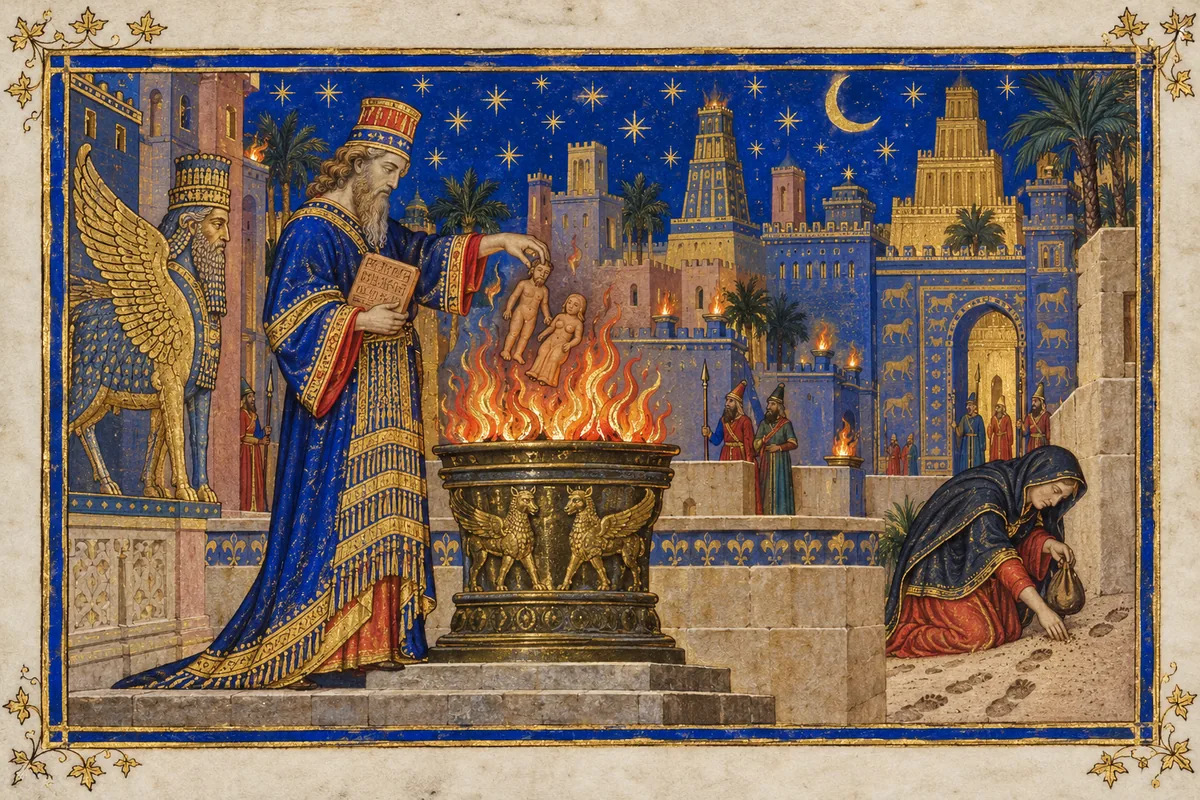
Sometime in the seventh century BCE, in a house at Assur that modern excavators call the House of the Exorcist, a scholar sat down with the great anti-witchcraft series Maqlû ("Burning") and explained its hard words one by one. The tablet he produced, known as KAR 94, survives in this library. It opens a window on the patient's complaint as the incantation framed it, in the first person, and on the scholar's dry glosses beneath it.
e-le-ni-tu₂ ub-bir₂-⸢an⸣-[ni] / ub-bu-ru ka-[su-u] / SIK₂.UZ₃ im-li-šu ma-la-šu ⸢ba⸣-[qa-mu] / i-ti-iq SAHAR GIR₃-MIN-ia₂ ⸢iš⸣-[bu-šu₂] / ša₂-ba-šu₂ na-⸢sa⸣-[hu]
"The witch has bound me." To bind means to tie up. "They have torn out my hair": tearing means plucking. "They have scooped up the dust of my footsteps": scooping means removing.
The passage holds both halves of Mesopotamian magic as the library preserves it. One is the theory: a woman who obtains a man's hair or the earth his feet have pressed can "bind" him, tying up his body, speech and luck from a distance. The other is the setting. A professional exorcist, trained in a temple school, glosses the witch's methods as he would gloss an obscure verb in an omen. It is a world full of demons, ghosts, curses and portents, described by men who wrote commentaries on their own manuals and dated their tablets by the reigning king.
The culture's own categories
Akkadian has no word that corresponds to "magic". The broad category was ummânūtu, "scholarship", the expertise of the ummânu or master. When Esarhaddon (680–669 BCE) restored the cult of Babylon after his father had destroyed the city, he reinstated its personnel as a single body: cult priests, "guardians of the secret", purification priests, exorcists, lamentation priests and singers, "masters of all scholarship" (RINAP 4 105 vi 21–27).
The exorcist's craft was āšipūtu or mašmaššūtu, the word an Uruk scholar wrote as a heading over a recipe for pounding aromatic resin (SpTU 1 47 o 2–5, with o 11). The diviner's lore was bārûtu. An incantation was a šiptu, closed by a rubric beginning ka-inim-ma, "wording of", that names its ritual; the accompanying actions were the kikiṭṭû, the "procedure". Against these licensed crafts stood kišpū, witchcraft, worked by the kaššāpu (sorcerer) and far more often, in the incantations, by the kaššāptu (witch). The verbs carry the moral geography. The witch "binds" (kasû, ubburu); the exorcist "loosens" or "releases" (pašāru), and the ritual that cancels the evil announced by an omen is called namburbû, from a Sumerian phrase meaning "its loosening".
Between these poles lies the most distinctive concept in the library's material, māmītu. The word means an oath. It also means the curse that falls on whoever breaks an oath, and by extension the curse that clings to anyone who has broken a taboo or committed a sin, even unknowingly. In the incantations māmītu becomes a demon in its own right, adjured to go away: "Oath, oath, be loosed! Withdraw, be far off! Oath, I adjure you by heaven!" (GAAL 2 pl. 17–18, 1–4). The same word names the treaty-oath that bound Assyria's vassals, so a single concept joins what we would split into religion, law, ethics and magic.
Who practised it
The practitioners in the library are almost all men, literate, salaried and attached to temples or the court, often from scholarly families who handed their tablets down for generations.
| Title | What he did | Example in the library |
|---|---|---|
| āšipu / mašmaššu (exorcist) | Diagnosed the supernatural cause of illness or misfortune and removed it by incantation, ritual, drugs and amulets | SAA 1 128 r 16–19 |
| kakugallu (senior exorcist) | Ritual expertise invoked at building foundations | RINAP 3 168, 29–31 |
| išippu (purification priest) | Ritual cleansing; had his own professional jargon taught in school | Examination Text A 9–10 |
| bārû (diviner, "seer") | Read the entrails of a sacrificed lamb (extispicy) | RINAP 4 48 r 73–75 |
| šā'ilu ("asker", dream-interpreter) | Inquired of the gods with incense, interpreted dreams | Ludlul II, comm. K.3291 o 26'–29' |
| kalû (lamentation priest) | Sang laments that calmed divine anger; also wrote commentaries | OIC 22 131 no. 20 |
| maḫḫû (ecstatic) | Delivered messages from the gods in an altered state | RINAP 4 57 ii 12–19 |
An administrative letter from the reign of Sargon II (721–705 BCE) shows how ordinary this was. It allots two measures of bread and two of beer to the exorcist and one of each to the temple steward, out of the regular offerings of the temple of Nabû (SAA 1 128 r 16–19).
The exorcist did not claim his power as his own. A bilingual incantation against the oath (māmītu) gives him a formula of delegated authority.
ša₂ {⸢d}e₂⸣-a a-na-ku ... ša₂ {d}DAM.KI.NA a-na-⸢ku⸣ ... DUMU šip-ri ša₂ {d}AMAR.UTU a-na-ku ... ša₂ qa-ti {d}e₂-a ina qa-ti-ia i-ba-aš₂-ši
I belong to Ea; I belong to Damkina; I am the messenger of Marduk. Ea's hand is in my hand.
Ea (Sumerian Enki), god of the fresh-water deep and of wisdom, was the source of every incantation; his son Marduk, identified with the older exorcist-god Asalluhi, was the divine practitioner. A list of gods inscribed for Sennacherib calls Marduk "sage of the gods, exorcist of the Igigi and Anunnaki" (RINAP 3 153 o 15), and a bilingual hymn hails its god as "pure diviner" (CT 58 28 r 8'). The human expert imitated a divine office, and in the culture's own terms that made him legitimate.
Colophons, the scribal notes at the end of tablets, name the experts. At seventh-century Assur the young exorcist Kiṣir-Nabû, son of Šamaš-ibni, copied commentaries on house-protection and on Šurpu (AfO 12 240), one of them labelled his maš'altu, his "questioning", an oral lesson put in writing (JRL 1053). Three centuries later the Uruk exorcists Iqīšâ of the Ekur-zākir clan and Anu-ikṣur of the Šangi-Ninurta clan wrote on eclipses, malformed births, potency, lice and a demon of the washroom. Iqīšâ signed his commentary on birth omens as "exorcist of Uruk" and dated it to the fourteenth of Duʾuzu in the sixth year of "Philip, king of the lands" (SpTU 2 38, 35), that is, Alexander's half-brother Philip Arrhidaeus, in 318 BCE.
The only female specialists the Mesopotamian texts name are hostile. They are the witch of the incantations and the "witches" whom one Assur commentator, in a broken gloss, places under the goddess Bēlet-Akkade as their "mistress" (KAR 94 33'–35'), which would give even illicit witchcraft a place in the divine order; but the line he glosses sends that goddess, Ishtar of Agade, against the witch (Maqlû II 195–197; see 'Maqlû in its own words' below), so the witches' mistress is a power turned against them. Midwives are implied in a birth incantation and ecstatics could be of either sex, but no woman in these texts writes, signs or teaches. In three of the anti-witchcraft rites for pregnancy, though, the woman herself speaks and performs parts of the rite (CMAwR 5.5.1:26–32; see 'Stars, ghosts and births' below), and Maqlû gives the witch the titles of women's religious offices, among them exorcist and ecstatic (Maqlû III 41–44).
What they did
Undoing the witch
The witch worked in secret, through contact with her victim's traces, and through food. The exorcist answered in the open, on her image. KAR 94 explains what lay behind a line of Maqlû III, in the incantation "O you who have performed sorcery against me", where the speaker threatens the witch with residues from the kiln and the cooking-pot.
a-laq-qa-kim-ma ha-ha-a ša₂ UDUN dih₂-me-e ša₂ UTUL₂ / ma-a NU ša₂ IM DU₃{uš} / kur-ban-nu ša₂ UDUN dih₂-me-e ša₂ UTUL₂ / a-mah-ha-ah ina SAG.DU NU ša₂ IM a-tab-bak
"I take slag of the kiln and ash of the pot against you." That means: he makes a figurine of clay. "A clod of the kiln and ash of the pot I soak, and I pour it over the head of the clay figurine."
The figurine (ṣalmu, written NU) stood for the witch. What was done to it was done to her. In Maqlû the climax was burning, and a Late Babylonian schoolboy copied the cry to the fire-god on an exercise tablet: "I shall burn them in a blazing kiln. Girra, burn my sorcerer and my sorceress!" (LB school tablet, 15–16). The same tablet carries lexical lists and the creation epic, so anti-witchcraft liturgy was part of an ordinary scribal education.
Witchcraft could also explain ailments a modern doctor would see as poisoning or neurological disease. The Diagnostic Handbook (Sakikkû) describes a patient who cannot speak properly, whose hands and feet shake, who salivates and keeps vomiting, and a Babylonian commentator explains its key phrase.
[ne₂-per-ku-u₂] ba-ṭa-lu ŠU-MIN-šu₂ u GIR₃-MIN-šu₂ i-ra-ʾu-bu ... [at-mu-u₂] da-ba-bi il-la-ti ru-ʾu-tu lu-ʾa-a-ti ⸢šu-kul⸣ / [lu-ʾa-(a)]-⸢ti⸣ kiš-pi ŠA₃-šu₂ ana BURU₈{a-re-e}e i-te-ne₂-el-la-⸢a⸣-[ma]
"Halting" means ceasing. "His hands and feet shake." ... "Talk" means speaking; "slaver" means spittle. "He has been fed debility": debility means witchcraft. "His stomach keeps rising to vomit."
Witchcraft was eaten. A commentary by Iqīšâ on the potency texts records a man "made to moan through witchcraft" in a series concerned with his desire for his wife (SpTU 2 39 r 4'–8'). Sexual failure, like the loss of speech, was a classic sign that someone had worked against you.
Expelling demons and drawing boundaries
Demons came in classes. The bilingual incantation against the oath lists the utukku, the alû, the gallû, the ghost (eṭemmu, the spirit of a dead person), the child-killing demoness Lamaštu and the night-demons lilû. Against all of them the exorcist drew a line on the ground.
lu-u u₂-tuk-ku lem-nu lu-u a-lu-u lem-nu lu-u e-ṭem₂-mu lem-nu ... ša₂ a-na zi₃-sur-re-e ša₂ {d}ni-sa-ba i-ṣar-ru-ru / ... sa-pa-ru ša₂ {d}ni-sa-ba lik-su-šu₂
Be it an evil utukku, an evil alû or an evil ghost ... whoever casts his eye on the flour circle of Nisaba, may the net of Nisaba bind him.
The zisurrû was a circle of flour poured around the patient or the bed; Nisaba was the goddess of grain. Here the exorcist turns the language of binding against the demons. A rubric from Assur names the ritual "for the flour circle and the drawn design" and declares that "the incantation of the Apsû and of Eridu cannot be undone" (VS 24 54 r 2'–3'); the Apsû was Ea's subterranean ocean and Eridu his city. The house itself could be sealed by oath. Kiṣir-Nabû's commentary on the incantation "The house is conjured" identifies, opening by opening, the windows the demon is forbidden to use: "the side window" is the bathroom window, "the outer side window" the window of the animal pen (AfO 12 240, 1–6).
Entering a patient's house, the exorcist recited that Šamaš the sun-god walked before him, Sîn the moon-god behind, Adad on his right and Ninurta on his left; the Assur commentator read this as an instruction to face the rising sun at dawn (JRL 1053, 11–14). Another copy puts Nergal, god of the underworld, on the right, and glosses the demon "who has set foot in the netherworld" as someone who was killed (LKA 82 o 6–11).
Healing
No sharp line divided the exorcist from the physician. The Uruk exorcist Anu-ikṣur explained a demon of the lavatory by taking its name apart into cuneiform signs.
a-na E₂ mu-sa-a-tu₂ la₃ KU₄{ub} {d}ŠU.LAK SIG₃-su / {d}ŠU.LAK ša₂ E{u₂} ŠU qa-tu₄ la la-a KU₃ el-lu / ana E₂ mu-sa-a-tu₂ KU₄{ub} ŠU₂-šu₂ NU KU₃ ana UGU qa-bi
"He must not go into the washroom, or Šulak will strike him." It says "Šulak" because ŠU means hand, LA means not, KU means pure: it is said of one who goes into the washroom with unclean hands.
The learned wordplay delivers a hygienic rule. The same man's commentary on a remedy for scalp disease explains upul as "one whose head the lice gnaw", identifies "black river-stone" as sulphur, and promises that "the old hair falls out and new hair comes out" (SpTU 1 51 r 2–8).
Seizures were described with special care. A commentary on the fumigation series Qutāru defines "Fallen-from-Heaven" (antašubbû) as a condition in which the patient chokes and his spittle runs, "Lord-of-the-Roof" as one in which his eyes roll back, and "Hand-of-a-god" as one in which he curses the gods (BRM 4 32 o 1–3). Each disease was the "hand", the touch, of some agent. Diagnosis meant identifying who had touched you; therapy meant driving that agent off. The same tablet then turns to the ingredients.
A.RI.A NAM.LU₂.U₁₈.LU {u₂}maš-ta-kal ... {u₂}IGI-lim ki-ma GIR₃.PAD.DU NAM.LU₂.U₁₈.LU ... MUD₂ ka-mi-i MUD₂ {lu₂}ga-ar-ba-nu
"Human semen" is the maštakal plant ... the "It-faced-a-thousand" plant is like human bone ... "blood of a captive" is "blood of a leper".
Modern editors call such entries Decknamen, cover names. Recipes that sound like a pharmacy of filth turn out, at least in part, to be coded herbal prescriptions, though some such ingredients may have been meant literally. A Nineveh commentary similarly glosses the "plant of Šamaš" as šakirû, an identification often rendered "henbane" but disputed (K.4320 o i 1–3, ii 1).
Childbirth had its incantation too. A commentary on "The woman giving birth is a boat loaded with lapis lazuli" explains that the reed is mentioned "because the reed is what cuts the umbilical cord" (OIC 22 131 no. 20, 1, 12–13). Its author, Enlil-kāṣir, a lamentation priest of Enlil at Nippur, passes from the myth of the moon-god's cow in labour to the instruction to reach in with the hand, so that mythic analogy and midwifery share a single text.
Reading the signs
Divination was the largest and most prestigious craft, and the one most bound up with the king. Its theory was that the gods wrote: on the liver of a sacrificed lamb, in the moon and planets, in a malformed birth, in thunder, in a snake on the threshold, in a remark overheard in the street. Trained readers decoded the signs by rules of analogy, collected in vast omen series of the form "If X, then Y".
The liver came first. An extispicy commentary from Ashurbanipal's library marks some configurations as "omens that not every diviner knows" and speaks of "lines that are strange in the diviner's lore" (CT 30 43 o 14'–15', r 6'–7'). Malformed births (izbu) were read by resemblance. In Iqīšâ's commentary a newborn "covered with scales like a goat-fish or a snake" means the anger of the moon-god, and a man will be covered with a scaly skin disease (SpTU 2 38, 21–22); in another, a birth with a lion's head means "a prince will seize kingship of the world" (CM 31 139, 1–2). Everyday omens of the series Šumma ālu ("If a city") made the same act good or bad according to the day: a man who kills a snake on the moonless twenty-ninth will be free of his fears, and the commentary refers him to the matching namburbû (Commentary A on Šumma ālu 22–23, 29–31).
The sky was read with the greatest system. Venus rising in the morning watch means killings in the land (ACh Ištar 5, 20–21); Mercury flickering at its rising in early summer means a good harvest and falling prices (ACh Ištar 21 o 13'–14'). Weather was part of the sign. "Thunder out of its time" is defined as thunder in high summer, when Mesopotamian thunder is in fact rare (ACh Adad 25 o 1–3), and an eclipse with cloud, thunder, rain or lightning each changes the forecast (BM 47447, 1–3).
The richest single text is Iqīšâ's commentary on the lunar-eclipse tablet of Enūma Anu Enlil, copied at Uruk in the second year of Philip, 322 BCE (SpTU 4 162 r 21'–23'). An eclipse in the constellation of the Hired Man (roughly our Aries) means "the king of Akkad will die", and the scholar must weigh the wind he has recorded before he "gives the decision to the king of Akkad" (SpTU 4 162 o 6–9). A few lines later comes a rule of a different kind.
KU₄ ina U₄.NA₂.A dele-bat ana ŠA₃ 30 KU₄-ma 1 me AN.GE₆ DUG₄.GA / [U₄].NA₂.A AN.GE₆ u₂-kal-lam-ka ul-tu U₄.NA₂ ša₂ {iti}GAN / [ana] U₄ AN.GE₆ ša₂ {iti}BARA₂ ta-qab-bi 1 me U₄{mi}
"If on the day the moon disappears Venus enters the moon, you announce an eclipse for a hundred (days)." The day of disappearance shows you the eclipse: from the disappearance day of Kislīmu to the eclipse day of Nisannu you count a hundred days.
This forecasting rule sits in an omen commentary by a man whose title was exorcist. Babylonian scholars of this period could compute lunar eclipses from long-observed periodicities, but the Venus condition is the kind of correlation an omen series collects, and the plausibility panel found that it would usually fail however "enters the moon" is read (chapter XII). Here it shows that exorcism, astronomy and political advice were one profession.
The king's divination
The Assyrian royal inscriptions publish divination as public proof of divine favour. Sennacherib (705–681 BCE), choosing his younger son Esarhaddon as heir, "asked Šamaš and Adad by extispicy, and they answered him a firm yes: he is your replacement"; the people of Assyria then swore "by water and oil" to protect the new heir (RINAP 4 1 i 12–14, 50–51). Before new statues of the gods were made, Esarhaddon "lined up the diviners", and the extispicies "agreed as with one mouth" (RINAP 4 48 r 73–75). The statues were then brought to life by "mouth-washing" (mīs pî), performed at night in the temple courtyard "before the stars of heaven ... through the craft of the sage" (RINAP 4 1015 r v 10–13), the closest the library comes to the later Greek idea of animating images. Sennacherib laid the foundation of a festival house "in a good month, on a favourable day, through the craft of purification-priesthood and the wisdom of exorcism" (RINAP 3 168, 29–31).
Unsolicited signs counted too. Esarhaddon reports "messages of ecstatics" and good signs "in dreams and in chance utterances" (egerrû, a remark overheard and taken as an oracle) (RINAP 4 57 ii 12–19; compare RINAP 4 1 i 73, ii 5–6). Jupiter, Marduk's star, "reached its place of exaltation" as a sign that Babylon might be rebuilt (RINAP 4 104 ii 33–41), and in the diviner's bowl the flesh gave "reliable omens" for the same work (RINAP 4 104 iii 12–14).
Any general account would add the substitute-king ritual, in which, when an eclipse portended the king's death, a stand-in was set on the throne to absorb the evil. It is known from the scholars' letters in SAA 10, which this library does not hold, and no text here attests it. The library does hold its logic: the eclipse omen naming the king of Akkad as victim, and the instruction to give the king a decision (SpTU 4 162 o 6–9). The doctrine that signs warn rather than doom appears in a commentary on a namburbû for the case "if evil signs are repeatedly seen against a man and his house", whose equipment includes an unfired clay vessel and "a figurine of the sorcerer and the sorceress" (BM 38271, 10–11, 20–21). The evil an omen announced could be traced to witchcraft and discharged onto effigies before it arrived.
Oaths and curses
The state used the witch's powers openly. Royal inscriptions close by cursing whoever alters them: may Aššur and the great gods "curse him with a grievous curse that cannot be loosened, overthrow his kingship and take his life" (RINAP 3 10, 25–29). The phrase arrat lā napšuri, "a curse without release", is the exact opposite of the exorcist's loosening. Treaty-oaths bound vassals. Samsi, queen of the Arabs, "had transgressed the oath of Šamaš" (RINAP 1 TP III 20, 18'); the people of Ekron put their king Padî, "bound by treaty and oath to Assyria", in iron fetters (RINAP 3 4, 42). When a rebel governor fled to Elam and was killed there, Esarhaddon presented the death as the oath doing its work: the gods "imposed a heavy punishment on him" because of the oath he had broken (RINAP 4 1 ii 55–57).
The dead could be made to enforce a curse. The tomb of Yabâ, queen of Tiglath-pileser III, found at Nimrud, carries this warning.
ša₂ {na₄}KIŠIB ša₂ KI.MAḪ šu-a-tu₂ BAD-u₂ / e-le-nu ina šu-ru-ru {d}šam-ši / e-ṭe₂-ma-šu₂ ina ṣu-me-e ka-ma-te / li-ir-pu-du / šap-la-nu ina KI-tim ina na-qa me-e ... la i-ma-ḫar
Whoever breaks the seal of this tomb: above, in the rays of the sun, may his ghost wander outside in thirst; below, in the underworld, when water is poured, may it receive nothing.
The robber is to become the kind of hungry, unquiet ghost the exorcist's rituals laid to rest. Scholarly tablets were protected the same way. Iqīšâ's birth-omen commentary ends: "whoever carries it off, may Adad carry him off" (SpTU 2 38, 34).
The craftsman's ritual
The glass-making texts from Ashurbanipal's library wrap exact recipes in ritual.
e-nu-ma uš-ši ku-u₂-ri ša NA₄ ŠUB{⸢u₂⸣} / i-na ITI šal-me U₄ ŠE.⸢GA KIN⸣.KIN-ma uš-ši ku-u₂-ri ta-nam-di ... {d}KU₃.BU-MEŠ tu-⸢še⸣-[šib]-⸢ma⸣ ša₂-nu-u a-hu-u NU KU₄{ub} NU KU₃ a-na pa-ni-šu₂-nu la GIB
When you lay the foundations of a kiln for "stone": you look for a favourable month and a propitious day, and you lay the foundations ... You seat the kūbu gods; no outsider or stranger may come in, no one impure may pass before them.
The kūbu were deified stillborn foetuses, dangerous beings who received at the kiln the kispu, the offering normally made to the dead (Glass text K 4266+ r i 33'–36'). On the same tablet as the kiln ritual stands a quantitative recipe for blue glass: ten minas of sand, fifteen of plant ash, a little "white plant", ground separately, mixed, and melted over "a good, smokeless fire" (K 2520+ o 13–16). The texts treat the ritual and the chemistry as equally necessary parts of the procedure.
Maqlû in its own words
Maqlû itself is the rite of one night and the morning after: eight tablets of incantations, and a Ritual Tablet that sets out what is done at each. It opens as a lawsuit. The speaker lays his case against the witch before the gods of the night, with her image as the exhibit.
EN₂ alsīkunūši ilū mušīti … aššu kaššāptu ukaššipanni / elēnītu ubbiranni … izizzānim-ma ilū rabûtu šimâ dabābī / dīnī dīnā alaktī limdā / ēpuš ṣalam kaššāpīya u kaššāptīya … šī limūt-ma anāku lubluṭ
Incantation. I call upon you, Gods of the Night, … Because a witch has bewitched me, A deceitful woman has accused me; … Stand by me, O great gods, and give heed to my suit, Judge my case and grant me an (oracular) decision! I have made a figurine of my warlock and witch, … May she die, but I live.
Line 5 opens the passage of KAR 94 quoted at the start of this chapter. Abusch renders it "A deceitful woman has accused me" (Maqlû I 5). The Assur commentator explained its verb, ubburu, by kasû, to tie up (KAR 94 7'–8'), and that is the verb the series itself sets beside it, where the witch "has bound my body" and "has tied my limbs together", as Abusch renders the pair there (Maqlû VII 60–61).
The witch is female. Counted by Oracc's lemmatisation, kaššaptu, witch, occurs 117 times in Maqlû I–VIII and kaššāpu, warlock, 46 times; 71 lines name only the witch, 44 the pair and 2 the warlock alone. She is foreign and familiar at once. One litany answers each of her guises with "(but) I am a releaser": she is the speaker's friend, an Elamite, a Gutean, a Sutean, a snake-charmer, an ecstatic, a metal-worker, "a native of my city" (Maqlû IV 123–136). Another hails her by the titles of women's religious offices: "Exorcist, ecstatic, Snake charmer, agugiltu. qadištu-votary, nadītu-priestess, Ishtar-votary" (III 41–44). The female exorcist, āšiptu, appears in the series only as a name for the witch.
Against her the speaker turns her own acts.
ubbir[u] minâtīya / ukassû mešrêtīya ukanninu manānīya / yâši Ea mašmaš ilī umaʾʾiranni / maḫar Šamaš ṣalamki ēṣer … ina Nissaba elleti bunnannîki umaššil / minâtīki ubber mešrêtīki ukassi / manānīki ukannin / ipšu tēpušīnni ēpuški
Who has bound my body, Who has tied my limbs together, who has twisted my sinews. As for me, Ea, exorcist of the gods, has sent me, And before Šamaš I draw your likeness— … And reproduce your features with pure flour (lit.: Nissaba), I bind your body, I tie your limbs together, … I twist your sinews. The sorcery that you have performed against me I perform against you,
The verbs are the witch's, and so is the noun for her act, ipšu. Nuska is even asked to "bewitch her with the witchcraft with which she bewitched me" (Maqlû I 125–127). What the speaker never calls his own rite is kišpū, which occurs 75 times in 74 lines of Maqlû I–VIII, counted by lemma. Akkadian uses one neutral verb, epēšu, to do, for both sides. What separates them is commission and direction. He acts because Ea sent him, and because, as he says, he did not perform sorcery against her, "but she has performed sorcery against me" (II 198). The Ritual Tablet's morning rites make such a likeness: for an incantation beginning "Whoever you are, O witch, who has made", the officiant draws a likeness of the witch in flour inside a washbasin and sets a clay figurine of her on it, and he washes his hands over them (Maqlû Ritual Tablet 140'–142').
No human exorcist is named in the series. Of the 18 words for exorcist in Maqlû I–VIII, 17 are divine titles of Ea, Asalluhi or Nuska, as in the line above; the eighteenth is the witch's epithet. The Ritual Tablet addresses its officiant only in the second person and has the patient recite: "When [you perform] the Maqlû ritual", it begins, and "He recites the Incantation 'I call upon you' three times" (Maqlû Ritual Tablet 1–6'). In a royal bath-house ritual from Uruk the king himself speaks many of the incantations, though the officiant recites others, and the tablet names a mašmaššu, an exorcist, among the reciters (SpTU 2 12 o ii 37–39). Among the king's is the incantation "Formidable Nusku, offspring of Anu" (SpTU 2 12 r i 30–32), the opening of an incantation of Maqlû I (Maqlû I 122).
The Ritual Tablet calls for about 45 figurines of the warlock and witch, in clay, tallow, dough, bitumen, wax, tamarisk, cedar, sesame pomace, bronze and gypsum, several of them restored by the editor. Nine are set in a row on the crucible near the start (Maqlû Ritual Tablet 23'–25'), and the witch's own figurines of the sufferer, which she has fed to dogs and pigs and cast into a river, are of eight of the same materials (Maqlû IV 36–41). One of the series' analogies is melting: "As these figurines dissolve, melt, and drip ever away, So may my! warlock and witch dissolve, melt, and drip ever away" (Maqlû II 147–148). The rite ends with dough figurines of the pair put inside two loaves and thrown to a male and a female dog, and with the patient looking at his face in a bowl of water (Maqlû Ritual Tablet 170'–177').
Set against the series, the Assur commentator reads well. His slag-and-ash lemma (KAR 94 37'–40') is Maqlû III 114–115 (Maqlû III 114–115), and the Ritual Tablet prescribes for that incantation what he says the line means, a clay figure, which it calls a goddess (ištar), on whose head "Slag from a kiln (and) soot from a pot you moisten in water and [pour]" (Maqlû Ritual Tablet 50'–52'). His gloss on Ishtar of Agade, mistress of the witches (KAR 94 33'–35'), explains one of the powers sent with Girra "To collect the seed of my warlock and my witch" (Maqlû II 191–196), and the series itself invokes a goddess on the victim's side as "Kanisurra, the mistress of witches" (Maqlû V 55–56). The schoolboy's cry to the fire-god on the Late Babylonian exercise tablet (LB school tablet, 15–16) is Maqlû IV 139–140 (Maqlû IV 139–140).
Stars, ghosts and births
One kind of witchcraft had a sky. Maqlû lists "Zikurrudâ-magic", cutting of the throat, done "in the presence of" the moon, Jupiter, Cygnus, Lyra, Leo, Ursa Major, Scorpio, Orion and Centaurus (Maqlû IV 52–60). A diagnostic tablet infers such attacks from the body and dates them: a man whose torso is hot on the right side and cold on the left, whose eyes flicker and whose nose bleeds, has had sorceries performed against him "in the month Šabaṭu, on the fifth day, before Centaurus", and he will die (CMAwR 12.1.1:48–51). Its colophon calls it the "33rd tablet of 'When yo[u] approach the patient'" (CMAwR 12.1.1:102). Nobody looks at the star. The healer reads it from the symptoms, so there is no observation that could be right or wrong. Other night rites were set before stars too: a cure for lost potency begins with a sacrifice "before Ištar-of-the-Stars" (CMAwR 4.2.1:1–2), so a rite done before a star is not by that fact astrology.
The witch's devices could also be found, and then the counter-rite was done in front of the victim. "If 'cutting-of-the-throat' magic has been performed against a man and was seen", the devices are set before Šamaš, a pig is slaughtered over them and they are packed into its skin, and the man says seven times: "Šamaš, the one who has performed 'cutting-of-the-throat' against me: let him not come to see (well-being); let me come to see [well-bein]g" (CMAwR 10.3.1:1–8).
Ten texts of the Corpus of Mesopotamian Anti-witchcraft Rituals protect pregnant women and infants (CMAwR 5.1–5.10). In seven the woman, or in one her baby (CMAwR 5.7.1:1–3), is the patient on whom the officiant acts; in three the woman also speaks for herself and does parts of the rite, though in two of these an officiant prepares it and recites some of the incantations (CMAwR 5.5.1:13; 5.8:9′). In one, a pregnant woman who has had stillbirths bathes in the river, then goes to a potter's kiln and embraces it.
kīam iqabbi atūnu elletu mārat Ani rabītu ša ina libbīšu nanḫuzat / išāt qabli ina libbīšu Girra qardu irmû šubassu šalmāti-ma / udêka šalmū šat ana šat tamallê u tariqqa u anāku errē-ma / ša ina libbīya ul u[ša]llam šalmānūtka binnim-ma lā šalmānūta-ma / liqê
Then she speaks thus: “Pure kiln, great daughter of Anu, in whose inside the fire of battle is burning, in whose inside heroic Girra has established his dwelling. You are sound, and your ware is sound, year after year you fill and you empty. I, however, conceive, but cannot keep the fruit of my womb sound. Give me your sound condition and take (from me) (my) unsound condition!”
She then embraces a date palm and asks it to take her guilt and "the loss of a child" (CMAwR 5.5.1:33–35), and in a second rite on the same tablet she slips three times beneath a pregnant jenny, saying "May your baby die, and may my baby live!" (5.5.2:11–13). The colophon, partly restored, names the tablet's owner as Anu-ikṣur, the Uruk exorcist met above (5.5.2:18–19). In another of the three a woman speaks in her own voice, "I, N.N., daughter of N.N.", in a prayer that opens by calling on Ursa Major (CMAwR 5.9:2–7).
The dead were the witch's agents, and they could be the expert's informants. Maqlû's witch hands her victim over "to a ghost of (a member of) my family", "to the ghost of a stranger", "to a roaming ghost who has no one to take care of it" (Maqlû IV 16–18). An Uruk tablet gives the "Wording for the ghost to appear and make a decision": anameru-plant pounded in oil, the incantation recited three times, the eyes anointed, "and the Anunnaku will speak with you" (SpTU 2 20 r 22–24); if the ghost stays silent, a namburbû is performed (r 4–6). Another rite is "In order to keep away the dead who keep appearing", with water from an ox horn and leather pouches of plants and stones tied at the neck (SpTU 4 134 r 1–9). Consulting the dead is here a written procedure among the scholars' tablets.
How it was supposed to work
The commentaries rarely theorise, but their glosses imply consistent assumptions.
- The world is written. Gods inscribe their decisions in livers, stars, births and events, and trained readers decode them. What is written can also be read again.
- Signs warn. An omen announces what will happen unless something is done, and the namburbû does it.
- Illness has an author. A god, ghost, demon or witch has laid a "hand" on the patient, and naming the agent is half the cure.
- Contact and substitution. The witch acts through hair, dust and food; the exorcist acts on her image, which suffers in her place.
- Sin binds. Moral offences generate a māmītu that clings to the offender. Kiṣir-Nabû's commentary on Šurpu II glosses the sin of one who "said no for yes, yes for no" as denying what was said and asserting what was not (AfO 12 240, 39–42). Confession and ritual burning released sin and curse together. Šurpu III adds a long litany of curses incurred unknowingly (see 'Šurpu at Uruk and Nimrud' below), such as "sitting facing the Sun", which the divine exorcist Asalluhi releases (KAR 94 46'–49').
- Authority is delegated. The exorcist's words are Ea's words, which is why "the incantation of Eridu cannot be undone".
The theology of history used the same terms. Esarhaddon explained his father's destruction of Babylon by saying that under an earlier king "evil omens appeared" and the people "answered one another yes for no and spoke lies" (RINAP 4 104 i 19–24), the very sin of Šurpu II. Then he described how the sentence was shortened.
⸢mar-qi₂-ti⸣ 70 MU.AN.NA.MEŠ / ⸢mi⸣-nu-ut ni-du-ti-šu / ⸢iš⸣-ṭur-ma re-me-nu-u₂ / {d}AMAR.UTU sur-riš lib₃-ba-šu / i-nu-uḫ-ma e-liš a-na / šap-liš uš-bal-kit-ma / a-na 11 MU.AN.NA.MEŠ / a-šab-šu₂ iq-bi
He had written seventy years as the length of its desolation. But merciful Marduk's heart was quickly calmed; he turned it upside down and ordered its resettlement in the eleventh year.
In cuneiform 70 is written with the sign for 60 followed by the sign for 10; in reverse order the same two signs give 10 and 1, eleven. The inscription presents this as Marduk's mercy. Modern historians see the king's scholars finding in the god's written decree a reading that let rebuilding begin at once. Both accounts share a premise, that a divine decision is a text and experts in texts may interpret it.
Šurpu at Uruk and Nimrud
The scholars' tablets of Uruk include copies of Šurpu, whose incantations release a man from curses he has incurred. Its second tablet lists the offences that may lie behind his suffering, social and religious alike: "Who knows (something, but) doesn't say (it); Who says (something, but) exaggerates; Who treated unjustly the wronged weak man, the weak woman; Who turned away a widow in the lawsuit of his city" (Šurpu II, SpTU 2 13 o i 7'–10'). It goes on to false measures and false words, giving by the small unit and receiving by the large, and saying there is for there is not (o i 32'–33'), a kin of the sin of saying no for yes that Kiṣir-Nabû glossed, though that line itself is broken away in this copy. Then comes the release: 27 lines in which gods, temples and cities are called on to release, among them the Elamite gods Iambar, Humbar and Napriš (r ii 25), whom Kiṣir-Nabû's commentary equates with Anu, Enlil and Ea (AfO 12 240, 52–54). Midway, the stars and "the four winds, blow and release his curse" (SpTU 2 13 r ii 26–27).
Of Šurpu III the library has two overlapping Uruk copies, which together keep about 64 distinct curse lines, 54 of them legible. Each names a curse, māmītu, and adds that "Asalluhi, incantation priest of the gods, will undo" it; the Akkadian title, mašmaš ilī, is the one Maqlû gives Ea. Some curses come from objects and acts: "The curse of bed", "The curse (related to) breaking off reed in a reed bed", "The curse (related to) showing a pestle in the assembly" (Šurpu III, SpTU 2 14 o i 2'–26'). Others are caught from people: "The curse (related to) speaking with a cursed person", "eating a cursed person's bread", "drinking a cursed person's water", and the same again with a sinner (r ii 1–8). A curse spreads, like the witch's food-borne kišpū, by contact and by a shared meal. At Nimrud a bilingual copy of Šurpu VII asks "Damu, the great exorcist" to make the man's utterance acceptable and Gula, "the goddess who revives the dead", to pacify him (Šurpu VII, CTN 4 94 r 3'–4'). In Šurpu as in Maqlû, the exorcist's title belongs to gods.
Where the line was drawn
The boundary between licensed and illicit practice was clear in principle and invisible in technique. Witch and exorcist both made figurines, spoke binding formulae and worked through material substances; the exorcist bound demons with Nisaba's net as surely as the witch bound her victim. What separated them was authorisation, openness and aim. The exorcist acted as Ea's man, openly, for a patient, from tablets his profession could read; the witch acted on her own account, in secret, to harm. The state's curses were legitimate binding because they served the gods' justice.
How the law punished the illicit kind cannot be documented here. Scholars know from the laws of Hammurabi, which the library lacks, that an unproven accusation of witchcraft could go to the river ordeal. The library preserves the ordeal itself. A commentary on the poem Ludlul bēl nēmeqi explains the healed sufferer's passage along "the bank of the River, where people's cases are decided" as huršān, the ordeal, in which the divine River judged guilt (K.3291 r 30–31). In the ritual texts the witch is punished through her image, burned in effigy and handed to the fire-god, so that in the library's sources the punishment of witchcraft is itself a rite performed by the exorcist.
The licensed crafts kept secrets of their own. Babylon's cult experts were "guardians of the secret" (pirištu) (RINAP 4 105 vi 21–27); some liver omens were known "not to every diviner"; recipes hid their plants behind cover names; glassmakers barred strangers from the kiln. Secrecy went with expertise and did not mark a practice as illicit.
Voices of doubt
No text in this corpus mocks magic or calls its practitioners frauds. Witchcraft is feared and fought; nobody says it is impossible. Doubt appears in two subtler forms.
The first is theological. Ludlul bēl nēmeqi ("I will praise the lord of wisdom"), a Babylonian poem composed in the late second millennium and preserved here through a seventh-century commentary and in Assyrian copies of its first tablet from Sultantepe and Nimrud (STT 1 32; CTN 4 201), is the complaint of a righteous man whom every expert failed.
i-na maš-šak-ki {lu₂}⸢ENSI⸣ ul u₂(I-)ša₂-pi ⸢di-ni⸣ / maš-šak-ku sur-qe₂-nu ša₂ {lu₂}⸢ENSI⸣ / {lu₂}MAŠ.MAŠ ina KID₃.KID₃{ṭe₃-e} ki-mil-ti ul ip-ṭur / KID₃.KID₃{⸢ṭu-u₂⸣} ne₂-pe-ši
"The dream-interpreter did not clear up my case with his incense": maššakku is the dream-interpreter's incense offering. "The exorcist did not undo the anger against me with his ritual": kikiṭṭû means procedure.
The sufferer is healed only when Marduk relents. The poem admits that rites can fail and locates the failure in the god's will, leaving the craft intact; the commentator glosses it without remark.
The second form is procedural. The Assyrian court knew that diviners might tell the king what he wished to hear. One inscription, probably describing Sennacherib's choice of heir (the attribution is uncertain), records a precaution that reads like a modern blind trial.
⸢ul⸣ u₂-pat-ti ša DUMU.MEŠ {lu₂}⸢ḪAL pal⸣-ka-a ḫa-si-sun₂ / i-na ṭup-pi iš-ṭur e-ri-im ib-⸢ri⸣-im id-din-šu₂-nu-ti / ⸢ul⸣ iṣ-lul kal mu-ši a-di ip-pu-ḫa ... {d}UTU
He did not open the matter to the diviners, broad as their understanding was. He wrote it on a tablet, wrapped it, sealed it and gave it to them. He did not sleep all night until Šamaš rose.
The question was hidden so that the answer could not be steered, as the extispicies about the gods' statues had to agree "as with one mouth". Such checks guarded against human bias and assumed that the method works when honestly applied. Nobody in the library questions the gods' writing on the liver itself.
Change over time
The library's Mesopotamian texts span well over a millennium, though most copies are late. The Old Babylonian period (early second millennium) appears through a scribal examination, copied later, in which the student must know "the language of the purification priest" among other professional jargons (Examination Text A, 9–10), and through the Sumerian roots of the bilingual incantations. The Kassite period (later second millennium) gave Ludlul and the canonical shape of the great series.
The evidence is densest and most public at the Neo-Assyrian court of the eighth and seventh centuries. Kings announced extispicies, eclipses and prophecies in stone, bound vassals by oath, and gathered the scholarly corpus at Nineveh. Esarhaddon even carried off Egyptian ritual experts after taking Memphis: "exorcists, ḫarṭibu, ... veterinarians, Egyptian scribes ... snake charmers" (RINAP 4 9 i' 9'–11'). Ḫarṭibu renders the Egyptian title of the chief lector-priest and comes from the same Egyptian title as the Hebrew ḥarṭummîm, Pharaoh's magicians in Genesis and Exodus (see chapters I and III). Foreign expertise was booty worth taking.
The texts did not fade when Assyria fell. Under Persian, Macedonian and Seleucid rule the temple scholars of Uruk, Babylon and Nippur kept copying and explaining. The same incantation against the oath survives in copies from Nineveh, Assur, Sultantepe, Nippur, Ur, Uruk, Sippar and Babylon (GAAL 2 pl. 17–18; VS 24 54). What changed was the direction of interpretation, as commentators increasingly read the incantations against the sky. The Assur commentator had already said that "Šamaš" in Šurpu means Jupiter (KAR 94 46'–49'). A Hellenistic-period commentary from Babylon assigns each of Asalluhi's boasts ("I am Asalluhi, the diviner who decides the verdict") to a region of the zodiac, here Sagittarius, and glosses the sign HAL as both "divination" and "secret" (BM 47529+, 14–15). The system grew more astronomical and more exegetical, and the old demons kept their places within it.
What is distinctive here
Almost everything we can see of Mesopotamian magic is written scholarship produced by the state's own experts, with commentaries on commentaries and a curriculum that set anti-witchcraft liturgy beside lexical lists. Divination dominates, as a vast rule-based science of signs tied more closely to kingship than anywhere else in the library. The archetypal evil is the witch, female in the incantations, working in secret through bodily traces and food, and the archetypal remedy is to burn her image. Sin, oath, curse and disease are fused in māmītu, so that a lie, a broken treaty and an unlucky seat facing the sun are all removed by the same release. The texts also hold things found nowhere else in the library: deified stillborn children guarding a glass furnace, drug cover names decoded in writing, a demon's name etymologised from the signs that spell it, and a god's seventy years reread as eleven. Later chapters meet the Chaldaean astrologer and the Babylonian magus as figures of Greek and Roman imagination. Here they appear in their own records, as temple scholars drawing a double ration of bread and beer.
Chapter III
Israel: forbidden arts and sanctioned signs
The Hebrew Bible bans the diviner, the sorceress and the medium in some of the harshest laws of the ancient world, yet it keeps priestly lots, a curse dissolved in water and a bronze serpent that heals, because it judged a rite by the power it served and by the person who performed it.
A night at Endor
Saul, the first king of Israel, had driven the mediums out of his land (1 Sam 28.3). On the eve of a battle with the Philistines he asks his god for guidance and hears nothing, "neither by dreams, nor by Urim, nor by prophets" (1 Sam 28.6), the three channels the Bible approves. So he disguises himself and goes by night to a woman at Endor whom the Hebrew calls "mistress of a ghost" (baʿălat ʾôb, 1 Sam 28.7 WLC), and asks her to bring up the man he will name (1 Sam 28.8). She suspects a trap: "why then lay you a snare for my life, to cause me to die?" (1 Sam 28.9). Saul swears by Yahweh that she will come to no harm, and asks for Samuel, the dead prophet who had made him king.
The king said to her, Don’t be afraid: for what do you see? The woman said to Saul, I see a god coming up out of the earth.
"Do not be afraid. What do you see?" The woman said to Saul, "I see ʾĕlōhîm, a divine being, rising out of the earth."
Nothing in the Bible's fullest consultation of the dead suggests that the rite failed. Only the woman sees. Saul recognises Samuel from her description of an old man in a robe, and Samuel foretells Saul's death on the following day, a prophecy the story then fulfils (1 Sam 28.12–25). Her words are ʾĕlōhîm rāʾîtî ʿōlîm min-hāʾāreṣ (1 Sam 28.13 WLC). ʾĕlōhîm is the ordinary word for God or gods; the participle with it, ʿōlîm, "coming up", is plural, though Saul's next question treats the figure as one, "What form is he of?" (1 Sam 28.14 WLC), and the Greek translators kept the plural: Θέους ἑόρακα ἀναβαίνοντας ἐκ τῆς γῆς, "I have seen gods coming up from the earth" (1 Sam 28.13 LXX). Then the king collapses, and the medium, whose trade could cost her her life, kills her fattened calf and bakes bread for him and his men before they leave in the dark (1 Sam 28.24; 28.25).
The scene holds most of the tensions of this chapter. In the story a forbidden practice works, the king who banned it uses it in secret, and the forbidden woman is the kindest person in the story. The Greek version of Chronicles, condemning Saul for the consultation, adds "and Samuel the prophet answered him" (1 Chr 10.13 LXX). The Greek Bible also calls the woman an ἐγγαστρίμυθος, a "belly-talker", the everyday Greek word for a ventriloquist medium (1 Sam 28.7 LXX), a word that fed later Christian argument over whether the woman threw her voice.
The words for it
The Hebrew texts have no single term matching the modern word "magic". They name specialists, and most of the names survive in lists of what is forbidden. The table sets the main terms beside the English of the World English Bible (WEB), one of the forms in which the library stores the Old Testament, and the Septuagint (LXX), the Greek translation made by Jews in Egypt from the third century BCE. The Hebrew forms are those of the library's Hebrew text, the Westminster Leningrad Codex (WLC); the senses come from standard lexical scholarship, and several meanings are uncertain. What the Hebrew adds is set out after the list in Deuteronomy below.
| Hebrew term | Probable sense | WEB | LXX |
|---|---|---|---|
| kĕšāpîm, mĕkaššēp, mĕkaššēpâ | harmful sorcery, probably spells and potions; cognate with Akkadian kišpū | sorcery, sorcerer, sorceress, witchcraft | φαρμακεία, φαρμακός |
| qesem, qōsēm | divination by lots, arrows or livers, but also by a ghost (1 Sam 28.8 WLC); once, without blame, the king's inspired verdict (Prov 16.10 WLC) | divination, diviner | μαντεία, μάντις |
| naḥaš, niḥēš | reading omens | enchantment, divine | οἰωνισμός (bird-omen) |
| ʿônēn | soothsaying; method unknown | soothsayer, sorcery | κληδονίζομαι (omens from chance words) |
| ḥōbēr ḥeber | "binder of bindings": spell-binder, also snake-charmer | charmer | ἐπαείδων ἐπαοιδήν |
| ʾôb, yiddĕʿōnî | the ghost and the "knowing one": spirits of the dead and those who handle them | familiar spirit, wizard | ἐγγαστρίμυθος |
| laḥaš, mĕlaḥăšîm | "whisper": the spoken charm, above all the snake-charmer's; also the amulet (Isa 3.20 WLC) | charmer, enchanter, charms | ἐπᾴδοντες |
| ʾaššāpîm | court enchanters, in Daniel only; usually derived from Akkadian āšipu, the exorcist (Dan 2.2 WLC) | enchanters | μάγοι |
| ḥarṭummîm | foreign court ritual experts; widely taken as an Egyptian loanword for the chief lector-priest | magicians | ἐπαοιδοί, σοφισταί |
| tĕrāpîm | household images, sometimes consulted as oracles | teraphim | θεραφείν, γλυπτά |
| ʾûrîm wĕtummîm | the priestly lot-oracle | Urim and Thummim | δήλωσις καὶ ἀλήθεια |
Most of these words name ways of finding things out. The master list in Deuteronomy, the law code associated with King Josiah's reform in the late seventh century BCE, opens with child sacrifice and then names seven or eight specialists, as the Hebrew is counted (see below).
There shall not be found with you anyone who makes his son or his daughter to pass through the fire, one who uses divination, one who practices sorcery, or an enchanter, or a sorcerer,
Let there be found among you no one who passes son or daughter through the fire, no diviner of divinations (qōsēm), no soothsayer (mĕʿônēn), no omen-reader (mĕnaḥēš), no sorcerer (mĕkaššēp).
The next verse adds the spell-binder, the one who asks a ghost or a "knowing one", and the one who seeks the dead (Deut 18.9–14). All but two of them seek knowledge from signs or from the dead. Only the sorcerer and the binder act directly on the world. The Greek turned the list into professions Alexandrian readers knew: μαντευόμενος μαντείαν, κληδονιζόμενος καὶ οἰωνιζόμενος, φαρμακοῖς, "one who prophesies prophecies, reads chance words, takes bird-omens, drug-men" (Deut 18.10 LXX). Calling sorcerers φαρμακοί tied sorcery to φάρμακον, a drug, remedy or poison, and the φαρμακεία of Paul and Revelation (chapter VII) descends from that choice.
In the Hebrew, with the English of the Jewish Publication Society's translation of 1917 (JPS), the two verses read:
לֹֽא־יִמָּצֵ֣א בְךָ֔ מַעֲבִ֥יר בְּנֽוֹ־וּבִתּ֖וֹ בָּאֵ֑שׁ קֹסֵ֣ם קְסָמִ֔ים מְעוֹנֵ֥ן וּמְנַחֵ֖שׁ וּמְכַשֵּֽׁף׃ וְחֹבֵ֖ר חָ֑בֶר וְשֹׁאֵ֥ל אוֹב֙ וְיִדְּעֹנִ֔י וְדֹרֵ֖שׁ אֶל־הַמֵּתִֽים׃
There shall not be found among you any one that maketh his son or his daughter to pass through the fire, one that useth divination, a soothsayer, or an enchanter, or a sorcerer, or a charmer, or one that consulteth a ghost or a familiar spirit, or a necromancer.
After the one who passes his child through the fire, the Hebrew has seven participles, one for each specialist. The ghost (ʾôb) and the "familiar spirit" (yiddĕʿōnî, the knowing one) are the objects of the one who consults them, so JPS counts seven where the WEB, taking the knowing one as a practitioner, counts eight (Deut 18.11). Both readings are possible, because the same words name the spirit and the person who houses it. Leviticus sentences the man or woman in whom there is a ghost or a knowing one, kî-yihyeh bāhem ʾôb ʾô yiddĕʿōnî (Lev 20.27 WLC), and the woman of Endor says that Saul has cut off "those that divine by a ghost or a familiar spirit", in the Hebrew simply the ghosts and the knowing one (1 Sam 28.9 WLC).
Every word in the table occurs in the library's Hebrew text. The root of the first row, kšp, is in twelve verses, and its noun kĕšāpîm appears only in the plural. Five of the twelve give it to a woman: the sorceress of the law (Exod 22.17 WLC), Queen Jezebel, whose "witchcrafts are so many" (2 Kgs 9.22 WLC), and the sorceries of Babylon and Nineveh, each pictured as a woman, Nineveh as "The mistress of witchcrafts" (Isa 47.9 WLC; 47.12; Nah 3.4 WLC). The other seven speak of Pharaoh's and Nebuchadnezzar's experts (Exod 7.11 WLC; Dan 2.2 WLC), of sorcerers in the lists of Deuteronomy, Jeremiah and Malachi (Deut 18.10 WLC; Jer 27.9 WLC; Mal 3.5 WLC), of the "witchcrafts out of thy hand" that Micah's God will cut off (Mic 5.11 WLC), and of King Manasseh. Kings lists his soothsaying and enchantments, ʿônēn and niḥēš, which the WEB renders "practiced sorcery, and used enchantments" (2 Kgs 21.6); Chronicles, retelling the reign, adds kiššēp, that he "practised sorcery" (2 Kgs 21.6 WLC; 2 Chr 33.6 WLC).
The table's rows for qesem and laḥaš rest on these verses. Qesem is not only a technique. Saul asks the woman of Endor to divine for him by a ghost with the same verb, qosomî-nāʾ lî bāʾôb (1 Sam 28.8 WLC); Balak's elders carry "the rewards of divination", qĕsāmîm again (Num 22.7 WLC); and Proverbs uses the noun without blame: "A divine sentence is in the lips of the king" (Prov 16.10 WLC). Laḥaš, a whisper, is the word the prophets and the wisdom books use for charms. It is the snake-charmer's art, "If the serpent bite before it is charmed" (Eccl 10.11 WLC; Jer 8.17 WLC), and the psalm of the deaf cobra names both kinds of charmer, the mĕlaḥăšîm and the "most cunning binder of spells", ḥôbēr ḥăbārîm (Ps 58.6 WLC). Isaiah's "skilful enchanter" is a nĕbôn lāḥaš, literally one skilled in whispering (Isa 3.3 WLC), and among the women's ornaments are the lĕḥāšîm that JPS calls amulets (Isa 3.20 WLC).
Daniel has a court title found only in that book, ʾaššāp, which JPS renders enchanter (Dan 1.20 WLC; Dan 2.2 WLC). It is in eight verses, in both the Hebrew and the Aramaic chapters, and is usually taken as a loan from the Akkadian āšipu, the exorcist of chapter II; Theodotion's Greek renders it μάγοι (Dan 2.2 Th).
Who practised
The foreigners are mostly men at royal courts: Pharaoh's ḥarṭummîm (Gen 41.8) and Nebuchadnezzar's "magicians, and the enchanters, and the sorcerers, and the Chaldeans" (Dan 2.2–13). The Philistines consult "the priests and the diviners" (1 Sam 6.2–5), and the elders of Moab bring the seer Balaam "the rewards of divination" (Num 22.7).
At home the picture is more mixed than the laws suggest. In the eighth century Isaiah lists "the diviner" beside the judge, the prophet and the elder among the supports God will take from Jerusalem, and in the next verse the "clever enchanter", without a word of blame (Isa 3.1–3). Among the finery of the city's wealthy women he names lĕḥāšîm, "whisperings", usually taken to be inscribed amulets, and condemns them as luxury (Isa 3.20). Kings appear as patrons: Manasseh "practiced sorcery, and used enchantments, and dealt with those who had familiar spirits" (2 Kgs 21.6), and the foreign queen Jezebel is accused of "witchcraft" in the same breath as "prostitution" (2 Kgs 9.22).
Women appear where the practice is domestic, cheap or necromantic, and the only detailed picture of Israelite specialists at work is a picture of women.
and say, Thus says the Lord Yahweh: Woe to the women who sew pillows on all elbows, and make kerchiefs for the head of [persons of] every stature to hunt souls! Will you hunt the souls of my people, and save souls alive for yourselves?
Say, Thus says the Lord Yahweh: Woe to the women who sew bands on every wrist and make veils for heads of every height, to hunt lives. Will you hunt down the lives of my people and keep lives alive for yourselves?
Ezekiel, a priest among the exiles in Babylonia, describes "daughters of your people" who kill some souls and keep others alive, paid "for handfuls of barley and for pieces of bread" (Ezek 13.19). The Hebrew words for the bands and veils are rare and disputed, and the WEB's "pillows" follows an old Greek guess (Ezek 13.17–23).
Households kept their own ritual objects. Rachel steals her father's teraphim and hides them in a camel saddle (Gen 31.34). David's wife Michal lays one in his bed with goat hair at its head to fool the king's men (1 Sam 19.13), so such an object stood in the house of Israel's greatest king and was large enough to pass for a man in a bed. Snake-charmers were a familiar trade: the wicked are like a cobra "which doesn’t listen to the voice of charmers, No matter how skillful the charmer may be" (Ps 58.5). On the sanctioned side stand Moses and Aaron, the high priest, the prophets Elijah and Elisha, Daniel and, late, the angel Raphael, whose deeds often resemble what the law condemns.
What they did
Asking the god
Israel kept a divination of its own at the centre of its cult. The high priest carried the Urim and Thummim in his breastpiece "on Aaron’s heart, when he goes in before Yahweh" (Exod 28.30). The Greek of one passage keeps a fuller prayer of Saul that sets out a two-way choice, δὸς δήλους, "give the Clear Ones", for one outcome and δὸς δὴ ὁσιότητα, "give Holiness", for the other (1 Sam 14.41 LXX). Lots decide which goat on the Day of Atonement goes "for the scapegoat", Hebrew la-ʿăzāʾzēl, often read as the name of a wilderness demon (Lev 16.8).
The early stories also let their heroes use techniques the laws would ban. Joseph's silver cup is the one in which, the Greek says, οἰωνισμῷ οἰωνίζεται, "he takes omens" (Gen 44.5 LXX), a method well known in Mesopotamia; the narrator never comments, though the claim may be part of Joseph's ruse. The prophets record forbidden forms: "My people consult with their wooded idol, And answer to a stick of wood" (Hos 4.12). Ezekiel watches the king of Babylon at a fork in the road: "he shook the arrows back and forth, he consulted the teraphim, he looked in the liver" (Ezek 21.21). Ezekiel does not say the omen lies. The lot falls on Jerusalem because Yahweh is using the Babylonian's sheep-liver to carry out his sentence (Ezek 21.21–23). At the Persian court Haman casts pûr, the lot, "from day to day, and from month to month" to choose a date for killing the Jews (Esth 3.7).
Calling up the dead
Necromancy is the art the Hebrew Bible attacks most often and most concretely. Isaiah records the sound the spirits made: "Consult with those who have familiar spirits and with the wizards, who chirp and who mutter" (Isa 8.19). His objection concerns allegiance: "shouldn’t a people consult with their God?" He does not say the dead are silent. Leviticus calls turning to the mediums a way "to play the prostitute after them" (Lev 20.6), the language the prophets used for worshipping other gods.
Cursing and binding
The Balaam story is a whole narrative about a hired curse. King Balak of Moab believes "he whom you curse is cursed" and pays Balaam, who builds seven altars and goes off to seek omens (Num 22.6–7; 23.1–3). Yahweh turns each curse into a blessing, and Balaam declares "Surely there is no enchantment with Jacob; Neither is there any divination with Israel" (Num 23.23). The Hebrew preposition can mean "in" or "against", so the line either defines Israel as a people without diviners or declares that no spell can touch it.
Yahweh's prophets curse too, and in the stories their curses kill. When boys jeer at Elisha's baldness he "cursed them in the name of Yahweh. There came forth two she-bears out of the wood, and mauled forty-two lads of them" (2 Kgs 2.24). Dying, he has King Joash strike the ground with arrows and rebukes him for stopping at three: "You should have struck five or six times" (2 Kgs 13.19). The number of blows fixes the number of victories. In the narrative even enemies' rites could work. Besieged, King Mesha of Moab burns his heir on the city wall, "There was great wrath against Israel", and the siege is lifted (2 Kgs 3.27). The historian does not say whose wrath it was.
Healing and protection
The best-known healing image in the Bible was commanded by God. When snakes bite the people, "Moses made a serpent of brass, and set it on the standard", and whoever looked at it lived (Num 21.9). An image of the harm cures the harm. The Philistine diviners prescribe the same logic, golden "images of your tumors, and images of your mice" sent to Israel's god (1 Sam 6.5), and in the story their advice works. Priestly rites protect in ways that would be called magic on anyone else's ground. Lamb's blood on the doorposts keeps "the destroyer" out on Passover night (Exod 12.23). After skin disease the priest dips a live bird in another bird's blood, sprinkles the patient seven times "and shall let the living bird go into the open field" (Lev 14.7). In Israel's own terms this is purification. The priest declares the person clean once the disease has gone and claims no cure.
The prophets' cures are physical and often numbered. Elisha revives a dead boy by lying on him "his mouth on his mouth, and his eyes on his eyes" (2 Kgs 4.34), and, after his death, revives a corpse that touches his bones (2 Kgs 13.21). David's lyre drives off the "evil spirit" that troubles Saul, a spirit sent "from God" (1 Sam 16.23).
The fullest recipe comes late and in Greek. In Tobit, a Jewish tale of the third or second century BCE set in Assyria, the angel Raphael tells young Tobias that a fish's heart and liver, burned as smoke, will drive off any demon, and that its gall cures white films on the eyes (Tob 6.8). Tobias's bride has lost seven husbands to the demon Asmodeus. On the wedding night he lays the organs on the incense ashes.
ὅτε δὲ ὠσφράνθη τὸ δαιμόνιον τῆς ὀσμῆς, ἔφυγεν εἰς τὰ ἀνώτατα Αἰγύπτου, καὶ ἔδησεν αὐτὸ ὁ ἄγγελος.
When the demon smelled the odour, it fled to the farthest parts of Egypt, and the angel bound it.
A substance moves the demon, the angel binds it with the standard verb of exorcism, and because an angel taught the method the text counts it pious. After a battle in 163 BCE, Judas Maccabeus's men found ἱερώματα τῶν ἀπὸ Ἰαμνίας εἰδώλων, "sacred tokens of the idols of Jamnia", under the tunics of their dead (2 Macc 12.40). The author concludes that the charms meant to protect them had killed them.
The bitter water
The clearest sanctioned rite built from the methods of binding magic is the ordeal of the suspected wife, in a priestly law usually dated to the sixth or fifth century BCE that may preserve an older practice. A husband who suspects adultery but has no witness brings his wife to the priest, who mixes holy water with dust from the sanctuary floor. The Greek calls it τὸ ὕδωρ τοῦ ἐλεγμοῦ τοῦ ἐπικαταρωμένου, "the water of proof that brings the curse" (Num 5.18 LXX). The priest pronounces the curse and the woman answers "Amen, Amen" (Num 5.22).
The priest shall write these curses in a book, and he shall blot them out into the water of bitterness.
The priest shall write these curses on a scroll and wash the writing off into the bitter water.
She drinks the words. If guilty, "her body will swell, and her thigh will fall away" (Num 5.27); if innocent, "she shall be free, and shall conceive seed" (Num 5.28). Writing a curse and dissolving it into a drink so that it enters the body is among the commonest operations of ancient magic, and here a priest performs it inside the Torah. In the text's own terms the oath before Yahweh, the sanctuary dust and the priest make it lawful. Only women were tested this way. Chapter XII asks whether water and dust could have done anything at all.
How it was supposed to work
The narratives rarely explain, but a few mechanisms recur. Likeness: a bronze snake against snakebite, golden mice against mice, arrows struck on the ground as victories. Transfer: the goat carries sins away, the released bird carries impurity. Ingestion: the curse drunk in water. Contact: Elisha's body on the child's, a corpse touching bones. Smell: the demon fleeing the smoke. Number: seven sprinklings, seven bathings for the Aramean general Naaman, three stretchings by Elijah over a dead boy (1 Kgs 17.21).
Naaman also supplies a rare outsider's description of how a healer was expected to behave. He had thought the prophet "will surely come out to me, and stand, and call on the name of Yahweh his God, and wave his hand over the place, and recover the leper" (2 Kgs 5.11). Elisha refuses the performance and sends a message telling him to bathe.
Explicit theory is scarce. A proverb gives the rationale for sacred lots: "The lot is cast into the lap, But its every decision is from Yahweh" (Prov 16.33). Chance is God's channel, so the lot counts as no technique at all. The Greek-speaking writers of the last two centuries BCE add natural causes. Ben Sira, a Jerusalem scribe of about 180 BCE whose book survives here in his grandson's Greek, writes Κύριος ἔκτισεν ἐκ γῆς φάρμακα, καὶ ἀνὴρ φρόνιμος οὐ προσοχθίσει αὐτοῖς, "The Lord created medicines out of the earth, and a sensible man will not despise them" (Sir 38.4). He rereads Moses sweetening bitter water with wood at Marah (Exod 15.25) as a lesson in the "strength" of natural substances (Sir 38.5). The Greek word-family that names sorcery in the Exodus translation names, for him, a gift of God.
Where the line ran, and how it was punished
The oldest law is a single line in the Covenant Code of Exodus, a collection of disputed date often placed in the eighth or seventh century BCE: "You shall not allow a sorceress to live" (Exod 22.18). The Hebrew is three words, mĕkaššēpâ lōʾ tĕḥayyeh (Exod 22.17 WLC; the Hebrew numbers the verse one lower), and the first is a feminine participle: this is the only biblical law that names a practitioner in the feminine alone, and this verse later became a favourite proof-text of Europe's witch trials. The library's Greek reads Φαρμακοὺς οὐ περιποιήσετε, "you shall not preserve drug-makers" (Exod 22.18 LXX), turning one woman into a masculine plural. The Holiness Code of Leviticus, usually dated to the sixth century, names both sexes and sets the penalty.
Καὶ ἀνὴρ ἢ γυνὴ ἃς ἂν γένηται αὐτῶν ἐνγαστρίμυθος ἢ ἐπαοιδός, θανάτῳ θανατούσθωσαν ἀμφότεροι· λίθοις λιθοβολήσατε αὐτούς, ἔνοχοί εἰσιν.
A man or a woman among them who becomes a belly-talker or a chanter of spells: let both be put to death. Stone them with stones; they are guilty.
The client fares differently. Whoever turns to the mediums is "cut off from among his people" (Lev 20.6), which leaves the punishment to God. No biblical narrative shows a sorcerer stoned, though the rabbis later fixed stoning as the sorceress's penalty (see 'Witches and amulets in the Talmud' below). The stories show expulsion. Saul "put away" the mediums (1 Sam 28.3), and Josiah removed "those who had familiar spirits, and the wizards, and the teraphim" to fulfil "the words of the law which were written in the book that Hilkiah the priest found" (2 Kgs 23.24).
Deuteronomy gives the reason. The forbidden arts are the "abominations" of the nations Israel is to displace, and in their place God "will raise up to you a prophet from the midst of you, of your brothers, like me; to him you shall listen" (Deut 18.15). The prophet replaces the technician. The law even tests the prophet by results: "if the thing doesn’t follow, nor happen, that is the thing which Yahweh has not spoken" (Deut 18.22). It never applies that test to the diviners, whose offence lies in whom they consult.
So the same act can be holy in one place and abominable in another. Divination through the high priest's Urim is commanded; divination through a diviner is a capital crime. A curse drunk in water is law when a priest administers it. Objects could cross the line over time. Moses' bronze serpent survived in the temple until Hezekiah, in the late eighth century, "broke in pieces the brazen serpent that Moses had made; for to those days the children of Israel did burn incense to it" (2 Kgs 18.4). The labels were weapons among Israelites too. Ezekiel calls rival prophets of Yahweh men of "lying divination, who say, Yahweh says; but Yahweh has not sent them" (Ezek 13.6), and Samuel tells Saul that "rebellion is as the sin of witchcraft" (1 Sam 15.23), where the Hebrew word is qesem, divination (1 Sam 15.23 WLC).
The magicians of Pharaoh and Babylon
The Bible's favourite way of handling foreign magic is the court contest. Joseph interprets Pharaoh's dreams after the experts fail, Moses and Aaron face the magicians of Egypt, and Daniel outdoes the wise men of Babylon. In each story the foreign specialists have real powers, and each time they lose.
συνεκάλεσεν δὲ Φαραὼ τούς σοφιστὰς Αἰγύπτου καὶ τοὺς φαρμακούς· καὶ ἐποίησαν καὶ οἱ ἐπαοιδοὶ τῶν Αἰγυπτίων ταῖς φαρμακίοις αὐτῶν ὡσαύτως,
Pharaoh called together the sophists of Egypt and the drug-men, and the chanters of the Egyptians did the same with their sorceries.
The Greek, made in Egypt, gives Pharaoh's court the vocabulary of drugs and incantation that its readers knew. In the Hebrew the magicians do likewise bĕlahăṭêhem, and in the later plagues bĕlāṭêhem, which JPS renders each time "with their secret arts" (Exod 7.11 WLC; 7.22 WLC); as the WEB renders it, they "did in like manner with their enchantments" (Exod 7.11). Their staffs become snakes, though Aaron's swallows them, and they match the water turned to blood and the frogs (Exod 7.8–13, 7.22, 8.7). Nobody calls them frauds. At the third plague "The magicians tried with their enchantments to bring forth lice, but they couldn’t" (Exod 8.18), and they are the ones who name what they face.
Then the magicians said to Pharaoh, This is the finger of God: and Pharaoh’s heart was hardened, and he didn’t listen to them; as Yahweh had spoken.
The ḥarṭummîm said to Pharaoh, "This is the finger of a god." But Pharaoh's heart was hard and he did not listen to them, as Yahweh had said.
Their art copies wonders until a god takes over. The Babylonian tales of Daniel, stories of the third century BCE gathered into a book around 165 BCE, add a test designed to catch fraud. Nebuchadnezzar refuses to tell his experts the dream he wants explained.
But if you don't make known to me the dream, there is but one law for you; for you have prepared lying and corrupt words to speak before me, until the time be changed: therefore tell me the dream, and I shall know that you can show me the interpretation of it.
If you do not tell me the dream, there is one sentence for you all. You have agreed to tell me lies and deceit until the times change. So tell me the dream, and I will know that you can give me its meaning.
Anyone can invent a meaning; only real insight can recover the dream. The experts admit no one on earth can do it, and Daniel agrees, in Theodotion's Greek, that the mystery οὐκ ἔστιν σοφῶν, μάγων, ἐπαοιδῶν, γαζαρηνῶν ἀναγγεῖλαι, "is not for sages, magi, chanters or fate-reckoners to tell" (Dan 2.27 Th). Nebuchadnezzar puts Daniel over the wise men, and the queen later remembers him as "master of the magicians, enchanters, Chaldeans, and soothsayers" (Dan 5.11), head of the professions Deuteronomy bans. The book judges him by the source of his knowledge and ignores his title. The Old Greek translator went further and rendered the "magicians and enchanters" whom Daniel surpasses as τοὺς σοφιστὰς καὶ τοὺς φιλοσόφους, "the sophists and the philosophers" (Dan 1.20 OG). Second Isaiah, a prophet writing in Babylonia about 540 BCE, mocks its omen science to its face: "let now the astrologers, the star-gazers, the monthly prognosticators, stand up, and save you" (Isa 47.13). They will burn like stubble in a fire that "shall not be a coal to warm at" (Isa 47.14).
The Hebrew of the oracle names Babylon's arts with the words of the laws above, the spell-binder's ḥeber and the sorceress's kešep, and speaks to the city as a woman (Isa 47.9 WLC):
עִמְדִי־נָ֤א בַחֲבָרַ֨יִךְ֙ וּבְרֹ֣ב כְּשָׁפַ֔יִךְ בַּאֲשֶׁ֥ר יָגַ֖עַתְּ מִנְּעוּרָ֑יִךְ אוּלַ֛י תּוּכְלִ֥י הוֹעִ֖יל אוּלַ֥י תַּעֲרֽוֹצִי׃
Stand now with thine enchantments, And with the multitude of thy sorceries, Wherein thou hast laboured from thy youth; If so be thou shalt be able to profit, If so be thou mayest prevail.
The contest retold in the Quran
The Quran, recited in Arabia between about 610 and 632, tells the contest of Moses and Pharaoh's magicians several times, and tells it as a contest of sorcery. Pharaoh's chiefs first call Moses "some knowing wizard" (Quran 7.109); Pharaoh orders "Bring every cunning wizard unto me" (10.79), and the wizards ask for a reward "if we are victors" (7.113). Moses lets them throw first.
قَالَ بَلْ أَلْقُوا ۖ فَإِذَا حِبَالُهُمْ وَعِصِيُّهُمْ يُخَيَّلُ إِلَيْهِ مِن سِحْرِهِمْ أَنَّهَا تَسْعَىٰ
He said: Nay, do ye throw! Then lo! their cords and their staves, by their magic, appeared to him as though they ran.
The Arabic says that their ropes and staves were made to seem to Moses to run, yukhayyalu ilayhi: the sorcery acts on the eye (Quran 20.66). Another telling says so outright:
قَالَ أَلْقُوا ۖ فَلَمَّا أَلْقَوْا سَحَرُوا أَعْيُنَ النَّاسِ وَاسْتَرْهَبُوهُمْ وَجَاءُوا بِسِحْرٍ عَظِيمٍ
He said: Throw! And when they threw they cast a spell upon the people's eyes, and overawed them, and produced a mighty spell.
Exodus lets the magicians' staffs become serpents and never calls their wonders illusions. In the Quran Moses' staff "swallowed up their lying show" (Quran 7.117), and God tells him that "that which they have made is but a wizard's artifice, and a wizard shall not be successful to whatever point (of skill) he may attain" (20.69). The ending changes too. In Exodus the magicians concede "the finger of God", and at the plague of boils they "could not stand before Moses" (Exod 8.15 WLC; 9.11 WLC); in the Quran "the wizards fell down prostrate" and declare their faith in "the Lord of the Worlds" (Quran 7.120; 7.121). Pharaoh calls Moses "your chief who taught you magic", promises to cut off their hands and feet on alternate sides and crucify them on the trunks of palm trees (20.71), and they answer that he had driven them to it, asking forgiveness for "the magic unto which thou didst force us" (20.73). The foreign experts are not only beaten; they convert.
The charge of sorcery runs the other way as well. To Pharaoh's people the signs Moses brings are "Lo! this is mere magic" (Quran 10.76), and Moses answers: "Is this magic? Now magicians thrive not" (10.77). Pharaoh tells him "I deem thee one bewitched, O Moses" (17.101), and Pharaoh, Haman and Korah call him "A lying sorcerer!" (40.24). The Quran makes this the common lot of prophets: "there came no messenger unto those before them but they said: A wizard or a madman!" (51.52). Chapter VII follows the same charge against Jesus.
Babylon, whose diviners Daniel outdid, has its own place in the Quran's account of where sorcery came from:
وَاتَّبَعُوا مَا تَتْلُو الشَّيَاطِينُ عَلَىٰ مُلْكِ سُلَيْمَانَ ۖ وَمَا كَفَرَ سُلَيْمَانُ وَلَـٰكِنَّ الشَّيَاطِينَ كَفَرُوا يُعَلِّمُونَ النَّاسَ السِّحْرَ وَمَا أُنزِلَ عَلَى الْمَلَكَيْنِ بِبَابِلَ هَارُوتَ وَمَارُوتَ ۚ وَمَا يُعَلِّمَانِ مِنْ أَحَدٍ حَتَّىٰ يَقُولَا إِنَّمَا نَحْنُ فِتْنَةٌ فَلَا تَكْفُرْ ۖ فَيَتَعَلَّمُونَ مِنْهُمَا مَا يُفَرِّقُونَ بِهِ بَيْنَ الْمَرْءِ وَزَوْجِهِ ۚ وَمَا هُم بِضَارِّينَ بِهِ مِنْ أَحَدٍ إِلَّا بِإِذْنِ اللَّهِ ۚ وَيَتَعَلَّمُونَ مَا يَضُرُّهُمْ وَلَا يَنفَعُهُمْ ۚ وَلَقَدْ عَلِمُوا لَمَنِ اشْتَرَاهُ مَا لَهُ فِي الْآخِرَةِ مِنْ خَلَاقٍ ۚ وَلَبِئْسَ مَا شَرَوْا بِهِ أَنفُسَهُمْ ۚ لَوْ كَانُوا يَعْلَمُونَ
And follow that which the devils falsely related against the kingdom of Solomon. Solomon disbelieved not; but the devils disbelieved, teaching mankind magic and that which was revealed to the two angels in Babel, Harut and Marut. Nor did they (the two angels) teach it to anyone till they had said: We are only a temptation, therefore disbelieve not (in the guidance of Allah). And from these two (angles [sic]) people learn that by which they cause division between man and wife; but they injure thereby no-one save by Allah's leave. And they learn that which harmeth them and profiteth them not. And surely they do know that he who trafficketh therein will have no (happy) portion in the Hereafter; and surely evil is the price for which they sell their souls, if they but knew.
The "division between man and wife" is the separation spell, which the Coptic handbooks of chapter VII still prescribe. The verse grants that sorcery works, but only "by Allah's leave", much as Ezekiel's Babylonian liver-reading works because Yahweh directs the lot (above). It also clears Solomon of a charge: "Solomon disbelieved not; but the devils disbelieved, teaching mankind magic" (Quran 2.102); his command of spirits is the subject of 'Solomon's ring' below. The Quran's own defence against everyday sorcery is its short sura 113, which asks refuge "from the evil of malignant witchcraft", in Arabic min sharri n-naffāthāti fī l-ʿuqad, literally from the evil of the blowers on knots, a feminine plural (Quran 113.4).
Doubt and mockery
Most of the Hebrew Bible's hostility says the forbidden arts are disloyal. Mockery and doubt form a smaller stream. On Mount Carmel the prophets of Baal "cut themselves after their manner with knives and lances" to bring down fire (1 Kgs 18.28), and Elijah taunts them at noon: "either he is musing, or he is gone aside, or he is on a journey, or peradventure he sleeps and must be awakened" (1 Kgs 18.27). Elijah only prays, and "the fire of Yahweh fell" (1 Kgs 18.38). After the exile a prophet says flatly that "the teraphim have spoken vanity, and the diviners have seen a lie" (Zech 10.2). Even the Philistine diviners build a test with chance as its alternative, yoking cows whose calves are shut up at home: if the cows walk away toward Israel the plague was God's, "but if not, then we shall know that it is not his hand that struck us; it was a chance that happened to us" (1 Sam 6.9).
Real scepticism arrives with Greek learning.
μαντεία καὶ οἰωνισμοὶ καὶ ἐνύπνια μάταιά ἐστι, καὶ ὡς ὠδῖν’ οὔσης φαντάζεταί σου ἡ καρδία.
Divinations and omen-takings and dreams are empty things, and your heart has fancies like a woman in labour.
Ben Sira allows one exception, a dream "sent from the Most High" (Sir 34.6 (stored as 31.6)). The Wisdom of Solomon, retelling the plague of darkness, says μαγικῆς δέ ἐμπαίγματα κατέκειτο τέχνης, "the tricks of the magic art lay prostrate" (Wis 17.7), and those who promised "to drive away terrors and disturbances" from the soul were sick with fear themselves (Wis 17.8). The Greek Isaiah writes an explanation of necromancy into the prophet's own words.
Ζητήσατε τοὺς ἐνγαστριμύθους καὶ τοὺς ἀπὸ τῆς γῆς φωνοῦντας, τοὺς κενολογοῦντας οἳ ἐκ τῆς κοιλίας φωνοῦσιν,
Seek out the belly-talkers and those who make voices come from the earth, the empty-talkers who speak out of their bellies.
Where the Hebrew had spirits chirping, the Greek has the medium throwing her own voice, and necromancy moves from forbidden to fake. The one fully worked exposure is the tale of Bel, an addition to Daniel that survives only in Greek. Bel's priests claim their idol eats the food set before it each night. Daniel has ashes sifted over the temple floor in the king's sight, and the doors are sealed. In the morning the seals are whole.
καὶ ἐγέλασεν Δανιὴλ, καὶ ἐκράτησεν τὸν βασιλέα τοῦ μὴ εἰσελθεῖν αὐτὸν ἔσω, καὶ εἶπ εν Ἴδε δὴ τὸ ἔδαφος καὶ γνῶθι τίνος τὰ ἴχνη ταῦτα.
Daniel laughed, held the king back from going in, and said, "Look at the floor, and see whose footprints these are."
The prints lead to the priests and their families, who show the king τὰς κρυπτὰς θύρας, "the hidden doors", by which they came in to eat (Bel 21). Daniel then kills Babylon's living serpent-god with cakes of pitch, fat and hair, with no prayer or spell (Bel 27). Chapter XIII follows these exposures further.
Change over time
The books are hard to date and were revised over centuries, so any sequence is a reconstruction. The patriarchal and early royal stories are relaxed: their heroes keep teraphim and divine with cups, and the narrators shrug. Eighth-century Isaiah counts the diviner among Jerusalem's leading men while attacking necromancy. In the seventh century the Deuteronomic reform turns those complaints into a system, defining Israel against "the nations" and blaming royal magic for national ruin.
The exile brought Judahites face to face with Babylonian divination in its homeland. After the return the priestly oracle was gone. Priests who could not prove their descent were barred from the most holy food "until there stood up a priest with Urim and with Thummim" (Ezra 2.63), and no later text in the library shows the Urim in use again; lots, dreams and angels filled the gap. The Hellenistic centuries brought Greek terms, doubt and natural explanation, while popular practice flourished. The prefatory letter of 2 Maccabees tells how "thick water", found where the temple fire had been hidden, was poured on the sacrifice and blazed up when "the sun, which had been clouded over, shone out" (2 Macc 1.22). Nehemiah and his companions called it Νεφθάρ and glossed it as "Purification" (2 Macc 1.36). A modern reader recognises naphtha, a petroleum that can ignite; the text presents a temple miracle.
Demons, almost absent from the Hebrew Bible, arrive with Tobit's Asmodeus and with the spirits of the giants in the Book of the Watchers (see 'The angels who taught sorcery' below), and fill the gospels. Baal-zebub, the god of Ekron whom King Ahaziah consulted about his injury (2 Kgs 1.2), returns in Mark as Beelzebul, "the ruler of the demons" (Mark 3.22). Chapter VII takes the story on from there.
The angels who taught sorcery
Genesis gives the sons of God and the daughters of men four verses and no verdict on the sons of God; the one sentence it records limits man's days to a hundred and twenty years (Gen 6.2 WLC; 6.3; 6.4). The Book of the Watchers, the first part of 1 Enoch, makes them the origin of the forbidden arts. It is usually dated to the third century BCE and survives complete only in Ethiopic, which R. H. Charles translated in 1917; the library also has the Greek of a manuscript from Akhmim in Egypt, in two printed editions, one of them with the excerpts of the Byzantine chronicler Syncellus. Two hundred angels, the Watchers, come down on Mount Hermon (1 Enoch 6.6), take wives, "and they taught them charms and enchantments, and the cutting of roots, and made them acquainted with plants" (1 Enoch 7.1).
The Greek names the arts with the Septuagint's words for sorcery and spells, and adds root-cutting: the angels taught φαρμακείας καὶ ἐπαοιδὰς καὶ ῥιζοτομίας, drugs, incantations and the cutting of roots, and its pronoun, αὐτάς, makes the women their pupils (1 Enoch 7.1 Greek). Azazel, Azael in the Greek, teaches men to make weapons and work metals, and the arts of adornment: "bracelets, and ornaments, and the use of antimony, and the beautifying of the eyelids, and all kinds of costly stones, and all colouring tinctures" (1 Enoch 8.1). The other leaders divide the rest between them.
Σεμιαζᾶς ἐδίδαξεν ἐπαοιδὰς καὶ ὸιζοτομίας· Ἀρμαρὼς ἐπαοιδῶν λυτήριον· Ῥακιὴλ ἀστρολογίας· Κωχιὴλ τὰ σημειωτικά· Σαθιήλ ἅστεροσκοπίαν· Σεριὴλ σεληναγωγίας.
Semiazas taught incantations and root-cutting; Armaros the undoing of incantations; Rakiel astrology; Kochiel the reading of signs; Sathiel the watching of the stars; Seriel the leading of the moon.
The list sets arts the laws of the Hebrew Bible forbid beside crafts they never mention. Spells and the undoing of spells, roots and herbs, astrology and omens are one curriculum, taught beside weapons and cosmetics, and the antidote is taught with the poison. Charles's Ethiopic names more teachers, and for the last art has "the course of the moon" (1 Enoch 8.3); the Greek σεληναγωγίας is literally the leading of the moon, a word that may recall the Thessalian women who drew the moon down (chapter IV). Deuteronomy had condemned such arts as "the abominations of those nations" (Deut 18.9 WLC). The Book of the Watchers gives them a heavenly origin and makes them illicit because they were heaven's secrets, revealed without leave: Azazel "revealed the eternal secrets which were (preserved) in heaven, which men were striving to learn" (1 Enoch 9.6). In the sentence that Enoch carries back to the Watchers, their knowledge is both partial and passed on to women:
Ὑμεῖς ἐν τῷ οὐρανῷ ἤτε, καὶ πᾶν μυστήριον ὃ οὐκ ἀνεκαλύφθη ὑμῖν καὶ μυστήριον τὸ ἐκ τοῦ θεοῦ γεγενημένον ἔγνωτε, καὶ τοῦτο ἐμηνύσατε ταῖς γυναιξὶν ἐν ταῖς σκληροκαρδίαις ὑμῶν, καὶ ἐν τῷ μυστηρίῳ τούτῳ πληθύνουσιν αἱ θήλειαι καὶ οἱ ἄνθρωποι τὰ κακὰ ἐπὶ τῆς γῆς.
You were in heaven, and not every mystery had been revealed to you, yet you knew a mystery that came from God; and in the hardness of your hearts you made it known to the women, and by this mystery the women and the men multiply evils on the earth.
Charles's Ethiopic makes the mysteries the Watchers knew "worthless ones", and has "through these mysteries women and men work much evil on earth" (1 Enoch 16.3). The Watchers' sons, the giants, live on as spirits: "the giants, who are produced from the spirits and flesh, shall be called evil spirits upon the earth" (1 Enoch 15.8), and they "afflict, oppress, destroy, attack, do battle, and work destruction on the earth" (15.11). The book thus gives the demons that the Hebrew Bible barely knows a genealogy, and the forbidden arts a teacher. Tertullian retold the story at Carthage and named the book (chapter VII).
Jubilees, a retelling of Genesis and Exodus usually dated to the second century BCE and also known complete only in Ethiopic, gives the same knowledge two sources. Its Watchers first came down "that they should instruct the children of men, and that they should do judgment and uprightness on the earth" (Jub. 4.15). After the flood Noah's descendant Kainam finds their teaching carved on a rock, "the teaching of the Watchers in accordance with which they used to observe the omens of the sun and moon and stars", copies it, sins by it and hides it from Noah (Jub. 8.3–4). When the giants' spirits begin to lead Noah's grandsons astray and kill them, God has nine parts of them bound and leaves a tenth to Mastema, their chief (Jub. 10.1–9). Then the good angels teach: "And we explained to Noah all the medicines of their diseases, together with their seductions, how he might heal them with herbs of the earth. And Noah wrote down all things in a book as we instructed him concerning every kind of medicine", and so "the evil spirits were precluded from (hurting) the sons of Noah" (Jub. 10.12–13).
The herbs are the same in both books; what differs is who taught them and who received them. The Watchers' omen-lore is sin, and the angels' book of remedies is an inheritance that Noah hands to Shem (Jub. 10.14). The same test explains the magicians of Egypt: "the prince of the Mastêmâ … helped the Egyptian sorcerers, and they stood up and wrought before thee. The evils indeed we permitted them to work, but the remedies we did not allow to be wrought by their hands" (Jub. 48.9–10). The men who matched Moses' first plagues (above) had a demon behind them, and could harm but not heal. Abram, who sits up a whole night to read the year's rains in the stars, concludes: "All the signs of the stars, and the signs of the moon and of the sun are all in the hand of the Lord. Why do I search (them) out?" (Jub. 12.16–17).
Solomon's ring
In Kings, Solomon's wisdom is a knowledge of nature: "he spoke of trees, from the cedar that is in Lebanon even unto the hyssop that springeth out of the wall; he spoke also of beasts, and of fowl, and of creeping things, and of fishes" (1 Kgs 5.13 WLC). By the first century CE Josephus credited him with an art against demons (chapter V). The Testament of Solomon makes him their master. Its date is disputed: it is usually put in the first to third century CE, by some later, and it is Christian in the form that survives, for one of its demons foretells that the Son of God will be stretched on wood (T. Sol. 15.10). The library has McCown's edited Greek text (1922) and Conybeare's English (1898) of a single Paris manuscript, which often differs from it. In McCown's text a demon called Ornias takes half the wages and food of the master-builder's boy, whom Solomon loves, and sucks his right thumb every day at sunset, and Solomon prays night and day in the Temple for power over him (T. Sol. 1.2–5).
καὶ ἐγένετο ἐν τῷ προσεύχεσθαί με πρὸς τὸν θεὸν τοῦ οὐρανοῦ καὶ τῆς γῆς ἐδόθη μοι παρὰ κυρίου Σαβαὼθ διὰ Μιχαὴλ τοῦ ἀρχαγγέλου δακτυλίδιον ἔχον σφραγῖδα γλυφῆς λίθου τιμίου· καὶ εἶπέ μοι· Λάβε, Σολομῶν υἱὸς Δαυείδ, δῶρον ὃ ἀπέστειλέ σοι κύριος ὁ θεὸς ὁ ὕψιστος Σαβαώθ, καὶ συγκλείσεις πάντα τὰ δαιμόνια τά τε θηλυκὰ καὶ ἀρσενικὰ καὶ δι᾽ αὐτῶν οἰκοδομήσεις τὴν Ἱερουσαλὴμ ἐν τῷ τὴν σφραγῖδα ταύτην σε φέρειν τοῦ θεοῦ.
And as I prayed to the God of heaven and earth, there was given to me from the Lord Sabaoth, through Michael the archangel, a little ring with a seal of engraved precious stone. And he said to me: "Take, Solomon son of David, the gift that the Lord God the Most High Sabaoth has sent you, and you will shut up all the demons, female and male, and through them you will build Jerusalem, as you wear this seal of God."
Conybeare's manuscript adds that the seal's engraving is a Pentalpha (T. Sol. §5 (Conybeare)). Each demon in turn is brought before Solomon and made to give its name, its work and the angel that defeats it, and is then set to building: Ornias, defeated by the archangel Ouriel, is put to cutting stone for the Temple (T. Sol. 2.4–5). The answers make the book a manual. Asmodeus is put to flight by Raphael and by the liver and gall of a fish smoked over coals, Tobit's remedy changed, since Tobit burns the heart and liver and keeps the gall for the eyes (T. Sol. 5.9; Tob 6.8). Thirty-six spirits of the decans of the zodiac each name a pain, from headache and migraine to sore eyes, throats and colic, and the formula that sends it away, Μιχαήλ, ἔγκλεισον Ῥύαξ, Michael, shut up Ryax, and the like (T. Sol. 18.4–13). Against quarrels at home one prescribes writing the names that defeat it on seven laurel leaves, washing the leaves and sprinkling the house with the water (T. Sol. 18.15), the technique of the bitter water, writing dissolved into liquid. Solomon says he wrote the testament so that the sons of Israel might know the powers and the forms of the demons and the names of the angels by which they are defeated (T. Sol. 15.14). Its last chapter undoes him. For love of a Jebusite girl he sacrifices five locusts to Raphan and Moloch, the spirit of God leaves him, and he becomes a laughing-stock to idols and demons (T. Sol. 26.4–7). The king who bound the demons falls by a sacrifice trivial in itself, as the Solomon of Kings fell when "his wives turned away his heart after other gods" (1 Kgs 11.4 WLC).
The Talmud tells the story differently. To cut the Temple's stones without iron Solomon needs the shamir, and the demons he questions say that perhaps Ashmedai, king of the demons, knows where it is. Benaiah son of Jehoiada is sent with a chain and a ring, each engraved with the divine Name, with fleeces and skins of wine; he makes the demon drunk and brings him back (b. Gittin 68a). On the way Ashmedai laughs at a diviner at work, because the man sat on a king's treasure and could not divine what lay beneath him; the Aramaic word is the biblical qesem (b. Gittin 68b). Later the demon gets the ring from Solomon and flings him four hundred parasangs, and the king is restored when the rabbis give him the ring and the chain engraved with the Name again (b. Gittin 68b; 68b).
In the Quran God subjected to Solomon the devils, "every builder and diver", "And others linked together in chains" (Quran 38.37; 38.38), and jinn who made him "synagogues and statues, basins like wells and boilers built into the ground" (34.13). It is in this setting that the Quran insists that Solomon was no unbeliever and that the magic taught in his reign was the devils' (Quran 2.102). Three traditions agree that Solomon commanded demons, and each finds the power for it outside magic: an archangel's gift, the Name of God, or God's leave.
Witches and amulets in the Talmud
The Babylonian Talmud treats sorcery as part of ordinary life. It is a commentary on the Mishnah, which was compiled in Palestine about 200 CE, and it gathers the sayings of the earlier Palestinian sages with those of rabbis of the third to fifth centuries, most of them Babylonian; it was edited in the sixth century or later. The library holds five of its tractates, Berakhot, Shabbat, Pesahim, Hagigah and Gittin, in the Vilna text; the translations here are the report's own. The law comes first. Exodus says only that the sorceress shall not live. The sage Ben Azzai reads the verse with the next, which condemns a man who lies with a beast, and concludes that the witch, like him, is stoned; Rabbi Judah reaches the same penalty another way, counting the ghost and the knowing one among the sorcerers, so that what holds for them, stoning, holds for the sorceress too (b. Berakhot 21b). The sorceress of Exodus thus received the penalty that Leviticus gives the medium (Lev 20.27 WLC).
Knowledge of sorcery was another matter. Rav taught that whoever learns a single thing from a magus deserves death, and the Talmud asks what kind of magus he meant (b. Shabbat 75a):
מגושתא רב ושמואל חד אמר חרשי וחד אמר גדופי תסתיים דרב דאמר גדופי דאמר רב זוטרא בר טוביה אמר רב הלומד דבר אחד מן המגוש חייב מיתה דאי ס"ד חרשי הכתיב (דברים יח, ט) לא תלמד לעשות אבל אתה למד להבין ולהורות תסתיים
Magianism: Rav and Shmuel. One said it is sorcery, the other said it is blasphemy. Conclude that it was Rav who said blasphemy, since Rav Zutra bar Toviah said in the name of Rav: whoever learns a single thing from a magus is liable to death. For if you thought it was sorcery, it is written, Thou shalt not learn to do (Deut 18.9): to do you may not learn, but you may learn in order to understand and to teach. Conclude so.
The rabbis read the Hebrew of Deuteronomy closely: the verse says "thou shalt not learn to do" (Deut 18.9 WLC), and so leaves room to study. They reread Isaiah's "skilful enchanter" in the same spirit. In Hagigah the nĕbôn lāḥaš becomes a scholar fit to be entrusted with the Torah, which was given in a whisper, lāḥaš, and the ḥărāšîm of the "cunning charmer", a word the WEB takes for a craftsman and the Greek for a master builder, become the silence of the deaf, ḥērĕšîm, that falls when a scholar opens the Torah (b. Hagigah 14a; Isa 3.3 WLC). The Greek translators had already made him a συνετὸν ἀκροατήν, an intelligent listener (Isa 3.3 LXX).
Amulets were allowed under conditions. The Mishnah lets a man go out on the Sabbath with an amulet only if it comes from an expert (b. Shabbat 60a), and the Talmud defines expertise by results:
ת"ר איזהו קמיע מומחה כל שריפא ושנה ושלש אחד קמיע של כתב ואחד קמיע של עיקרין אחד חולה שיש בו סכנה ואחד חולה שאין בו סכנה … אמר רב פפא פשיטא לי תלת קמיע לתלת גברי תלתא תלתא זימני איתמחי גברא ואתמחי קמיע תלתא קמיע לתלתא גברי חד חד זימנא גברא איתמחי קמיעא לא איתמחי חד קמיע לתלתא גברי קמיעא איתמחי גברא לא איתמחי בעי רב פפא תלתא קמיע לחד גברא מאי קמיעא ודאי לא איתמחי גברא איתמחי או לא איתמחי מי אמרינן הא אסי ליה או דילמא מזלא דהאי גברא הוא דקא מקבל כתבא תיקו.
Our Rabbis taught: which is a proven amulet? One that has healed, and healed again, and a third time; whether an amulet of writing or an amulet of roots, whether for a sick man in danger or a sick man not in danger. … Rav Papa said: it is plain to me that with three amulets for three men, three times each, the man (who wrote them) is proven and the amulet is proven; three amulets for three men, once each, the man is proven and the amulet is not; one amulet for three men, the amulet is proven and the man is not. Rav Papa asked: three amulets for one man, what then? The amulets are certainly not proven. Is the man proven or not? Do we say that he healed him, or perhaps it is the fortune of this (patient) that takes to writing? Let it stand.
Rav Papa's unanswered question, whether the healing belongs to the writer or to a patient on whom writing happens to work, asks who deserves the credit, not whether the amulets helped, and the Talmud leaves it open. Healing was also the test of what was forbidden. The Mishnah allows a man to go out with a locust's egg, a fox's tooth or a nail from a crucified man, for healing, in Rabbi Meir's view, while the Sages forbid them even on weekdays as the ways of the Emorite, darkhei ha-Emori; the Talmud explains the uses, the egg for earache, the tooth for sleep and the nail for a swelling (b. Shabbat 67a). Two of its masters then state the rule:
אביי ורבא דאמרי תרוייהו כל דבר שיש בו משום רפואה אין בו משום דרכי האמורי
Abaye and Rava both said: anything that has the nature of healing does not count as the ways of the Emorite.
The list of Emorite ways that follows includes women's kitchen and farmyard practice: she who dances for her relish, silences for her lentils or shouts for her groats, she who urinates before her pot so that it cooks quickly (b. Shabbat 67b). But a man with a bone in his throat may lay a bone of the same kind on his head and say, one, one, go down, swallow, swallow, go down, one, one, and that is no Emorite way (b. Shabbat 67a). Augustine drew the line elsewhere: asking how a remedy works, not whether it heals, he condemned the herb hung round the neck, a worn cure of the kind Rabbi Meir allows (chapter VII).
Witches belong to daily life in these tractates, and those shown at work are women. Even where most people are Jews, Rabbi Yose says, a blessing over the scent of incense is not said, because the daughters of Israel burn incense for sorcery (b. Berakhot 53a). Two women sitting facing each other on either side of a crossroads are certainly at sorcery, and a traveller should go another way, or pass between them holding a companion's hand (b. Pesahim 111a). Abaye passed on the lore of knots of the woman he called Mother, his foster-mother: three stop an illness, five heal it, and seven are good even against sorcery (b. Shabbat 66b). Amemar had his counter-charm from the other side:
אמר אמימר אמרה לי רישתינהי דנשים כשפניות האי מאן דפגע בהו בנשים כשפניות נימא הכי חרי חמימי בדיקולא בזייא לפומייכו נשי דחרשייא קרח קרחייכי פרח פרחייכי …
Amemar said: the chief of the witches told me that whoever meets witches should say this: Hot dung in split baskets into your mouths, you witch-women! May your heads go bald, may your crumbs (?) fly away! …
The rabbis themselves win the contests. When a matron asked Rav Hisda and Rabba bar Rav Huna to seat her on their boat and they refused, she said a word and bound the boat, and they said a word and released it; she then told them she could do nothing to men so careful in small matters (b. Shabbat 81b–82a). And Elijah's double cry on Carmel, "Hear me, O LORD, hear me" (1 Kgs 18.37 WLC), is read as two prayers: one for the fire, and one that the people should not say the fire was the work of sorcery, maʿăśēh kĕšāpîm (b. Berakhot 9b). The rabbis knew that a miracle could be taken for magic, the problem chapter VII follows among the Christians.
What is distinctive here
Set beside the Egyptian and Mesopotamian material of chapters I and II, the biblical corpus is a literature about magic. Apart from Tobit's fumigation and the bitter water it preserves no recipes, and nothing like its neighbours' incantation series or spell papyri. It records a contest over authority. In the recurring court contest, from Joseph to Daniel, the sanctioned hero beats the foreign specialist by greater power, and exposes fraud only in the late Greek additions. Divination is banned while the high priest keeps his lots and Daniel heads the magicians, because the line follows allegiance and source and largely ignores technique. The practitioner the law most fears is a woman, and so is the most humane practitioner in the narratives. Demons and exorcism are nearly absent outside Tobit; in the Hebrew Bible the one spirit driven out is driven out by a lyre.
Outside the Hebrew canon the picture changes without changing the rule. The Book of the Watchers gives the forbidden arts a history, as heavenly secrets taught to women by fallen angels (1 Enoch 7.1), and Jubilees gives Noah the good angels' book of remedies (Jub. 10.12–13). The Testament of Solomon is a handbook of demons and their remedies in the form of a story (T. Sol. 15.14), and the Talmud judges amulets by their results and charms by whether they heal (b. Shabbat 61a; 67a). The Quran retells the court contest as a contest of sorcery whose losers convert (Quran 20.70). In each, as in the Bible, what decides is the source of the power and the purpose of the rite.
The Bible in this library is also layered. The Greek translators changed the witch's gender, made the medium a ventriloquist, turned Babylonian magi into philosophers and added that Samuel really answered Saul. Read side by side, the WEB and the Septuagint show one tradition arguing with itself over whether these arts were dangerous, foreign, fraudulent or simply real.
Chapter IV
Archaic and Classical Greece: drugs, songs and a borrowed word
Early Greek poetry treats drugs and charms as part of an ordinary world of gods and skills; between about 430 and 350 BCE Athenian doctors, orators and philosophers took a Persian priestly title, magos, made it an insult, and with it drew the first lines between medicine, religion and "magic".
Circe's cup
The first magician in Greek literature is a hostess. Odysseus' scouts reach a stone house on the island of Aiaia, where mountain wolves and lions, enchanted by evil drugs, fawn on them like dogs round a master. Inside, a woman is singing in a lovely voice (Hom. Od. 10.212–221). She seats the men, mixes cheese, barley meal and honey into wine, and adds something else.
οἴνῳ Πραμνείῳ ἐκύκα· ἀνέμισγε δὲ σίτῳ φάρμακα λύγρʼ, ἵνα πάγχυ λαθοίατο πατρίδος αἴης. αὐτὰρ ἐπεὶ δῶκέν τε καὶ ἔκπιον, αὐτίκʼ ἔπειτα ῥάβδῳ πεπληγυῖα κατὰ συφεοῖσιν ἐέργνυ. οἱ δὲ συῶν μὲν ἔχον κεφαλὰς φωνήν τε τρίχας τε καὶ δέμας, αὐτὰρ νοῦς ἦν ἔμπεδος
She stirred it up in Pramnian wine, and into the food she mixed baneful drugs, so that they would forget their homeland altogether. When she had served it and they had drunk, she struck them at once with her wand and shut them in the pigsties. They had the heads of pigs, the voice, the bristles and the shape, but their minds stayed as they had been.
Several things in this scene set the pattern for what follows. Circe uses a pharmakon, a substance, and a wand (rhabdos). Homer gives her no incantation. She is a goddess, the daughter of the Sun, so the scene is no picture of an ordinary human witch. And the defence against her is another substance. Hermes pulls a plant from the ground for Odysseus.
ὣς ἄρα φωνήσας πόρε φάρμακον ἀργεϊφόντης ἐκ γαίης ἐρύσας, καί μοι φύσιν αὐτοῦ ἔδειξε. ῥίζῃ μὲν μέλαν ἔσκε, γάλακτι δὲ εἴκελον ἄνθος· μῶλυ δέ μιν καλέουσι θεοί· χαλεπὸν δέ τʼ ὀρύσσειν ἀνδράσι γε θνητοῖσι
With these words the Slayer of Argos handed me the drug, drawing it out of the earth, and showed me what it was like. Its root was black and its flower like milk. The gods call it moly. It is hard for mortal men to dig up.
In the story moly works. Circe's drink fails to enchant Odysseus, he draws his sword as Hermes told him, and she swears not to harm him. She then turns the men back by rubbing a second drug on each of them, and they come out of the sties younger and handsomer than before (Hom. Od. 10.388–396). The same art that degrades also restores. A black-figure cup in Boston, painted about 550–525 BCE, shows Circe stirring a cup while the men around her sprout the heads of a boar, a ram, a wolf and a lion, and Odysseus comes at her with his sword (Boston, MFA 99.518).
This chapter runs from Homer (late eighth or early seventh century BCE) to the generation after Plato (about 300 BCE), with a glance at the early Hellenistic poets. Over those four centuries the Greeks took a foreign priest's title, made it the word from which "magic" descends, and turned it into an accusation.
The Greeks' own words
Homer has no word for magic. He has a word for the substance, pharmakon, which means drug, remedy, poison, dye or charm according to context, and he says plainly that it can go either way. Helen's grief-killing drug came from Egypt, where the earth bears "many good drugs mixed, and many baneful" (Hom. Od. 4.219–232). He has a verb for the effect on the mind, thelgein, "to enchant" or "to spellbind", which is used of drugs, of Hermes' wand closing men's eyes in sleep (Hom. Od. 24.1–5), of love and of song. And he has, once, a word for a spoken charm, epaoidē, literally "a song sung over" something. The table gives the words that matter most in this chapter.
| Greek word | Plain meaning | How it is used |
|---|---|---|
| φάρμακον (pharmakon) | drug, poison, charm | Neutral in itself; good or baneful by use. Practitioners: pharmakis (a woman, usually pejorative), pharmakeus (a man). |
| ἐπαοιδή / ἐπῳδή (epaoidē, epōidē) | incantation, a song sung over someone | Respectable in healing from Homer on; suspect when sold for harm. Plato borrows it for philosophy. |
| θέλγω, θελκτήριον (thelgō, thelktērion) | to enchant; a charm | Used of drugs, love, song and persuasion alike. |
| φίλτρον (philtron) | love-charm, love-potion | Usually drunk; repeatedly turns out to be a poison. |
| ἴυγξ (iynx) | the wryneck bird; a spinning love-wheel | "Draws" a lover; a gift of Aphrodite. |
| κατάδεσμος, ἐπαγωγή (katadesmos, epagōgē) | binding spell; attraction spell | The prose names for curse magic (Plato). |
| γόης, γοητεία (goēs, goēteia) | sorcerer; sorcery | Usually connected by modern scholars with goos, ritual lament. By the 4th century a stock word for a cheat. |
| μάγος, μαγεία (magos, mageia) | a Persian priest; his craft | Honorific for Persians; from about 430 BCE an insult for Greek ritual experts. |
| ἀγύρτης, καθαρτής (agyrtēs, kathartēs) | begging priest; purifier | Freelance ritual specialists, usually named with contempt. |
None of these words divides "religion" from "magic" the way modern English does. A purification (katharmos) could be a civic duty or a racket. An incantation could stop a wound bleeding or bind an enemy. The Greeks drew their lines with other questions. Was the act open or hidden? Did it help or harm? Was it done by a citizen or a foreigner, for the community or for a fee?
A Persian word turned against Greeks
The word that eventually gave Europe "magic" arrives in Greek as an ethnic and professional label. Aeschylus' Persians (472 BCE) can still list "Magos the Arab" among the dead as a personal name (Aesch. Pers. 318). Herodotus, writing around 430 BCE, describes the Magi as a Median tribe and as the priests of the Persians, without any hint of disapproval. No Persian sacrifice could be performed without one.
Μάγος ἀνὴρ παρεστεὼς ἐπαείδει θεογονίην, οἵην δὴ ἐκεῖνοι λέγουσι εἶναι τὴν ἐπαοιδήν· ἄνευ γὰρ δὴ Μάγου οὔ σφι νόμος ἐστὶ θυσίας ποιέεσθαι.
A Magus stands beside it and chants a birth of the gods over it, which is what they say the chant consists of. It is not their custom to sacrifice without a Magus.
Herodotus' Magi read dreams for kings (Hdt. 1.107.1), and "worked charms" on the river Strymon by sacrificing white horses, where he uses the verb pharmakeuein for a ritual with no drug in it (Hdt. 7.113.2–114.2). When a storm wrecks Xerxes' fleet off Magnesia they chant to the wind and sacrifice to Thetis, and it stops on the fourth day, "or else it somehow dropped of its own accord" (Hdt. 7.191.2). Xenophon's Magi are court priests (Xen. Cyr. 8.1.23), and the Platonic Alcibiades I, whose authenticity is disputed, defines the "mageia of Zoroaster" as "the service of the gods" ([Pl.] Alc. 1, 121e–122a).
Inside Greece the same word was already a weapon. In Sophocles' Oedipus the King, probably staged about 429 BCE, Oedipus turns on the blind seer Teiresias.
ὑφεὶς μάγον τοιόνδε μηχανορράφον, δόλιον ἀγύρτην, ὅστις ἐν τοῖς κέρδεσιν μόνον δέδορκε, τὴν τέχνην δʼ ἔφυ τυφλός.
…having slipped in this plot-stitching magos, this crafty begging-priest, who can see only where there is profit and was born blind in his own art.
The irony is the point of the scene. The man called a mercenary magos is the only one telling the truth. Soon the label had a theory attached to it. Gorgias of Leontini, in his showpiece Encomium of Helen (undated, but usually put in the last decades of the fifth century), set the two words side by side as names of arts.
συγγιγνομένη γὰρ τῇ δόξῃ τῆς ψυχῆς ἡ δύναμις τῆς ἐπῳδῆς ἔθελξε καὶ ἔπεισε καὶ μετέστησεν αὐτὴν γοητείᾳ. γοητείας δὲ καὶ μαγείας δισσαὶ τέχναι ηὕρηνται, αἵ εἰσι ψυχῆς ἁμαρτήματα καὶ δόξης ἀπατήματα.
The power of the incantation, meeting the soul's opinion, charms it, persuades it and changes it by sorcery. Two arts of sorcery and magic have been found, and they are errors of the soul and deceptions of opinion.
A few paragraphs later Gorgias makes speech itself a pharmakon of the soul, able to heal or to kill (Gorg. Hel. 14). By the 340s goēs, sometimes paired with magos, was ordinary courtroom abuse for a slippery speaker, and Aeschines threw it at Demosthenes, while Demosthenes used it of Philip (Aeschin. 3.137; Dem. 19.109).
Who practised it
The texts name a wide cast, and they divide roughly into five groups.
- Goddesses and heroines. Circe; Aphrodite, whose embroidered band holds "all enchantments" (Hom. Il. 14.214–221); Agamede, "who knew all the drugs the broad earth nourishes" (Hom. Il. 11.740–741); Helen, whose drug was a gift from an Egyptian woman, Polydamna; and Medea.
- Men with recognised skill. The sons of Autolycus with their bleeding charm, Asclepius and his sons, and seers such as Teiresias.
- Freelance specialists. Begging priests and seers who worked at rich men's doors for fees (Pl. Resp. 364b–c), some performing their rites from books of Orpheus and Musaeus (Pl. Resp. 364e–365a), along with purifiers and the "Orpheus-initiators" whom Theophrastus' superstitious man visits every month (Theophr. Char. 16).
- Ordinary women. Midwives, nurses, "old women who chant", the Thessalian moon-pullers, and the courtesans and concubines of the love-charm stories.
- Foreigners. Persian Magi, Thracian healers, the Neuri of the far north, the Lydian "sorcerer-enchanter" that Pentheus takes the disguised Dionysus to be (Eur. Bacch. 233–238), and the people beyond the Libyan desert whom Herodotus reports were "all goētes" (Hdt. 2.33).
The word field leans female. Euripides' Medea, about to kill, says that poison is "the straight road, in which we women are by nature most skilled" (Eur. Med. 384–398), and Aristotle can mention "the pharmakides" who collect a substance from horses as a known type of woman (Arist. HA 6.22, 577a). Practice was more mixed than the stereotype. The men in the record are healers, seers and the purifiers whom doctors attacked, and the necromancers in Aeschylus are a chorus of old Persian men.
The vases add the person the literature hardly mentions, the mother or nurse who protects a child. An Athenian scene of about 440–430 BCE shows a mother handing her baby to a Thracian slave nurse. The museum's catalogue reads the string of charms across the infant's chest as protection against sickness (Harvard 1960.342). On another vase a woman at a washbasin wears a thread round her thigh that the catalogue reads as an amulet (Munich 2411). Painters showed such things without comment, as part of ordinary life.
What they did
Healing with songs, drugs and amulets
The oldest Greek spoken charm is a first-aid measure. When a boar gashes the young Odysseus on Parnassus, his uncles treat him.
ὠτειλὴν δʼ Ὀδυσῆος ἀμύμονος ἀντιθέοιο δῆσαν ἐπισταμένως, ἐπαοιδῇ δʼ αἷμα κελαινὸν ἔσχεθον
They bound up the wound of blameless, godlike Odysseus with skill, and with an incantation they held back the dark blood.
Bandage and song stand in one sentence as parts of one competent treatment. In the Iliad Machaon treats Menelaus with no charm at all, sucking out the blood and sprinkling on soothing drugs (Hom. Il. 4.217–219). Pindar, in an ode whose date is disputed (about 474 BCE), lists the hero Asclepius' whole repertoire.
τοὺς μὲν μαλακαῖς ἐπαοιδαῖς ἀμφέπων, τοὺς δὲ προσανέα πίνοντας, ἢ γυίοις περάπτων πάντοθεν φάρμακα, τοὺς δὲ τομαῖς ἔστασεν ὀρθούς.
Some he tended with gentle incantations, others by giving soothing drinks, or he fastened remedies all round their limbs, and others he set on their feet by the knife.
Charm, drink, amulet and surgery form a single toolkit here. A century later Plato could still list drugs, cautery, surgery, incantations and amulets together as treatments that will do an intemperate invalid no good until he changes his life (Pl. Resp. 426a–b), and he describes midwives who, "by giving little drugs and singing charms", bring on or ease labour and procure miscarriage (Pl. Tht. 149c–d). The toolkit had its doubters long before Plato. Sophocles' Ajax, in a play probably of the mid-fifth century, says that a wise doctor does not "wail incantations over a sore that needs the knife" (Soph. Aj. 581–582).
Healing by the gods themselves was public cult. A relief of about 430–400 BCE in Athens shows a priest leading a patient to bed in the god's sanctuary, and Asclepius appearing twice, laying his hand on the sleeper's head (Athens, NM 1841). To the Greeks this temple sleep (enkoimēsis) was religion and medicine together, and none of the classical texts surveyed here calls it mageia.
Love: philtra, wheels and poison
Greek love-magic is told mostly from a woman's side, and its story keeps ending in a death. Pindar's version of the Argonaut myth reverses that. Aphrodite brings the iynx down from Olympus, "the maddening bird" bound to a four-spoked wheel, and teaches Jason "suppliant incantations" so that Medea will lose her reverence for her parents (Pind. Pyth. 4.213–223). The future witch is first the victim. South Italian vases of about 350–330 BCE put the wheel in the hands of Aphrodite and Eros, once at the triumph and marriage of Andromeda (Malibu 86.AE.680; Malibu 87.AE.23).
Tragedy shows the danger. In Sophocles' Women of Trachis Deianira, displaced by a younger captive, remembers the dying centaur Nessus' gift. His blood, he said, would be "a charm for the heart of Heracles" (Soph. Trach. 555–581). She draws a line before she uses it.
κακὰς δὲ τόλμας μήτʼ ἐπισταίμην ἐγὼ μήτʼ ἐκμάθοιμι, τάς τε τολμώσας στυγῶ· φίλτροις δʼ ἐάν πως τήνδʼ ὑπερβαλώμεθα τὴν παῖδα καὶ θέλκτροισι τοῖς ἐφʼ Ἡρακλεῖ,
Wicked boldness I hope I may never know or learn, and I loathe the women who are bold that way. But if somehow, with love-charms and enchantments worked on Heracles, I can get the better of this girl…
The robe she smears with the blood eats into Heracles' flesh. The tuft of wool she used dissolves in sunlight into a boiling froth (Soph. Trach. 672–706). The distinction she trusts, between harmful drugs and a wife's love-charm, is real to her and impossible to apply. Phaedra's nurse in Euripides' Hippolytus has "love-charms that enchant" in the house and needs only a token from the young man, a word or something taken from his clothes (Eur. Hipp. 478–517).
The courts saw the same plot. In Antiphon's speech Against the Stepmother (420s BCE) a concubine poured a "love-drug" into a libation to win back her lover. He died at once and the speaker's father within twenty days, and she was tortured and executed. The speaker adds that his father had once caught the stepmother herself preparing drugs for him, and that she "claimed she gave it not to kill but as a love-potion" (Antiph. 1.9). A Peripatetic treatise, perhaps post-Aristotelian, remembers a woman acquitted on the Areopagus because her fatal love-potion was given without intent to kill ([Arist.] MM 1.16).
Binding and harming
Greek archaeology knows hundreds of lead curse tablets, and the library now holds those of Attica and Sicily (see 'What the binders wrote' below). The literary texts name the practice too. Aeschylus' Furies dance round Orestes and sing a "binding hymn", "binder of wits, lyreless, withering for mortals" (Aesch. Eum. 306–396). A pseudo-Homeric poem of uncertain date, the Kiln, is a working threat. If the potters cheat the singer, he will call up the kiln-wreckers Smasher, Crasher, Unquenchable, Shatterer and Raw-Breaker, and "Circe of many drugs" to throw wild drugs on the firing ([Hom.] Epigr. 14). Plato supplies the technical names and the market.
ἐάν τέ τινα ἐχθρὸν πημῆναι ἐθέλῃ, μετὰ σμικρῶν δαπανῶν ὁμοίως δίκαιον ἀδίκῳ βλάψει ἐπαγωγαῖς τισιν καὶ καταδέσμοις, τοὺς θεούς, ὥς φασιν, πείθοντές σφισιν ὑπηρετεῖν.
And if he wants to hurt an enemy, for a small outlay he can harm just and unjust alike with certain attraction spells and bindings, since they persuade the gods, so they say, to work for them.
In the Laws he adds the frightening detail of "wax images" set at doorways, at crossroads or on parents' tombs (Pl. Leg. 932e–933c).
Raising the dead
Circe gives Odysseus the most detailed ritual recipe in early Greek poetry: dig a pit a cubit square, pour honey-milk, then wine, then water for all the dead, sprinkle white barley, and sacrifice a ram and a black ewe (Hom. Od. 10.508–540). In the poem it works. The souls gather out of Erebus, and Teiresias explains the rule that whichever of the dead drinks the blood "will tell you the truth" (Hom. Od. 11.23–50, 95–99, 145–149). Homer presents this as a heroic consultation and does not condemn it. In Aeschylus' Persians the queen pours libations at the tomb of the dead king Darius while the elders sing "soul-leading laments", and the ghost rises to complain that the gods below "are better at taking than letting go" (Aesch. Pers. 681–693). By the late fifth century the "soul-leader" (psychagōgos) was a suspect trade. Euripides' Heracles denies being one (Eur. Alc. 1127–1128), Aristophanes casts Socrates as one (Ar. Av. 1553–1564), and in the fourth century Plato makes it a crime (Pl. Leg. 909a–d).
The moon, the weather and the sky
The signature feat of the Greek witch was to draw the moon down from the sky, and it was attached to one region. In Aristophanes' Clouds (423 BCE) the debtor Strepsiades, whose interest falls due at the new moon, has an idea. "What if I bought a Thessalian witch and drew the moon down by night, and shut it up in a round box like a mirror?" (Ar. Nub. 749–757). It is among the earliest explicit mentions of the feat, and the joke works only if the audience already knew the belief. Socrates in the Gorgias alludes to "the Thessalian women who draw down the moon" and the price they pay in what is dearest to them (Pl. Grg. 513a). A later Peripatetic collection of marvels has a Thessalian woman draw a circle, set down her drugs, step inside with her son, and imitate a deadly snake's voice until it crawls into the circle and shrivels ([Arist.] Mir. 151).
Against the evil eye
Later Greek writers explain that envy could harm through the eyes, and modern scholars read the eyes that Archaic painters put on cups and ships as an answer in kind. Athenian "eye-cups" of the 530s and 520s BCE become a staring mask over the drinker's face when he raises them (Munich 2044). On one cup the catalogue reads the teardrop corner of each eye as a copy of the Egyptian Eye of Horus, a combination it says does not recur on later Greek vases (Champaign 70.8.1). On a vase in Boston a male siren whose whole body is a single eye shares the vase with masturbating revellers and defecating dogs (Boston 10.651), so the protective eye and obscene joking could sit side by side. The earliest text about protecting a baby from such harm is in the Homeric Hymn to Demeter (seventh or sixth century BCE), where the goddess, disguised as a nurse, promises a "counter-cut" and a "safeguard" against the "attack" that might harm the baby. The words are riddling, and their exact sense is disputed (Hymn. Hom. Dem. 227–230).
What the binders wrote
The bindings that Plato condemned survive in their makers' own words. The library holds every Attic curse tablet in Curbera's edition, IG II/III³ 8, 1, 486 in all, with German translations and, for all but one, English, and the Sicilian tablets of I.Sicily. By the edition's own dates 396 of the Attic tablets are Classical, of the fifth and fourth centuries BCE (a few reaching into the third); a series from the Agora of about 250 CE belongs to chapter V. About two-fifths carry nothing but names. Where there is more, the writer binds his victims down (καταδῶ or another verb of binding down, on 133 Attic tablets), often before a god of the earth or the dead, and on the Classical tablets that god is most often Hermes: "Lord Hermes Katochos, seize Phrynichos and his extremities", and then the feet, the hands, the soul and the rest of the body (IG II/III³ 8, 1, 272). Counted by name with the edition's dates, Hermes is on 63 Classical tablets and Hekate on 15, 13 of them beside Hermes.
The writers bind the parts of a person that act. The tongue is bound most often, on 94 Attic tablets (82 if words wholly restored by the editor are left out), then the soul (60), the hands (48) and deeds (about 46–52), the feet (41), the mind (37) and words (33). A litigant of the mid-fourth century asks Palaimon to become "a punisher of those whom I have listed", prays that "to the judges let them seem to speak unjust things" and that his opponents' witnesses achieve nothing, and asks the god to "bind their hands, tongue, soul, and their works" (IG II/III³ 8, 1, 300). The case was still to come: another, in the editor's restored text, binds Menon and his endeixis, a legal denunciation, and destroys "the legal action which he is going to take" in the month Maimakterion (292). Of the tablets that state an occasion, the commonest concern courts (about 45) and trade (about 43). One binds more than twenty tradespeople by name, a miller, tavern-keepers, a seller of groats, a procuress, many of them with "hands, feet and workshop and everything in the workshop" (317); others bind an actor and the trainers of a chorus (391; 389). Only about a dozen concern love or marriage. One of these is in a woman's voice, as both translations read it: Glykera binds her husband, who "loves others than me", and asks Persephone to make him end the separation and his rage (384).
The gods are those of the earth and the dead. Five tablets of the early fourth century, against tavern-keepers and others, repeat one formula: "Hecate Chthonia, Artemis Chthonia, Hermes Chthonios", then "I bind my enemy" in blood and ashes, "with all the dead" (IG II/III³ 8, 1, 358; 357). So some writers worked from a model. Another binds a rival's business before the Praxidikai and Hermes Katochos and promises them "a sacrifice for the good news" if he fares badly (339). No tablet in the library names Selene, Luna or Aphrodite as a power (two Latin readings of Venus are unclear). The binders called on Hermes, who holds down, rather than on the Moon and Aphrodite of the love rites in the literature, though a later love charm on papyrus does ask Kyprogeneia, Aphrodite, to fulfil its incantation (Suppl. Mag. 72 i 13–14; chapter V).
The writing itself could be part of the spell. Curbera marks lines written right to left on 106 Attic tablets, all Classical or undated, and two of them say why. One binds its victims to Hermes Katochos with the words "Just as these (letters) are written backwards", so may their actions turn out contrary (IG II/III³ 8, 1, 301); the other is quoted here.
ὥσπερ ταῦτα ψυχρὰ καὶ ἐπαρίστερα, οὕτω̣ς τὰ Κράτητος τὰ ῥήματα ψυχρὰ [καὶ] [ἐπαρί]στερα γέν[οι]το
just as this is cold and is written backwards, in the same way must Krates’ words be cold and achieve the opposite
The word the English renders "written backwards" and then "achieve the opposite" is ἐπαρίστερα, leftward. The same tablet turns to one of the untimely dead, "Just as you are dead before your time", so may everything of theirs be unripe and unaccomplished (308). A third tablet scrambles each victim's name letter by letter, writing αιλνκαλι for Kallias, and adds "just as these (letters) are jumbled up", so may everything be jumbled for him, words, actions, hands, feet, knees and soul (252). This is the second of the ideas listed below, like acting on like, worked through the writing on the lead. Latin tablets of the Roman provinces make the same comparison centuries later (EDH HD054658; chapter VI).
Plato wrote that for a small outlay such men would harm just and unjust alike (Pl. Resp. 364b–c). Most tablets give no reason at all, but about a dozen Attic writers say that they have been wronged, as this one of the mid-fourth century does.
Εὐρυπτόλεμος Ἀγρυλῆθεν̣· Ε̣ὐ̣[ρ]υ̣πτόλ̣εμον κατ̣αδῶ καὶ Ξεν[ο]φῶντα, Ξενοφῶν· τὸμ μετ’ Εὐρυπτολέμου· καὶ γλώττας τὰς τούτων καὶ ἔπη καὶ ἔργα τὰ τούτων καὶ εἴ τι βουλεύονται καὶ εἴ τι πράττουσιν ἀτελῆ α[ὐ]τ̣ο̣ῖ̣[ς] γένοιτο· φί̣λ̣η Γῆ, κάτεχε Εὐ[ρυ]πτόλεμον [κ]αὶ Ξενοφῶντα καὶ ἀδυνάτους αὐτοὺς πόει καὶ ἀτελεῖς καὶ φθόην Εὐρυπτολέμωι καὶ Ξενοφῶντι· φίλη Γῆ, βοήθει μοι· ἀδικούμενος γὰρ ὑπὸ Εὐρυπτολέμου καὶ Ξενοφῶντος καταδῶ αὐτούς.
Euryptolemos from Agryle – I bind down Euryptolemos and Xenophon, Xenophon – the one with Euryptolemos, and the tongues and words and deeds of them and if they are planning or doing anything, may turn out to be useless. Dear Earth, seize Euryptolemos and Xenophon and make them powerless and useless; and (bring) decay for Euryptolemos and Xenophon. Dear Earth, help me. For I have been wronged by Euryptolemos and Xenophon and that is why I bind them down.
A woman at Memphis made the same claim in the same century, in Ionic Greek on papyrus. Artemisia, daughter of Amasis, lays a supplication before Oserapis and the gods who sit with him against the father of her daughter, who had robbed the girl of her funeral gifts and her tomb and done wrong to Artemisia and the children, and she asks the god to judge the case (PGM XL 1–10). The fear of being bound is on the tablets too. One writer of about 370 BCE, guarding against anyone who may have bound him, lists every possible attacker, "whether woman or man or slave or free or foreigner or citizen", binds back all his enemies, and then binds his own opponents in a sale (IG II/III³ 8, 1, 394). That is the victim's belief on which Plato rested his law on bindings (Pl. Leg. 932e–933c).
The binders almost never name what they do. None of the 841 tablets in the library uses a word from the stems γοη-, φιλτρ- or ἐπαγωγ-, or μαγεία or μάγος, or Plato's noun κατάδεσμος; the nearest form, the verb καταδεσμεύω, is on two (394; 384). The only μαγει- word is μάγειρος, cook, and the one φαρμακ- word, broken across a line on a later tablet, is a drug that someone else gave the victim, which the English renders "gave either poison" (397). The one possible Greek word for spells on the tablets is the writer's own. A Sicilian tablet of about 475–450 BCE, bought from a dealer and attributed to Gela, writes down "all the khoragoi" so that they fail, "for love of Eunikos", and near its end, in the library's English: "As this lead (does), so may my spells against those men draw away their honour" (ISic030019). Even there the word the translators render as spells, printed [επ]ο̣⟨ι⟩δ{ι}α̣ὶ̣, has its first letters restored and most of the rest uncertain, earlier editors read no such word, and the possessive in the English is the translators' addition. What the tablets do in their own words is bind, write down, hand over and give.
The oldest Sicilian tablets are older still. Those from Selinus, most of which I.Sicily dates to the late sixth and the fifth century BCE (four as late as the fourth or third), never use the verb of binding. The writer enrols (ἐνγράφω) his opponents and turns their tongues back; 7 Selinus tablets name tongues, and 4 of them the opponents' advocates. This one, of the beginning of the fifth century, goes on to two more names, Timaso and Tyrrhana, both apparently women's (ISic030005).
Σελιν⟨ό⟩ντιος [κ]α̣ὶ ͱα Σελινοντίο̄ γλο͂σα ἀπεστραμέν’ ἐπ’ ἀτ⟨ε⟩λείαι τᾶι τέ̄νο̄ν ἐνγράφο̄ καὶ το͂ν ξένο̄ν συνδίϙο̄ν τὰς γλό̄σας ἀπεστραμένας ἐπ’ ἀτελείαι τᾶι τέ̄νο̄ν ἐνγρά̣φο̄
Selinontios, and the tongue of Selinontios, twisted back, I enrol for the failure of those people; and the tongues of the foreign advocates, twisted back, I enrol for the failure of those people.
The Selinus tablets name almost no god; one registers its victims' souls and power before a Pure Goddess, πὰρ τὰν ͱαγνὰν θεόν, whom it does not name (ISic030007). At Kamarina a list of about twenty names is headed, in the library's English, "Those who follow are written (in lead) so that they fail" (ISic030032). Writing the name down was itself the act.
Set against the literature, the tablets bear out what the critics said was done: bindings laid with the dead, gods of the underworld asked to act, victims who believed themselves bound. They do not bear out the stories' picture of who did it and why. Their users were litigants, shopkeepers and rivals in the theatre, and now and then a wronged wife, more often than lovers, and they called on Hermes rather than the Moon.
How it was supposed to work
No Greek text before Plato sets out a full theory of magic, but the stories assume several, and they overlap.
- Substances have powers. Moly, Helen's Egyptian drug and Nessus' blood act by what they are. Some need a trigger. Deianira was told to keep the blood from fire and the sun, and heat set it off.
- Like acts on like. A wheel spins so the lover will circle the door, and wax melts so he will melt. Something of the target, such as a word or a piece of his clothing, makes the link.
- Gods and daimones do the work. The practitioner calls on Hecate, the Moon or Aphrodite, or claims to persuade the gods to serve, and they act. The Classical binders' own tablets call above all on Hermes, and none names the Moon or Aphrodite (see 'What the binders wrote' above).
- Song is a force. The same verb, thelgein, covers a drug, a wand, a poem and a persuasive speech. Lament (goos) draws up the dead.
- Belief does it. This was the critics' theory, discussed below.
Plato gave the first explicit account of the third idea. In the Symposium the priestess Diotima explains that "god does not mingle with man", so all traffic between them passes through the daimonic realm, "all divination and the art of priests concerned with sacrifices, initiations, incantations, and all prophecy and sorcery" (Pl. Symp. 202e–203a). Sorcery sits in that list without blame, and in the same passage Eros is "a clever goēs and pharmakeus and sophist".
Where the line was drawn
The doctors' attack
The first sustained attack on magic in Greek comes from medicine. The Hippocratic treatise On the Sacred Disease, written about 420–400 BCE, argues that epilepsy is no more divine than any other illness, and names the people who said otherwise.
ἐμοὶ δὲ δοκέουσιν οἱ πρῶτοι τοῦτο τὸ νόσημα ἀφιερώσαντες τοιοῦτοι εἶναι ἄνθρωποι οἷοι καὶ νῦν εἰσι μάγοι τε καὶ καθάρται καὶ ἀγύρται καὶ ἀλαζόνες, ὁκόσοι δὴ προσποιέονται σφόδρα θεοσεβέες εἶναι καὶ πλέον τι εἰδέναι.
In my view the first people to make this disease sacred were the sort of men we still have today, magoi, purifiers, begging priests and impostors, who pretend to be very god-fearing and to know more than other people.
The author gives a detailed picture of what his rivals did. They diagnosed by symptom. A patient who bleated had been struck by the Mother of the Gods, one who neighed by Poseidon, and night terrors were "attacks of Hecate and assaults of heroes". They treated with "purifications and incantations", washed the patient with blood as if he were polluted, and buried or threw into the sea what they had wiped off him (Hippoc. Morb. Sacr. 4 (Jones)).
His central objection is religious. If a man, "by magic and sacrifice, will bring down the moon, make the sun vanish, and produce storm and fair weather", then those things are human and not divine, and the men who claim such powers must believe that the gods either do not exist or have no strength (Hippoc. Morb. Sacr. 3–4 (Jones)). The physician presents himself as the truly pious party. His closing chapter keeps the divine and spreads it through nature. Cold, sun and winds are divine, so "all are divine and all are human" (Hippoc. Morb. Sacr. 21 (Jones)). Medicine was no purely secular party in this quarrel. The Hippocratic Regimen tells patients that prayer is "fitting and very good" so long as they also help themselves, and its dream-cures include prayers to the averting gods (Hippoc. Vict. 4.87).
Plato's laws
Plato's last work, the Laws (about 350 BCE), turns the objection into statute. Its harshest treatment of the impious falls on the men who claim "to lead up the souls of the dead" and promise "to persuade the gods" with sacrifices, prayers and incantations, ruining individuals, households and cities for money. They are to be imprisoned for life in a remote prison and denied burial (Pl. Leg. 909a–d). In the law on harmful drugs Plato divides pharmakeia in two. One kind harms bodies by bodies, as poison does. The other is described in this passage.
ἄλλη δὲ ἣ μαγγανείαις τέ τισιν καὶ ἐπῳδαῖς καὶ καταδέσεσι λεγομέναις πείθει τοὺς μὲν τολμῶντας βλάπτειν αὐτούς, ὡς δύνανται τὸ τοιοῦτον, τοὺς δʼ ὡς παντὸς μᾶλλον ὑπὸ τούτων δυναμένων γοητεύειν βλάπτονται.
The other, by trickeries, incantations and what are called bindings, persuades those who dare to do harm that they are able to, and persuades their victims that they really are being harmed by people with the power to bewitch.
This is a psychological theory, close to what we would call a nocebo effect, and Plato does not try to settle whether the spells also work in some other way. He advises the lawgiver not to argue people out of their fear of wax figures but simply to forbid the practice. The penalty depends on expertise. A doctor who poisons dies, and so does a seer or reader of portents who "seems like one who harms by bindings or attraction-spells or incantations"; a layman's penalty is left to the court (Pl. Leg. 933d–e). Just before this law Plato affirms that parents' curses "have been fulfilled for many people, many times" (Pl. Leg. 931b–932a). In Plato's scheme the power to curse is legitimate inside the family and criminal when it is hired.
Real trials
No surviving Athenian law names "magic" as such, and the charges in the surviving cases are not always stated. Still, women were put to death. A speech preserved under Demosthenes' name, probably not his, reminds the jury that they executed "the foul Theoris, the Lemnian, the pharmakis, both her and all her family", and accuses the defendant's twin brother of taking her drugs and incantations from the slave who informed against her and now claiming to cure epileptics ([Dem.] 25.79–80). Demosthenes himself alludes to a priestess executed for running the private cult groups that Aeschines' mother led (Dem. 19.281). In Plato's Meno the charge even touches philosophy. Meno tells Socrates that he "bewitches, drugs and chants spells" over him, and that in another city he might be arrested as a goēs (Pl. Meno 80a–b).
The limit set by the gods
Before there were laws there were limits. In the Odyssey a man refuses to give Odysseus arrow poison, "for he feared the indignation of the gods" (Hom. Od. 1.259–264). The hard limit was death. Pindar's Asclepius, bribed with gold, raised a dead man, and Zeus struck both with a thunderbolt (Pind. Pyth. 3.47–58). Aeschylus' Apollo says that his father Zeus "made no charms" against death (Aesch. Eum. 645–651), and a chorus of Euripides finds nothing stronger than Necessity, no remedy "in the Thracian tablets that the voice of Orpheus wrote down" (Eur. Alc. 962–972). That last passage suggests that an Athenian audience in 438 BCE already knew of written remedies ascribed to Orpheus.
Doubters and mockers
Doubt in classical Greece took several forms. Herodotus records and declines to believe. The Scythians swear that every one of the Neuri turns into a wolf for a few days each year, "but those who say this do not persuade me" (Hdt. 4.105.1–2). Thucydides is drier. In the plague, prayers and oracles were as useless as medicine and were finally abandoned (Thuc. 2.47.4), and Nicias, "somewhat too much given to divination", insisted on waiting "thrice nine days" after an eclipse, a delay that left the Athenian army at Syracuse to be destroyed (Thuc. 7.50.4).
Comedy aimed at the people who ran the rites. In Aristophanes' Wealth (388 BCE) a slave spending the night in Asclepius' temple watches the priest sweep the cakes and figs off the holy table "into a sack" (Ar. Plut. 653–747). Then the god himself mixes a stinging eye-plaster of garlic, fig-juice, squill and vinegar, all real irritants, and smears it on a politician's eyelids to make them hurt more.
Plato's critique had the widest reach. He calls optical illusion and stage conjuring goēteia, sorcery that preys on a weakness of our nature, and prescribes measuring and counting as the cure (Pl. Resp. 602d). Yet Plato kept the vocabulary for himself. Philosophical arguments are "charms" to sing to the frightened child within us (Pl. Phd. 77e–78a), and the Thracian healer's charm turns out to be "beautiful words" that produce self-control in the soul (Pl. Chrm. 156d–158b).
Aristotle and his pupil Theophrastus sorted the claims one by one. Aristotle accepts that hippomanes, the substance from horses, exists, but says the tales about it "have been invented by women and by the people concerned with incantations" (Arist. HA 8.24, 605a). Theophrastus, writing on plants about 300 BCE, records the root-cutters' rules without endorsing them. They draw three circles round the mandrake with a sword, cut it facing west, and have a companion dance round it talking about sex (Theophr. HP 9.8.7–8). He accepts plants that act on the mind and draws his line at symbols, saying that the claims about "amulets and generally about the so-called protective charms for bodies and houses" are "sillier and less credible" (Theophr. HP 9.19.2–3). In his Characters the superstitious man, whose deisidaimonia is "cowardice towards the divine", purifies his house because he thinks Hecate has been sent against it (Theophr. Char. 16). Theophrastus also told, in a passage that survives only as Plutarch quotes it, how the dying Pericles showed a friend the amulet "the women" had hung round his neck, to prove how ill he was if he put up with such folly. For an elite man the amulet was women's business (Theophr. fr. 146).
Change over time
Three changes stand out in the library's evidence.
The words. Homer has pharmakon, thelgein and a single epaoidē. The words magos, goēs, mageuma, psychagōgos and agyrtēs appear in fifth-century Athenian drama, mostly as abuse. Theseus calls his chaste son a goēs (Eur. Hipp. 1038–1040), and an old man in Euripides' Suppliants says he hates those who stretch out life with diets, drinks and mageumata, "magic practices" (Eur. Supp. 1108–1113). In Euripides' Iphigenia among the Taurians the heroine fakes a purification by chanting "barbarian songs, playing the magus" (Eur. IT 1331–1338). Between about 420 and 400 BCE the Hippocratic polemic and Gorgias turned the word into a category. The fourth century put it into law and invective.
Hecate and Medea. Hesiod's long hymn to Hecate (about 700 BCE) contains no magic at all. She is a goddess of kings, horsemen, fishermen and children, approached "by fine sacrifices according to custom" (Hes. Theog. 411–452). Coins of the Thessalian city of Pherae in the 360s BCE still show her as a civic patron (Dewing 1418). Euripides' Medea in 431 BCE is the earliest figure in the library who keeps her at the hearth as a patron of poison (Eur. Med. 384–398). Medea herself changes in the same way. In Pindar she is a princess who gives Jason a protective oil (Pind. Pyth. 4.213–223). Vases of about 510–470 BCE show her scattering herbs over a cauldron from which a ram leaps out, rejuvenated (London E 163; Harvard 1960.315). In Euripides she is a killer, and her poisoned robe and crown burst into flame on the king's daughter and kill the king who embraces her (Eur. Med. 784–789, 1156–1221).
The full portrait. In the early Hellenistic poets, about two generations after Plato, the picture is complete. Theocritus' second Idyll, titled The Sorceresses (about 275 BCE), shows an ordinary young woman of the city, Simaetha, working a night rite against the lover who left her. She invokes the Moon and Hecate "of the underworld", burns barley and bay, and whirls a bronze rhombos, a spinning disc or bull-roarer whose exact form is disputed.
ὡς τοῦτον τὸν κηρὸν ἐγὼ σὺν δαίμονι τάκω, ὣς τάκοιθʼ ὑπʼ ἔρωτος ὁ Μύνδιος αὐτίκα Δέλφις. χὡς δινεῖθʼ ὅδε ῥόμβος ὁ χάλκεος ἐξ Ἀφροδίτας, ὣς τῆνος δινοῖτο ποθʼ ἁμετέραισι θύραισιν.
As I melt this wax with the goddess's help, so may Myndian Delphis melt with love at once. And as this bronze rhombos whirls by Aphrodite's power, so may he whirl about my door.
She has already gone the round of "every old woman who knew how to chant charms" (Theoc. Id. 2.85–92), and she keeps deadly drugs in a box, learned "from an Assyrian stranger", in case the love-charms fail (Theoc. Id. 2.159–162). In Apollonius' Argonautica (about 250 BCE) Medea, taught by Hecate, can "bind the paths of the stars and the holy moon" (Ap. Rhod. Argon. 3.528–533). The Thessalian moon-witch of Aristophanes' joke had become the witch of literature. Chapters V and VI follow her into the Hellenistic and Roman world.
What is distinctive here
Set beside the other cultures in this report, archaic and classical Greece stands out in four ways.
First, Greek "magic" is tied to substances. The key word, pharmakon, covered the doctor's remedy, the poisoner's dose, the love-charm and the state's hemlock. Small bottles that probably held the hemlock for executions were found in the building identified as the Athenian state prison (Athens, State Prison). That is why Plato's law on magic is part of a law on drugs, and why the classic Greek plot is the love-charm that kills.
Second, the culture that wrote about it was mainly a culture of critics. Egyptian and Mesopotamian texts in this library often preserve the spell itself, spoken from the practitioner's side. Greek literature of this period almost never does. Apart from the Kiln curse and the refrains of Theocritus, it shows the practice through a doctor attacking rivals, a philosopher writing laws, an orator abusing an opponent and a comic poet looking for a laugh. Only the lead tablets, and one curse on papyrus from Memphis (PGM XL), keep the binders' own words, and they bear the critics out on what was done more than on who did it and why (see 'What the binders wrote').
Third, the category itself was made here, out of another people's religion. A Persian priestly title became, within one or two generations, the name for a Greek fraud. In the same decades the same writers kept the old words of song and charm and gave them to philosophy, rhetoric and poetry. Gorgias called speech a drug, and Plato called argument a charm.
Fourth, the Greeks offered, at least in outline, the theory a modern reader reaches for first. Gorgias put the power of incantation in "the soul's opinion", and Plato put the power of binding spells in the belief of the person who casts them and the fear of the victim. Chapter XII starts from that explanation when it asks whether any of it could have worked.
Chapter V
The Hellenistic and Imperial Greek world
Between Polybius and Proclus, Greek writers described magic, sold it, tested it, mocked it and finally turned part of it into philosophy, and they argued at length about where the line ran between magic and legitimate knowledge.
ἐπὶ τὸν νεκρὸν τοῦ παιδὸς προκύψασα καί τινα πρὸς τὸ οὖς ἐπᾴδουσα ἐξήγειρέ τε καὶ ὀρθὸν ἑστάναι τῇ μαγγανείᾳ κατηνάγκαζεν.
She bent over her son's body, chanted something into his ear, woke him, and with her sorcery forced him to stand up straight.
The night after a battle near the Egyptian village of Bessa, an old woman goes out among the dead on the third night after the full moon. She digs a pit, lights a fire, pours honey, milk and wine, throws in a man-shaped figure of dough crowned with laurel and fennel, cuts her own arm, and calls on the moon with names nobody understands. Her son's body rises and speaks. He rebukes her for forcing the laws of the Fates, foretells her violent death, and falls back. Soon afterwards she runs onto a spear and dies. The Egyptian priest Calasiris, close by, refuses to take part (Heliod. Aeth. 6.14–15). The scene comes from Heliodorus' Aethiopica, a novel of disputed date (third or fourth century CE). It is fiction, yet nearly every element in it turns up elsewhere in this library in sources that claim to be fact: the pit and libations, the effigy, the unintelligible names, the charge of forcing fate, the priest who keeps his distance, and the bad end that awaits the practitioner.
This chapter runs from the Hellenistic historians of the second century BCE to the Neoplatonist philosophers of late antiquity. Its authors lived under Hellenistic kings and then Roman emperors, wrote in Greek, and inherited the vocabulary of chapter IV. The library documents them well, with 106 verified passages of imperial Greek prose and some thirty of pagan philosophy, and these writers did something earlier Greeks rarely did. They theorised about magic, and a few of them tested it.
The words and the categories
Imperial Greek had no single word that matches the modern "magic". It had a cluster of overlapping terms, each with its own history and tone, and authors moved between them deliberately.
| Term | Literal sense | What it covers in these texts | Usual tone |
|---|---|---|---|
| μάγος, μαγεία (magos, mageia) | a Persian priest; his art | Zoroastrian fire-priests in Strabo and Dio Chrysostom; elsewhere any practitioner of the forbidden art | split between exotic wisdom and sorcery |
| γόης, γοητεία (goēs, goēteia) | a wailer, a chanter | sorcerer, and very often simply a fraud or a deceiver; also demagogues and false prophets | almost always hostile |
| φάρμακον (pharmakon) | a substance that acts | drug, remedy, poison and charm in one word; a φαρμακίς is a drug-woman or witch | neutral in medicine, sinister elsewhere |
| ἐπῳδή (epōidē) | a song sung over something | incantation: Persian liturgy, healing charms, weather rites, exorcism | neutral to sceptical |
| μαγγανεία (manganeia) | contrivance | sorcery seen as artifice and manipulation | hostile |
| βασκανία (baskania) | envious harm | the evil eye; also plain envy | taken seriously by some, laughed at by others |
| περίαπτον, φυλακτήριον | something tied on; a guard | amulet, in medicine, astrology and folk practice | acceptable or suspect by context |
| δεισιδαιμονία (deisidaimonia) | fear of the divine powers | superstition, contrasted with proper piety (εὐσέβεια) | hostile |
| θεουργία (theourgia) | god-working | the late Neoplatonists' ritual union with the gods | a proud self-description |
The most revealing of these is μάγος. Greek authors knew it was a Persian priestly title. Strabo watched magi in Cappadocia chant for about an hour a day before an unquenchable fire, holding a bundle of rods. "These things we have seen," he says (Strabo 15.3.15). Dio Chrysostom says the Persians call magi "men skilled in serving the divine", and that the Greeks, "through ignorance of the word", apply it to goētes (Dio Chrys. Or. 36.41). Diogenes Laertius presents them as philosophers (Diog. Laert. 1.6–9). Philostratus puts the popular Greek sense most sharply. People who call Apollonius a magos, he says, slander him as "wise by force" (βιαίως σοφός) (Philostr. VA 1.2).
The commonest word in practice is γόης, with 255 occurrences across the imperial authors surveyed, a raw count that may include some forms of γοάω, "to lament". A goēs could be a spell-caster, a seductive orator, a quack or a political agitator; Josephus uses it for the men who led crowds to the Jordan or into the desert promising signs of deliverance (Joseph. AJ 20.97; BJ 2.259–263). The word records the speaker's judgement more than any technique.
Who practised magic
The cast is wide, and most of it is foreign. Persian magi light fires without fire in Lydian sanctuaries (Paus. 5.27.5–6) and open the gates of Hades for Lucian's Menippus (Lucian, Nec. 6–10). Babylonian "Chaldaeans" appear as a hereditary priestly caste of astronomers and diviners who avert evils "by purifications, sacrifices and incantations" (Diod. Sic. 2.29), which modern scholars link to the Babylonian namburbi rites of chapter II. A Chaldaean snake-charmer saves a dying slave in Lucian (Philops. 11–13). Egypt supplies the most prestigious experts: Pancrates, a sacred scribe of Memphis said to have learned magic from Isis during twenty-three years underground (Lucian, Philops. 34–36), the Egyptian woman who teaches Leucippe a charm against bee-stings (Ach. Tat. 2.7), and the marketplace performers "taught by Egyptians" whom the pagan philosopher Celsus despised (Orig. Cels. 1.68). Syrians exorcise and make love charms (Lucian, Philops. 16), and a Syrian prophetess, Martha, served Marius in a purple cloak (Plut. Mar. 17). Josephus says that "Arabian women are the most skilled in drugs of all women" (AJ 17.62–63). Within the Greek world, Thessalian women keep their old reputation (Plut. Conj. praec. 48).
Closer to home, wives were suspected of love potions (Conj. praec. 5), and so were Queen Olympias, whose snake cooled Philip's ardour (Plut. Alex. 2), and Aretaphila of Cyrene, tortured for preparing a potion (Plut. Mul. virt. 19). Itinerant professionals included beggar-priests and purifying old women (Plut. De superst. 3, 12), the market diviners Artemidorus spent years among (Artem. 1 pr.), and fate-tellers who seek out people in trouble (Alex. Aphr. Mantissa 24). Holy men and intellectuals were accused of magic: Apollonius of Tyana, the physician Galen, and the sophist Dionysius of Miletus, whose students' memories were credited to "Chaldaean arts" (Philostr. VS 1.22). Last come civic priests and states that did what would elsewhere be called goēteia, and were never called goētes for it.
What they did
Love and binding
Erotic magic is the practice these texts describe most concretely, usually from a distance. Lucian's courtesans recommend a Syrian drug-woman who charges a drachma and a loaf, plus sulphur, a torch and wine. She needs something belonging to the man, a cloak, a shoe or a few hairs, which she fumigates with sulphur and salt while saying both names.
εἶτα ἐκ τοῦ κόλπου προκομίσασα ῥόμβου ἐπιστρέφει ἐπῳδήν τινα λέγουσα ἐπιτρόχῳ τῇ γλώττῃ, βαρβαρικὰ καὶ φρικώδη ὀνόματα.
Then she takes a bull-roarer from the fold of her dress and spins it, rattling off an incantation, foreign and terrifying names.
A hate-charm against a rival goes with it: tread on her footprint, left foot on right. In Lucian's Philopseudes ("The Lover of Lies") a Hyperborean magos, paid four minae down and sixteen on success, sends a clay Eros flying to fetch a married woman (Philops. 13–15). Galen names the genres: love potions (φίλτρα), attraction spells (ἀγώγιμα, literally "leaders"), dream-senders and hate-spells. He refuses to record them, and he calls "ridiculous" the spells for binding legal opponents "so that they cannot utter a word in court" (Gal. SMT 10.1). That is the genre of the lead curse tablets (κατάδεσμοι, Plato's word, which the tablets themselves never use), which survive by the hundred. On the Attic tablets the tongue is the part bound most often (chapter IV), and a Latin tablet of the early second century from Upper Germany asks the Manes below that a man's adversary be struck mute when he comes before the consularis, probably the governor (EDH HD004630).
The library's Attic tablets of the Roman period show the genre in the generations after Galen. A series from the Agora, which the IG dates to about 250 CE, repeats one long formula, changing only the names and the occasion. The writer hands his victim over to "Mighty Typhon", whom the formula also calls Seth, to be chilled "in your dark air", and adds that "as these names grow cold", so may the victim's name and soul (IG II/III³ 8, 1, 415; 453). Typhon is on 28 of the series' 40 tablets and Hermes, the god of the Classical tablets, on none. Several are against athletes: four bind the same wrestler, Eutychianos, "the pupil of Aithales", two of them before bouts with different opponents (415; 416; also 414; 417), and another a long-distance runner from Pergamon on the day of his race (421). The victims are now named by their mothers, as in the magical papyri: "Tyche, whom Sophia bore", whose hair, the tablet says, is rolled up inside it, and the tablet calls on the power "who presides over this well" (453). All 27 Attic tablets that name by the mother are Roman. On the theft curses of the Roman period, which the IG dates mostly to the second or third century, Hermes and Hekate appear together, and a writer whose house was robbed asks the gods to "Exempt me, the writer and the loser", since he acts "not willingly but forced by the thieves" (473). A fragmentary hymn on another Roman tablet adjures a triform night goddess, "light bringer" and "Threeformed", and calls her [βασκ]οσύνα, witchery, the first letters restored (457): the one tablet that gives a word for magic to the power it invokes.
Love potions were also understood as drugs with doses. In Achilles Tatius' novel a potion given undiluted drives Leucippe mad for ten days (Ach. Tat. 4.15), and Josephus reports a "love potion" that was really poison (AJ 17.62). Plutarch warns wives that love won by drugs is like fish caught with poison, quick to land and spoiled to eat (Conj. praec. 5).
Healing, amulets and the doctors
Medical handbooks record folk healing. Dioscorides, the first-century pharmacologist, keeps magical uses at arm's length by putting them in indirect speech: "it is thought", "they say". Spleenwort tied on with a mule's hoof "is thought" to prevent conception, and "they say" it must be dug on a moonless night (Diosc. MM 3.134). Hellebore-gatherers face east, pray to Apollo and Asclepius and watch for an eagle, and first eat garlic against the heady fumes (MM 4.162). Mandrake, "Circe's plant", is a love-potion root and also the surgeon's anaesthetic for patients about to be cut or cauterised (MM 4.75).
Galen, a century later, went further and tested. He scorned the grammarian Pamphilus' herbal for its "silly Egyptian sorceries" and the incantations said over herbs as they are dug (Gal. SMT 6 prooem.). But he did not dismiss amulets as a class. Of a peony root worn against childhood epilepsy he writes:
καὶ οἶδά γέ ποτε παιδίον ὀκτὼ μησὶ μηδ’ ὅλως ἐπιληφθὲν ἐξ ὅτου τῆς ῥίζης ἐφόρει, ὡς δ’ ἀπεῤῥύη πως ἀπὸ τοῦ τραχήλου τὸ περιάπτον, εὐθὺς ἐπελήφθη
I know of a child who had no fit at all for eight months while he wore the root; when the amulet somehow slipped off his neck, he had a fit at once.
A new root was hung on and the fits stopped. Galen then took it off again "for the sake of experiment", saw another fit, and hung on a large fresh piece, after which the boy had no more. He blamed particles of the root, breathed in. He separated a scorpion-killing charm into its parts and found that "the scorpion died from the saliva alone, without the incantation" (SMT 10.2.16). He tried a colleague's amulet of wolf dung for colic and was surprised to see most patients helped, insisting that what is hung on is "a substance, not barbarous names, as some of the goētes do" (SMT 10.2.21). Chapter XII weighs what these trials showed. The peony and wolf-dung results are what the natural remission of epilepsy and colic, and expectation, would produce; the scorpion test rightly removed the incantation as a cause but does not show what killed the scorpion.
The other side of the line is written from within. The Cyranides, a compilation of uncertain date (first to fourth century CE), calls itself a book of "natural powers, sympathies and antipathies" revealed by Hermes Trismegistus, and tells the reader to engrave an eagle on an eagle-stone, set a grape-pip and the tip of an eagle's or a hawk's feather beneath it, and wear it (Cyran. 1.1.39). Philosophers kept a respectable place for healing by song. Porphyry says Pythagoras treated those sick in soul "with incantations and magic rites" (ἐπῳδαῖς καὶ μαγείαις), using the word with approval (Porph. VP 33), and Iamblichus derives ἐπῳδή itself from Pythagorean music therapy (Iambl. VP 114).
Driving out daimones
A δαίμων (daimōn) in Greek is any lesser divine power, good or bad; the hostile sense of "demon" is only one of its meanings. Josephus, a Jewish priest writing in Greek, calls exorcism an art God taught Solomon, "very strong among us to this day", and saw a fellow Jew, Eleazar, perform it before Vespasian:
προσφέρων ταῖς ῥισὶ τοῦ δαιμονιζομένου τὸν δακτύλιον ἔχοντα ὑπὸ τῇ σφραγῖδι ῥίζαν ἐξ ὧν ὑπέδειξε Σολόμων ἔπειτα ἐξεῖλκεν ὀσφρομένῳ διὰ τῶν μυκτήρων τὸ δαιμόνιον
He held to the possessed man's nose a ring with one of the roots Solomon had prescribed set under its seal, and as the man smelled it he drew the demon out through his nostrils.
Eleazar then ordered the departing demon to overturn a basin of water as proof. Elsewhere Josephus calls demons "spirits of wicked men" who enter the living, and describes a glowing root near Machaerus that drives them out, so deadly to touch that a dog is used to pull it up (BJ 7.180–185). Pagan accounts are cooler. Lucian's "Syrian from Palestine" questions the daimōn, which answers "in Greek or in a barbarian tongue", and drives it out with oaths and threats for a large fee (Philops. 16). In Philostratus, Apollonius expels a daimōn from a laughing youth at Athens with a stare and a command (VA 4.20) and exposes the rich bride of his pupil Menippus at Corinth as an ἔμπουσα, a shape-shifting female demon "fattening Menippus with pleasures in order to eat his body" (VA 4.25).
The Solomon of Josephus has a book of his own. The Greek Testament of Solomon, of disputed date and Christian in the form in which it survives, tells in its first chapter how the king received from the Lord Sabaoth, through the archangel Michael, a ring with a seal engraved on a precious stone, so that he may shut up all the demons, female and male, and build Jerusalem with their labour (T. Sol. 1.6–7); one of the demons foretells that they will lead the world astray until the Son of God is stretched upon a tree (T. Sol. 15.10). The practitioners used the same authority. A damaged fifth-century amulet against demons names King Solomon in its adjuration (Suppl. Mag. 24), and a Latin curse of the early third century from Carnuntum on the Danube has a line of Greek on the seals of Solomon (EDH HD035454).
The dead and the future
Necromancy stood in an odd position. Strabo lists Persian "magi and necromancers" among the honoured national seers who were "thought worthy even of kingship", together with Chaldaeans and Etruscan augurs (Strabo 16.2.39). Plutarch reports that Sparta, on Delphi's instruction, hired "soul-guides" (ψυχαγωγοί) from Italy to draw the ghost of their regent Pausanias away from a sanctuary (De sera num. vind. 17). Josephus treats the woman of Endor's raising of Samuel as real (AJ 6.330–332), and the emperor Caracalla had the best magi consult the dead about his own end (Herodian 4.12). Yet the dream-interpreter Artemidorus files necromancers with sieve-diviners and cheese-diviners as frauds (Artem. 2.69). The great oracles counted as religion, though Plutarch, himself a priest at Delphi, explains them in nearly physical terms: the earth sends up a prophetic breath that acts on the soul "like a drug" and can weaken or fail, and a Pythia forced to prophesy on a bad day rushed screaming for the exit, and died a few days later (Plut. De def. or. 50–51).
The stars
Astrology in this period is an applied science to its practitioners and a fraud to its critics. Claudius Ptolemy, the astronomer of the Almagest, grounds it in physics: the sun drives the seasons, the moon moves tides and living things, and sailors and farmers already forecast from the sky (Ptol. Tetr. 1.2). Because the stars' influence is strong but not strictly necessary, it can be counteracted, and he praises the Egyptians for joining astrology to medicine:
οὐ γὰρ ἄν ποτε ἀποτροπιασμούς τινας καὶ φυλακτήρια καὶ θεραπείας συνίσταντο πρὸς τὰς ἐκ τοῦ περιέχοντος ἐπιούσας ἢ παρούσας περιστάσεις
Otherwise they would never have devised averting rites, amulets and treatments against the conditions that the surrounding heavens bring on, or have already brought.
The same Ptolemy makes "goētes, magoi, poisoners" a personality type produced by Mars joined with Mercury in a bad position, listed with housebreakers and forgers (Tetr. 3.13). The sceptic Sextus Empiricus accepted weather forecasting from the sky and attacked birth horoscopes, observing that the Chaldaean on his hilltop learns of a birth by a gong and can never fix the exact rising degree (Sext. Emp. M. 5). Plotinus found a middle way, treating the planets as letters "always being written in the sky" that signify events without causing them (Plot. Enn. 2.3.7).
Weather, fire and public wonders
Some of the most striking evidence concerns rites that were public and lawful. At Titane near Sicyon a priest sacrificed one night each year into four pits to tame the winds, and "they say he even chants the spells of Medea" (Paus. 2.12.1). At Methana men ran round the vineyards with the halves of a white cockerel against a withering wind, and Pausanias adds: "I have myself seen men turning away hail with sacrifices and incantations" (Paus. 2.34.3). He also saw a magos in Lydia read from a book, in a language unintelligible to Greeks, until dry wood on an altar caught fire by itself (Paus. 5.27.6). Plutarch's sources called the Roman rite of evocatio, which summoned an enemy city's gods to Rome, "bewitchments of gods" (γοητεῖαι θεῶν), and Rome kept its own guardian god's name secret for fear of the same treatment (Plut. Quaest. Rom. 61).
How it was supposed to work
Imperial Greek writers mostly explained magic in the language of natural philosophy, and several explanations ran side by side.
Emanation. Plutarch, at a dinner where the other guests laughed at the evil eye, built a physical theory for it:
μάλιστα δὲ τοῦτο γίγνεσθαι διὰ τῶν ὀφθαλμῶν εἰκός ἐστι· πολυκίνητος γὰρ ἡ ὄψις οὖσα μετὰ πνεύματος αὐγὴν ἀφιέντος πυρώδη θαυμαστήν τινα διασπείρει δύναμιν
This most likely happens through the eyes. Sight moves very readily, and together with the breath, which sends out a fiery ray, it scatters a remarkable power.
Bodies give off smell, voice and breath, Plutarch argues, and envious eyes send out their vice "like poisoned arrows". Grotesque amulets against the eye (προβασκάνια) work by catching the gaze with their oddness, so that it presses less on its victim (Quaest. conv. 5.7.3). Heliodorus' Calasiris gives the same account, comparing envy in the air to the spread of plague (Heliod. Aeth. 3.7).
Sympathy. The cosmos was widely held to be one living body whose parts affect each other by likeness and contrariety (συμπάθεια, ἀντιπάθεια). Plotinus, writing in Rome in the 260s, made sympathy the basis of a complete theory of magic:
καὶ γὰρ μηδενὸς μηχανωμένου ἄλλου πολλὰ ἕλκεται καὶ γοητεύεται: καὶ ἡ ἀληθινὴ μαγεία ἡ ἐν τῷ παντὶ φιλία καὶ τὸ νεῖκος αὖ. καὶ ὁ γόης ὁ πρῶτος καὶ φαρμακεὺς οὗτός ἐστιν
Even when no one contrives anything, many things are drawn and bewitched. The true magic is the Love in the universe, and the Strife as well. This is the first sorcerer and drug-maker.
For Plotinus a sorcerer only exploits connections that nature makes anyway. A charm's melody moves the irrational part of the soul as music does, and a prayer is answered without the star "hearing" it. The wise man's reasoning soul cannot be bewitched, though his body can, and he can undo spells "by chanting back" (Enn. 4.4.43–44). He also explained why statues can hold divine presence: whatever imitates something is receptive to it, "like a mirror able to catch a form" (Enn. 4.3.11). Sallustius, of the emperor Julian's circle, extended this "receptivity" to altars, herbs, stones and the magical signs called χαρακτῆρες (Sallust. De deis 15).
Daimones. Porphyry, Plotinus' pupil, gave a darker account. Evil daimones cause plagues and droughts and then persuade people the good gods are angry, and "all goēteia is accomplished through the opposite kind" (Porph. Abst. 2.41). Their bodies are made of vapour and fattened on the smoke of sacrifices, and through them "the wretched prepare philtres and love charms" (Abst. 2.42). Eusebius later quoted this for its closeness to Christian demonology. Celsus reported the Egyptian doctrine that thirty-six daimones each rule a part of the body and heal it when invoked by name (Orig. Cels. 8.58–60).
Names and tokens. Iamblichus, writing about 300 CE under the persona of an Egyptian priest, defended the "barbarous names" of ritual. If names were conventional, one could swap them, "but the barbarian names have great expressive force and great concision"; Greeks, being "innovators by nature", wear their prayers out by changing them (Iambl. Myst. 7.4–5). A Hermetic treatise asks that it never be translated, because Egyptian speech consists of "sounds full of deeds" (CH 16.2). Iamblichus' central claim goes further still:
οὐδὲ γὰρ ἡ ἔννοια συνάπτει τοῖς θεοῖς τοὺς θεουργούς … καὶ γὰρ μὴ νοούντων ἡμῶν αὐτὰ τὰ συνθήματα ἀφ’ ἑαυτῶν δρᾷ τὸ οἰκεῖον ἔργον
It is not thinking that joins theurgists to the gods … even when we are not thinking of them, the tokens do their own work by themselves.
The συνθήματα (synthēmata) are tokens the gods themselves planted in stones, plants, sounds and rites, which they recognise and answer. On this view ritual works independently of the practitioner's understanding. Plotinus would not have accepted it.
Compulsion. The most troubling idea was that rites could force the gods. Porphyry's collection of oracles, preserved by Eusebius, has a god complain, "Hear me, unwilling as I am, since you have bound me with necessity" (Eus. PE 5.8 = Porph. Phil. ex orac.). Egyptian operators threatened "to dash down heaven", "to stop the sacred barque" or "to scatter the limbs of Osiris". Iamblichus defended the threats by saying they were aimed only at lower, irrational powers, and that the theurgist speaks in the person of a god (Myst. 6.5–7). Since most authors defined illicit magic by this claim, the theurgists had to explain it away.
Where the line ran, and what happened to those who crossed it
Nearly every author in this chapter draws a line between magic and something respectable, and they draw it in different places. Philostratus draws it at fate:
οἱ γόητες, ἡγοῦμαι δʼ αὐτοὺς ἐγὼ κακοδαιμονεστάτους ἀνθρώπων, οἱ μὲν ἐς βασάνους εἰδώλων χωροῦντες, οἱ δʼ ἐς θυσίας βαρβάρους, οἱ δὲ ἐς τὸ ἐπᾷσαί τι ἢ ἀλεῖψαι μεταποιεῖν φασι τὰ εἱμαρμένα
The goētes, whom I consider the most wretched of men, claim to alter what is fated, some by torturing images, some by barbarous sacrifices, some by chanting over something or anointing it.
Apollonius, by contrast, followed the Fates and foreknew what the gods revealed. When he slipped his leg out of a prison shackle, his companion took it as proof of a divine nature, because he did it "without sacrifice, prayer or word" (VA 7.38). Heliodorus draws the line between two kinds of Egyptian wisdom:
ἣ μὲν γάρ τις ἐστὶ δημώδης, καὶ ὡς ἄν τις εἴποι, χαμαὶ ἐρχομένη, εἰδώλων θεράπαινα καὶ περὶ σώματα νεκρῶν εἰλουμένη, βοτάναις προστετηκυῖα καὶ ἐπῳδαῖς ἐπανέχουσα
One kind is common and, so to speak, crawls on the ground. It waits on phantoms and creeps about dead bodies, clings to herbs and relies on incantations.
The higher wisdom of priests and prophets looks upward, studies the stars and aims at the good. Porphyry says purity belongs "to divine and god-wise men", which sorcerers cannot keep because they trouble evil daimones for lust (Porph. Abst. 2.45). Iamblichus rejects image-makers because their maker "is not a god but a human being" (Myst. 3.28). Josephus' Moses tells Pharaoh that his signs come "by God's providence and power" (AJ 2.284–287). Galen draws the line at substance against words, Artemidorus inside his own profession (Artem. 2.69), and Plutarch between piety and superstition, whose signs are "sorceries and magic rites, runnings-around and drummings, unclean purifications" (De superst. 12).
The state drew it in political terms. In the speech Cassius Dio composed for Maecenas, advising Augustus, the historian of the Severan age sets out a policy:
μαντικὴ μὲν γὰρ ἀναγκαία ἐστί, καὶ πάντως τινὰς καὶ ἱερόπτας καὶ οἰωνιστὰς ἀπόδειξον, οἷς οἱ βουλόμενοί τι κοινώσασθαι συνέσονται· τοὺς δὲ δὴ μαγευτὰς πάνυ οὐκ εἶναι προσήκει.
Divination is necessary, so by all means appoint haruspices and augurs for anyone who wants to consult them. But magicians ought not to exist at all.
The reason given is that such men, by telling a few truths among many lies, stir people to revolution. Dio also records that Agrippa expelled astrologers and goētes from Rome (Cass. Dio 49.43.5). The goētes of Josephus met the sword: the procurator Fadus' cavalry killed Theudas' followers and beheaded him (AJ 20.97). Philostratus says the art "is condemned both by nature and by law" (VA 7.39), and that many goētes on trial confessed their skill (VA 5.12). Apollonius' defence speech answers a charge of magic that included sacrificing a boy (VA 8.7); the Roman laws behind such trials belong to chapter VI. In 371–372 pagan philosophers who had used a laurel tripod to spell out Valens' successor were burned or beheaded, and men stopped wearing the philosopher's cloak (Soz. HE 6.35; see chapter VI).
Private accusations had force too. Galen did not advertise his accurate prognoses "lest the physicians and philosophers hate me even more, babbling that I am a goēs and a seer" (Gal. De praenot. 10). Aretaphila, caught preparing a potion for the tyrant of Cyrene, saved herself under torture by saying it was only a love charm, "foolish perhaps and womanish, but not worth death" (Plut. Mul. virt. 19). The pagan Celsus turned the same accusation on Jesus, who he claimed had learned "certain powers on which the Egyptians pride themselves" while working in Egypt (Orig. Cels. 1.28). Meanwhile the wind-priest at Titane, Spartan ghost-laying and Roman evocatio did what goētes were accused of doing, and nobody prosecuted them. The line followed who performed a rite and on whose authority more closely than it followed the rite itself.
Doubters and mockers
Educated scepticism was widespread, though it rarely amounted to complete disbelief. Marcus Aurelius thanks his tutor for teaching him "disbelief in what wonder-mongers and goētes say about incantations and the sending-away of daimones" (M. Aur. 1.6). Polybius called claims that certain statues were never rained on "childish", tolerable only where they kept the masses pious (Polyb. 16.12). Plutarch tells young wives to laugh at anyone who claims to draw down the moon, since Aglaonice of Thessaly simply knew when lunar eclipses would fall and used the knowledge to fool other women (Conj. praec. 48; De def. or. 13).
Lucian was the great mocker. His Philopseudes sets a sceptic among philosophers who swap cures (a shrew's tooth tied on in a lion skin, or must it be a doe's?) and tall tales, among them the first sorcerer's apprentice, who sets a pestle carrying water and cannot stop it (Philops. 7–8; 34–36). His Alexander exposes a real oracle-founder at Abonuteichos on the Black Sea coast:
μεμηνέναι προσποιούμενος ἐνίοτε καὶ ἀφροῦ ὑποπιμπλάμενος τὸ στόμα· ῥᾳδίως δὲ τοῦτο ὑπῆρχεν αὐτῷ, στρουθίου τῆς βαφικῆς βοτάνης τὴν ῥίζαν διαμασησαμένῳ
Sometimes he pretended to be mad and filled his mouth with foam. That came easily: he chewed the root of soapwort, the dyers' plant.
Lucian goes on to explain how sealed questions were opened with a hot needle (Alex. 19–21) and how the god's "self-spoken" oracles came through a tube of cranes' windpipes (Alex. 26). Sextus notes that goētes treat lamp wicks with verdigris to change the colour of onlookers' faces (Sext. Emp. PH 1.46). Chapter XIII covers these tricks.
More interesting than the exposés are the ancient explanations of why people believed. Philostratus describes something close to what modern psychologists call confirmation bias:
ἢν μὲν γὰρ παθόντων τι τῶν παιδικῶν πρὸς τοὺς ἐρῶντας ἢ δώροις ὑπαχθέντων προβαίνῃ τὰ ἐρωτικά, ὑμνεῖται ἡ τέχνη ὡς ἱκανὴ πάντα, εἰ δʼ ἀποτυγχάνοι ἡ πεῖρα, ἐς τὸ ἐλλειφθὲν ἡ ἀναφορά
If the beloved warms to the lover, or is won over by gifts, and the affair goes ahead, the art is praised as all-powerful. If the attempt fails, the blame goes to something left out.
The client says, "if only I had burned the thing", and returns. Alexander of Aphrodisias describes fate-tellers who approach people in crises and make shrewd guesses from experience "of what usually follows in such cases", then present them as a science of fate (Mantissa 24); the technique resembles modern cold reading. An Egyptian musician told Celsus that magic works on "the uneducated and those of corrupted character" and can do nothing to philosophers (Orig. Cels. 6.41). Plotinus attacked Gnostic teachers who claimed to drive out disease-demons by speech, replying as a physician would that diseases come from "fatigue, surfeit, deficiency or putrefaction" and yield to purging and drugs (Enn. 2.9.14).
Doubt about one practice often sat beside belief in another. Plutarch laughed at moon-pulling and theorised the evil eye; Galen mocked binding spells and tested a peony amulet; Philostratus called goēteia the vilest trade and told Apollonius' miracles with conviction. Genre mattered as much as temperament. Satire mocks, handbooks instruct, histories hedge with "it is said", and defences of a hero or a nation insist that their wonders were of another kind.
The practitioners' own books
The Greek magical papyri let the practitioners speak for themselves. The library holds 151 Greek texts, most of them from Roman and late antique Egypt and none translated in the library: the whole of PGM I, 48 of the 100 texts of the Supplementum Magicum, and formularies, amulets and curses from Oxyrhynchus and elsewhere. By one reading of each text there are 46 formularies and 67 applied texts: 50 amulets, 13 curses or prayers for justice and 4 love spells. The great handbooks PGM IV, V, XII and XIII are not among them, and of PGM VII only eleven lines.
The longest is PGM I, a handbook from Diospolis (Thebes) of the later third century CE. It opens with a rite to win a paredros, an assistant daimon who will tell the practitioner everything, eat with him and sleep beside him (PGM I 1–3), and follows it with a second rite presented as a letter from Pnouthis to one Keryx, under the heading of a sacred scribe, ἱερογραμματεύς (PGM I 42–43). Lucian made his Pancrates one of the sacred scribes of Memphis (Lucian, Philops. 34). The handbook's list of what the paredros does is the hostile writers' catalogue of sorcery, set out by its users as a promise.
αὕτη ἡ ἱερὰ λῆψις τοῦ παρέδρου. γινώσκεται ὅτι οὗτός ἐστιν ὁ θεός πνεῦμά ἐσ̣τ̣ιν ἀέριον, ὃ εἶδες. ἐὰν ἐπιτάξῃς παραυτὰ τὸ ἔργον ἐπιτελεῖ ὀνε̣ι̣ροπομπεῖ ἄγει γυναῖκας ἄνδρας δίχα οὐσίας, ἀναιρεῖ, καταστρ̣έφει, ἀναρίπτει ἀνέμους ἐκ γῆς, βαστάζει χρυσόν, ἄργυρον, χαλ̣χὸν, καὶ δίδωσί σοι ὅταν χρεία γε̣{γέ}νηται. λύει δὲ ἐκ δεσμῶν̣ [ἁ]λύσεσι φρουρούμενον, θύρας ἀνοίγει, ἀμαυροῖ, ἵνα μηδεὶς κ̣αθόλου σε θεωρήσῃ
This is the sacred receiving of the paredros. Know that this is the god: what you saw is an aerial spirit. If you give him an order, he performs the task at once. He sends dreams, he brings women and men without any material taken from them, he kills, he overturns, he raises winds from the earth, he carries gold, silver and bronze and gives them to you when there is need. He frees from his bonds a man held in chains, opens doors, and makes you invisible, so that no one at all sees you.
The list goes on. He stops ships, puts dogs to sleep, changes into whatever animal the practitioner wants (or, on another reading, changes him into one), carries him through the air, freezes rivers and the sea so that he can run on them, brings down stars and makes hot things cold (PGM I 114–126). The handbook then hails its reader, ὦ μα[κάρι]ε μύστα τῆς ἱερᾶς μαγείας, blessed initiate of the sacred magic, and tells him to share this great mystery with no one (PGM I 127–131). Galen's dream-senders and attraction spells, the Hyperborean magos who fetches a married woman in Lucian, and the bonds that fell from Apollonius' leg are all here as services the daimon performs. So is the kind of consultation Alexander of Aphrodisias described, seen from the practitioner's side. When a client asks what he has in mind, or what has happened or will happen to him, the practitioner is to ask the angel, who answers in silence, and then give the answer as if it were his own (PGM I 174–177). A man joined to the paredros, the handbook adds, will not go down to Hades: when he dies, the daimon will carry his spirit up into the air (PGM I 177–181).
In their own texts the practitioners avoid the insults this chapter has followed. γόης, γοητεία, μάγος and θεουργία never occur in the 151 texts: goēs was a word for someone else, and theurgy was the philosophers' word, not the handbooks'. μαγεία and μαγικός occur once each, both in PGM I, in the greeting above and in a list of topics, all that belongs to magical experience (PGM I 329–331); a third word of the family, μαγευ[μάτων], spells, stands in a broken line of a formulary from Oxyrhynchus (P.Oxy. 88 5654 1.5–6). The neutral words of this chapter's table and of chapter IV's are everywhere: ἐπαοιδή or ἐπῳδή in 22 passages of 10 texts (in five of them only in restorations), φυλακτήριον in 14 passages of 11 texts, φίλτρον in 4 texts and κατάδεσμος in 2. The hostile words are kept for other people's attacks. A prayer to Hermes asks to be kept safe for ever from φάρμακα and tricks, from all βασκοσύνη and evil tongues (PGM VIII 32–35), and a lot-book can tell its client that he has been bewitched (P.Oxy. 67 4581 2.9). φάρμακον, as the table says, cuts both ways. A love charm that claims to be extracted from a sacred book of Hermes, found in the inner sanctuary at Heliopolis and translated from Egyptian letters, calls the practitioner's own apple τόδε φάρμ[ακον], this drug (Suppl. Mag. 72 i 1–14).
Things the philosophers argued over are working practice here. The barbarous names that Iamblichus defended and Galen scorned are on the amulets: one writes ablanathanalba as a wing, a letter lost from each end in every line, before asking that Techosis be released from her daily shivering fever, ἤδη ἤδη, ταχὺ ταχύ, now now, quickly quickly (Suppl. Mag. 9). A love spell on lead from Hermoupolis calls on the lord of the dead κρυπτοῖς τοῖσδε συμβόλοις, with these secret tokens (Suppl. Mag. 42 A 24–25), a word Iamblichus also uses, beside the συνθήματα quoted above, in the same passage, of unspoken symbols known to the gods alone (Iambl. Myst. 2.11). And the threats that Iamblichus explained away are written out. A formulary of the late first century from Oxyrhynchus warns that if the gods do not act, the speaker will go to Heliopolis, turn over the bones of the phoenix and open the place where great Osiris lies (P.Oxy. 65 4468 i 26–34); a love spell tells the dead that if they disobey, the sun will not go down beneath the earth, and neither Hades nor the cosmos will exist (Suppl. Mag. 45, 9–11). The doubled now and quickly that closes these texts is the commonest closing formula in the collection: it is complete in 11 texts, 9 of them with every letter preserved, at the end of handbook rites, a business spell, a love spell, a curse and three Christian amulets.
Women are as visible as men among the clients. Of the 26 amulets whose wearer's sex is known, 14 are for women, by the survey's reading. A woman commissions the oldest prayer for justice among the papyri, Artemisia's appeal to Oserapis at Memphis in the fourth century BCE (PGM XL 1–10), and a woman the one same-sex love spell, in which a corpse-daimon is to drive Gorgonia, whom Nilogenia bore, to Sophia, whom Isara bore, and to turn bath-attendant to bring her (Suppl. Mag. 42 A 12–14). But all four applied love spells aim at women, as the stories would lead one to expect. Two women appear as authorities. A handbook of hexameter charms of about the turn of the era credits one charm, against inflammation, to a Syrian woman of Gadara whose name is lost, and another to Philinna of Thessaly (PGM XX 2.21–36).
Φιλίννης Θε[σσ]αλῆς ἐπαοιδὴ π[ρὸς] κεφαλῆς π[ό]νον· φεῦγ’ ὀδύν[η κ]εφαλῆς, φεύγει δὲ [..] ὑπὸ πέτ[ρα]ν̣, φεύγουσιν δὲ [λύ]κοι, φεύγ̣[ουσι]{ν} δὲ μώνυχε̣ς [ἵπ]ποι
Incantation of Philinna the Thessalian, for pain of the head: Flee, pain of the head; [...] flees beneath a rock, wolves flee, single-hoofed horses flee …
Plutarch's Thessalian woman is Aglaonice, who used her knowledge of eclipses to fool other women into thinking she drew down the moon (Plut. Conj. praec. 48); in the practitioners' own book the Thessalian woman is a healer of headaches. The handbooks also hold the kind of trick the exposers described. One tells how to make people drinking at a symposium look to those outside as if they had donkeys' snouts, with a new wick in a new lamp (PGM XIb 12–16), the sort of lamp trick Sextus reports, filed among the spells.
The papyri also show the change that ends this chapter. Dating each text by the midpoint of its DCLP date range, and counting as Christian only texts with explicit Christian content, none of the 26 texts dated before 200 CE is Christian, 1 of 34 in the third century, 6 of 16 in the fourth and 15 of 30 in the fifth, or 21 if texts that carry only Septuagint psalms are counted. After 400, 22 of 26 applied amulets and all 4 curses are Christian, against 1 of 5 formularies and the one love spell; since 36 of the 46 formularies date from before 300, their paganism is partly a matter of date. The Christian amulets keep the old apparatus. A fifth-century fever amulet for a woman named Kale begins with a creed and ends as its pagan predecessors did (Suppl. Mag. 23). Chapter VII follows the Christian side.
Χριστὸς ἐγεννήθη, ἀμήν. Χριστὸς ἐσταυρώθη, ἀμήν. Χριστὸς ἐτάφη, ἀμήν. Χριστὸς ἀνέστη, ἀμή⟨ν⟩. ἠγέρθη κρῖναι ζῶντας καὶ νεκρούς. φύγε καὶ σύ, ῥιγοπυρέτιον, ἀπὸ Καλῆς τῆς φορούσης τὸ φυλ⟨α⟩κτήριον τοῦτο. … ἁγία στήλη καὶ ἰσχυροὶ χαρακτῆρες, ἀποδιώξατε τὸ ῥιγοπύρετον ἀπὸ Καλῆς τῆς φορούσης τὸ φυλακτήριον τοῦτο, ἤδη ἤδη ἤδη, ταχὺ ταχὺ ταχύ.
Christ was born, amen. Christ was crucified, amen. Christ was buried, amen. Christ rose, amen. He was raised to judge the living and the dead. You too, shivering fever, flee from Kale who wears this phylactery. … Holy stele and mighty characters, drive away the shivering fever from Kale who wears this phylactery, now now now, quickly quickly quickly.
Change over time
The Hellenistic historians mainly rationalise. Polybius rejects marvels. Diodorus makes Hecate a Taurian princess who tested aconite on strangers (Diod. Sic. 4.45) and treats goētes as figures of myth, such as the Idaean Dactyls who invented incantations (Diod. Sic. 5.64). Strabo, under Augustus, suggests that the sorcerer Telchines were skilled metalworkers slandered by rivals (Strabo 14.2.7), and treats magi and Chaldaeans as honoured foreign priesthoods.
In the first century CE the subject turns political and practical: Josephus' goētes are revolutionary prophets, Solomonic exorcism is an inherited science, and Dioscorides catalogues folk uses at a distance. The most intense debate falls under the Antonine emperors, roughly 150–190, the decades of Lucian, Galen, Ptolemy, Sextus, Artemidorus, Marcus and Celsus. From the Severan age the emphasis shifts to definition and defence. Philostratus keeps his holy man clear of goēteia, Cassius Dio argues for banning magicians, and Heliodorus' two wisdoms, if the novel is this early, anticipate the philosophers. Plotinus in the 260s explains magic by cosmic sympathy, Porphyry assigns sorcery to evil daimones, and around 300 Iamblichus makes ritual the summit of philosophy under its own name, theurgy. In the 360s the emperor Julian speaks of "the blessed theurgists" who know what the "rabble" do not (Jul. Or. 5), and in the fifth century Proclus still cites a "soul-drawing wand" that drew a sleeping boy's soul from his body before Aristotle (Procl. In Remp. II.122 Kroll). Over six centuries magic moves from an exotic and mythical topic to a moral, legal and finally theological one.
What is distinctive here
Set beside the other cultures in this report, the Hellenistic and imperial Greek world stands out first for the amount of theory it produced. Many texts elsewhere in the library state what a rite does; these authors ask how it could work, and answer with emanations, breath, sympathy, daimones, the nature of names and the tokens of the gods. Second, the period contains real testing: Galen's on-off-on trial of the peony, his saliva without the spell, and his trial of the wolf-dung amulet have few parallels anywhere in the library. Third, it has the richest literature of exposure, from Lucian's forensic notes to Sextus' lamp wicks, written by men who often believed in something close by.
Fourth, magic in these texts is almost always somebody else's: Persian, Chaldaean, Egyptian, Syrian, Jewish, Arabian or Thessalian. Yet Strabo, Dio Chrysostom and others said plainly that at home the magos was a priest, and the practitioners advertised the same map themselves, crediting charms to a Thessalian and a Syrian woman (PGM XX 2.21–36) and their books to the temples of Egypt (Suppl. Mag. 72 i 1–5; see 'The practitioners' own books'). Fifth, the label was a weapon feared by doctors, sophists and holy men, while the civic rites that most resembled sorcery went unchallenged. Finally, no culture in the library took what its own writers called magic so far into philosophy: Plotinus explained it, Iamblichus elevated it, and the theurgists practised it as the highest piety. Chapter VII follows the Christian writers of the same centuries, who took over many of these categories and redrew the line again.
Chapter VI
Rome: the law of the evil song
Roman magic was defined less by what was done than by who did it, where and for whom, and the city's law, poetry and history show the line between rite and crime moving from the Twelve Tables to the treason trials of the fourth century.
Lead tablets in the walls
In the autumn of 19 CE Germanicus Caesar, Tiberius' adopted son and heir, lay sick at Antioch, convinced that the governor of Syria, Gnaeus Piso, had poisoned him. Tacitus reports what was found in the house.
reperiebantur solo ac parietibus erutae humanorum corporum reliquiae, carmina et devotiones et nomen Germanici plumbeis tabulis insculptum, semusti cineres ac tabo obliti aliaque malefica quis creditur animas numinibus infernis sacrari.
Dug out of the floor and the walls they kept finding human remains, spells and curses, Germanicus' name cut into tablets of lead, half-burnt ashes smeared with gore, and the other instruments of harm by which, it is believed, souls are handed over to the powers below.
Germanicus died. A lead tablet with a name is what archaeologists have recovered from Roman graves, springs and shrines in large numbers, and the Latin tablets in the library hand such names to the powers below, one of them under the heading inimicorum nomina ad inferos, names of enemies to the underworld (EDH HD076474; see 'Curses from the provinces' below). Tacitus does not say whether the curse worked; he sets it beside the suspicion of poison, and the two charges ran together because Latin used one word, veneficium, for both. And the victim was the heir to the throne, so private sorcery had become a matter of state. Roman magic is known to us mostly at moments like this, when it was found and prosecuted.
The chapter draws on two bodies of verified texts: Latin poetry from Plautus (about 205 BCE) to the Christian poets of Gaul (about 507 CE), and non-Christian Latin prose from Cato the Elder (about 160 BCE) to Ammianus Marcellinus (about 390 CE). Christian prose belongs to chapter VII, and the Greek writers of the empire to chapter V. The Latin curse tablets of the provinces, added to the library since, are read in 'Curses from the provinces' below.
The Roman vocabulary
Early Rome had no word for "magic". The noun magia is rare in the library before Apuleius in the 150s CE. Romans had instead words for particular acts, most of them neutral until context made them sinister.
- Carmen is any formal, rhythmic utterance: poem, hymn, legal formula, prayer or spell. With its verbs incantare and excantare ("charm away") it is the oldest Roman word for magic. Horace says of a children's choir praying for rain that "by song the gods above are appeased, by song the shades below" (Hor. Epist. 2.1.132–138).
- Venenum is any potent drug, even a hair dye. Veneficium is the giving of harmful drugs and, from the late Republic, the main legal name for sorcery. A venefica is poisoner and witch at once.
- Saga, "wise woman", and anus, "old woman", name the female practitioner. Petronius' freedmen call such women mulieres plussciae, "women who know more" (Petron. Sat. 63).
- Magus first means a Persian priest, as still in Catullus (Catull. 90). By the first century BCE it is an insult for anyone dealing in foreign, secret rites.
- Devovere, to consecrate someone to the gods below, and defigere, to pin or transfix, are the words of cursing. On the curse tablets themselves both words are uncommon: defigo is on 12 of the library's 287 Latin tablets (EDH HD024366) and devoveo or devotio on 7 (EDH HD051474), while the British writers more often give (dono) the culprit to a god (EDH HD000090; see 'Curses from the provinces' below).
- Maleficium means "wrongdoing" in Cicero. Only from Tacitus and Apuleius on does it narrow to "sorcery".
- Superstitio, religion that is excessive, fearful, private or foreign, is the frame into which Romans fitted most of this, set against religio, correct ancestral worship.
Two more words name creatures. The strix is a screech-owl that eats children's entrails, or a woman turned into one; Plautus' cook already jokes about rivals who season their dishes "with screech-witches" (Plaut. Pseud. 819–821). The versipellis, "skin-changer", is a werewolf (Pliny NH 8.80–84).
Romans also had a map on which magic always came from elsewhere. Witches were Thessalian, love-poisons Colchian (Medea's country), astrologers Chaldaean, entrail-readers Etruscan, snake-charmers Marsian or Libyan. Plautus' Amphitryo blames his household's madness on "that Thessalian sorcerer" (Plaut. Amph. 1043), and Sidonius still recites the map in 458 (Sidon. Carm. 5.259–263).
Who practised it
The first practitioner to consider is the head of a Roman household. Cato's farming manual gives the landowner a charm for a dislocated joint.
Luxum siquod est, hac cantione sanum fiet. harundinem prende tibi viridem P. IIII aut quinque longam, mediam diffinde, et duo homines teneant ad coxendices. incipe cantare [...] 'motas uaeta daries dardares astataries dissunapiter', usque dum coeant.
If there is a dislocation, this chant will make it sound. Take a green reed four or five feet long and split it down the middle, and have two men hold it to the hips. Begin to chant [...] "motas uaeta daries dardares astataries dissunapiter" until the halves come together.
The words mean nothing in Latin. Cato goes on to have the reed cut and bound to the dislocation or fracture, where it would serve as a splint, though nothing in the rite puts a joint back. The same Cato forbids his slave farm-manager to consult a haruspex, an augur, a soothsayer or a Chaldaean (Cato Agr. 5.4), and prescribes a lustration in which a pig, a sheep and a bull are led round the fields while Mars is asked to keep off disease and storm (Cato Agr. 141.2–3). The master's own charm and sacrifice were household religion; the paid outsider was the danger. Two centuries later Columella repeats the rule and adds the saga (Columella 1.8.6).
Below the master stood ordinary female specialists. Plautus' old bachelor will not marry because a wife would want money at Minerva's festival for the charm-woman, the dream-reader, the soothsayer, the female entrail-reader and "the woman who reads by the eyebrow" (Plaut. Mil. 690–696). The joke is about expense, and nobody treats these women as criminals. In Persius a grandmother dabs spittle on a baby's forehead against the evil eye (Pers. 2.31–40), and when Tibullus' Delia was sick an old woman sang a charm over her (Tib. 1.5.9–16).
Men appear mostly as professionals with ethnic titles: Persian or Armenian magi, Chaldaean astrologers, Etruscan haruspices, Marsian snake-charmers like Virgil's priest Umbro, who can soothe vipers but not heal a spear wound (Verg. Aen. 7.750–760). The best clients sat at the top of society. The augur Appius Claudius consulted oracles of the dead (Cic. Div. 1.132); the senator Nigidius Figulus used entranced boys to find a lost purse (Apul. Apol. 42); a leading senator wore an amulet of two Greek letters (Pliny NH 28.22–29). Tiberius kept the astrologer Thrasyllus (Tac. Ann. 6.21), and Nero had magi try to raise the ghost of the mother he had murdered (Suet. Nero 34.4).
In literature the witch is a woman, usually old, poor and urban, and often also a bawd. Pliny calls drawing down the moon "this one female science" (Pliny NH 25.9–11), and Quintilian tells students that one would more readily believe banditry of a man and veneficium of a woman (Quint. Inst. 5.10.25). Many of the accused in real trials were women, from the matrons of 331 BCE to Martina, sent from Antioch after Germanicus' death, which suggests that the stereotype shaped who was suspected.
What they did
Love and binding
Latin poetry's model love spell is Virgil's eighth Eclogue, adapted from Theocritus. A woman whose lover has gone to the city ties three threads of three colours in three knots, because "the god delights in an odd number" (Verg. Ecl. 8.75), and puts a clay figure and a wax one in the same fire: "as this clay hardens and this wax melts" (Ecl. 8.80), so may Daphnis harden to others and melt for her.
Carmina vel caelo possunt deducere Lunam; / carminibus Circe socios mutavit Ulixi; / frigidus in pratia cantando rumpitur anguis. / Ducite ab urbe domum, mea carmina, ducite Daphnim.
Songs can pull the Moon itself down from the sky; with songs Circe changed Ulysses' crew; chanting bursts the cold snake in the meadows. Bring him home from the city, my songs, bring Daphnis home.
(The edition misprints pratis as pratia.) Horace's Canidia uses two dolls, a large woollen one to punish a small wax one (Hor. S. 1.8.17–50). Ovid, impotent with a girl, wonders whether a witch "has pinned my name in red wax and driven fine needles into the middle of the liver" (Ov. Am. 3.7.27–36). The magic wheel was spun to draw a lover and reversed to release one (Hor. Epod. 17).
Binding also had a place in the official year. At February's festival of the dead, Ovid's old woman performs the rite of Tacita, the Silent Goddess, among a group of girls.
tunc cantata ligat cum fusco licia plumbo / et septem nigras versat in ore fabas, / quodque pice adstrinxit, quod acu traiecit aena, / obsutum maenae torret in igne caput;
Then she binds enchanted threads with dark lead, turns seven black beans over in her mouth, and roasts in the fire the head of a small fish, stitched shut, sealed with pitch and run through with a bronze needle.
Leaving, tipsy on the leftover wine, she announces that hostile tongues are bound. Lead, piercing and the silencing of opponents are the stuff of real curse tablets, and here they sit in the calendar of state religion. Three Latin tablets call on Muta Tacita, the Cambodunum tablet perhaps on Mutae in the plural, to strike their writers' opponents dumb (EDH HD019906; EDH HD027805; EDH HD082820; see 'Curses from the provinces' below).
The dead
Necromancy was the most feared practice and the one most often charged. Cicero accuses his enemy Vatinius of "calling up the souls of the dead and appeasing the gods below with boys' entrails" (Cic. Vat. 14). Horace's fifth Epode makes a poem of the charge. Canidia and her helpers bury a kidnapped freeborn boy to his chin and set food before him that he cannot reach.
exsucta uti medulla et aridum iecur / amoris esset poculum, / interminato cum semel fixae cibo / intabuissent pupulae.
so that his marrow, sucked out, and his dried liver might make a love potion, once his eyes, fixed on the food he was forbidden, had wasted away.
The ingredients (grave fig, a strix feather, eggs smeared with toad's blood), and the setting of Horace's other Canidia poem, the old paupers' cemetery on the Esquiline, became the stock of every later Latin witch. Under Nero the figure grew into a monster. In Lucan's civil-war epic, Pompey's son Sextus consults the Thessalian Erichtho, whom Lucan defines by everything Roman worship required.
Nec superos orat, nec cantu supplice numen / Auxiliare vocat, nec fibras illa litantes / Novit: funereas aris imponere flammas / Gaudet,
She does not pray to the gods above or summon a helping power with a suppliant hymn, and she knows nothing of entrails that show a sacrifice accepted. She delights in putting funeral fire on the altars.
She picks a fresh corpse with sound lungs so that its voice will be full, fills it with hot blood and "moon-froth", and threatens the underworld gods with their true names until the dead man rises and foretells Pompey's ruin (Luc. 6.667–830). The same rite is pious when Thebes' royal seer performs it for the king (Sen. Oed. 548–607). Real Romans tried it. In 16 CE the young noble Libo Drusus was ruined when a man he had asked "to lure up the shades of the underworld with chants" informed on him (Tac. Ann. 2.27–30).
Healing and protection
Most Roman practice was protective and mundane. Pliny lists blessing sneezes and not sweeping while a guest leaves (Pliny NH 28.22–29), and spitting into one's own lap to excuse a boastful hope (28.35–38). Against quartan fever, he says, bedside medicine "is almost powerless", so he gives amulets: dust a hawk has rolled in, a black dog's tooth, a lizard's right eye (Pliny NH 30.98–99). Myrrha's nurse in the Metamorphoses offers three remedies for unexplained suffering: for madness, a woman who heals with chant and herbs; for harm done by someone, a magical purification; for divine anger, sacrifice (Ov. Met. 10.394–399). Folk healing, counter-magic and cult were three services in one market.
The stars and the future
From the second century BCE Chaldaean astrology was the foreknowledge Rome's rulers most wanted and most feared. Juvenal's women trust an astrologer as if he spoke from Ammon's spring, "since the oracles at Delphi have fallen silent" (Juv. 6.553–556). Tacitus describes the astrologers urging Otho on in 69.
urgentibus etiam mathematicis, dum novos motus et clarum Othoni annum observatione siderum adfirmant, genus hominum potentibus infidum, sperantibus fallax, quod in civitate nostra et vetabitur semper et retinebitur.
The astrologers pushed him on as well, declaring from the stars that there would be upheavals and a glorious year for Otho: a kind of men that betrays the powerful and deceives the hopeful, and that in our state will always be forbidden and always be kept.
The most elaborate device in the library is described at a treason trial in 371: a laurel tripod, a metal dish with the alphabet round its rim, and a ring on a thread that swung from letter to letter spelling out hexameters (Amm. Marc. 29.1.29–32). Asked who would succeed Valens, it spelled THEOD, and a man named Theodorus was executed with many others.
Curses from the provinces
Roman literature shows magic mostly when it was found and prosecuted; the lead tablets of the provinces let some of its practitioners speak. The library holds 287 Latin tablets and 24 Greek ones from the Roman provinces, in the texts of the Epigraphic Database Heidelberg and without translations. 175 of the Latin tablets are from Britain, 87 of them labelled Aquae Sulis (Bath) and 39 Uley, and 55 from Upper Germany, most of them from Mainz and Cruciniacum (Bad Kreuznach); the rest come from Spain, the Danube provinces, Italy, Gaul, Africa and elsewhere. A few are protective amulets rather than curses.
The British tablets are a type of their own. Their writers seldom bind anyone. They give the thief, or what he stole, to the god of the place (EDH HD000090).
Minervae de(ae) Suli donavi furem qui caracallam meam involavit si servus si liber si baro si mulier hoc donum non redemat (!) nessi (!) sangu(i)ne suo
To Minerva the goddess Sulis I have given the thief who has stolen my hooded cloak, whether slave or free, whether man or woman. He is not to redeem this gift except with his own blood.
The list of suspects whether slave or free is on 34 tablets in the library, all of them from Britain, 24 with the exact words si servus si liber. Bath and Uley use dono, I give (on 18 and 6 tablets); defigo is on 12 Latin tablets in five named provinces, one Italian region and one of unknown province, and on none from Bath or Uley. Sulis is named on about two dozen Bath tablets. Six people, most of them of one family, who swore an oath at the spring of the goddess Sulis on the day before the Ides of April are listed so that whoever swore falsely there may pay for it with his blood (EDH HD001033), and a writer of the fourth century widens the list of suspects to seu gentilis seu Christianus, whether pagan or Christian (EDH HD001051). At Uley the god is usually Mercury, named on 19 of the 39 tablets (one other is addressed to Mars, EDH HD079430), and one thief is to bring what he took back in templo Mercurii, to the temple of Mercury (EDH HD008951).
The Uley tablets borrow the forms of Roman law. Honoratus files a complaint, and the god is addressed as an official would be (EDH HD053285).
Deo sancto Mercurio Honoratus conqueror numini tuo me perdidisse rotas duas et vaccas quattuor et resculas plurimas de hospitiolo meo rogaverim genium numinis tuui (!) ut ei qui mihi fraudem fecerit sanitatem ei non permittas nec iacere nec sedere nec bibere nec manducare si baro si mulier si puer si puella si servus si liber nissi (!) meam rem ad me pertulerit et meam concordiam habuerit iteratis praecibus (!) rogo numen tuum ut petitio mea statim pareat me vindicatum esse a maiestate tua
To the holy god Mercury. I, Honoratus, complain to your divinity that I have lost two wheels and four cows and a great many small belongings from my house. I would ask the genius of your divinity not to allow health to the one who has done me wrong, nor to let him lie down or sit or drink or eat, whether man or woman, whether boy or girl, whether slave or free, unless he brings my property back to me and makes his peace with me. With repeated prayers I ask your divinity that my petition may at once show that I have been avenged by your majesty.
The punishment lasts only until the goods come back. Saturnina, a woman, sends Mercury a commonitorium, a memorandum, about a linen cloth she has lost, and gives the god a third of it on condition that he exact it; a Marti Silvano erased after Mercury's name, and a second offer to Silvanus, suggest that the god was chosen as the tablet was written (EDH HD008089). Cenacus, whose draught animal was stolen, asks that the thieves have no health until they return it to him, and render to the god the devotio demanded of them (EDH HD008086). The language is that of a complaint lodged with an official, and of a contract.
On the Continent the tablets keep closer to the Roman writers' words. A tablet from Cruciniacum (Bad Kreuznach), which EDH dates to the second half of the first century CE, is headed inimicorum nomina ad inferos, names of enemies to the underworld, and lists about twenty men, some by their trades (EDH HD076474), much as Tacitus describes in the house where Germanicus died. In Noricum a writer asks Pluto, or Jupiter of the underworld, as one ought to call him, and Aeracura, Juno of the underworld, to hand Aurelius Sinnianus Caeserianus over to the Manes, and tells Silvia that so she sees her husband upside down, as his name is written (EDH HD021808). A bilingual tablet from Spain gives its victims to those below in Greek and in Latin, devotos defixos inferis, and says in both that they were justly cursed, quos merito devovi (EDH HD051474): the consul's word in Livy, used against a private enemy. A tablet from near Carmo in Baetica, which EDH dates to the second half of the first century BCE, asks the gods below to receive the name of Luxsia and promises to pay a vow if they make her ill every day (EDH HD052736), the ordinary contract of Roman religion turned against a person.
Ovid's February rite of Tacita, in which an old woman binds hostile tongues with lead, has its counterpart on three tablets that call on Muta Tacita. One of them, from Cambodunum in Raetia, is dated by EDH to 31–100 CE, within a century of the Fasti (EDH HD019906).
Mutae Tacitae ut mutus sit Quartus agitatus erret ut mus fugiens aut avis adversus basyliscum (!) ut e[i]us os mutu(m) sit
To Mutae Tacitae: that Quartus may be mute; harried, may he wander like a fleeing mouse or a bird before a basilisk, so that his mouth may be mute.
Whether Mutae Tacitae is the goddess in the dative or a plural of her, the tablet does not say. At Aquincum on the Danube a writer gives his adversaries' names to Dis Pater, Aeracura and Mercury, calls on Muta et Tacita, and asks that they be silent quomodo Manes muti et taciti sunt, as the Manes are mute and silent (EDH HD082820); a tablet from Siscia also names Muta Tacita (EDH HD027805). Silencing is a common aim here too, as in Athens. In Upper Germany a man asks the Manes below that his adversary be struck mute when he comes before the consularis, probably the governor (EDH HD004630). At Aquincum another binds the tongues of a slave household's accusers: eo modo hoc ego averso graphio scribo sic linguas illorum aversas, as I write this with a reversed stylus, so may their tongues be reversed (EDH HD072436). At Mainz a wife asks the Great Mother to avenge her on the man who defrauded her of her husband's goods, quemadmo[dum] hoc ego averse scribo, so may everything he does turn out backwards for him (EDH HD054658). Seven Latin tablets of the first to third centuries make this analogy with their own writing, as Classical Athenians had done (chapter IV).
Love is rare here too: a search of the Latin tablets for the words of love finds one love charm, from Carthage, which asks that Successa burn, uratur Successa aduratur amore vel desiderio Successi, set on fire with love or longing for Successus (EDH HD067821), the burning of Virgil's eighth Eclogue written on lead, and other Carthage tablets name their victims by their mothers, Fortunata quen peperit Pacatha (EDH HD050483), as the magical papyri and the Roman-period Attic tablets do.
None of these writers calls what he does magic. The Latin tablets in the library never use defixio or magia, nor carmen or veneficium, the words of the law. Magica occurs once, in an obscure phrase whose sense is uncertain (EDH HD047991), and maleficium once, mostly restored, for the thief's misdeed that the god is not to forgive (EDH HD051574). The writers give, hand over, devote, complain and petition. Their vocabulary is that of the gift, the vow and the lawsuit, the forms of Roman religion and law turned to private ends.
How it was supposed to work
Exact words. Roman state religion held that formulae failed if misspoken. Pliny notes that a magistrate's prayer needed a reader, a checker and a piper to drown ill-omened sounds, and asks outright "whether words and the incantations of charms have any power" (Pliny NH 28.10–13). His evidence is Roman: the Vestals were believed to root runaway slaves to the spot by prayer, and the consul Decius destroyed an army with a formula.
Likeness and contact. Clay hardens and wax melts; a doll is punished, a name pierced; a split reed closes and so does the joint. Modern scholars, following Frazer, call this sympathetic magic. The Latin texts perform it without explaining it. The curse tablets state the comparison outright, as I write this backwards, so may everything he does go backwards, but give no reason why it should hold (EDH HD054658; see 'Curses from the provinces' above).
Potent substances. Herbs cut at night with bronze sickles, the hippomanes discharge of a mare in heat (Verg. G. 3.280–283), menstrual blood that drives pests from a field (Pliny NH 28.77–80), corpse parts. Medea's rejuvenating cauldron in Ovid holds moon-frost, a werewolf's entrails and the head of a crow that has outlived nine generations, so that the animal's long life passes to the old man (Ov. Met. 7.179–293).
Compulsion of the gods. Lucan alone among the poets turns this into theory. "What bargain, what pact, holds the gods bound? Must they obey, or do they enjoy it?" (Luc. 6.492–499). He offers a pact, an unknown piety, threats and a supreme god who compels the rest, and leaves the question open. He also sets a limit. Erichtho admits that her art can delay or hasten one man's death, but when the whole chain of causes from the world's beginning is at stake, fate is stronger (Luc. 6.589–623). Stoic fate has been put into a witch's mouth.
Daemons and the soul. Apuleius the Platonist argues that a child's soul, lulled by chant or scent, can return towards its divine nature and foresee the future, with daemons as go-betweens (Apul. Apol. 43).
The human mind. Pliny's own theory is psychological and historical.
fraudulentissima artium plurimum in toto terrarum orbe plurimisque saeculis valuit. [...] natam primum e medicina nemo dubitabit ac specie salutari inrepsisse velut altiorem sanctioremque medicinam
The most fraudulent of all the arts has had the greatest power over the whole world and for the most ages. [...] No one will doubt that it was born from medicine and crept in looking like a cure, as a higher and holier kind of medicine.
Magic then absorbed religion and astrology, and by holding together the hope of health, the fear of the gods and the wish to know the future it gained its hold over the mind. Pliny goes on to trace it from Zoroaster through Osthanes (Pliny NH 30.3–11). Written in the 70s CE, this is the earliest Latin text in the library that treats magic as a single thing with a history.
Where the line ran, and how Rome punished
The Twelve Tables
Rome's first law code, of about 450 BCE, survives only in quotation. Pliny preserves two clauses.
quid? non et legum ipsaruin in duodecim tabulis verba sunt: qui fruges excantass it, et alibi: qui malum carmen incantassit ? [...] defigi quidem diris precationibus nemo non metuit.
Are these not the very words of the laws in the Twelve Tables: "whoever has charmed away crops", and elsewhere "whoever has chanted an evil song"? [...] And there is no one who is not afraid of being transfixed by dread curses.
(The library's text has the misprints ipsaruin and excantass it.) Scholars dispute whether malum carmen first meant a harmful spell or a defamatory song, and the library does not give the penalty. The crop clause is clear: charming a neighbour's harvest into one's own field was theft by magic. The poets remembered it. Chant "lures the crops from neighbours' fields", says Tibullus (Tib. 1.8.17–24), and Virgil's Moeris can move sown crops to another field (Verg. Ecl. 8.99).
Pliny also shows the law in use. In 191 BCE the freedman Furius Cresimus was harvesting far more from a small farm than his neighbours from large ones, and was prosecuted for luring their crops with veneficia. He brought his sturdy slaves, iron tools and fat oxen into the Forum and said "these, citizens, are my sorceries", adding that he could not bring his late nights and sweat. He was acquitted by every vote (Pliny NH 18.41–43). An outsider who did unusually well was the natural suspect.
The same act on both sides of the line
No technique in itself made an act magical. In 340 BCE the consul Publius Decius Mus repeated after the chief priest a formula giving himself and the enemy army to the gods of the dead.
dique Manes, vos precor, veneror, veniam peto oroque, uti populo Romano Quiritium vim victoriamque prosperetis hostesque populi Romani Quiritium terrore, formidine morteque adficiatis.
And you, gods of the dead, I pray to you, I worship you, I ask and beg your favour: give strength and victory to the Roman people of the Quirites, and strike the enemies of the Roman people with terror, dread and death.
Then he rode into the enemy and died. In form this devotio is a curse; Livy treats it as the most glorious act of Roman religion, and Germanicus' tablets bore the same word. King Numa lured Jupiter down from the sky with charms and haggled with him over sacrifice, though how it was done is "forbidden for a man to know" (Ov. Fast. 3.323–346); his successor Tullus performed the rite wrongly and was killed by lightning (Livy 1.31.8). At the Lupercalia a bride is told she will not become a mother "by potent herbs, nor by prayer, nor by magic song", only by the blows of the priests' goatskin thongs (Ov. Fast. 2.425–428).
What made a rite a crime was its setting and aim: privacy, night, graveyards, payment, foreign origin, a woman or stranger as agent, harm or coercion as purpose. In the war crisis of 213 BCE, Livy says, refugees crowded into Rome and "petty sacrificers and seers" made "easy profit from other people's error" (Livy 25.1.6–12), and the senate ordered all prophetic and ritual books handed in. Augustus burned more than two thousand prophetic books and kept only the state's Sibylline oracles (Suet. Aug. 31.1).
Poison and sorcery
The first mass trial in the library is for veneficium. In the plague year 331 BCE a slave woman revealed that matrons were "cooking" drugs; two insisted they were medicines, were made to drink them, and died, and about 170 women were condemned (Livy 8.18.4–13). Livy wishes the story were false. More inquiries ran through the plague years 184–180 BCE beside the suppression of the Bacchic cult, which began, Livy says, with "a Greek of low birth, a petty sacrificer and seer" (Livy 39.8.3–8); he reports thousands condemned, though he doubts one figure of 2,000 (Livy 39.41.5–6).
In 81 BCE Sulla created a standing court for murder and poisoning; Cicero quotes the law against anyone who "made, sold, bought, possessed or gave" poison (Cic. Clu. 148). Whether spells counted was for lawyers to argue. Quintilian's classroom example asks whether "the spells of magi" are veneficium, since everyone knows spells are not a deadly drink (Quint. Inst. 7.3.7).
Treason
Under the emperors the gravest magic was asking about the emperor's death, which counted as maiestas, treason. After Libo's trial the senate expelled astrologers and magi from Italy and threw one from the Tarpeian Rock (Tac. Ann. 2.32). When the decree was renewed in 52, Tacitus judged it atrox et inritum, "harsh and ineffectual" (Tac. Ann. 12.52). In 66 Servilia, not yet twenty, was charged with selling her jewels to pay for "magic rites" after asking magi about her father's fate (Tac. Ann. 16.30–31).
Apuleius on trial
About 158 CE, at Sabratha in North Africa, the philosopher Apuleius was accused of using magic to win a rich widow, Pudentilla. His Apologia is the only surviving speech by a man charged with magic. In the learned sense, he says, a magus is just the Persian word for a priest, so "what crime is it to be a priest" (Apul. Apol. 25.9–11)? In the popular sense a magus can do anything by converse with the gods, in which case his accusers were brave to prosecute (Apul. Apol. 26.6–9). Then he describes what the law punished.
magia ista, quantum ego audio, res est legibus delegata, iam inde antiquitus XII tabulis propter incredundas frugum inlecebras interdicta, igitur et occulta non minus quam tetra et horribilis, plerumque noctibus uigilata et tenebris abstrusa et arbitris solitaria et carminibus murmurata
This magic, so I am told, is a matter for the laws, forbidden long ago by the Twelve Tables because of unbelievable ways of luring crops. So it is secret as well as foul and horrible: kept up mostly at night, hidden in darkness, done alone without witnesses, and muttered in spells.
The prosecution said fifteen slaves had watched his rite; Apuleius replies that so many witnesses rule out magic. They said he worshipped a skeleton carved from rare wood. He produced it in court, a pretty boxwood Mercury (Apul. Apol. 61–64). The verdict is not recorded; scholars usually infer acquittal from the speech's publication.
His novel, the Golden Ass, is full of the magic he denied. The innkeeper Meroe can "bring down the sky, hang the earth in the air, harden springs, dissolve mountains" (Apul. Met. 1.8). Pamphile's rooftop workshop holds inscribed metal plates and the limbs of corpses (Apul. Met. 3.17–18), and when Lucius copies her ointment to become a bird he becomes a donkey (Apul. Met. 3.21–25). The cure is Isis, whose priest tells Lucius he has passed from blind Fortune to "a Fortune who sees" (Apul. Met. 11.15).
Ammianus and the fourth-century trials
Under the Christian emperors Constantius II and Valens, the treason charge reached down to ordinary healing. Ammianus, a pagan officer writing about 390, reports that at Scythopolis in 359 anyone who wore a remedy for quartan fever round his neck, or was said to have passed a tomb at dusk, was condemned as a poisoner (Amm. Marc. 19.12.14). Pliny had listed such amulets without a hint of crime. An old wives' pain charm, "which medical authority also allows", could be fatal (Amm. Marc. 16.8.2), and a governor of Asia executed an old woman who cured fevers "with a gentle charm" after she had cured his own daughter (Amm. Marc. 29.2.26).
Visus adulescens in balneis admovere marmori manus utriusque digitos alternatim et pectori, septemque vocales litteras numerasse, ad stomachi remedium prodesse id arbitratus: in iudicium tractus, percussus est gladio post tormenta.
A young man was seen in the baths touching the marble and then his chest with the fingers of both hands in turn, counting off the seven vowels, in the belief that it would help his stomach. He was dragged to court, tortured and beheaded.
The seven Greek vowels, linked to the seven planets, are common in the Greek magical papyri, written in rows on handbooks and amulets alike (PGM I 11–12; Suppl. Mag. 10). After the Antioch trials owners across the East burned their own libraries, and Ammianus insists that most seized books were ordinary learning (Amm. Marc. 29.1.41). The persecutors used what they punished: Maximinus, who ran the Roman trials, had kept a Sardinian necromancer and then had him killed (Amm. Marc. 28.1.7).
Doubt and mockery
Elite Latin writers were mostly sceptical in principle and inconsistent in practice. Cicero, himself an augur, wrote antiquity's fullest attack on divination after Caesar's murder. He remembers the Chaldaeans promising Pompey, Crassus and Caesar that each would die "in old age, at home, and in glory" (Cic. Div. 2.99); all three died violently. Throw dice often enough, he adds, and the best throw comes up by chance (Cic. Div. 2.121). Shown votive paintings of sailors saved by their vows, the atheist Diagoras asks where the paintings of the drowned are (Cic. ND 3.89).
Pliny tested magic against history. Nero, with unlimited wealth and a wish to command the gods, studied it under the Armenian king Tiridates and gave it up.
inmensum, indubitatum exemplum est falsae artis, quam dereliquit Nero [...] proinde ita persuasum sit, intestabilem, inritam, inanem esse, habentem tamen quasdam veritatis umbras, sed in his veneficas artes pollere, non magicas.
That Nero abandoned it is a vast and certain proof that the art is false. [...] So let us be persuaded that it is detestable, useless and empty. It does have some shadows of truth, but in those it is the art of drugs that has power, and not the art of magic.
If the magicians' herbs routed armies, Rome would not have needed siege engines at Carthage (Pliny NH 26.18–20); if a salamander quenched fire, fire-prone Rome would have used it (Pliny NH 29.74–76). Yet Pliny filled five books with magical remedies.
The poets mocked from inside the tradition. Horace counts laughing at "dreams, magic terrors, marvels, wise-women, ghosts of the night and Thessalian portents" among the marks of a free mind (Hor. Epist. 2.2.208–209), and his wooden Priapus scatters Canidia and Sagana with a fart, so that they drop false teeth and wig as they flee. Ovid, the fullest describer of rites, was also their plainest debunker. A girl's hair fell out because of her own dye and no rival's spell (Ov. Am. 1.14.39–46), love philtres only drive people mad (Ov. Ars 2.99–107), and Marsian chants split no snakes; the moon "will never be shaken from her horses", gongs or no gongs (Ov. Medic. 35–42). The gongs were real. Seneca and Martial describe the whole city beating bronze during a lunar eclipse to drown the witches dragging the moon down (Sen. Phaedr. 785–794; Mart. 12.57.15–17), while Pliny praised astronomers who predicted eclipses to the hour (Pliny NH 2.53–55).
Satire made magic a market of dream-expiators, philtre-sellers and astrologers (Mart. 7.54; Juv. 6.592–626). The particular tricks exposed by the medical writer Celsus and by Livy belong to chapter XIII. Some doubters half-believed. Tacitus blames failed predictions on incompetent astrologers rather than on astrology (Tac. Ann. 6.22).
Change over time
| Period | What the texts show | Main sources |
|---|---|---|
| Archaic and mid-Republic (to c. 150 BCE) | No word for "magic". Crop-charming and the evil song are crimes; household charms and cult formulas are normal; freelance diviners are kept off the farm. | Twelve Tables (in Pliny), Cato, Plautus |
| Crisis years (213–180 BCE) | Repression tied to war, refugees and plague: prophetic books seized, the Bacchanalia, mass poisoning inquiries with many women accused. | Livy |
| Late Republic and Augustus (81 BCE–14 CE) | Sulla's poisoning court; magus as insult; Cicero's critique; the literary witch and her powers over moon, rivers, ghosts and crops. | Cicero, Virgil, Horace, Tibullus, Ovid |
| Early and high empire (14–200 CE) | Questions about the emperor are treason; astrologers repeatedly expelled; Pliny's history of magic; the epic witch as cosmic horror; Apuleius' trial. | Tacitus, Pliny, Lucan, Juvenal, Apuleius |
| Fourth century | Treason trials reach amulets, folk charms and graveyards; book-burning; Christian poets reclassify all pagan ritual as demonic. | Ammianus, Prudentius |
Two shifts run through the whole span. Maleficium narrowed from "crime" to "sorcery". And the line between harmless folk healing and punishable magic moved inward, until what Plautus treated as a household expense and Pliny as a folly could cost a man his head. Christian poets kept the old vocabulary and reversed its values: for Prudentius around 402, augury, haruspicy, the Sibyl and astrology are all a demon's tools for leading souls astray (Prud. C. Symm. 2.887–895). That story belongs to chapter VII.
What is distinctive about Rome
Every culture in this report separates acceptable ritual from unacceptable. Rome did it unusually through law. Its first code names magical crimes, its poisoning statute stretched to spells, and its treason law made the stars a police matter. In Egypt and Mesopotamia ritual experts worked within the temple; at Rome the official experts, augurs, pontiffs and haruspices, belonged to the state, and the private specialist was suspect by definition. Its writers gave each foreign people its own art and took credit for ending Druidic human sacrifice (Pliny NH 30.12–13). And Cicero, Pliny and Ovid built a tradition of empirical doubt, with failed predictions, counterfactuals and natural causes found for supposed bewitchments, that has few parallels in the rest of the ancient library. The same writers preserved magic in bulk, and the same elite that banned it kept consulting it. Tacitus' line about astrologers, always forbidden and always kept, fits Roman magic as a whole.
Chapter VII
Early Christianity: miracle, magic and the demons
From the gospels to Bede, Christians mostly took it for granted that magic worked, traced its power to demons, and spent seven centuries deciding which of their own healings, blessings and lots stood on the right side of the line.
A bonfire at Ephesus
The Acts of the Apostles, written late in the first century, sets one of its liveliest scenes in Ephesus, a city famous for spells. Cloths that have touched Paul cure the sick. Seven sons of a Jewish chief priest named Sceva, travelling exorcists, try the formula "I adjure you by the Jesus whom Paul preaches" on a possessed man; the spirit replies that it knows Jesus and Paul but not them, and the man beats them out of the house naked (Acts 19.13–16). Believers come forward to confess their practices, and then:
ἱκανοὶ δὲ τῶν τὰ περίεργα πραξάντων συνενέγκαντες τὰς βίβλους κατέκαιον ἐνώπιον πάντων· καὶ συνεψήφισαν τὰς τιμὰς αὐτῶν καὶ εὗρον ἀργυρίου μυριάδας πέντε.
A good many of those who had practised the curious arts brought their books together and burned them in front of everyone. They added up what the books were worth and found it came to fifty thousand pieces of silver.
Whether the fire happened cannot be checked, but the story holds this chapter in small. Christian power travels by touch and by a name. The same name fails in the mouths of people without the right allegiance. And magic is a thing with a price, written down, owned, and destroyed in public by the convert. The phrase τὰ περίεργα, "the over-elaborate things", was a common Greek euphemism for sorcery, and nobody in the story doubts that the books worked.
The words for it
Greek-speaking Christians inherited a ready vocabulary. A μάγος (magos) was first a Persian priest, and Matthew's magoi who follow a star are honoured visitors (Matt 2.2); in Acts the word marks a rival. A γόης (goēs) was a sorcerer as cheat, and the Pastoral Epistles warn that goētes "will go from bad to worse, deceiving and deceived" (2 Tim 3.13). Φαρμακεία (pharmakeia), drug-craft, covered medicine, poison and spell in one word. Paul lists it among the "works of the flesh" next to idolatry (Gal 5.20), and the church manual called the Didache, of disputed date around 100, sets "you shall not practise magic, you shall not practise pharmakeia" directly before abortion, which suggests that drugs to end pregnancy were part of the meaning (Did. 2.2). Against these stood the approved words δύναμις, σημεῖα and τέρατα, "power, signs and wonders". Mark has Jesus feel dynamis leave him when a sick woman touches his clothes (Mark 5.30).
Latin writers used magus and ars magica, but their sharpest word was maleficus, "evil-doer", which became the legal name for the sorcerer and his crime, maleficium. Around it gathered the praecantator who sang charms over the sick, the sortilegus who cast lots, the ariolus who diagnosed and foretold, the mathematicus, who was an astrologer, and in sixth-century Gaul the caragius, a local word whose sense is lost. Their objects were ligaturae, things tied on the body, and phylacteria, amulets. Jerome's definitions on Daniel were copied for centuries. Enchanters, he says, work "by words", magi "philosophise about each thing", and malefici "use blood and victims, and often touch the bodies of the dead" (Hier. In Dan. 1.2.2).
In the Christians' own terms the deepest division ran between the power of God and the work of demons. A technique that works by itself hardly existed for them. Someone always acted behind the rite, and the question was who.
Jesus accused
The earliest charge of magic in this literature is aimed at Jesus, and it comes from inside the gospels:
καὶ οἱ γραμματεῖς οἱ ἀπὸ Ἰεροσολύμων καταβάντες ἔλεγον ὅτι Βεεζεβοὺλ ἔχει, καὶ ὅτι ἐν τῷ ἄρχοντι τῶν δαιμονίων ἐκβάλλει τὰ δαιμόνια.
The scribes who had come down from Jerusalem kept saying, "He has Beelzebul," and, "It is by the prince of the demons that he drives the demons out."
Nobody in the scene doubts that the exorcisms work. The quarrel is over the source of the power. Jesus' retort in Matthew, "by whom do your sons cast them out?", assumes that other Jewish exorcists were at work and were accepted (Matt 12.27), and in Mark the disciples find a stranger already using Jesus' name against demons (Mark 9.38). Some of Mark's cures follow a procedure. Jesus takes a deaf man aside, puts his fingers in his ears, spits, touches his tongue, groans, and says the Aramaic word Ephphatha, "Be opened" (Mark 7.34). Many modern scholars think Matthew and Luke dropped this story because it looked too much like a magician's routine; that is an inference from their silence.
Outsiders said it plainly. The pagan philosopher Celsus, around 175–180, gave the charge to a Jewish speaker, and Origen preserved it seventy years later in order to answer it:
καὶ ὅτι οὗτος διὰ πενίαν εἰς Αἴγυπτον μισθαρνήσας κἀκεῖ δυνάμεών τινων πειραθεὶς, ἐφ᾿ αἷς Αἰγύπτιοι σεμνύνονται. ἐπανῆλθεν ἐν ταῖς δυνάμεσι μέγα φρονῶν, καὶ δι᾿ αὐτὰς θεὸν αὑτὸν ἀνηγόρευσε.
…and that because he was poor he went to Egypt to work for hire, and there tried his hand at certain powers the Egyptians pride themselves on. He came back full of himself on account of these powers, and on their strength proclaimed himself a god.
Egypt was the classic school of magic, and Celsus compared Jesus' wonders with those of Egyptian-trained performers who sell their lore in the marketplace "for a few obols", drive out demons, blow diseases away and lay out banquets that do not exist (Orig. Cels. 1.68). The charge was older than Celsus, for Justin, in Rome around 155, already rebuts the question "what prevents the one we call Christ from having done his powers by magic art?" (Just. 1 Apol. 30.1). It also lasted. Carthaginian pagans around 411 still ranked Apollonius and Apuleius above Christ, which Augustine found barely "worth a laugh" (Aug. Ep. 138.18). Julian granted the cures and dismissed them as village work (Jul. Gal. 191E).
A like story is told in the Talmud, of a man it does not name as Jesus, and the charge itself is in the Quran. The Talmud recalls a Ben Stada who brought sorceries out of Egypt in a cut on his flesh, and the sages dismiss him as a fool; a bracketed passage that the library's text marks as restored from the omissions of the Talmud calls him Ben Pandira and names his mother Miriam (b. Shabbat 104b). The name echoes Πανθήρα, Panthera, the soldier whom Celsus' Jew made the father of Jesus (Orig. Cels. 1.32), though the Talmud never says whom it means. The Quran, in which Jesus is "the messenger of Allah", records the charge as the unbelievers' answer to his miracles: "those of them who disbelieved exclaimed: This is naught else than mere magic" (Quran 5.110; 61.6, though there the one so answered may be the messenger whom Jesus foretells), as Pharaoh's people had said of Moses (chapter III).
How Christians answered
Since both sides agreed that wonders happened, Christians needed tests for telling a miracle from a magical act, and each test drew the line in a different place. The first was the formula:
οὐ γὰρ κατακηλήσεσιν ἰσχύειν δοκοῦσιν ἀλλὰ τῷ ὀνόματι Ἰησοῦ μετὰ τῆς ἀπαγγελίας τῶν περὶ αὐτὸν ἱστοριῶν.
They do not appear to prevail through spells. They prevail through the name of Jesus, together with the telling of the stories about him.
Origen admits that the name sometimes works "even when named by bad men", which makes the line very fine. The second test was the apparatus. Eusebius challenged anyone to name "sorcerers and drug-workers who practise their sorcery without libations and sacrifices and the summoning and presence of demons"; Jesus used none of these, so he was no goēs (Eus. Dem. ev. 3.6.34). Others looked at results. The Pseudo-Clementine Homilies call Simon's walking statues "useless" signs because they heal nobody (Ps.-Clem. Hom. 2.32–34). The last argument was victory. Ignatius of Antioch wrote around 110 that at the Nativity "all magic was dissolved, and every bond of wickedness vanished", using the word for a binding spell (Ign. Eph. 19.3), and Athanasius in Egypt invited doubters to make the sign of the cross and watch "all magic and sorcery" become powerless (Athan. Inc. 48.3).
Simon Magus and the magician-heretic
If Jesus was the accused, Simon of Samaria was the accusers' ideal type:
Ἀνὴρ δέ τις ὀνόματι Σίμων προυπῆρχεν ἐν τῇ πόλει μαγεύων καὶ ἐξιστάνων τὸ ἔθνος τῆς Σαμαρίας, λέγων εἶναί τινα ἑαυτὸν μέγαν,
There was a man named Simon who had for some time been practising magic in the city and amazing the people of Samaria, claiming that he was someone great.
Simon is baptised, sees the apostles give the Spirit by laying on hands, and offers money for the same power. Peter's curse gave the church the word simony and one of its lasting rules, that a divine gift cannot be bought. A few chapters later Paul strikes the court magus Elymas blind, "not seeing the sun for a time" (Acts 13.11). In form this is a curse that disables a rival, exactly what a curse tablet was for; Luke calls it "the hand of the Lord".
By the second century Simon had become the father of heresies. Justin says he was honoured in Rome with a statue inscribed SIMONI DEO SANCTO (Just. 1 Apol. 26.1); modern scholars usually think Justin misread a dedication to the Sabine god Semo Sancus. Every rival teacher could be cast this way. Irenaeus accused the Gnostic Marcus of giving women "love-philtres and attraction spells" (Iren. Haer. 1.13), and the Refutation of All Heresies attributed to Hippolytus, whose authorship is disputed, explains how Marcus turned the eucharistic cup red with a hidden drug while he "babbled at length" ([Hippol.] Ref. 6.39). In 385 the charge became lethal, when Priscillian, bishop of Avila, was "convicted of maleficium" at Trier and executed, the first Christian, it is usually said, to be put to death by a Christian government on a religious charge (Sulp. Sev. Chron. 2.50.8).
Who practised, and what they did
The sources name Jewish exorcists, court magi, a slave girl with "a python spirit" whose fortune-telling earned her owners "much profit" (Acts 16.16), curse-specialists hired for the chariot races, philosophers, senators, and in the sermons and councils of sixth-century Gaul and Spain a whole village profession of charmers, lot-casters and diviners. Women appear mostly as alleged targets of love magic, and clergy often enough that councils had to forbid them to make amulets; the Coptic spell-books bear out both (see 'The spell-books of Christian Egypt' below). On the other side stood Jesus, the apostles, the elders who were to pray over the sick and anoint them "in the name of the Lord" (Jas 5.14), and later monks, bishops and saints' shrines, whose actions closely mirror the ones they condemned.
Exorcism and names
The Gerasene demoniac tries to bind Jesus with the exorcist's own formula, naming him exactly and saying "I adjure you by God" (Mark 5.7). Names crossed religious lines. Origen noticed pagan enchanters using "the God of Abraham" without knowing who Abraham was (Orig. Cels. 1.22), and the late Acts of Philip has the apostle cry "Zabarthan, sabathabat, bramanouch, come quickly!", words like the nonsense names of the magical papyri, while his opponent shouts that this is "true sorcery" (Acta Philippi 23).
Healing, amulets and the preachers
Amulets were where bishops met daily life, and where they lost most often. The Council of Laodicea, probably in the 360s, forbade clergy to "make what are called phylacteries, which are in truth chains for their own souls" (Conc. Laodicea can. 36). Augustine settled for less: "When your head aches, we praise you if you put the Gospel to your head instead of running to a ligature" (Aug. In Ioh. tr. 7.12). The fullest picture comes from Caesarius, bishop of Arles in the early sixth century, whose sermons the library files under Augustine's name. He imagines the sick-bed of a Christian surrounded by helpful neighbours:
Mitte ad illum divinum, transmitte ad illum cingulum aut fasciam tuam, mensuretur et aspiciat; et ipse tibi dicet quid facies,aut utrum evadere possis. Dicit et alius Ille bene novit fumigare
"Send to that diviner. Send him your belt or your headband to be measured and looked over, and he will tell you what to do, and whether you can pull through." Another says, "That man really knows how to fumigate."
Caesarius calls refusing such help a kind of martyrdom. He also lets his parishioners answer back: "What are we to do, since these auguries, and the caragi and diviners, often tell us true things?" (Caes. Arel. Serm. 54). Gregory of Tours shows the same contest from the saint's side. Arioli diagnose a collapsed peasant woman with "the noonday demon" and bring "ligatures of herbs and words of incantations"; his niece takes them off and pours oil from St Martin's tomb into her mouth (Greg. Tur. Virt. Mart.). Yet the word "phylactery" never became purely negative. Around 603 Pope Gregory the Great sent a gift to the Lombard boy-king:
Excellentissimo autem filio nostro Adulouvaldo regi transmittere e phylacteria curavimus, id est cru- cern cum ligno sancte crucis Domini, et r lectionem sancti Evangelii g theca Persica inclusafu.
To our most excellent son King Adaloald we have taken care to send phylacteries, that is, a cross holding wood of the Lord's holy Cross, and a reading from the holy Gospel enclosed in a Persian case.
Laodicea's "chains of the soul" and the pope's gift share a name and a shape, a case worn on the body holding something powerful. What separated them was the content and the giver.
Divination and lots
Christians had a lot-oracle from the start, for the apostles cast lots for Judas' replacement and "the lot fell on Matthias" (Acts 1.26). Opening the Bible for omens, the "lots of the saints", was condemned at Agde in 506 for "clerics and laymen" alike (Conc. Agde can. 42). Seventy years later Gregory of Tours tells, without disapproval, how the prince Merovech laid the Psalter, Kings and the Gospels on St Martin's tomb and kept vigil for a sign; in the same chapter Gregory laughs at a pythoness and opens Proverbs at random himself (Greg. Tur. Hist. 5.14). Divination about the throne was treason, as the trial of the laurel tripod that spelled out ΘΕΟΔ in 371 showed (Soz. HE 6.35; see chapter VI).
Love, binding and the dead
Jerome's Life of Hilarion tells of a young man of Gaza, rejected by a consecrated virgin, who studied a year at Memphis and buried "monstrous figures engraved on a plate of Cyprian copper" under her threshold, so that she tore off her veil and shouted his name (Hier. V. Hil. 21). When a Syrian noblewoman believed a concubine had bewitched her husband, the monk Aphrahat "dimmed the working of the sorcery" by prayer and gave her blessed oil, and the husband's love returned (Thdt. HR 8.18). The holy man did what a love charm promised, inside a marriage and by approved means.
Few Christians doubted that necromancy worked. Justin cited necromancy as proof that souls survive death (Just. 1 Apol. 18). Origen held that the woman of Endor really raised Samuel, against fellow Christians who said "I do not believe the ventriloquist" (Orig. De engastr. 3). Rufinus has the Egyptian abbot Macarius call a murdered man by name at his grave and hear him answer that the accused was innocent (Rufin. Hist. mon. 28), a necromancy used as legal evidence. Transformations were treated more warily. Augustine heard of Italian innkeeper women who turned travellers into pack animals with something in cheese, and decided that the victim's dream-image appeared to others as a beast while his drugged body lay asleep (Aug. Civ. 18.18).
The spell-books of Christian Egypt
Everything above was written by bishops, councils, preachers and hagiographers about other people's practice. Christian Egypt has left the practitioners' side: handbooks of recipes, and the curses and amulets made from them for real clients, written in Coptic, the last stage of the Egyptian language, and copied between the fourth century and the eleventh. The library has 353 such texts from the Kyprianos database of the Coptic Magical Papyri project at Würzburg, 350 of them in Coptic, each with the project's English. By the database's own classification 290 are sections of handbooks, about 245 of them distinct, since one Michigan handbook survives in a second copy and in parts of two more; 45 are objects made for clients, 25 curses and 20 amulets, many of them naming the client; and 18 are colophons, letters and other pieces. Most of their language is Christian, though some texts still call on Greek and Egyptian gods (KYP T30; KYP T341). Of the texts that name them in the project's English, 51 name Jesus or Christ, 46 Michael, 38 Gabriel and 29 Raphael, beside the old names of power of the Greek papyri, Sabaoth in 42 and Iao in 26. A man named Iakōb, "this miserable wretch", who wanted blindness and jaundice for three people and their families, wrote in the fourth or fifth century to the throne of God and to the archangels (KYP T72):
ⲙⲓⲭⲁⲏⲗ ⲉⲕⲁⲡⲁⲧⲁⲥⲥⲉ ⲛ̅ⲙⲟⲟⲩ ϩⲛ̅ ⲧⲉⲕⲥⲏϥⲉ ⲛ̇ⲥⲁⲧⲉ ⲅⲁⲃⲣⲓⲏⲗ ⲉⲕⲁⲡⲁⲧⲁ̣ⲥⲥⲉ ⲛ̇ⲙⲟⲟⲩ ⲛ̅ⲅ̅ⲡⲁϩⲟⲩ ϩ̅ⲛ̅ ⲧⲉⲕⲥⲏϥⲉ ⲛ̇ⲥⲁⲧⲉ ϩⲣⲁⲫⲁⲏⲗ ⲉⲕⲁⲡⲁ- / ⲧⲁⲥⲥⲉ ⲛ̇ⲙⲟⲟⲩ ϩⲛ̅ ⲧⲉⲕⲥⲏϥⲉ ⲛ̇ⲥⲁⲧⲉ ϩⲣⲁⲕⲟⲩⲏⲗ ⲉⲕⲁⲉⲥⲧⲟⲩ ϩⲛ̅ ⲧⲉⲕⲥⲏϥⲉ ⲛ̅ⲥⲁⲧⲉ ⲥⲟⲩⲣⲓⲏⲗ ⲉⲕⲁⲡⲁⲧⲁⲥⲥⲉ ⲛ̇ⲙⲟⲟⲩ ϩⲛ̅ ⲧⲉⲕⲥⲏϥⲉ ⲛ̅ⲥⲁⲧⲉ ϩⲁⲙⲏ̅ⲛ / ⲥⲁⲥϣϥ̅ ⲛ̅ⲁⲣⲭⲏⲁⲅⲅⲉⲗⲟⲥ ⲉⲧⲁϩⲉ ⲉⲣⲁⲧⲟⲩ ⲛ̅ⲡⲉⲙⲧⲟ ⲉⲃⲟⲗ ⲛ̅ⲡⲛⲟⲩⲧⲉ ⲉⲕⲁⲡⲁⲧⲁⲥⲥⲉ ⲛ̅ⲙⲟⲟⲩ ϩⲛ̅ ⲧⲉⲕⲥⲏϥⲉ ⲛ̇ⲥⲁⲧⲉ …
Michael, you will strike them with your fiery sword! Gabriel, you will strike them and hack them with your fiery sword! Raphael, you will strike them with your fiery sword! Raguel, you will saw (?) them with your fiery sword! Suriel, you will strike them with your fiery sword, amen! O seven archangels who stand in the presence of God, you (s.) will strike them with your (s.) fiery sword! …
Another petitioner tells the archangels that he acts "not by my power, ⟨but⟩ by the power of the Lord Sabaoth" (KYP T70). In these texts the words for magic name other people's work, though one applied curse urges "My craft, work it!" (KYP T18), and the reciter of one love spell speaks as Cyprian the magician (below). The Coptic word ϩⲓⲕ (hik) descends from heka, the Egyptian word for magic of chapter I. It occurs in ten texts, always for sorcery done to the client and always inside a recipe to protect or heal him. One handbook's entry reads in full "For every magic. Altar water and Abraham wood" (KYP T1371), water from a church altar against it, and the entry before it treats "a man against whom magic has been done" with wormwood and wine (KYP T1370). Counted in the Coptic, the nouns for magic, ϩⲓⲕ, ⲙⲁⲅⲟⲥ, ⲫⲁⲣⲙⲁⲕⲓⲁ and their kin, are in 23 texts: 17 name an enemy's act to be undone, four name rival specialists and two name figures of story. A curse that sends seventy diseases on its victim adds "so that neither a male magician nor a female sorcerer will be able to take pity on him, nor heal him from my hands" (KYP T483). The Prayer of Gregory, written "so that it might be a phylactery" (KYP T61), sends each harm back "upon the head of the one who sent you", whether slave or free, "a magician, or a female magician, or a Persian man, or a Persian woman, or a Chaldaean", a Hebrew, "an Egyptian, or an Egyptian woman" (KYP T61). The old catalogue of foreign magicians (chapters V and VI) survives here, but in a list that also names a relative and a passer-by, puts Egyptians on it and ends "whoever it is".
The curses change their form over time. The applied curses that survive from the fourth and fifth centuries are petitions to God and the saints. A woman named Theodora wrote hers as a ⲗⲓⲃⲉⲗⲗⲟⲥ, a legal petition, to the holy martyrs (KYP T53):
ϯⲥⲁⲡⲥ̅ⲡ̅ ϯⲡⲁⲣⲁⲕⲁⲗⲉⲓ ϯⲧⲱⲃ̅ϩ̅ ⲙ̅ⲙⲱⲧⲛ̅ ⲙ̅ⲙⲁⲣⲧⲩⲣⲟⲥ̣ / ⲉⲧⲟⲩⲁⲁⲃ ⲁ̣ⲛⲁⲕ ⲑ̣ⲉⲱⲇⲟⲣⲁ ϯⲥϩⲓⲙⲉ ⲉⲧϫⲏⲩ ⲛ̅ϭⲁⲛⲥ̅ / ϯϯ ⲙ̅ⲡⲓⲗⲓⲃⲉⲗⲗⲟⲥ ⲉϩⲟⲩⲛ ϩⲁ ⲡϫⲟⲣ̅ ⲙⲛ̅ ⲧϥ̅ⲥϩⲓⲙⲉ / ⲉⲓ̈ⲡⲱϩⲧ̅ ⲙ̅ⲙⲟⲓ̈ ⲛ̅ⲧⲉⲧⲛ̅ⲙⲛ̅ⲧ̅ⲁⲅⲁⲑⲟⲥ ϫⲉⲕⲁⲁⲥ / ⲁⲧⲉⲧⲛⲁⲣ̣̅ ⲡⲁϩⲉ̣ⲡ̣ ⲙⲛ̅ ⲡϫⲟⲣ ⲙⲛ̅ ⲧϥ̅ⲥϩⲓⲙⲉ …
I entreat, I invoke, I beseech you, holy martyrs, I, Theōdora, the abused woman, I am making this petition concerning Pčor and his wife, prostrating myself before your goodness, so that you avenge me against Pčor and his wife, …
She asks that "the worm and the annihilation" fall on Pčor and his wife, and that the martyrs "pass a judgement for me" so that their property is taken away (KYP T53). The applied curses that survive from the later fifth century to the eleventh compel instead. One was laid under a corpse with its victim's hair, "his substance which I give to you", the οὐσία of the Greek papyri, and names no Christian power at all (KYP T14). Another, written on a bone in the tenth century, adjures a dead man "by the way that you took" and by "the river of fire which casts wave upon wave" to pass his torments on (KYP T1054):
… ⲉⲙⲡⲉⲕϩⲓⲥⲉ / ⲧⲏⲣⲉ ϫⲉⲕⲁⲁⲥ / ϩⲉⲛ ⲧⲉⲩⲛⲟⲩ / ⲉⲓⲛⲁⲟⲩⲱϩ / ⲉⲛⲧⲓⲕⲉⲥ ϩⲁ / ⲡⲉⲕⲥⲟⲓ ⲉⲕⲉ- / ⲉⲓⲛⲉ ⲉⲙⲡⲉ̣ⲕ- / ϩⲓⲥⲉ ⲧⲏⲣⲉϥ / ⲉϩⲣⲁⲓ ⲉϫⲉⲛ / ϩⲁⲣⲱⲛ ⲡϣ- / ⲉ ⲛⲧⲕⲟⲩⲓ- / ⲕⲓⲣⲁ ⲁⲓⲟ ⲧⲁ- / ⲭⲏ ⲧⲁⲭⲏ
… all your suffering, so that in the moment I place this bone under you, you shall bring all your suffering down upon Harōn the son of Tkouikira, yea, quickly, quickly!
Compelling formularies are as old as the petitions, though: a Greek separation spell from Kellis is dated 351–390, and a Coptic curse to make a woman bleed 401–600 (KYP T350; KYP T610). What changes is which kind of applied curse survives, not what the practitioners knew. Neither kind needs a pagan god: the curses quoted here call on God, the archangels, the martyrs and the dead.
Practitioners also borrowed voices. The longest love spell in the collection, copied in the tenth or eleventh century, is spoken by Cyprian, the magician of Christian legend whose arts failed against a virgin; Prudentius, writing about 400, had already given a youth of sinister arts and magic chanted among tombs to Cyprian of Carthage (Prud. Perist. 13.21–24).
… ⲧⲁⲉⲡⲓⲑⲉⲙⲓⲁ ⲁⲧⲁⲥⲱⲫⲓⲁ ⲉⲣ- / ⲕⲁⲕⲉ ⲁⲧⲁϭⲁⲙ ⲱϫⲏⲛ ⲁⲓⲟⲩⲱ- / ⲥⲃ ϩⲉⲛ ⲧⲁⲧⲉⲭⲛⲓ ⲁⲛⲁⲕ ⲡⲉ ⲕⲉⲡ- / ⲣⲓⲁⲛⲟⲥ ⲡⲛⲁϭ ⲉⲙⲙⲁⲕⲟⲥ ⲡⲉ̣ⲛ- / ⲧⲁⲃⲉⲣ ϣⲃⲏⲣ ⲉⲡⲉⲧⲣⲁⲕⲱⲛ ⲉⲡⲛⲟ⧹ⲩ̅⧸ / ⲁⲃⲙⲟⲩϯ ⲉⲣⲁⲓ ϫⲉ ⲡⲁϣⲏⲣⲉ ⲁⲓⲙⲟ⧹ⲩ⧸- / ϯ ⲉⲣⲁⲃ ϫⲉ ⲡⲓⲱⲧ ⲁⲃϯ ⲡⲉⲃⲕⲗⲁⲙ / ⲙⲉ ⲧⲉⲃϭⲣⲏⲡⲓ ϩⲓϫⲉⲛ ⲧⲁⲁⲡⲏ …
… of my desire. My wisdom has darkened. My power has perished. I have been undone in my craft. I am Cyprian the great magician, the one who was companion to the Dragon of the Abyss. He called me “my son” and I called him “father”. He put his crown and his diadem upon my head; …
"All these things left me because of a maiden named Justina", the speaker goes on, and "She made my power and ⟨the⟩ power of Satan like a sparrow in ⟨the⟩ hand of a small child" (KYP T15). The convert's confession then drives the spell: the reciter adjures Gabriel to go to "NN the daughter of NN" and inflame her (KYP T15). Simon Magus was the magician the church condemned; Cyprian is the magician it converted, and here his voice works a love charm.
The love spells run mostly one way. Twenty love recipes, seventeen distinct compositions, aim at a woman, and one at a man (KYP T1576). In four domestic recipes a wife acts to keep or win back her husband, as in the handbook of the Praise of Michael: "A man with an enmity between him and his wife. Pronounce this prayer upon oil, and she anoints the face. They will reconcile" (KYP T905), which is what Aphrahat's blessed oil did in Theodoret's story (above). The only love spell made for named people is a man's for a man, Apapōlō son of Noōē's for Phlo son of Maure (KYP T19). And the technique Jerome gave the lovesick young man of Gaza, a plate buried under a virgin's threshold, is a recipe here: "You should write these onto a leaf of tin" and "bury it at the door of the woman" (KYP T330).
Clergy wrote some of these texts, as the canons feared, and monks others. A sheet of two cursing formularies, a separation spell and a curse against a man's virility that binds a woman's virginity "until ⟨the⟩ virginity (of) the Holy Virgin is released", ends with its scribe's signature, dated by the Era of the Martyrs to 967: "I am the deacon Iōhannes, servant of Michael, of Pcellēt" (KYP T23; KYP T24). Among that curse's bindings is the one "⟨with⟩ which they bound Christ upon the wood" of the cross (KYP T23). An early eighth-century protective text for "the men of the monastery and the animals" is signed by the monk Frange: "Frange writes with his ⟨own⟩ hand" (KYP T344). The councils had forbidden clergy to make phylacteries (above); the handbooks use the word for their own products: "Write it on a papyrus sheet and make a phylactery and bind it to your right arm and you will be trusted" (KYP T888).
The clients did not all bear Christian names. In the tenth and eleventh centuries amulets that call on the archangels, one of them also on Christ, were written for Ahmēt son of Mariam and for Sōliman son of Mariham, named, like most clients here, by their mothers (KYP T102; KYP T451). A curse of the eighth or ninth century, for Aptallah son of Telephēu against Mouflēh al-Pahapani son of Kin, opens with Moses before "Pharaoh, the King of Egypt, who ruled all the magicians of Satan" (KYP T568; KYP T568). Under Islamic rule a Christian specialist served clients with Arabic names and still told the story of Moses and Pharaoh's magicians (chapter III).
Older gods survive in the earlier books. Isis, Horus, Osiris, Seth and other Egyptian powers appear in eleven texts, all copied by 900 and none among the later ones, though the later texts come from only 36 manuscripts. In a charm for stomach-ache Horus falls ill, a demon carries word to Isis, and she gives the cure, which ends in a new voice: "it is I who recite, it is the lord Jesus who grants healing" (KYP T144).
How it was supposed to work
The master explanation was demonic. Tertullian, at Carthage around 200, retold the Jewish myth of the angels who lusted after women and taught them metals, "the powers of herbs", "the force of incantations" and the reading of the stars (Tert. Cult. fem. 1.2). His source was the Book of the Watchers, where Azazel teaches metals, bracelets and eye-paint and Semjaza "enchantments, and root-cuttings" (1 Enoch 8.1; 8.3; see chapter III). Tertullian names the book and knows that some reject it because the Jews do not admit it to their scriptures (Tert. Cult. fem. 1.3), and his calliblepharum, eye-paint, is the καλλιβλέφαρον of the Greek Enoch (Cult. fem. 2.10; 1 Enoch 8.1 Greek). The fallen angels' heirs, the demons, have airy bodies and fly everywhere at once, so they know distant news and feel rain coming. Their cures are a confidence trick:
Benefici plane et circa curas valitudinum. Laedunt enim primo, dehinc remedia praecipiunt ad miraculum nova sive contraria, post quae desinunt laedere, et curasse creduntur.
They are benefactors, to be sure, where health is concerned. First they do harm; then, to make a marvel of it, they prescribe remedies, novel or contrary ones. After that they stop doing harm, and people believe they have cured.
Beside the demons ran theories of signs and names. The Syrian Tatian said roots, sinews and bones have no power of their own; they work like letters, by a convention the demons fixed (Tatian Or. 17). Origen took the Stoic view that names belong to things by nature and defended magic as "a consistent system with principles known to very few", whose names lose their force in translation (Orig. Cels. 1.24).
Augustine's theories
Augustine of Hippo (354–430) made these scattered arguments into a system that the Latin Middle Ages inherited almost whole. He gave demons a physics. Their keen senses, speed and centuries of experience let them "seem to divine" as old men, doctors and sailors do to the inexperienced (Aug. Div. daem. 3.7). They cannot create; when Pharaoh's magicians made frogs and serpents, demons only hurried along "certain hidden seeds" already in the elements (Aug. Trin. 3.8.13).
He also gave magic a theory of signs. Superstition covers "consultations and pacts of signification agreed with demons", including amulets their users call physica, "natural remedies", to make them sound respectable (Aug. Doctr. chr. 2.20.30). Omens work like the letter X, which means one thing to Greeks and another to Latins, so people made them valid by noticing them, "and so they turn out differently for different people" (Aug. Doctr. chr. 2.24.37). This shared code with demons is the root of the later doctrine of the demonic pact. It yielded a practical test for medicine:
Aliud est enim dicere, Tritam istam herbam si biheris, venter non dolebit; et aliud est dicere, Istam herbam collo si suspenderis, venter non dolebit. Ibienim probatur contemperatio salubris, hic significatio superstitiosa damnatur.
It is one thing to say, "If you crush this herb and drink it, your stomach will stop aching," and another to say, "If you hang this herb round your neck, your stomach will stop aching." In the first a wholesome mixture is approved; in the second a superstitious signification is condemned.
A remedy that acts on the body is nature; one that acts by being worn is a message to someone. Augustine admitted hard cases and left them to the user's intention. Finally he refused the Platonists' distinction between base goetia and honourable theurgia, ritual union with the gods, treating "magia, or by a more detestable name goetia, or by a more honourable one theurgia" as labels for one cult of demons (Aug. Civ. 10.9).
Isidore's taxonomy
Around 620 Isidore of Seville gathered all this into the chapter "On the magi" of his Etymologies, the definition the early Middle Ages used. Magic, "handed down by the evil angels", ruled the world for ages, and haruspicy, augury, oracles and necromancy are its inventions (Isid. Etym. 8.9.3). Then comes the decisive equation:
Magi sunt qui vulgo malefici ob facinorum magnitudinem nuncupantur. IIi et elementa concutiunt, turbant mentes hominum, ac sine ullo veneni haustu violentia tantum carminis interimunt.
Magi are those whom people commonly call malefici, evil-doers, because of the scale of their crimes. They throw the elements into turmoil, unsettle people's minds, and kill by the sheer violence of a spell, with no poison drunk at all.
A list follows: diviners by the four elements (8.9.11–13), sortilegi with their "lots of the saints" (8.9.28), amulet-makers whose ligatures "the medical art condemns" (8.9.30), and the praestigium, the trick that "dazzles" the eyes (8.9.33). Because the library holds his sources, the seams show. The magi and malefici come from Jerome on Daniel, the ligatures from Augustine's On Christian Teaching, the sortilegi almost word for word from canon 42 of Agde, and the elemental divination from Augustine's reading of Varro. Isidore's taxonomy carried authority because every piece of it had already been ruled on.
Councils, emperors and kings
Roman law had always punished harmful magic, and Constantine at first kept the old line between public and private. In 319 he forbade any haruspex to "cross another's threshold" on pain of burning while leaving public rites alone (CTh 9.16.1). In 321 he punished magic aimed at health or chastity and protected the rest:
Nullis vero crimina- tionibus implicanda sunt remedia b humanis c quae- sita corporibus aut in agrestibus locis, ne maturis d vindemiis metuerentur imbres, aut ruentis e grandi- nis lapidatione quaterentur
But no charge is to attach to remedies sought for human bodies, or to measures taken in the countryside so that ripe grapes need not fear the rains or be battered by a stoning of hail.
The stray letters are the printed edition's footnote marks, kept as they stand in the library's text. The Visigothic interpretation of the same law in 506 drops the exemption and adds "storm-senders" to the criminals. Within two centuries the healing charm and the hail rite had moved from protected to punishable. Church penalties ran alongside.
| Date | Authority | Offence | Penalty |
|---|---|---|---|
| c. 300–306 | Elvira, can. 6 | Killing by maleficium, "since it cannot be done without idolatry" | No communion even at death |
| 314 | Ancyra, can. 24 | Bringing diviners home to find something out or purify the house | Five years' penance |
| 375 | Basil, Ep. 217, can. 65 | Confessed sorcery or poisoning | A murderer's term of penance |
| 506 | Agde, can. 42 | Divining by the "lots of the saints" | Expulsion from the church |
| 589 | Narbonne, can. 14 | Harbouring diviners, "Goth, Roman, Syrian, Greek or Jew" | Householder fined six ounces of gold; diviner flogged in public and sold |
| c. 600 | Columbanus, Penitential | Killing by sorcery; love magic that harms no one | Seven years; one year for a cleric, half a year for a layman |
| 666 | Mérida, can. 15 | Sick priests torturing church slaves they accuse of sorcery | Bishop to appoint judges |
The canons punish clients as well as practitioners, and the charge could be turned against the weak. When Queen Fredegund's son died of dysentery in 584, she had Parisian women tortured until they confessed to killing him by sorcery, then executed them; Gregory of Tours adds that part of the confession was something "which I cannot by any means allow myself to believe" (quod nulla ratione credi patior) (Greg. Tur. Hist. 6.35).
Doubt, mockery and exposure
Most Christian writers held two positions at once. Magic was real because demons were real, and particular wonders were often fakes. A few went further. Theophilus of Alexandria attacked Origen for having written that "the magic art does not seem to me the name of any really existing thing; but even if it were, it is not an evil work", a sentence that survives only because an opponent quoted it (Hier. Ep. 96.16). Tertullian himself asks what magic is and answers "what nearly everyone says, a deception" (Tert. An. 57). Eusebius noted that oracles' rare hits are carved on stone while their misses are forgotten, like marvelling when two people drawing lots from ten thousand get the same number (Eus. PE 4.2.2). The physician Vindicianus told Augustine that astrologers' hits were chance (Aug. Conf. 4.3.5). Cassiodorus, writing for Theodoric about a charioteer whom fans called a sorcerer, explained that magic gets the credit "when victory cannot be credited to the horses" (Cassiod. Var. 3.51).
Exposures of temple machinery after 391 (Rufin. HE 11.23; Aug. Civ. 21.6) and the Hippolytan catalogue of conjuring tricks ([Hippol.] Ref. 4.28) are treated in chapter XIII. Christian impostors got the same scrutiny; one wandering holy man's bag held herb roots, moles' teeth and mouse bones (Greg. Tur. Hist. 9.6). Debunking left the demonic theory intact and gave Christians a way to win arguments while keeping the demons in reserve.
Change over time
The first-century texts already include the basic categories of magic and pharmakeia in vice lists, exorcism "in the name", the honoured Magi and the magician-heretic. Second-century apologists built the demonic theory while Celsus systematised the charge against Jesus. After 312 Christianity gained the state. Eusebius accused the defeated Maxentius of divining from the entrails of babies (Eus. HE 8.14.5), a stock charge against fallen rulers. Law and canons took over, and Augustine gave the West its theory. From about 500 the target moved from temples and philosophers to the village, and the vocabulary grew local words such as the Sicilian canterma (Greg. Reg., to Cyprian), while Christian counter-practices multiplied, among them tomb oil and dust, Gospel books on aching heads and relic phylacteries.
Bede, writing in 731, marks the end of the period. When the mission of Augustine of Canterbury landed in Kent in 597, King Æthelberht met them in the open air, "following an ancient augury", in case they had "any magic art" that would work indoors (Bede HE 1.25). In the plague of the 660s baptised Northumbrians ran back to "incantations or phylacteries" (Bede HE 4.27). And when the chains of a captured thegn named Imma kept falling off whenever his brother said Mass for him, his captor asked the obvious question:
an forte litteras solutorias, de qualibus fabulae ferunt, apud se haberet, propter quas ligari non posset. At ille respondit nil se talium artium nosse
…whether he perhaps had about him loosening letters, of the kind the stories tell of, that made it impossible to bind him. He answered that he knew nothing of such arts.
Scholars often link the "loosening letters" with runic charms, though Bede does not say so. Bede gives a known magical effect a Christian cause, much as the gospel writers had claimed exorcism for the Spirit of God.
What is distinctive here
Taking up the Jewish story that fallen angels taught mankind sorcery (1 Enoch 7.1; see chapter III), this is the first body of texts in the library to apply that one cause people by people, with Persian magi, Egyptian priests, Etruscan haruspices, Greek theurgists, Roman state cult and Germanic charms all explained by the same demons. It fused magic with heresy, so that a rival teacher was by definition a magician. It appealed unusually often to physicians as judges of a lawful remedy, and its sermons describe village practitioners and their clients in close detail. Above all, its holy men did much of what the condemned specialists did. They cast out demons by names, healed with touch and oil, sent protective objects, cast lots on tombs, made the dead speak and undid love spells. The texts place the difference in who acted and by whose power, and seldom in technique. That was the ground on which Celsus attacked Jesus, and it is the ground the Christian authors chose to hold.
The practitioners' own books from Christian Egypt show the same ground held from the other side. Their users called on Christ and the archangels, wrote prayers for justice to the martyrs, and kept the words for magic, heka's descendant among them, for the sorcery of enemies and rivals (KYP T1371; KYP T483; see 'The spell-books of Christian Egypt' above).
Chapter VIII
The North: seiðr, galdr and the runes
In the Old Norse and Old Swedish texts of the library, magic is a learnable craft of song, carving and trance, sharply divided by gender and ethnicity, and told mostly by Christian Icelanders looking back on a pagan past they both remembered and reshaped.
A song outside the door
In western Iceland, some time before the year 1000 as the saga reckons it, a family of Hebridean immigrants came by night to the farm of the old chieftain Hrútr. Kotkell, his wife Gríma and their sons had already chanted a storm onto the sea from a raised platform and drowned Guðrún's husband (Laxd. 35). Now they turned on Hrútr's household.
Þau fóru á bǿ Hrúts. ok gerðu þar seið mikinn. En er seiðlǽtin kómu upp, þá þóttusk þeir eigi skilja, er inni váru, hverju gegna mundi. En fǫgr var sú kveðandi at heyra.
They went to Hrútr's farm and worked a great seiðr there. When the seiðr-sounds rose, the people indoors could not make out what was happening. But the chanting was lovely to hear.
Only Hrútr knew what the sound meant. He ordered everyone to stay awake and not look out, but sleep came over them all. His twelve-year-old son Kári, the one the rite was aimed at, went out into the singing and fell dead. Hrútr and his kinsman Óláfr pái hunted the family down. Kotkell and Gríma were stoned to death and buried under a cairn. Their son Hallbjǫrn Whetstone-eye had a bag pulled over his head so that his gaze could do no harm; when it was taken off at sea before he was drowned, he looked at the land and cursed it, "and the look of his eyes was not good" (Laxd. 37).
The scene holds much of this chapter. Outsiders work a named technique through sound and sleep, the eye is dangerous, and the community kills without trial, because, as the saga had said after the storm, "people thought those who practised such sorcery deserved to die" (Laxd. 35).
It also shows the problem of the evidence. Laxdæla saga was written around 1245, two and a half centuries after the events, by a Christian for Christians. A few skaldic verses and Völuspá may reach back to pagan times; the rest is thirteenth-century sagas and histories, Norwegian Christian laws, sermons, translations, and late Swedish devotional texts.
The words for it
Old Norse has no single word for what we call magic. The most general term is fjǫlkynngi, "much-knowing", and a person skilled in it is fjǫlkunnigr. The word puts knowledge at the centre. Gunnhildr, found in a Sámi hut, says she has come "to learn arts" from two Finns who are the wisest in the region (HHárf. 32), and Snorri says that all the sorcery of the North descends by teaching from Óðinn and his priests and "has spread widely and lasted long" (Yng. 7). Within that field the sources name particular crafts.
| Term | Literal sense | What the texts use it for |
|---|---|---|
| seiðr | uncertain | Chanted rite for foreknowledge and for compelling, harming or killing at a distance; shameful for men |
| galdr | from gala, to crow or chant | Spell-song; an honourable craft of the gods in Snorri, condemned in the laws |
| gerningar | "doings, deeds" | Sorcerous acts; gerningaveðr is a magic-made storm |
| spá, vǫlva | prophecy; "staff-bearer" | Foretelling, and the woman who does it |
| rúnar | letters, also "secrets" | Carved signs that heal, protect, harm or win love |
| níð | scorn | Insulting verse or carved scorn-pole with legal and magical force |
| hamr | skin, shape | The form a self can leave or change |
| sjónhverfing | "sight-turning" | Optical illusion, by giants, gods or devils |
| fordæða | "ruin-doer" | Destructive witch; the worst legal category |
Some of these words were ordinary before they were magical. In the Norwegian Strengleikar, a woman travelling alone hears dogs barking far off and the hana galdr, the "galdr of the cock", which is simply cock-crow (Strengleikar, 22v.23). Gerningar means only "deeds" in the Norwegian sermons, so King Sverrir's Christian law has to say "evil gerningar" when it means sorcery (Sverris kristinréttr 79).
Who practised magic
Óðinn and Freyja
The oldest datable mention of seiðr in the library is a half-stanza by the skald Kormákr, composed in the 960s and quoted in the Codex Wormianus. It alludes to Óðinn working seiðr toward Rindr, the woman he had to win to father an avenger for his son Baldr (Skáldsk., Kormákr, Sigurðardrápa 3). Its syntax is notoriously difficult.
The fullest account is Snorri Sturluson's in Ynglinga saga, written around 1230, where Óðinn is a human chieftain from Asia whose skills made people take him for a god. When he changed shape, "his body then lay as if asleep or dead" while he travelled as a bird or beast, fish or serpent, and "with words alone" he could quench fire, still the sea and turn the winds (Yng. 7). He made the embalmed head of Mímir speak by galdrar (Yng. 4) and woke the dead from their mounds (Yng. 7). He taught these arts "with runes and with songs, those that are called galdrar", and so the Æsir are called "smiths of galdrar" (Yng. 7). Snorri gives seiðr a separate, female origin among the Vanir, the other family of gods.
Dottir Nia-rþar var Freyia, hon var blot-gyðia hon kende fyrſt með Áſom ſeið ſem Vǫnom var títt.
Njǫrðr's daughter was Freyja. She was a priestess of sacrifice, and she was the first to teach seiðr among the Æsir, as was the custom among the Vanir.
Óðinn learned it, Snorri says, and it was the art "which carries the greatest power". It could reveal men's fate, cause death, misfortune or sickness, and take wits or strength from one person and give them to another. "But such great ergi follows this sorcery when it is performed that men did not think it fitting to deal with it, and so the art was taught to the priestesses" (Yng. 7). Ergi was the gravest insult a man could receive: unmanliness, with a strong suggestion of sexual passivity.
The seeresses
The most authoritative magical voice in the library is a woman's. In Völuspá, usually dated around 1000 though the date is disputed, a vǫlva tells Óðinn the history of the world. The frame is a paid consultation. She "sat out alone" when the old god came and looked into her eyes, and he "chose for her rings and necklaces" in return for her speech (Vsp. 28–29). After the gods have three times burned a woman called Gullveig in Óðinn's hall, and she still lives (Vsp. 21), the poem portrays a wandering seeress.
Heiði hana hétu hvar til húsa kom völu velspá vitti hon ganda seið hon kunni seið hon leikinn æ var hon angan illrar brúðar.
Heiðr they called her, wherever she came to a house, a seeress who foretold well. She worked with wands. She knew seiðr; in seiðr she was entranced. She was always the delight of a wicked woman.
Almost every word is disputed. Ganda may mean staffs or spirits, and leikinn "skilled" or "possessed"; Hauksbók reads hugleikin, "mind-entranced" (Vsp. 22 (Hauksbók)), and modern readings of seiðr as trance lean on that variant. The figure is clear enough, a woman who goes from house to house, paid for what she knows.
The sagas fill out the type. Huld the seiðkona is hired by a Finnish wife to draw the faithless Swedish king Vanlandi back to her or kill him. He feels an overpowering longing for Finland, falls asleep, and cries out that a mara, a nightmare-being, is trampling him; when his men hold his head it tramples his legs, and when they hold his legs it crushes his head until he dies (Yng. 13). The seeress persisted even beneath the church. Late in Laxdæla saga, Guðrún has the floor dug up where she knelt to pray, and under it lie blackened bones, a brooch and a great staff, "and people thought they knew that a seeress's grave had been there" (Laxd. 76).
Women of the household, and a queen
Many saga practitioners are not professionals. Þorgerðr brák, the slave-woman who fostered Egill, was "strong as a man and very skilled in magic" (Egils saga 40). The widow Þórveig, whose sons Kormákr had killed, cursed him so that he "should never enjoy Steingerðr", and the narrator explains his later coldness toward his bride by her seiðr (Kormáks saga 5). At the top of society stands Gunnhildr, queen of Eiríkr Bloodaxe, trained by Sámi masters. In Egils saga she has seiðr worked so that Egill "should never find rest in Iceland until she saw him" (Egils saga 59).
Men, shame and the fire
Men did practise seiðr, and the texts treat them with contempt or violence. The sharpest episode concerns a son of Haraldr Fairhair.
hann nam fiolkyngi oc gerðiz ſeiðmaðr . Haralldi konongi þotto illir ſeiðmenn. ... hann breɴdi iɴi Rognvald bróðor sinn með Lxxx ſeið manna oc var þat verc lofat mioc.
He learned sorcery and became a seiðr-man. King Haraldr thought seiðr-men evil. ... [Eiríkr] burned his brother Rǫgnvaldr in his house, together with eighty seiðr-men, and that deed was much praised.
Between those sentences another seiðmaðr, Vitgeirr, answers the king's order to stop with a verse: small harm if the children of old men and old women do seiðr when the king's own son does it (HHárf. 34). Snorri sets the hostility under a pagan king. Whether that reflects pre-Christian attitudes or a Christian writer projecting his own cannot be settled from the texts.
Men's rune-magic, by contrast, was honourable. In Rígsþula, which tells how slave, farmer and earl came to be, the boy Konr ungr (his name plays on konungr, "king") surpasses his father because he knows "runes of eternity and runes of life": he can save men, blunt sword-edges, calm the sea, understand birds, quench fires and allay sorrows (Rígsþula 43–44). Rune-knowledge makes the king. The poem's date is disputed (tenth to thirteenth century), but it is the library's best list of what runes could do.
The Sámi and other outsiders
The texts repeatedly place magic at the edge of Norse society. The Finnar of the sagas are mainly the Sámi of the far north. Gunnhildr's two Sámi masters track like dogs, ski so well that neither man nor beast escapes them, and when they are angry "the earth turns over before their gaze, and if any living thing comes before their gaze it falls dead" (HHárf. 32). Eyvindr kinnrifa, tortured for refusing baptism, says he is "a spirit quickened in a human body by the sorcery of Finns" (ÓT 76).
What they did
Foreknowledge
Knowing the future was the most respectable aim of Northern magic. The seeress of Völuspá "sits out", the posture the later laws call útiseta, sitting out at night to learn fate or wake the dead. When the Althing split between pagans and Christians around 1000, the pagan lawspeaker Þorgeirr "lay down and spread his cloak over himself" for a day and a night without a word, then proclaimed that all should be Christian, though people might still sacrifice in secret (Íslendingabók 7). Many scholars read the cloak as a seer's seclusion; Ari, writing around 1125, says nothing of the kind.
Compulsion at a distance
The usual work of seiðr in the sagas is to make someone long for a place, lose desire, find no rest or die, as with Vanlandi, Kormákr and Egill. A twelfth-century Norwegian law shows what such harm was thought to leave behind. If a destroying witch's kit is found "in people's beds or bolsters", hair, nail-clippings, perhaps frogs, perhaps body parts, "or those things thought fit for sorcery", the accused must carry hot iron; the worst fordæða is she "who destroys a cow or calf, a woman or a child" (Borgarþ. kristinréttr I 16). Several readings are uncertain.
Runes
Rune magic is literate magic, and its texts insist on competence. Served a poisoned drink, Egill stabs his palm, carves runes on the horn, reddens them with his blood and speaks a verse, and the horn bursts (Egils saga 44). Later he visits a farm in Värmland where the daughter, Helga, has long been ill and sleepless.
þar fann hann talkn, ok váru þar á rúnar. Egill las þǽr, ok síðan telgði hann af rúnarnar. ok skóf þǽr í eld niðr. ... Skalat maðr rúnar rísta, nema ráða vel kunni
There he found a piece of whalebone with runes on it. Egill read them, then whittled the runes away and scraped them down into the fire. ... "A man should not carve runes unless he knows well how to read them."
A farmer's son had tried to carve love-runes for her and got them wrong. Egill burns the bone, has her bedclothes aired, and puts new runes under her pillow, and she wakes as if from sleep. Fresh bedding and ritual go together in the cure, and the saga does not separate them; the panel reads the illness and recovery as distress and reassurance (see chapter XII). Its lesson is that runes are a skill, and a skill done badly does harm.
Scorn that strikes
Níð was defamation, usually sexual insult, in verse or carved image. It was a legal offence, and in the sagas it works as a curse. Outlawed in Norway by Eiríkr and Gunnhildr, Egill set up a pole with a horse's head on it.
Hér set ek upp níðstǫng . ok sný ek þessu níði á hǫnd Eiríki konungi ok Gunnhildi dróttningu. Hann sneri hrosshǫfðinu inn á land. Sný ek þessu níði á landvǽttir þǽr, er land þetta byggja.
"Here I raise a scorn-pole, and I turn this scorn against King Eiríkr and Queen Gunnhildr." He turned the horse's head toward the land. "I turn this scorn against the land-spirits who live in this land."
The landvættir, spirits of hills, rocks and waterfalls, are to wander lost until they drive the king and queen out. Egill also carved the formula in runes on the pole, joining speech, writing and image in one act, and Eiríkr was soon driven from Norway. Snorri records níð as state policy. After the Danish king seized an Icelandic ship, "it was made law in Iceland that a scorn-verse should be composed about the Danish king for every nose in the land" (ÓT 33). The king's spy, sent in the shape of a whale, was driven off by the island's land-spirits (ÓT 33).
Wind, fog and shape
In a seafaring society weather was an obvious field for magic. Kotkell's family chanted galdrar from a seiðr platform, so the two native categories could be used together. The chieftain Rauðr the Strong, a great sacrificer with many Sámi followers, "always had a fair wind wherever he wanted to sail, and that came from his sorcery" (ÓT 78). Eyvindr kelda landed a shipload of seiðmenn under a fog so thick the king could not see them, but at daybreak the fog turned on its makers and they wandered in circles until caught (ÓT 63).
The idea of the hamr, the "skin" or shape a person wears, explains a family of phenomena. A man in battle-fury was said to hamask, to "go into his shape". Óðinn's warriors went without mail, "mad like dogs or wolves", and neither fire nor iron harmed them, which Snorri calls berserksgangr (Yng. 6). Egils saga adds an almost clinical note: "it is said" that while the fury lasted nothing could withstand such men, "but as soon as it had passed they were weaker than usual" (Egils saga 27).
Objects with a nature
Some magic lived in things. The sword Skǫfnungr had a "nature" (náttúra): the sun must not shine on its hilt, it must not be drawn where women are present, and its wounds healed only if its own healing-stone was rubbed on them (Laxd. 57). The most interesting case attaches magic to a real traded object. The Norwegian chieftain Þórir hundr had twelve reindeer-hide coats made by the Sámi "with such great sorcery that no weapon could take hold on them, far less than on a ring-mail coat" (ÓH 193). At Stiklestad in 1030 he wore one against King Óláfr himself.
Oláfr konongr hio til Þóris hundz um herþarnar ſverþit beit ekki, eɴ ſva ſyndiz ſem dyſt ryki ór hreínbialbanom ... Mildr faɴ gerſt hve galdrar gramr ſialfr megin rammir fiolkuɴigra fiɴa fullſtórum barg þóri
King Óláfr struck at Þórir hundr across the shoulders. The sword did not bite, but it looked as if dust flew from the reindeer coat. ... The generous prince found out for himself how the mighty spells of the sorcerous Finns gave Þórir great protection.
The verse is by Sigvatr, Óláfr's own skald, composed within a decade or so of the battle, so the magical explanation is almost contemporary. In Snorri the king's marshal Bjǫrn then turns his axe and strikes with its back, a practical answer to armour that resists a blade, and Þórir is wounded on the hand, where the coat does not cover him. The earlier Legendary Saga of St Óláfr has wolfskin coats instead, and gives Bjǫrn a great club (Legendary Óláfs saga). Thick hide is a plausible soft armour against cuts, but nothing supports the saga's claim that it outdid ring-mail.
How it was supposed to work
The texts imply several theories at once. Magic is knowledge, learned and passed on. It is sound, chanted in galdr and seiðr. It is writing, if the runes are rightly carved. It rests on a self that can leave the body. It works through the gaze, which is why Hallbjǫrn's head was bagged. And it engages spirits who can be coerced, woken or sent. Against all of this stands luck. When the young Óláfr Haraldsson's fleet was caught by a storm the Finns had raised, "the king's hamingja proved stronger, as it often did, than the Finns' sorcery" (ÓH 9). Snorri asks the question outright. In Gylfaginning the Swedish king Gylfi wonders whether the Æsir's power "came from their own nature, or whether the divine powers they worshipped caused it" (Gylf. 1–2). Snorri's own answer, as we shall see, was a third possibility.
Where the line fell, and what was done
Kings and communities
In the sagas, punishment of sorcerers does not begin with Christianity. Eiríkr's burning of the eighty seiðmenn happens at a pagan court, and when the ancient Swedish king Aun, having sacrificed nine sons to Óðinn for extra decades of life, lay drinking from a horn like an infant, the Swedes refused to let him sacrifice the tenth (Yng. 25). The conversion kings turned hostility into policy. Óláfr Tryggvason decreed that all men "known and proven to deal in galdrar and gerningar, or seiðmenn" must leave the land, then invited them to a feast, got them drunk and set fire to the hall (ÓT 62). The one who escaped, Eyvindr kelda, was later caught in his own fog and drowned on a tidal skerry. Rauðr the Strong, refusing baptism, was tied down with a peg between his teeth while the king tried to force an adder into his mouth (ÓT, the death of Rauðr). Snorri reports these acts without condemning them.
The Christian laws
The Norwegian provincial Christian laws, compiled in the twelfth century and copied in the fourteenth, draw a graded line. The older Borgarþing law makes it "an unatonable deed to make journeys to the Finns to ask prophecy", but fines a woman three marks if she "bites a finger or toe off her child for long life" (Borgarþ. kristinréttr I 16). Consulting a foreign seer was far worse than a domestic rite. The same law attends to procedure. A woman reputed "troll-ish" could clear herself with the oaths of six women, or else leave the district with her goods, and the clause adds that "it is not she herself who causes it that she is a troll" (Borgarþ. kristinréttr I 16). The Frostaþing law outlaws "as a murderer" anyone who sacrifices to heathen spirits or deals in prophecy or sorcery, and those who house him; men cleared themselves with hot iron, women with boiling water (Frostaþingslǫg III 15). King Sverrir's law orders that a woman proved a "troll-woman or man-eater" be taken out to sea and her back broken, but requires the charge to come from three households, and turns her penalty on an accuser from a single household whose charge fails (Sverris kristinréttr).
In the 1260s and 1270s King Magnús the Law-mender codified the field. His Christian law counts as "heathen error" not only galdrar and prophecy but belief "in land-spirits, that they dwell in groves, mounds or waterfalls", and "sitting out to ask about fate" (Magnús, kristinréttr 1–2). The ban now reached belief about the landscape itself. His national law of 1274 lists magic among the crimes that cost a man his life.
En þeir er líf sitt láta fyrir þýfsku sakir eða útilegu ... ok svá fyrir morð ok fordǽðuskap, fyrir spár ok útisetur, at vekja troll upp, at fremja með því heiðni
And those who forfeit their lives for theft or banditry ... and likewise for murder and witchcraft, for prophecies and sitting out to wake up trolls, to practise heathenism by it.
Sermons, medicine and the licit counterparts
The Old Norwegian Homily Book of around 1200 puts women's remedies on the forbidden side.
lauſung. mein æiðar. mutu fe. ok trva a liflyf qvenna eða gerningaʀ. eða a ſpa ſꜵgumſpa ſꜵgur. þat er allt diofulſ craftr.
... loose living, false oaths, bribes, and believing in women's life-herbs or in sorcery or in soothsaying. All that is the devil's power.
The word lyf meant both medicine and charm. An Icelandic medical fragment of about 1300 tells the healer, to stop bleeding, to pound a red-seeded field herb in wine or ale "and sing the Pater noster meanwhile" (AM 655 XXX 4to, 1v), and cites Dioscorides (whose text in the library has no such story; the closest match is Galen's, see chapter V) for a peony root hung on an epileptic boy's neck, who fell into a fit whenever it dropped off (AM 655 XXX 4to, 3r–v). Amulet and prayer were acceptable with Latin learning and a Christian formula behind them.
The sagas show the Church fighting ritual with ritual. Against Rauðr's storm Bishop Sigurðr, in full vestments, brought candles, incense, a crucifix, the Gospel and holy water to the prow, and the ship rowed through a lane of calm (ÓT 79). In Iceland a berserk who "feared neither fire nor edge" waded through a pagan-consecrated fire but shrank from the missionary Þangbrandr's, and when the priest struck him with a crucifix "such a miracle (jarteign) happened" that his sword fell (Njáls saga 103). A feast in Trøndelag shows the ambiguity openly. When the Christian king Hákon made the sign of the cross over the toasting cup, Jarl Sigurðr told the suspicious farmers he had made the sign of Þórr's hammer (Hák. góða 17). The gesture was the same either way.
Doubt, mockery and the art of illusion
The sagas mostly tell magic as true, but they hedge with "it is said", and characters sometimes refuse to believe. Kormákr's foster-mother Þórdís, a seeress, secretly tries to undo the curse that keeps him from Steingerðr.
hefir hon skorit tvǽr gǽs ok látit renna saman blóðit í bolla. ... Hafða ek nú ǽtlat at fyrirkoma þeim óskǫpum , er Þórveig hafði á lagt ykkr Steingerði. ... Kormákr mǽlir: Ekki trúi ek á slíkt.
She had cut the throats of two geese and let the blood run together into a bowl. ... "I meant to undo the evil fate that Þórveig laid on you and Steingerðr." ... Kormákr says, "I don't believe in such things."
His curiosity spoils the rite, and she had also taken a fee from his opponent. Earlier, told how to draw Skǫfnungr, he scoffs, "You have a lot of fuss, you charm-men!", and the sword howls and sticks in its scabbard (Kormáks saga 9). The plot punishes the sceptic, but the saga gives him the line.
Snorri's doubt is selective and learned. He mentions that on one journey "trolls and evil beings teased" Óláfr Tryggvason's men, then declines to tell it: "we would rather write about how King Óláfr christianised Norway" (ÓT 80). His larger move is to explain pagan religion as human skill and deception. In the expanded Prologue of the Codex Wormianus, Saturn is a man of Crete who "knew things before they happened" by the "pythonic art" and "found the red ore in the earth from which he smelted gold", so his people believed him a god (Edda, Prologue). The red ore, rauði, is the bog-iron Icelanders actually smelted. Gylfi's whole visit to the Æsir takes place inside an illusion, and within it the giant Útgarða-Loki explains to Þórr how he was fooled.
enn ſionhvꝼingar heꝼi ek goꝛt þer ok ꝼẏrſta ſinn a ſkoginum kom ek til ꝼunꝺar við ẏðꝛ ok þa er þu ſkẏllꝺer læẏſa neſtbaggan þa haꝼða ek bunꝺit hann með gꝛeſſ iarní
"But I worked illusions on you. The first time, in the forest, I came to meet you, and when you tried to untie the food-bag I had bound it with iron wire."
His hammer had struck a hidden mountain; the end of his drinking horn lay in the sea, and his draughts made the ebb tide. At the end the hall vanishes and Gylfi stands on an empty plain, while the Æsir take the names of the gods in their own stories "so that people should not doubt" they were the same (Gylf. 53). Christian translators used the same word. In the Icelandic Gregory, St Benedict tells monks who see their kitchen ablaze that it is a "sight-turning fire", dispelled by the cross (Greg. Dial. II.10).
Natural causes sit beside marvellous ones. The Norwegian King's Mirror explains Irish battle-madness as the terror of young men at the war-cry, then adds that the sufferers grow feathers and fly (Konungs skuggsjá 11). Gunnhildr disposes of her Sámi teachers by strewing what was taken for ash and by wholly practical means. Jealousy has kept them watching each other for three nights, and when they finally sleep she pulls sealskin bags over their heads and Eiríkr's men kill them (HHárf. 32). In the Swedish Flores och Blanzeflor (1312) the hero, accused of entering a guarded tower by sorcery, says he "cannot do truldom" (Flores och Blanzeflor); he had been carried in hidden in a basket of flowers.
Change over time
One medieval author names the change himself. Of the widow Gríma in early eleventh-century Iceland, Fóstbræðra saga says this.
Þat var mǽlt um Grímu, at hon kynni sér margt, ok þat tǫluðu menn, at hon vǽri fjǫlkunnig. Nú fyrir því at kristni var var ung ok vangǫr, þá sýndisk þat mǫrgum mǫnnum atgervi , at maðr vǽri fjǫlkunnigr.
It was said of Gríma that she knew a great deal, and people said she was skilled in magic. Now because Christianity was young and still unformed, many people thought it an accomplishment for someone to be skilled in magic.
The rough sequence runs from the verse of the 960s and Völuspá, through Sigvatr's magical reading of a real battle around 1040, to the twelfth-century laws and sermons. Between about 1200 and 1280 the sagas and Snorri projected magic back onto the Viking Age, mostly as the practice of outsiders and enemies of conversion, and explained it through euhemerism and ergi. By then seiðr needed glossing. Þiðreks saga, around 1250, explains that its sorceress queen "went to do seiðr, as was done in olden times, when sorcerous women, the ones we call völur, used to work seiðr" (Þiðreks saga, Ostacia).
In the Old Swedish texts of the fourteenth and fifteenth centuries the vocabulary and the conception change. Sorcery is truldom, the sorcerer a trolkarl or koklare (related to Old Norse kukl, "hocus-pocus"), and his art swartekonst, the "black art" of learned necromancy. A hired "devil's man" skilled in black art sends a devil to tempt a nun, and a picture of St Jerome keeps it off (Holm A 10, 87v). The converted magus of the Swedish Barlaam burns "all his books" of truldom and galdra (Fornsvenska Barlaam 25). Magic has become a matter of books and devils, on the continental model, and folk practitioners make things worse.
Sidha̅ komo qͥnno̅na frænder oc kalladho koklara at the ſkullo m; kokelſkap diæwlin wtkøra Ok tha koklarene willo diæwlin wtkøra tha pintis ho̅ ſo̅ ho̅ hafdhe thuſanda diæffla
Then the woman's kinsmen came and called in conjurors to drive the devil out with their conjuring. And when the conjurors tried to drive the devil out, she was tormented as if she had a thousand devils.
Only a bishop's prayer frees her. Around 1500 a prayer book from the Birgittine house at Vadstena promises that "no one is so great a sinner" that he will not receive grace from Mary at his end if he reads a certain prayer daily (Holm A 80). A fixed text on a fixed schedule guarantees an effect, and the Church called it devotion.
What is distinctive about the North
In the North shame attached to a single technique. Seiðr brought ergi on men, while galdr and runes were honourable for them. A neighbouring people, the Sámi, serve as the reservoir of expertise, consulted, traded with, feared and legislated against, down to coats bought on a trading trip. Runes make magic depend on literate competence, so that a badly carved love-charm sickens a girl. In níð, insult, lawsuit and curse are one act, addressed even to the spirits of the land. The single idea of the hamr explains both berserk fury and Óðinn's journeys in animal form. Communities kill sorcerers by stoning, drowning on tidal skerries and burning in halls, before the Church's laws as well as after them. And Snorri explained his ancestors' gods as men who won worship by skill, prophecy and illusion, and then preserved their stories with great care.
Nearly every Northern source on pagan magic was written by Christians two centuries after the conversion, fascinated by the old ways and committed to their end. What they show most reliably is how thirteenth-century Icelanders and Norwegians imagined their past, as a world of chanting women, shape-strong men, Sámi masters and land-spirits in the hills.
Chapter IX
Medieval Europe: blessings, fairies and frauds
Between the eleventh century and the fifteenth, German monks copied charms beside their herbals, French poets gave a fairy king a cup that judged sinners, and Dante put the sorcerers and alchemists of Italy in Hell among the frauds.
A wound stopped with a thumb
Somewhere in twelfth-century Franconia a scribe copied a few lines of German into a Latin medical book now in Bamberg. They tell a story nobody would find in the Gospels.
Krist unde. Judas spileten mit spieze. dô wart der heilige Krist wunt in sîne sîten. dô namer den dûmen. unde verdûhte sie vorne. sô verstant dû bluot. sôse Jordanis ahe verstuont.
Christ and Judas were playing at spears. Then holy Christ was wounded in his side. He took his thumb and pressed the wound shut at the front. So stand still, blood, as the river Jordan stood still.
Christ and his betrayer are playing with spears, and the Saviour gives himself first aid. Then the speaker turns from the story to the patient's blood and gives it an order. The charm goes on with a rhyme about Christ's wound that neither bled nor festered, three paternosters and an adjuration by the five holy wounds (Bamberger Blutsegen). Inside the sacred tale sits a real technique, pressure on the wound, but the charm never tells the healer to press. Chapter XII puts the charms' successes down to the spontaneous clotting of small wounds and nosebleeds, since a recitation of a minute or two is far shorter than the pressure a nosebleed needs.
This chapter covers the medieval material in two parts of the library. The first is the Reference Corpus of Middle High German (ReM), which holds about 400 German manuscripts written between about 1050 and 1350: charms, medical books, Bible poems, chronicles, sermons and courtly romances. The second is a mixed group of French, Italian and Latin texts: the Old French chansons de geste (heroic epics about Charlemagne's wars against the Saracens, as medieval Christians called Muslims), Dante's Commedia, and the line-by-line manuscript transcriptions of the CATMuS dataset, which reach from a Carolingian chronicle to a printed book of about 1500.
What medieval people called it
None of these medieval languages has a single word that matches the modern "magic". German speakers kept two families of words well apart. A segen was a blessing, the word for a priest's blessing; the modern titles of many charms (Blutsegen, Wurmsegen) borrow it. None of the German charms in the library calls itself zouber. A few call what they do a segen, others call themselves "these words", and many open with a Latin heading instead. Zouber was sorcery, the thing a confessor asked about and a saint denied doing. A third word, goukel, meant a conjuring trick or illusion. The working verb of the charms is büezen, to make good, the same verb that gives buoze, penance. A cured horse is "made good" of its foundering (Ad equum errehet).
The Old French epics use enchanter (in the Picard dialect encanter), a word that slides from casting a spell to simply beguiling someone. In Doon de la Roche a traitor "enchants" a court by flattery and slander, and no sorcery is involved (Doon de la Roche 115–116, 2956–2958). Faerie, from Latin fatum (fate), is both the fairy realm and its power. Nigromance, the art of the "black books", is Greek νεκρομαντεία (divination by the dead) reshaped by Latin niger, black. Dante's Italian adds malia (a spell), affatturare (to bewitch) and his own phrase magiche frode, "magical frauds".
| Term | Language | Sense | Usual colouring |
|---|---|---|---|
| segen | Middle High German | blessing; healing or protective charm | positive, Christian |
| zouber, zouberære | Middle High German | sorcery; sorcerer | hostile in religious texts, neutral or admiring in romance |
| goukel, goukelære | Middle High German | illusion, conjuring trick; juggler | deception |
| nigromanzîe | Middle High German | book-learned conjuring of spirits, "the black book" | learned and dangerous |
| heilsôd | Middle High German | omen-taking | a sin to confess |
| unholde | Middle High German | fiend, monster; once an insult for a woman suspected of sorcery | hostile |
| enchanter, enchantement | Old French | to bewitch; to beguile; a marvel or machine | mostly said by victims and pagans |
| faerie, faé | Old French | fairy realm or power; fated, lucky | under God's will in Huon |
| engien | Old French | machine, device, trick | craft, technical or deceitful |
| malia, affatturare | Italian | spell; to bewitch | fraud, punished in Hell |
Some absences matter as much as the words that occur. The German word hexe, "witch", never appears in the 1050–1350 corpus, and unholde usually means an ogre or a fiend. Old French sorcier and sorcerie do not occur in the library's epic editions at all.
Who practised magic
The German charms were written down by clerics. They survive in Latin codices from monasteries such as Prüll near Regensburg and in medical manuscripts at Bamberg, Innsbruck and Zürich. Their Latin rubrics leave a blank marked N. for the patient's name, and in a cattle charm for the colour of the beast (Contra vermes pecus edentes). One wound charm implies a lay healer. In it Christ makes three brothers swear that they will neither keep his remedy secret nor take money for it (Münchener Wundsegen). A fever charm gives its patient the ordinary names Heinrich or Hildegunde (Gothaer Fiebersegen). Travellers spoke their own protective charms (Münchener Ausfahrtsegen). Nobody in the corpus calls any of these people a zouberære.
The sorcerers of German narrative are a different cast. Most are male villains taken from the Bible and from saints' legends: Simon Magus, Pharaoh's magicians, the Ethiopian sorcerers Zaroes and Arphaxat whom St Matthew defeats (Sermon on St Matthew), and the hired seer Balaam (Vorauer Balaam). Beside them stand ambiguous masters of learning: Solomon, Klingsor, and a priest who had read the black books in his youth. The female sorcerer belongs almost entirely to courtly romances adapted from French and Latin, where Medea, Circe and Queen Isolde are learned women skilled in drugs.
The French epics give magic to fairies and their households, to Saracens and their servants, and to learned clerks. Auberon, the dwarf king of Faerie in Huon de Bordeaux (c. 1260–1268), says he is the son of Julius Caesar and Morgue la fée, and that fairies gave him gifts at his birth (Huon de Bordeaux 3494–3517). Healers include physicians, one a former pagan from overseas (Aymeri de Narbonne 4411–4418), and the women of Femenie, the poets' land of Amazons (Mort Aymeri 1984–2006). Dante's sorcerers are partly classical seers and partly astrologers, prophets and alchemists of his own century. The CATMuS manuscripts add clerics with lot-books, wives in the penitentials, possessed women at a saint's tomb and a royal astrologer defending his trade.
What they did
Charms for bodies, beasts and journeys
The largest single body of medieval European magic in the library is the German charm. Most follow a two-part pattern that scholars call the historiola, "little story". First comes a short narrative of a sacred precedent. Then the speaker applies it to the case in hand with "as... so". The Paris Jordan charm against nosebleed tells how Christ and John came to the Jordan and Christ told the river to stand still while they crossed. "As the Jordan stood then, so stand you, blood of N." The Latin rubric says to say it three times and tie a knot in the patient's hair each time (Pariser Jordansegen). The story changes with the illness. Job on his dunghill, eaten by worms, serves against worms, and the charm ends "the worm is dead, dead is the worm" (Prüler Wurmsegen). A chain of holy births asks a fever to leave the body as gently as Mary bore Christ (Gothaer Fiebersegen).
Animals were patients too. A horse charm has Christ meet a man leading a foundered horse and tell him to whisper in its ear and tread on its right foot (Ad equum errehet). A cattle charm addresses the most powerful thing in the sky.
contra vermes pecus edentes. ich beswere dich sunne. bîsancto Germano. daz dû hiute ne schîn. êr deme dic colore vihe die würme ûzsîn
Against worms that eat cattle. I adjure you, sun, by Saint Germanus, not to shine today until the worms are out of the [name the colour] beast.
Charms also protected. A morning charm for a man setting out asks that his enemies' weapons "lie and sleep today" and that his head be of steel, while his own sword alone cuts. It invokes Christ "by the wonderful name tetragrammaton", the four-letter Hebrew name of God (Münchener Ausfahrtsegen). A Cologne morning blessing binds every enemy, "visible or invisible", limb by limb (Kölner Morgensegen). A very old house blessing taunts a demon it calls wiht ("wight") with a word, chnospinci, that the creature supposedly cannot say. Nobody knows what the word means (Zürcher Haussegen).
The charm tradition was not confined to German. A twelfth-century Latin manuscript, BL Egerton 821, which also holds the lot-book discussed below, has a charm that names the fevers as seven sisters (Lilia, Reptilia, Fugalia, Africa, Vilia, Sufocalia, Ignea) and adjures them by the Trinity, the Virgin and the archangels (Egerton 821, fever charm).
The Arzneibücher: pharmacy, amulets and rites
The German Arzneibücher ("medicine books") translate Latin pharmacy, much of it from the medical school of Salerno, and credit it to Hippocrates and Galen. Most of the Arzenîbuoch Ipocratis is plain pharmacy, such as willow bark boiled in old wine for the spleen (Arzenîbuoch Ipocratis 2v). Yet the same books also give a dead horse's bone to hang on a live horse's neck (Innsbrucker Arzneibuch 77v–78r), a live lizard bound on the navel to draw out illness (Innsbrucker Arzneibuch 78r), and an egg laid on a Thursday against the stone (Zürcher Arzneibuch 45v).
The fullest mixture is the book of "Meister Bartholomäus" (c. 1200). It gives a test for a wounded man that a modern surgeon would recognise. If he digests a drink of burnet he will recover, and if it is found in the wound he will die. The drink can reappear only where the wound reaches the gut, and before modern surgery a pierced gut was usually fatal (Bartholomäus 9v). It fumigates "tooth-worms" with a candle of henbane oil and wax and promises that the worms will fall into a bowl of water, though tooth-worms do not exist and the recipe claims no relief of pain (Bartholomäus 7v). It staunches bleeding at a distance with water drunk by the messenger (Bartholomäus 8v). Verbena must be circled with gold and silver, adjured "by the seventy-two names of almighty God", dug before sunrise without iron and blessed on a feast of the Virgin. It then protects against "all zouber" and the nightmare-demon, the alp (Bartholomäus, verbena). For epilepsy, the book binds the illness into a knotted strap and sends it to the grave with a stranger.
In nomine patris et filii et spiritus sancti begrabe ich mit diseme riemen den siechtuom ditze mennischen. mit dem gedinge. daz disem mennischen dirre siechtuom niemer mêre gewerre. unz dirre lîchname andem jungestem tage erstê.
In the name of the Father and of the Son and of the Holy Spirit I bury this person's sickness with this strap, on condition that this sickness never trouble this person again until this corpse rises on the Last Day.
The Resurrection works here as a legal deadline. The compiler saw no contradiction between this rite and the burnet test a few leaves earlier.
Divination: lots, moons, ordeals and stars
Medieval divination in the library is often Church business. A twelfth-century manuscript copied in a religious house contains a dice oracle that calls itself the "lots of the saints".
Hae sũt sortes scõꝵ q̃ nũꝙͣ fallũt᷑ id̾oq dm̃ ... IIII IIII III Recede sortes ñ dãt tͥ respõsũ alt̾a die ueni.
These are the lots of the saints, which never fail; therefore [pray to] the Lord... Four, four, three: Go away. The lots give you no answer. Come another day.
Church councils had condemned the sortes sanctorum since late antiquity, yet monks still copied them. In German there is a lunar calendar that tells, day by day of the moon's month, whether a sick man will live and when dreams come true (Tegernseer Lunar). The judicial ordeal was divination run by priests. A Trier liturgy for a cold-water ordeal over a stolen horse has mass said, the water blessed, and a boy sent into it as proxy for the accused (Trierer Gottesurteil).
Astrology sat on the border. A life of St Elisabeth (c. 1300) has the Hungarian master Klingsor, "who knew all things: necromancy, and astronomy", read from the stars the birth of the future saint, and explains that God "sent his spirit" to him as he once did to Balaam (Leben der hl. Elisabeth 201ff.). In Anseïs de Metz astrology is a liberal art with biblical credentials. Joseph rose under Pharaoh by it and the Magi found Christ by their star (Anseïs de Metz, U 33r.301–324). In the epics a learned priest may foretell a hero's death without blame (Mort Aymeri 490–491).
Necromancy and the black books
From the twelfth century on, both literatures know a learned art of conjuring spirits from books. The Kaiserchronik tells how young Astrolabius put his ring on the finger of a Venus statue and was bound to the devil inside it. The court chaplain Eusebius, who "while he was a young man, read in the black books", summons the devil by reading from a book and forces him to give the ring back. The narrator approves (Kaiserchronik 13216–13250). Herbort von Fritzlar's Trojan poem (c. 1190–1210) gives the art a home address.
sie kunde arzedîen unt von nigromanzîen daz man heizet swarze buoch ... noch sô lernet man die list in einer stat zuo Tolêt ... des was niht man hette es wân daz iz alsô wære
She knew medicine and necromancy, which is called the black book... that art is still learned in a city, at Toledo... It was not so. People only imagined that it was so.
The last sentence refers to Medea's most famous feats. She made rivers run back to their source and the moon move backwards, and Herbort tells his audience that these things existed only in people's belief. Elsewhere he says that this "zouberlist called nigromantia" came down to us from the devil, who spoke out of pagan idols and foretold the future (Herbort 9365–9373). The mid-thirteenth-century Vorauer Novelle takes two young clerics to a city where "the books of necromancy" are read openly in a school of magic. The master warns that whoever learns the magic books "must take God's swift curse upon his soul". They learn anyway, use the art to seduce, and one dies "on the magic book" (Vorauer Novelle 128–165).
The French Anseïs de Metz (late thirteenth century) puts nigromance at the end of a clerk's studies. It is "the most hated of the arts, for the devil holds full power over it", and yet it lets the clerk name thieves, understand the speech of dogs and birds, turn himself into a partridge and take a castle without bloodshed. The barons at once wish he were on their side (Anseïs de Metz, U 33r.325–347).
Objects of virtue: fairy and Saracen magic in the chansons de geste
In the French epics magic lives mostly in things. Auberon owns an ivory horn made by four fairies that heals whoever hears it and banishes hunger (Huon 3231–3255); a seat that reveals poison (Huon 3609–3621); a hauberk whose wearer cannot drown or burn (Huon 5055–5073); and a golden cup.
De se main destre l’a trois fois enviré , / Puis fist crois sus de Dieu de maïsté ; / Lors devint plains de vin et de claré ... Nus n’i puet boire s’il n’est preudom par Dé , / Et nes et purs et sans pecié mortel .
With his right hand he turned it round three times, then made over it the cross of God in majesty, and it filled with wine and spiced wine... No one can drink from it unless he is a good man before God, clean and pure and free of mortal sin.
The cup is a fairy ordeal. Its powers, like the hauberk's, depend on the moral state of whoever uses it. The hauberk's inscribed collar even requires that the wearer's mother never desired any man but her husband (Huon 5055–5073). The horn comes with bans on needless blowing and on lying (Huon 3706–3729), and Huon's breaches drive the plot. Auberon himself works by wishing. He wishes two traitors and a lying abbot and monk onto the gallows, and there they hang (Huon 10355–10368).
Saracen magic in the chansons is exotic, technical and often criminal. In the emir's palace at Babylon in Aymeri de Narbonne (c. 1210–1220) stands a mechanical tree.
Fet fu de coivre si l ot en fet dorer ... Li enchanteres fist forment a loer ... Par nigromance i fait le vent entrer / Encontremont par le tuel monter / Qant li vanz sofle les oisiax fet chanter
It was made of copper, and he had it gilded... The enchanter deserved great praise... By necromancy he makes the wind go in and climb up through the pipe, and when the wind blows it makes the birds sing.
The poet calls it necromancy and describes plumbing. The tree closely resembles the air-driven singing-bird trees of the palaces at Constantinople and Baghdad. The same poem has Saracens call Charlemagne's overnight siege tower "a great enchantment" (Aymeri 1043–1048), and in Huon two copper men with flails guard a castle until a girl "throws down the engien", the machine (Huon 4563–4571, 5236–5239). The library's fragment of Fierabras has the one real burglar's spell in these poems.
une chandele a prise au feu l a alumee / vínt a l us de la chambre si la trova fermee / et il a dit son charme tantost est deffermee ... La chandele au larron est adonc anublee / Onc plus l enchantement n ot la dedenz duree
He took a candle and lit it at the fire, came to the chamber door and found it locked. He said his charm, and at once it stood unlocked... Then the thief's candle went dark, and the enchantment lasted no longer in that room.
The thief Malpin, hired by the emir, uses the charm and a sleep-candle to steal Floripas's girdle, which keeps the besieged French from starving (Fierabras V 71–81). When Gui de Bourgogne cuts him in two the candle goes out and the sleepers wake. Other marvels are plain dyes, as when a knight blackens his skin with a herb to pass as a Saracen (Floovant 1216–1223).
How it was supposed to work
The texts offer several explanations, sometimes in the same manuscript. The historiola works by precedent. A second model treats the illness as a person who can be addressed and commanded. "I command you, worm, who lie in the flesh, whether you are one or two or however many you are" (Contra vermem edentem). Its Latin note warns that if it is ever used on a beast of burden it will afterwards be useless for humans, as if a charm's power could be spoiled.
A third model is binding and transfer. Illness is tied into a knot in the hair or a strap, or drawn into a lizard, or taken by the white caladrius bird of the Physiologus, which looks a sick man in the face and draws his sickness into itself (Physiologus, Caladrius). A fourth is the power of names. Prayer books contain words nobody can translate, zanuel, paruc, domello, astac, efranis (Muri prayer book), and lists of the hidden names of God such as "On, Ione, Ot, Zel, Melchion, Adonay" (Vatikanische Gebete). A Benediktbeuern guide tells the reader to keep Gabriel in mind during thunder and Uriel against enemies, though Uriel was among the angel names a Roman synod had condemned in 745 (Benediktbeurer Ratschläge).
A fifth model gives stones, herbs and animal parts hidden natural powers, which ritual gathering could strengthen. Jasper staunches blood and helps the eyes if one blesses oneself with it on three mornings (Prüler Steinbuch, jasper). Every limb of a vulture killed without iron is a medicine, by authority of "Jerome's Chaldean books" (Bartholomäus, vulture letter). The Wiener Genesis (c. 1060–1080) explains the monstrous races in a similar way. Adam forbade the women certain herbs that harm the unborn, and they disobeyed (Wiener Genesis 1282–1297). Wolfram tells the same story in Parzival (Parzival 518.1–20).
Behind the hostile cases stands a theory of demons. The German Lucidarius, a vernacular encyclopedia, places evil spirits in the air below the moon until Judgement Day and says they take bodies of air when they appear to people (Lucidarius I 1v). Simon Magus in the Kaiserchronik boasts that he can make lead into gold and escape any captor (Kaiserchronik 2082–2094). St Peter reveals the source and tells him to bring out "your dead... an unblemished child, with which you have worked your sorcery" (Kaiserchronik 2565–2572).
The fairy world of Huon follows its own logic. Power was given at birth by fairies, sits in objects as their vertu or disnité (inherent power or worth), and is exercised by wishing. It can also produce mere appearances. Auberon raises storms and makes a river that a fleet could sail on, but "all you see there will be phantoms" (Huon 3161–3190). Dante adds a psychological model of his own. In a dream an ugly, stammering woman becomes beautiful under his gaze and sings that she is the siren who bewitches sailors. The beholder's desire makes the enchantment (Purg. 19.1–33).
Where the line was drawn
The boundary between licit and illicit did not follow technique. Lawful baptism used the same verbs as the charms. The priest "blows the devil away and adjures him in the name of the Father, Son and Holy Spirit" (Hoffmannsche Predigtsammlung 27r). A Latin collect to St Blaise becomes a throat charm once a German rubric adds "bless" and three paternosters (Münchner Halssegen). The texts drew the line by other tests. The first was the source of power. In the Kaiserchronik's disputation scene, the Jewish master Zambri kills a wild bull by whispering a secret word in its ear (Kaiserchronik 10043–10051). Pope Silvester answers that killing is the devil's work, like manslaughter, and sets a test.
habeez Zambrî mit gote getân. sô heize in ouch mit gote wider ûf stân.
If Zambri did it with God, let him with God command it to stand up again.
God gives life and the devil can only destroy. A thirteenth-century sermon applies the same test to pagan healing. The devil in the idol Astaroth made people deaf, blind and lame by zouber, then "took the magic off them" when they sacrificed, so that they took him for a god (Sermon on St Bartholomew).
The second test was who acted and why. The priest Eusebius may conjure the devil to free a bewitched young man. The student clerics of the Vorauer Novelle learn the same art for seduction and are damned. The third was reality against appearance. The Altdeutsche Exodus (c. 1120–1130) calls Pharaoh's magicians goukelære who make their serpents "by the art of illusion" (Altdeutsche Exodus 1242–1250). A sermon says Simon's carved heads only "seemed" to laugh (Sermon on Peter and Paul). The French epics draw the same line for fairy power with a recurring formula. Auberon acts "par faerie, par le Diu volonté", by fairy power and by the will of God (Huon 8996–9001). At the end of the poem he leaves Faerie for a seat at God's right hand in Paradise (Huon 10452–10458).
The penalties were mostly spiritual. A twelfth-century model confession from Bamberg lists the sins a lay person was to confess.
in zoubere. in goukele. in heilsôde. in getrügede. an deme verwâzenen merrsale. des gotes rehtes. in alleme tiuvelheite.
...in sorcery, in conjuring tricks, in omen-taking, in deceit, in the accursed obstruction of God's judgement, in all devilry.
"Obstruction of God's judgement" most likely means tampering with the ordeal, though that reading is an inference. Latin penitentials copied in a twelfth-century French manuscript set fifteen years of penance for "magicians and soothsayers" who practise "the magic art" (BnF lat. 12270, penitential canons). Other canons in the same book price the domestic magic of wives, such as mixing a husband's semen into his food to keep his love or burning a man's skull to give as medicine (BnF lat. 12270, canons on women). None of the German law-book texts in ReM, the Schwabenspiegel among them, has an article on sorcery in the parts ReM holds, though the full law books, like the Sachsenspiegel (Landrecht II 13), prescribe burning for it.
Secular punishment appears in a few places, and usually as politics. The oldest manuscript of Nithard's history records that in 834 Lothar had Gerberga, sister of his enemy Bernard of Septimania, "drowned in the Saône in the manner of sorcerers", more maleficorum (Nithard, Hist. 1.5). In the Kaiserchronik a rejected courtier calls the empress Crescentia's old attendant an unholde, and later Crescentia herself is accused of bewitching her husband. The narrator presents both charges as slander (Kaiserchronik 12179–12195).
Dante gave sorcery a fixed place in his moral map of Hell. In the eighth circle, the first of the two given to fraud, "nest hypocrisy, flattery and whoever casts spells", beside falsifiers, thieves and simonists (Inf. 11.52–60). The diviners walk with their heads twisted backwards, and among them stand the professionals of his own age.
Vedi Guido Bonatti; vedi Asdente, / ch'avere inteso al cuoio e a lo spago / ora vorrebbe, ma tardi si pente. / Vedi le triste che lasciaron l'ago, / la spuola e 'l fuso, e fecersi 'ndivine; / fecer malie con erbe e con imago.
See Guido Bonatti. See Asdente, who now wishes he had kept to his leather and his thread, but repents too late. See the wretched women who left the needle, the shuttle and the spindle to make themselves fortune-tellers. They worked spells with herbs and with images.
Michael Scot, astrologer at the court of Frederick II, "truly knew the game of magical frauds" (Inf. 20.106–117). Whether that means he mastered the game or saw through it is disputed. The alchemists lie lower still, among the falsifiers. Griffolino of Arezzo was burned because he joked that he could fly and could not teach a fool to do it, but Minos damned him "for the alchemy I practised in the world" (Inf. 29.109–120). His companion Capocchio, also burned according to Dante's early commentators, "falsified metals with alchemy" and was "a good ape of nature", an imitator who could not truly transform anything. Next to them sits Master Adam, burned for counterfeiting the florin (Inf. 29.136–139; 30.73–75). Dante puts alchemy in the same class of fraud as coining false money.
Astrology was allowed within limits. Dante has Marco Lombardo explain that the heavens start our movements, "I do not say all of them", and that free will remains (Purg. 16.67–81). In the heaven of the fixed stars Dante thanks Gemini, his birth sign, for "all my genius, whatever it may be" (Par. 22.112–120). Nearly two centuries later the royal astrologer Simon de Phares, condemned by the Paris theologians in 1494, drew the same line from the practitioner's side. In what seems to be his working copy, astrology is "the principal and dean of the seven liberal arts", set apart from "invokers, necromancers, deceivers or diviners" (BnF fr. 1357, Simon de Phares).
Doubt, irony and mockery
The epics reverse the usual direction of the charge. In older Christian writing Christians accuse pagans of magic. In the chansons the guilty and the pagans accuse Christians of it. When Auberon's cup empties in the hand of the emir Gaudise, and at the end in Charlemagne's own, both cry enchantment.
Li rois le prent , k’il ne l’ose véer ; / Lues qu’il le tint , li vins en est alés . / Vasal , dist Karles , vous m’avés encanté » / Dist Auberons : « Ains fait vo mauvaisté
The king takes it, for he dares not refuse. As soon as he held it, the wine was gone. "Vassal," said Charles, "you have bewitched me." Auberon said, "Your own wickedness has done this."
Huon himself, caught in a lie, blames it on the devil who "enchanted" him (Huon 5531–5534). In Otinel the Holy Spirit descends as a white dove and converts the Saracen champion (Otinel 615–625). The Saracen Clarel has another explanation: "You are enchanted. You have drunk a draught of forgetting, by which these physicians cause madness" (Otinel 1319–1324). French saints' lives repeat the move, with sceptics dismissing miracles as enchanterie (BnF fr. 412).
Courtly German poets were openly sceptical. Herbort's Medea, when she falls in love, at first suspects that "the elves are deceiving me" (Herbort 756–760, 845–856). His Ulysses says of Circe that "magic art is but wind against a man's heart", and that he escaped her drinks by resolve (Herbort 17631–17682). The German Alexander poets reject as a lie the story that Alexander was "a juggler's son", meaning the Egyptian magician Nectanabus of the Greek romance, whom they never name (Straßburger Alexander 83–88, 262–269). Gottfried von Straßburg (c. 1210) turned his irony on the ordeal. Isolde carries the hot iron unhurt because she has framed her oath so that it is technically true.
daz der vile tugenthafte Krist wintschaffen als ein ermel ist. ... erist allen herzen bereit. ze durhnehte unde ze trügeheit. ist ez ernest ist ez spil. er ist ie swie sô man wile.
...that Christ, for all his virtue, flutters in the wind like a sleeve... He is at the service of every heart, for honesty and for deceit. Be it earnest or be it play, he is always just as one wants him.
Gottfried calls the oath gelüppet, a word otherwise used for poison and magic drugs. Watching the diviners' twisted necks, Dante wonders whether palsy could ever turn a head so far round, "but I never saw it, nor do I believe it is so" (Inf. 20.10–18). He also has Virgil insist that Mantua was named "without any other casting of lots", taking augury out of the Aeneid's account (Inf. 20.52–99). At the end of the period the Évangiles des quenouilles (c. 1470–1480), a comic book of old women's "gospels" told at their spinning evenings, makes household magic a joke. A woman who wants her lover's devotion should feed him catnip, and two of the gossips are called "la fée" (Évangiles des quenouilles).
Change over time
The earliest German layer, roughly 1050–1150, includes charms whose figures are not obviously Christian. In the Strasbourg blood charm "Genzan and Jordan went shooting together" and Genzan shot Jordan in the side, and a "holy Tumbe" is asked to charm the wound away. The manuscript burned in 1870, and the names are disputed (Straßburger Blutsegen). An epilepsy charm opens with the word "Donerdutigo" and tells of the devil's son on Adam's bridge (Donerdutigo charm). The early Bible poems keep native words. The magicians of Egypt copy the plague of blood mit galsters liste, by the art of incantation, a cognate of Old Norse galdr (Altdeutsche Exodus 1288–1291), and Joseph's divining cup is rendered with the old verb liezen, to cast lots (Wiener Genesis 4669–4671). The twelfth-century monastic collections are thoroughly Christian.
Around 1150 the Kaiserchronik brought in full sorcerer narratives. Around 1200 courtly romance imported learned necromancy, Toledo, female enchantresses and a new scepticism, while Bartholomäus gathered herbal rites into a medical handbook. In the thirteenth century sermons carried the apostles' contests with magicians to lay audiences. The French chansons moved from exotic Saracen machines and poisons around 1200 to the fully Christian fairy kingdom of Huon in the 1260s, and by the late thirteenth century nigromance had become an academic subject in Anseïs. Dante (c. 1306–1321) combined Aristotelian astrology with a classification of magic as fraud. By the fifteenth century the CATMuS manuscripts show courtly astrology on the defensive, Merlin's prophecies read as political texts in the Hundred Years War (BnF fr. 1984), and women's folk magic turned into comic print.
What is distinctive here
Medieval Europe in this library differs from the ancient cultures earlier in the report in three ways, though the spell-books of Christian Egypt (chapter VII) share much of the first. First, almost all its healing and protective magic was written by people who considered themselves orthodox Christians and called their work blessing or medicine. Charm, prayer, herbal and lapidary sit in the same codices, and the historiola puts Christ, Mary, Job and the Jordan to work on nosebleeds, worms and foundered horses.
Second, the charge of magic had become an argument about the source of power, and it was often turned round. The pagan, the persecutor and the guilty king call God's work enchantment, and the narrator corrects them. Third, poets of around 1200 to 1320, Herbort, Gottfried and above all Dante, brought a scepticism closer to Lucian than to the charm books. They called Medea's reversed moon a belief, the ordeal a game and the diviner's craft a fraud, and yet Dante thanked his stars for his genius. The fairy magic of Huon has no real parallel elsewhere in the library. Its powers are held under God and test the sins of those who touch them.
Chapter X
Renaissance England: witches, conjurers and the art laid down
In the chronicles, treatises, chapbooks and plays of Elizabethan and Jacobean England, magic is a crime a king must never pardon, a weapon in court faction, a fairground cheat and, on the stage, a learned art partly built out of an ancient witch's prayer.
A wax king at Forres
Raphael Holinshed's History of Scotland, in its 1587 edition, tells of King Duff, a tenth-century ruler wasting from a sickness his physicians could not name. He sweated at night and could not sleep. Rumour blamed witches at Forres, hired by rebel nobles of Moray, and soldiers broke into their house at midnight.
one of the witches rosting vpon a woodden broch an image of wax at the fier … as the image did waste afore the fire, so did the bodie of the king breake foorth in sweat.
One of the witches was roasting a wax image on a wooden spit at the fire … and as the image wasted before the fire, so the king's body broke out in sweat.
A second witch recited words over the image and basted it. The image was broken, the witches burned, and the king recovered at that very hour. Holinshed hedges: the image was made "as is to be thought" by the devil's craft Holinshed, Duff 7–9. The story holds much of this chapter in small: a sympathetic image, a plot against a king, women hired by noblemen, a fire, and a chronicler who will not vouch for the wonder. Twenty years later Shakespeare put his witches on the road to Forres.
The library's Renaissance English collection supplies seventy surveyed passages. Most are from Shakespeare (c. 1590–1611). The rest come from Holinshed's Chronicles, the English Faust Book (c. 1592), the works of James I, Sidney's Defence of Poesie, a 1910 study that quotes North's 1579 Plutarch, and Arthur Golding's 1567 English Ovid. For several plays the library holds both the chronicle source and the play, so the reader can watch the material change hands. Beside them the chapter reads the treatises in which an English gentleman, two preachers and a Scottish king argued about witches and conjurers, the conjurers' own books, and both printed texts of Marlowe's Doctor Faustus.
The words for it
Elizabethan English had no neutral word for what this report calls magic. It had a cluster of terms, most of them accusations, each naming a different kind of person or act.
| Term | What it meant |
|---|---|
| witch | A person, usually a woman, who harms or helps by occult means; to learned writers, one in compact with the devil. Also plain abuse. |
| weird sisters | The Fates, from Old English wyrd, "destiny" |
| conjure, conjurer | To summon a spirit by solemn command; also to expel one; also simply to beg |
| necromancy | Strictly divination by the dead; in practice any ritual magic with spirits |
| juggler, cozenage | A conjuror who deceives the eye; cheating in general |
| charm, periapt | A spoken spell (Sidney derives it from Latin carmina, songs); an amulet worn on the body |
| familiar | A spirit attending a witch, fed on her blood |
| cunning man, wise woman | A village practitioner who found lost and stolen goods, healed, and named the witch behind a misfortune; also wizard or white witch; to the preachers, the good witch, as evil as the bad or, for Perkins, worse |
| figure-flinger | One who casts astrological charts for clients |
| art | Learned skill, magical or medical |
| mountebank, empiric | Itinerant remedy-seller; unlicensed healer |
Several of these words, juggler and cozenage among them, cover magic and fraud at once. The word "spirits" was also double. It could mean demons, or the fine vapours of Galenic medicine that carried life through the body, so when the doctor in Cymbeline says his drug only locks up "the spirits a time", he is talking physiology Cym. 1.5.33–44. The period's own categories turned less on technique than on where a power came from: God, nature or the devil.
Who practised it
The texts sort practitioners by sex, class and learning. Village witches are old, poor, female and quick to take offence. Macbeth's First Witch avenges a refused gift of chestnuts by tormenting a sailor's ship and his sleep Mac. 1.3.8–25. Learned magi are men with books, staff and circle: Prospero, Glendower, the conjurer Bolingbroke, Faustus. Faustus called himself an astrologer and, "for a shadow", a physician Faust Book ch. 1. Mixed teams link court and street. In 1441 Eleanor Cobham, Duchess of Gloucester, was accused together with a necromancer, a priest and "Margerie Iordeine, surnamed the witch of Eie" Holinshed, Henry VI 252–253. Foreigners carry occult power: Joan of Arc, the "Egyptian" charmer of Othello's handkerchief, Sycorax of Algiers, the Welsh Glendower, and an Ireland "much giuen to such dailie practises" Hooker, Irish Chronicle, Elizabeth 115. Then come frauds such as Pinch, and licit healers such as Friar Laurence and the king who touches for "the evil".
One real Elizabethan practitioner appears in the chronicle. Simon Penbrooke of Southwark was "a figureflinger, and vehementlie suspected to be a coniurer". Summoned before the church court at St Saviour's in January 1578, he collapsed and died with money in his hand. In his clothes were five books of conjuration and a tin man holding three dice, engraved "Chance dice fortunatlie" Holinshed, Elizabeth 2.6. Across the corpus, harmful village magic is women's work and learned ritual magic is men's, and the plays like to set them side by side, Prospero against Sycorax and Bolingbroke beside Jourdain.
Cunning men and wise women
The plays show the village witch through her accusers. The treatises add the practitioner a village went to for help. In George Gifford's Dialogue concerning Witches (1593) the schoolmaster M. B. admits he had thought it "a gift that God gaue vnto those whom we cal cunning men": when goods are lost or stolen "many goe to them, and they help them to it", and churchwardens whose communion cup had been stolen "rode to a wise man", were told where to stand and on what night, "and certainly they had it againe". His other cases show what else the service was. A woman ten miles away told a father to let his sick daughter lie a night in old clothes and then burn them, "for if they did burne black, that shewed the child was bewitched"; when the old woman he suspected came in during the burning, he "clawed her vntill the blood ranne down her cheeks", and the child was well two days later. A "verie skilfull man" asked a butcher whom he suspected, and "she was shewed him in a glasse"; then he told the butcher to burn his son's hair to bring her home Gifford, Dialogue 159. In another case a widow consulted a cunning man, who showed her the woman she suspected in a glass, wearing her old red cap; the woman was examined, confessed and was executed Gifford, Dialogue 117.
The cunning folk healed and found lost things, but their most consequential work was naming witches, and the preachers answered that their help came from the devil. Gifford's spokesman Daniel says the people "receiue their helpe, if it deserue the name to be called help, from the deuill" Gifford, Dialogue 160. The Cambridge preacher William Perkins, whose Discourse of the Damned Art of Witchcraft was printed in 1608 after his death, divides witches into "The bad Witch, and the good Witch: for so they are commonly called". The good witch cures the hurts the bad one causes and is "commonly tearmed the vnbinding Witch", and of the two is the worse. Such healers are "better knowne then the bad", being called "Wise-men, or Wise-women", and their cure "hath laid fast hold on the soule, and by curing the body, hath killed that" Perkins, Damned Art 5.12–16.
For let a mans childe, friend, or cattell be taken with some sore sicknes, or strangely tormented with some rare and vnknowne disease, the first thing he doth, is to bethink himselfe and inquire after some Wiseman or wise-woman, & thither he sends and goes for helpe.
If a man's child, friend or cattle is taken with some severe sickness, or strangely tormented with some rare and unknown disease, the first thing he does is to think of some wise man or wise woman and ask after them, and he sends and goes there for help.
For Perkins "a thousand deaths of right belong to the good Witch" Perkins, Damned Art 5.19. James VI counted among the devil's rudiments the charms "as commonlie dafte wiues vses, for healing of forspoken goodes", such as "curing the Worme, by stemming of blood, by healing of Horse-crookes" Daemonologie I.4, the same worm, blood and horse charms that German clerics had copied as blessings (chapter IX). Asked whether a disease cast on by witchcraft may be cured "by the helpe of some other Witche", the king's spokesman answers "No waies lawfull" Daemonologie II.5. Scot, who believed in no witch's power, called them cheats: the "cosening Witch, who will not stick to take upon her by words to heal the lame", and who "with her familiar and charms" undertakes to cure the blind Scot, Discoverie I.2, and a sort of witches "which be absolutely coseners", who for "glory, fame, or gain" undertake the "fore-telling of things to come, bewraying of secrets, curing of maladies" Scot, Discoverie I.3. Burton's Anatomy of Melancholy (1621), weighing the unlawful cures, writes of "Cunning men, Wisards, & whitewitches, as they call them, in every village" in a sentence he ends "saith Taurellus", and calls it in his own voice "a common practise of some men to goe first to a VVitch, and then to a Physitian" Burton, Anatomy 2.1.1.1.
Cunning folk were men and women. Perkins defines the good witch as "he or shee that by consent in a league with the deuill, doth vse his help, for the doing of good onely" Perkins, Damned Art 5.14, and Holinshed's figure-flinger Simon Penbrooke and the old woman of Brentford who works "by charms, by spells, by the figure" Wiv. 4.2.159–165 belong among them. The harmful witch, by contrast, is usually a woman. The Daemonologie asks why "there are twentie women giuen to that craft, where ther is one man", and answers that the sex is frailer, as Eve proved Daemonologie II.5. Scot's suspects are "women which be commonly old, lame, blear-eyed, pale, fowl, and full of wrinckles" Scot, Discoverie I.3. Gifford's schoolmaster describes their familiars, spirits "like cattes, weasils, toads, or mise, whome they nourish with milke, or with a chicken, or by letting them sucke now and then a drop of blood" Gifford, Dialogue 50.
What they did
Foretelling
Divination is the commonest practice in the collection. Its most famous case began in Holinshed as something other than witchcraft. Three women in "strange and wild apparell" hail Macbeth and Banquo and vanish. At first this was taken for illusion. When everything they said came true, opinion changed.
the common opinion was, that these women were either the weird sisters, that is (as ye would say) the goddesses of destinie, or else some nymphs or feiries, indued with knowledge of prophesie by their necromanticall science
The general opinion came to be that these women were either the weird sisters, which is to say the goddesses of destiny, or else nymphs or fairies endowed with knowledge of prophecy by their necromantic science.
Holinshed never calls them witches. The later prophecies about a man "borne of anie woman" and Birnam Wood come in his account from "a certeine witch, whome hee had in great trust", and their "vaine hope" drives Macbeth to tyranny Holinshed, Macbeth (Duncane 53). Shakespeare merged Fates, fairies and trusted witch into one set of bearded crones, and Banquo casts them as seers: "If you can look into the seeds of time, / And say which grain will grow" Mac. 1.3.48–69.
The chronicles return often to prophecy that fulfils itself. A seeress on Iona tells a royal messenger the king will die by a friend's hand, "Euen by thine saith she", and the frightened messenger does the deed Holinshed, Natholocus 2–3. Peter of Wakefield, a hermit "either inspired with some spirit of prophesie as the people beléeued, or else hauing some notable skill in art magike", told King John he would lose his crown by Ascension Day, and was hanged when the day passed Holinshed, John 168. Lower down, divination was a trade; Ford says the old woman of Brentford "works by charms, by spells, by the figure, and such daubery as this is" Wiv. 4.2.159–165, the figure being a chart cast to answer a client's question.
Harm at a distance
The wax image is the standard instrument of harmful magic in the chronicles, and it is political. Eleanor Cobham's associates "deuised an image of wax representing the king, which by their sorcerie by little and little consumed" Holinshed, Henry VI 252–253, so that her husband would inherit. On the stage the image gives way to the cauldron.
Round about the cauldron go; / In the poison'd entrails throw. … Eye of newt and toe of frog, / Wool of bat and tongue of dog … Root of hemlock digg'd i' the dark … Then the charm is firm and good.
Circle the cauldron and throw in the poisoned guts … newt's eye and frog's toe, bat's fur and dog's tongue … hemlock root dug up in darkness … then the charm is strong and sound.
The recipe mixes real poisons (hemlock, yew, toad) with matter whose force is sacrilege and horror, such as "witches' mummy" and the finger of a "birth-strangled babe", gathered at charged times. Macbeth asks what they are doing, and they answer "A deed without a name" Mac. 4.1. English trial records seldom mention cauldrons. The English cases that Gifford and Glanvill print have none: their witches work with familiars, curses and images of wax Gifford, Dialogue 50 Saducismus Triumphatus, Relation III. The one cauldron in Scot's Discoverie belongs to the continental demonologists he summarises, whose witches steal unbaptised children from their graves and "seeth them in a chaldron, until their flesh be made potable" to make a flying ointment Scot, Discoverie III.1. The brew owes more to the classical witches of Ovid and Seneca.
Raising spirits
The fullest staged conjuration is in 2 Henry VI. The hour is chosen ("Deep night, dark night, the silent of the night"), a "hallow'd verge" is drawn, a priest reads "Conjuro te", and the spirit is commanded "By the eternal God, whose name and power / Thou tremblest at". Its answer can be read two ways: "The duke yet lives that Henry shall depose" 2H6 1.4.15–31. Ritual magic used God's name to force a demon. The English Faust Book drops that claim. Faustus draws "with a wand a Circle in the dust, and within that many more Circles and Characters" and charges the spirit "in the name of Beelzebub to appeare" Faust Book ch. 2. A few chapters later he puts the bargain in writing.
giuen both bodie & soule, vpon such condition, that they shall learne me, and fulfill my desire in all things … at the end of 24. yeares … I haue written it with mine owne hand and blood
… have given both body and soul, on condition that they teach me and fulfil my desire in everything … at the end of twenty-four years … I have written this with my own hand and blood.
The pact is drafted like a legal deed, "by these presents" Faust Book ch. 6, with a term of years. Its English stage counterpart is bodily. Joan of Arc, as the French lose, calls on her familiars, "Where I was wont to feed you with my blood, I'll lop a member off and give it you" 1H6 5.3.1–29, and the fiends hang their heads and leave. The Faust Book is careful about what a conjurer can raise. When Faustus shows students Helen of Troy, they stay calm only because "they perswaded themselues she was a Spirit" Faust Book ch. 45. In the Protestant teaching of Marlowe's day the dead did not return. The second part of Lavater's Of Ghostes and Spirites (English 1572) sets out to show that apparitions "be not the Soules of Men, but be either good or euill Angels, or else some secret and hyd operations" Lavater, Of Ghostes and Spirites, Part II, and Perkins writes that "Dead men doe neither walke, nor appeare in bodie or soule after death" Perkins, Damned Art 3.3.12. So the Helen who appears is a demon in her shape.
Love, herbs and drugs
Oberon's love-in-idleness, the wild pansy, works when its juice is "on sleeping eye-lids laid" MND 2.1.165–172, on the eye because love was thought to enter there. Othello's handkerchief is darker. An Egyptian charmer gave it to his mother to keep her husband faithful, and he warns that "there's magic in the web of it … And it was dyed in mummy" Oth. 3.4.55–75, the embalmed-flesh powder that apothecaries really sold. Critics still argue over whether the play believes this history.
Much of the collection's "magic" is pharmacy. Friar Laurence states the theory, "mickle is the powerful grace that lies / In herbs, plants, stones, and their true qualities" Rom. 2.3.15–26, and his sleeping draught is a "distilled liquor" with no spell attached Rom. 4.1.93–106. The line between these and the witch's brew is thin. The poisoner in Hamlet's play-within-the-play addresses his "mixture rank, of midnight weeds collected, / With Hecate's ban thrice blasted" and invokes its "natural magic and dire property" Ham. 3.2.255–260. "Natural magic" was a technical term for the hidden physical powers of things, and here it shares a sentence with a goddess's curse.
Healing by holiness
The same means, an amulet and spoken words, sit on the right side of the line when the healer is sacred.
'Tis call'd the evil: / A most miraculous work in this good king … The mere despair of surgery, he cures, / Hanging a golden stamp about their necks, / Put on with holy prayers
It is called "the evil": a truly miraculous work in this good king … people whom surgery has given up he cures, hanging a gold coin round their necks, put on with holy prayers.
Edward the Confessor cures scrofula with a touch-piece and prayer. English kings still performed the ceremony, and the play compliments James I's line as its heirs. Fighters in a judicial combat under Richard II swore they carried no "herbe or stone" of the kind magicians used Holinshed, Richard II 64.
Illusion and spectacle
The Faust Book's third part is a jest-book. Faustus sells a horse that must never be ridden into water; the buyer does so, "and he sate on a bundell of strawe" Faust Book ch. 34. At Frankfurt fair "foure Iuglers" cut off one another's heads and send them to the barber Faust Book ch. 47. In The Tempest magic is described as theatre. Prospero praises Ariel's harpy as a part well "Perform'd" Tmp. 3.3.83–91, and after the masque he says "These our actors, / As I foretold you, were all spirits" Tmp. 4.1.148–149.
The conjurers' own books
Marlowe's Faustus means to be "as cunning as Agrippa was" Faustus B-text 136, and his friend Valdes sends him to a grove with "wise Bacons, and Albanus workes, / The Hebrew Psalter, and new Testament" Faustus B-text 172–174. Heinrich Cornelius Agrippa's Three Books of Occult Philosophy (Latin 1533, English 1651) is the learned magician's account of his own art. The world, he begins, is threefold, "Elementary, Celestiall, and intellectuall", each part governed by the one above it, and the magician draws virtues from all three, which Agrippa treats in his three books, "Whereof the first contains naturall Magick, the second Celestiall, and the third Ceremoniall" Agrippa, Occult Philosophy I.1. Magic is "the most perfect, and chief Science, that sacred, and sublimer kind of Phylosophy" Agrippa, Occult Philosophy I.2. Agrippa also submits all of it to the judgement of "the Universall Church" I.1.
The working manual is the Heptameron, attributed to Peter of Abano and printed in English with the spurious Fourth Book under Agrippa's name. Its circles are "certain fortresses to defend the operators safe from the evil Spirits" Heptameron 48; three of them, "of the latitude of nine foot", are written with the names of the hour, its angel and his sigil, the angel of the day and his ministers, and names that change with the season Heptameron 49. The operator is to be purified for nine days, "confessed, and receive the holy Communion", and to have "holy water from a Priest" and a Mass of the Holy Ghost said over his sword; he sprinkles the circle saying "Asperges me Domine" Heptameron 76. Then "there will appear infinite Visions and Phantasms, beating of Organs and all kinds of musical Instruments", sent to "force the Companions to go out of the Circle", and archers and horrible beasts after them: "nevertheless fear nothing" Heptameron 88.
The Faust Book's conjuring follows the same script. The devil roars "as if the whole Wood had been full of Lyons" and thunders at the four corners of the wood, and Faustus, "doubting whether he were best to abide any more such horrible Coniurings, thought to leaue his Circle and depart", until music "as if the Nimphes themselues had beene in place" revives him Faust Book ch. 2. James VI describes the rite from outside: "holie-water (whereby the Deuill mockes the Papistes)", "certaine seasons, dayes and houres", circles "triangular, quadrangular, round, double or single", and the fate of conjurers if "any of their feete once slyd ouer the circle through terror of his feareful apparition": the devil "carries them with him bodie and soule" Daemonologie I.5. The manual, the chapbook and the king agree on the procedure. They differ on who is in control.
The one English learned practitioner whose own record is in the library is John Dee. Meric Casaubon printed in 1659 the actions that Dee wrote down in the 1580s, in which Edward Kelley, E. K. in the record, looked into a shew-stone and reported what he saw and heard, while Dee prayed, questioned and wrote. In the first of them a spirit came "out of my Oratory ... like a pretty girle of 7 or 9 yeares of age". Dee, who called himself "the servant of God both by my bound duty, and also (I hope) by his Adoption", made her name herself "In the name of Jesus" Dee, Relation, 28 May 1583. He trusted the stone: "in the stone we have warrant that no wicked thing shall enter: but without the stone, Illuders might deal with us" Dee, Relation, Prague, 1 September 1584. His scryer was less sure. At Cracow in April 1584 Kelley said that "our Teachers were deluders", wished himself in England, and said that if the books were his "he would out of hand burn them" Dee, Relation, Cracow, April 1584. Dee rejected the word others used for him, recording as slander the talk at an ambassador's table "That I was a Conjurer, and a bank rupt alkimist" Dee, Relation, Prague, 24 September 1584.
How it was supposed to work
The texts carry several theories at once. In the Forres witches' own account Holinshed, Duff 8, sympathy makes the wax king sweat; James VI explained the same effect otherwise (see 'The king's theory' below). Holy names compel spirits, and the circle protects the conjurer while they rage outside it. Blood, in a pact or fed to a familiar, binds a spirit to serve. Books store the power, as Caliban knows: "Remember / First to possess his books; for without them / He's but a sot, as I am" Tmp. 3.2.86–93.
Over all of these lies the Protestant conviction that the devil works by deceit. Macbeth's Hecate, probably added later by Thomas Middleton (the authorship is disputed), promises "artificial sprites / As by the strength of their illusion / Shall draw him on to his confusion" Mac. 3.5.6–29. Her apparitions tell the truth in a way built to mislead. When Macduff turns out to have been "Untimely ripp'd" from the womb Mac. 5.8.16, Macbeth calls them "juggling fiends … / That palter with us in a double sense" Mac. 5.8.8–22, giving demons the name of fairground cheats.
The king's theory: the pact and the devil's illusions
The witches of Forres told their captors that "as the image did waste afore the fire, so did the bodie of the king breake foorth in sweat" Holinshed, Duff 8. That is magic by likeness, and the magicians' handbook gives it a theory. Agrippa teaches that "every thing moves, and turns it self to its like" Agrippa, Occult Philosophy I.15, and that to do harm "we make images distorted, broken in members, and parts after the likeness and figure of that thing which we would destroy", which are sometimes hung "in a Chimny over the smoak" Agrippa, Occult Philosophy II.49. James VI denied the wax any power at all. His Daemonologie is a dialogue in which Epistemon, the king's voice, answers the doubting Philomathes. There the devil teaches witches "how to make Pictures of waxe or clay: That by the rosting thereof, the persones that they beare the name of, may be continuallie melted or dryed awaie by continuall sicknesse", but the work is his own Daemonologie II.5.
that instrumente of waxe haue no vertue in that turne doing, yet may hee not verie well euen by that same measure that his conjured slaues meltes that waxe at the fire, may he not I say at these same times, subtilie as a spirite so weaken and scatter the spirites of life of the patient, as may make him on th'one part, for faintnesse to sweate out the humour of his bodie … hee at last shall vanish awaie, euen as his picture will doe at the fire.
That instrument of wax has no power in doing the deed; but may he not very well, by the same measure in which his conjured slaves melt the wax at the fire, at those same times, subtly as a spirit, so weaken and scatter the vital spirits of the patient as to make him, on the one hand, sweat out the moisture of his body for faintness … so that at last he will waste away, just as his image does at the fire.
The devil keeps time with the wax, "that both shall ende as it were at one time" Daemonologie II.5. On this account the sweating king of Holinshed's story was struck by a spirit, not by his image. The same reasoning governs the conjurer. It is "no power inherent in the circles, or in the holines of the names of God blasphemouslie vsed" that raises a spirit; the devil, "feining himselfe to be commanded & restreined thereby", keeps the rules so as to be trusted in small things Daemonologie I.5. Magicians command him "onelie secundum quid", only in a manner, by contract Daemonologie I.3, and the contract is "written with the Magicians owne bloud" Daemonologie I.6. The witch is recruited through despair: the devil meets her alone, "makes them to renunce their God and Baptisme directlie, and giues them his marke vpon some secreit place of their bodie" Daemonologie II.2.
Perkins made the same bargain the definition of the crime and widened it. The league is "either expressed and open, or secret and close". In the open league the witch gives "either his owne hand-writing, or some part of his blood, as a pledge & earnest pennie to bind the bargaine"; and anyone who knowingly uses a charm, which "hath no vertue in it selfe to cure", has made "a secret league" with the devil without a word spoken to him Perkins, Damned Art 2.7–14. The wise man's charms, in his phrase, are "nothing els but the deuills Sacraments" Perkins, Damned Art 5.15.
The devil's power stops at appearances. "God is a creator, what he makes appeare in miracle, it is so in effect"; but "the Deuill (as Gods Ape) counterfetting that by his Magicians" made their wands seem serpents "onelie to mennes outward senses", for "simple juglars will make an hundreth thinges seeme both to our eies and eares otherwaies then they are" Daemonologie I.6. Witches who believe they pass through closed houses in the shape of little beasts, or leave their bodies to travel to their meetings, are deceived. A spirit may carry a body through the air, James allows, but the rest are "meere illusiones", and he means to steer "betuixt Charybdis and Scylla", between "the errour that there is no Witches" and "innumerable absurdities" Daemonologie II.4. The same book has the devil win his scholars credit with princes by foretelling "manie greate thinges; parte true, parte false ... but alwaies doubtsome, as his Oracles were" Daemonologie I.6, a doubleness like that of the apparitions in Macbeth.
Where the line ran, and how it was punished
Three distinctions do most of the work. The first is the source of the power. The royal touch and the cauldron use comparable means, yet one is a "miraculous work" and the other "a deed without a name". Shakespeare's Joan protests that she was "chosen from above, / By inspiration of celestial grace", and that her accusers think it "a thing impossible / To compass wonders but by help of devils" 1H6 5.4.36–53. Holinshed sides with her judges. Her saints were "wicked spirits", and she was condemned for "diuelish witchcraft and sorcerie" Holinshed, Henry VI 128–129. The second is natural against demonic virtue. A friar may keep drugs, while Mantua's law kills an apothecary who sells "mortal drugs" Rom. 5.1. Rosalind, joking, claims a teacher "most profound in his art and yet not damnable" AYL 5.2.58–70, a joke that needs the distinction to be common knowledge. The third is law. Brabantio arrests Othello as "a practiser / Of arts inhibited and out of warrant" Oth. 1.2.62–79. When Hermione's statue moves, Leontes answers "If this be magic, let it be an art / Lawful as eating" WT 5.3.85–111. These echo the statutes, though the Witchcraft Acts of 1563 and 1604 are not themselves in the library; the second is cited once, in a prosecution described below Mompesson to Collins (1674), in Saducismus Triumphatus.
Two documents of enforcement are. Cardinal Pole's visitation articles under Mary I ask churchwardens to report anyone who practises "anie arts of magike, or necromancie … or be vehementlie suspected thereof" Holinshed, Mary I 341, between drunkards and irregular marriages. Suspicion alone could be reported. The other is James VI and I's manual of kingship for his son.
so is there some horrible crimes that yee are bound in conscience neuer to forgiue: such as Witch-craft, wilfull murther, Incest, (es- pecially within the degrees of consanguinitie) Sodomie, poisoning, and false coine.
There are some horrible crimes that you are bound in conscience never to pardon: witchcraft, wilful murder, incest (especially between blood relations), sodomy, poisoning and counterfeiting.
Witchcraft heads the list, ahead of murder. Later James tells the prince to consult "no Necromancier nor false Prophet, vpon the successe of your warres, remembring on king Saules miserable end" Basilikon Doron 2.31.
Punishment in the chronicles is graded by rank and sex. In the Cobham case the duchess did public penance and was imprisoned for life, the witch Jourdemaine was burned, and the cleric Bolingbroke was hanged, drawn and quartered, swearing to the end that "there was neuer anie such thing by them imagined" Holinshed, Henry VI 252–253. Joan and the Forres witches were burned; Peter of Wakefield was hanged with his son. The judge read Penbrooke's sudden death as "the iust iudgement of God towards those that vsed sorcerie" Holinshed, Elizabeth 2.6. Below the courts, Ford beats the "witch" out of his house, and Falstaff, in her clothes, nearly lands "i' the common stocks, for a witch" Wiv. 4.5.
Religion could move the line. James's Premonition turns the charge on Rome: "For their Sorcery consider of their Agnus Dei, that will slocken fire; of the hallowed shirts", and of prayers against shot and thunder, "And iudge, if this be not very like to Sorcerie and incantation of charmes" James I, Premonition 1.87. In Protestant eyes, Catholic sacramentals were charms.
The king's law and the jurors' doubts
The Daemonologie ends with the penalty. Witches and magicians "ought to be put to death according to the Law of God, the ciuill and imperial law, and municipall law of all Christian nations"; death "is commonly vsed by fire"; no "sexe, age nor ranck" is exempt, though children are "not that capable of reason as to practise such thinges"; and a prince who spares a witch sins as Saul did in sparing Agag Daemonologie III.6. This is the king of the Basilikon Doron's list, writing as a theorist. He warns that it is as great a crime "To condemne the innocent, as to let the guiltie escape free", but lets witches testify against one another, "For who but Witches can be prooues, and so witnesses of the doings of Witches", and "there are two other good helpes": the devil's mark, and "their fleeting on the water", because the water refuses those "that haue shaken off them the sacred Water of Baptisme" Daemonologie III.6.
English preachers on the same side would not convict on these proofs. Perkins kept a fellow witch's word and the devil's mark as grounds for examination, under which he allowed torture of the obstinate Perkins, Damned Art 7.2.5–11. He knew the swimming test as one used "in other countries" and "iustified by some that be learned", and answered the argument from baptism that James gives: "all water is not the water of Baptisme". Scratching the suspect and burning the bewitched beast are themselves "after a sort practises of witchcraft", and a wise man who offers to "shew the Witches face in a glasse" gives "a good presumption to cause strait examination: but a sufficient proofe of conuiction it can not be" Perkins, Damned Art 7.2.14–19. He warns jurors not to condemn "vpon bare presumptions" Perkins, Damned Art 7.2.37.
Gifford put a juror on the page. His Samuel once sat on a jury that tried an old woman. The evidence was a dying man's word, a neighbour's lame knee, a face seen in the night "as bigge as they vse to set vp in the signe of the Saracens-head", a cunning woman's diagnosis, and two or three honest men who said she was "by common fame accounted a witch" Gifford, Dialogue 363.
We found her giltie, for what could we doe lesse, she was condemned and executed: and vpon the ladder she made her prayer, and tooke it vpon her death shee was innocent and frée from all such dealings.
We found her guilty, for what less could we do? She was condemned and executed, and on the ladder she said her prayer and swore on her death that she was innocent and free of all such dealings.
Daniel's reply is a question: "Are you sure she was a witch?" Gifford, Dialogue 364. Scot gives a case with names. At the Rochester assizes of 1581 Margaret Simons of Brenchley was arraigned on the complaint of her vicar, whose son had chased her barking dog to her door with a knife and fallen sick five or six days later, and who blamed her too for his failing voice in the pulpit. Scot, who talked with both, found the vicar's voice hoarse at all times. The woman told him that neighbours had suspected the vicar of the French pox and refused communion with him until he brought from London a certificate from two physicians that the hoarseness came from a disease of the lungs; "if one of the Jury had not been wiser than the other, she had been condemned" Scot, Discoverie I.2. Two of his book's dedications go to a judge and to a justice, Sir Thomas Scot, before whom he saw "many poor old Women convented ... for working of Miracles, otherwise called Witchcraft" Scot, Discoverie, epistle to Sir Thomas Scot.
The 1604 statute appears in the library once, at second hand. John Mompesson of Tedworth, whose house had been troubled by drumming, indicted the drummer "on the Statute Primo Jacobi cap. 12. where you may find, that to feed, imploy, or reward any evil spirit is Felony". The grand jury found the bill, "but the Petty Jury acquitted him, but not without some difficulty" Mompesson to Collins (1674), in Saducismus Triumphatus. In the chronicles punishment for magic is graded by rank and sex; in the king's book the law of God admits no exception, and in the English treatises the hardest question is how anyone could know.
Doubt, mockery and exposure
Nearly every play that stages magic also stages doubt. Banquo wonders whether the witches were earth's "bubbles" or whether "we have eaten on the insane root / That takes the reason prisoner" Mac. 1.3.79–85, a plant traced to North's Plutarch, where Antony's starving soldiers ate a herb that "made them out of their witts" North's Plutarch, Antony, in MacCallum. Glendower boasts "I can call spirits from the vasty deep", and Hotspur asks "But will they come when you do call for them?" 1H4 3.1. The sharpest attack is on astrology, and Shakespeare gives it to a villain.
This is the excellent foppery of the world, that, when we are sick in fortune … we make guilty of our disasters the sun, the moon, and the stars: as if we were villains by necessity; fools by heavenly compulsion
This is the world's great stupidity: when our luck turns bad … we blame our disasters on the sun, the moon and the stars, as if we were villains because we had to be and fools because heaven forced us.
Then Edmund uses the same jargon to deceive his brother Lr. 1.2. The comedies of the 1590s treat professional magicians as cheats. Antipholus arrives in Ephesus expecting them.
They say this town is full of cozenage, / As, nimble jugglers that deceive the eye, / Dark-working sorcerers that change the mind, / Soul-killing witches that deform the body, / Disguised cheaters, prating mountebanks
They say this town is full of fraud: quick-handed tricksters who fool the eye, sorcerers working in the dark who alter the mind, soul-killing witches who deform the body, cheats in disguise, chattering quacks.
The list runs from magic into swindling without a break, and every wonder in the play turns out to be a pair of twins. The exorcist Pinch diagnoses possession by "gazing in mine eyes, feeling my pulse" Err. 5.1.237–246, and Feste in Twelfth Night exorcises a sane man TN 4.2.25–34. Edgar in King Lear feigns possession by devils whose names, "Flibbertigibbet" among them Lr. 4.1.57–64, scholars trace to Samuel Harsnett's 1603 exposé of Catholic exorcism, which the library does not hold.
Three famous charges in the plays are shown to be fabricated. Richard III bares a withered arm and blames "Edward's wife, that monstrous witch" and Jane Shore R3 3.4.59–75. His source, Holinshed copying Thomas More, adds five words, "as it was neuer other" Holinshed, Edward V 95. In 2 Henry VI the priest Hume admits he was hired "to undermine the duchess / And buz these conjurations in her brain" 2H6 1.2.87–107, and in the next act Duke Humphrey exposes a false miracle by asking a man "born blind" to name colours 2H6 2.1.124–135. Othello answers a charge of love magic with a story.
She loved me for the dangers I had pass'd, / And I loved her that she did pity them. / This only is the witchcraft I have used
She loved me for the dangers I had come through, and I loved her because she pitied them. That is the only witchcraft I have used.
Brabantio cannot accept that his daughter chose a Black man freely, so he concludes it was witchcraft, and the charge measures the accuser. The chroniclers doubt in their own register. Hooker rejects bewitchment as the cause of the Earl of Essex's death in Dublin as unchristian, "and therefore not to be credited" Hooker, Elizabeth 115. Harrison says King John abolished the ordeals because "sorcerous and artificiall practises" kept fire and water from working Harrison, Description II.9; historians credit the Fourth Lateran Council of 1215. Sidney calls the Roman habit of opening Virgil for omens "a verie vaine and godlesse superstition" Sidney, Defence 8.1. His poet, by contrast, "neuer maketh any Circles about your imagination, to coniure you to beleeue for true, what he writeth" Defence 48.1.
Scot's Discoverie: witchcraft as cozenage
The most thorough doubter among the library's English books is a Kentish gentleman. Reginald Scot's Discoverie of Witchcraft (1584) is in the library in its third edition of 1665, whose title page offers it "for the undeceiving of Judges, Justices, and Jurors, before they pass Sentence upon Poor, Miserable and Ignorant People" Scot, Discoverie (1665), title page. He saves his definition for the last book.
Witchcraft is in truth a cosening Art, wherein the Name of God is abused, prophaned, and blasphemed, and his power attributed to a vile creature. In estimation of the vulgar people, it is a supernatural work, contrived between a corporal old Woman, and a spiritual Divel.
Witchcraft is in truth an art of cheating, in which the name of God is abused, profaned and blasphemed, and his power attributed to a vile creature. In the opinion of the common people, it is a supernatural work arranged between a bodily old woman and a spiritual devil.
His account of accusation is social and medical. The suspect is old, poor and feared; she goes begging for "a pot full of milk, yest, drink, pottage", is refused, and curses. Then a neighbour or his children fall ill of "Apoplexies, Epilepsie, Convulsions, hot Fevers, Worms", which ignorant parents and "unskilful Physitians" blame on her, for "Witchcraft and Inchantment is the cloke of Ignorance". The woman herself, seeing her curses and her neighbours' losses coincide, comes to confess before a justice "that she (as a goddess) hath brought such things to pass" Scot, Discoverie I.3. It is "no marvel though Witches condemn themselves by their own confessions so tyrannically extorted" Scot, Discoverie II.12, and melancholy, as one chapter title puts it, "abuseth old women" Scot, Discoverie III.9.
Conjurers fare no better. Having printed their inventory of devils Scot, Discoverie XV.11 (1665), Scot answers that whoever believes it "may soon be brought to believe that the Moon is made of green Cheese", since of its masters "was never seen any rich man" Scot, Discoverie XV.14 (1665). He sets natural magic apart as "nothing but the Work of Nature" Scot, Discoverie XIII.3, and then gives away the jugglers' secrets. The art "consisteth in legierdemain", in balls, coins and cards, and is "not only tolerable, but greatly commendable, so they abuse not the Name of God" Scot, Discoverie XIII.22, so long as the juggler confesses at the end that his feats are "no supernatural actions, but devices of men, and nimble conveyances" Scot, Discoverie XIII.34.
The Faust Book's Frankfurt jugglers, who "cut one anothers head off" and set them on again Faust Book ch. 47, are in Scot a trick the jugglers call "the decollation of John Baptist". It needs a board of two planks with a hole for a neck at each end, a cloth and a platter cut to match, and two boys: one kneels under the table with his head up through the platter, the other lies along the board with his head down through the other hole, and a little brimstone smoke and blood make the head in the platter look dead Scot, Discoverie XIII.34. Scot names a living master of the craft, "John Cautares (a French man by birth, in conversation an honest-man)", at St Martin's Scot, Discoverie XIII.34. James VI, by contrast, counted "juglarie trickes at Cardes, dice" among the devil's gifts to magicians and cited "that Italian called SCOTO yet liuing" Daemonologie I.6. Chapter XIII follows the exposers of such tricks back to antiquity.
Scot did not deny God or the devil. His charge against the witchmongers is that they give God's power to creatures, when "God only worketh great wonders" Scot, Discoverie I.2. He even left one old belief open. Of natural witchcraft or fascination he writes that "although I my self cannot admit, without some doubts, difficulties and exceptions, yet will I give free liberty to others to believe them" Scot, Discoverie XVI.8. His opponents named him. Burton put "our countriman Scot" among those who "deny Witches at all" Burton, Anatomy 1.2.1.3, while granting that "many are deceaued by legerdemain, as Scot hath well shewed" Burton, Anatomy 1.3.3.1. Glanvill examined "Scot's Discovery" and found nothing in "all that Farrago" worth answering Glanvill, Philosophical Endeavour, and Henry More mocked "S. Scot, S. Adie, and if you will S. Webster" as "our new-inspired Seers, or Saints" More, postscript to Glanvill, in Saducismus Triumphatus.
Medea's prayer in Prospero's mouth
England met ancient magic mostly in translation, and the library lets one transfer be followed through three texts. In Ovid's Metamorphoses the witch Medea goes out at midnight for the herbs that will make old Aeson young. She calls on Night, on "triceps Hecate", the three-formed goddess of witches Ov. Met. 7.194, and on the powers of earth, air and water.
quaeque magos, Tellus, pollentibus instruis herbis, / auraeque et venti montesque amnesque lacusque / dique omnes nemorum, dique omnes noctis adeste.
And you, Earth, who furnish the magi with potent herbs; you breezes and winds, mountains, rivers and lakes; all you gods of the groves, all you gods of the night: be present.
With their help she has turned rivers back, moved forests, shaken mountains, and made "manesque exire sepulcris", the dead come out of their tombs Ov. Met. 7.206. Arthur Golding, a Puritan who also translated Calvin, Englished it in 1567.
Ye Charmes and Witchcrafts, and thou Earth which both with herbe and weed / Of mightie working furnishest the Wizardes at their neede: / Ye Ayres and windes: ye Elves of Hilles, of Brookes, of Woods alone, / Of standing Lakes
You charms and witchcrafts, and you Earth who supply wizards in their need with herbs and plants of mighty working; you airs and winds; you elves of hills, of brooks, of woods, of still lakes …
Golding made Ovid's magi into "Wizardes" and the gods of the groves into English elves, and he made Ovid's lakes "standing Lakes". Some forty years later Prospero, about to give up his art, speaks the same prayer.
Ye elves of hills, brooks, standing lakes and groves … I have bedimm'd / The noontide sun, call'd forth the mutinous winds … graves at my command / Have waked their sleepers, oped, and let 'em forth / By my so potent art.
You elves of hills, brooks, still lakes and groves … I have darkened the midday sun and called out the rebellious winds … at my command graves have woken their sleepers, opened and let them out, by my most powerful art.
The structure is Ovid's: an invocation of the spirits of places, then "by whose aid", then a catalogue of feats. Golding's elves and standing lakes survive word for word, and the darkest feat, opening graves, comes straight from the witch. Shakespeare drops Hecate and the herbs and adds fairy rings and Jove's thunderbolt. Many critics take this to mean that Prospero's art and Medea's are one kind. The renunciation follows at once.
But this rough magic / I here abjure … I'll break my staff, / Bury it certain fathoms in the earth, / And deeper than did ever plummet sound / I'll drown my book.
But this crude magic I here renounce … I will break my staff, bury it many fathoms in the earth, and drown my book deeper than any sounding-line has ever reached.
"Abjure" was the word for formally renouncing heresy. Prospero, who prized his books "above my dukedom" Tmp. 1.2.168, can return to Milan only once they are drowned. Reading the speech as Shakespeare's farewell to the stage is a modern inference.
Other ancient material travelled the same way. Medea's Hecate reappears in Hamlet and Macbeth. North's Plutarch gave Shakespeare Caesar's sacrifice, in which "one of the beastes which was sacrificed had no hart" North's Plutarch, Caesar, in MacCallum, and the soothsayer's "Beware the ides of March" JC 1.2.15–24. North, following Amyot's French, also Christianised Plutarch's Greek: Antony's guardian daimon becomes "the good angell and spirit that kepeth thee" North's Plutarch, Antony, in MacCallum, which Macbeth echoes in "My Genius is rebuked" Mac. 3.1.56.
From the Faust Book to Marlowe's stage
Marlowe's Doctor Faustus survives in two printed texts, both later than his death in 1593: the A-text of 1604 and the B-text of 1616, which in the library's transcriptions run to 1,068 and 1,641 numbered lines and end on the same warning against those who "practise more than heauenly power permits" Faustus A-text 1068 Faustus B-text 1641. Its source is the English Faust Book, and with all three in the library the borrowing can be checked line by line.
Much passes over nearly word for word. Faustus's deed in the Faust Book gives the devils power "to send, fetch, or carrie me or mine, be it either body, soule, flesh, blood, or goods, into their habitation, be it wheresoeuer" after 24 years, "by these presents" Faust Book ch. 6; the deed he reads aloud in the A-text grants "full power to fetch or carry the said Iohn Faustus body and soule, flesh, bloud, or goods, into their habitation wheresoeuer" Faustus A-text 451–456. Its first article, that "Faustus may be a spirit in forme and substance" Faustus B-text, the articles, is the book's "That he might be a Spirite in shape and qualitie" Faust Book ch. 4. Wagner's chorus seats Faustus "in a chariot burning bright, / Drawne by the strength of yoaky Dragons necks" Faustus B-text 485–486, the "Waggon, with two Dragons before it" that in the Faust Book "was of a light burning fire" Faust Book ch. 21. The horse sold for forty dollars that must not be ridden into water turns, in the play, into "a bottle of hey" Faustus A-text 827–856 where the book had "a bundell of strawe", and in both the buyer pulls off Faustus' leg Faust Book ch. 34. The old neighbour who urges repentance is in both. The book's spirit "could not once lay holde vpon him" Faust Book ch. 49; Marlowe's says "His faith is great, I cannot touch his soule" Faustus A-text 935.
The conjuring changes most. In the Faust Book Faustus calls the spirit "in the name of Beelzebub", and after the storm, the roaring and the music "sodainly ouer his head hanged houering in the ayre a mighty Dragon", then a flame that became a globe, a fiery man and at last a grey friar Faust Book ch. 2. Marlowe's Faustus describes a circle in the manner of the manuals, with "Iehoua's Name, / Forward, and backward, Anagramatis'd" and "Characters of Signes", "By which the spirits are inforc'd to rise" Faustus B-text 213–218, and conjures in Latin.
Sint mihi Dij Acherontis propitij, valeat numen triplex Iehouae, ignei Aerij, Aquatani spiritus saluete: Orientis Princeps Belzebub, inferni ardentis monarcha & demigorgon, propitiamus vos, vt appareat, & surgat Mephostophilis … per Iehouam, gehennan, & consecratam aquam, quam nunc spargo
Gods of Acheron, be favourable to me! Farewell to the threefold godhead of Jehovah! Spirits of fire, air and water, hail! Beelzebub, prince of the East, monarch of burning hell, and Demogorgon, we seek your favour, that Mephostophilis may appear and rise … by Jehovah, by Gehenna, and by the holy water which I now sprinkle
The prayer bids farewell to the Trinity and then swears by Jehovah, by holy water and by the sign of the cross Faustus B-text 221, the apparatus of the Heptameron Heptameron 76. In the B-text the word Dragon stands inside the Latin, after the spirit's name; it is probably a stage direction set in the wrong place, as the Thunder at the start of the same line seems to be, and would match the Faust Book's dragon. The B-text also brings on "Lucifer and 4 deuils" before Faustus begins to speak Faustus B-text, stage direction, so the audience sees that the devils are there already. In both texts a devil rises, too ugly to bear, and is sent back to return as a Franciscan friar Faustus A-text 229–237 B-text 222–225, the book's "Fryer, after the order of Saint Francis" Faust Book ch. 5. Faustus thinks he has proved "the force of Magicke and my spels", and is corrected.
Did not my coniuring spéeches raise thee? speake. / That was the cause, but yet per accident, / For when we heare one racke the name of God, / Abiure the scriptures, and his Sauiour Christ, / Wée flye, in hope to get his glorious soule … Therefore the shortest cut for coniuring / Is stoutly to abiure the Trinitie, / And pray deuoutly to the prince of hell.
"Did my conjuring speeches not raise you? Speak." "They were the cause, but only by accident. When we hear someone torture the name of God and renounce the Scriptures and his Saviour Christ, we fly to him in hope of winning his glorious soul … So the shortest way to conjure is boldly to renounce the Trinity and pray devoutly to the prince of hell."
That is the doctrine of the Daemonologie, in which the devil only feigns to be bound by circles and holy names (see 'The king's theory' above) Daemonologie I.5. The Faust Book's conjurer compels his spirit, which refuses him until he conjures again "in the name of Beelzebub" Faust Book ch. 2; Marlowe makes the conjuring a bait the devil takes.
The blood changes meaning too. In the book Faustus pricks a vein in his left hand, and o homo fuge appears written on it Faust Book ch. 5; he sets his blood "in a saucer on warme ashes" and writes Faust Book ch. 6. In the play the blood will not flow: "What might the staying of my bloud portend? / Is it vnwilling I should write this bill?" Mephastophilis fetches "a chafer of coles", and Faustus signs with "Consummatum est, this Bill is ended", using Christ's last words, before Homo fuge appears on his arm Faustus A-text 417–436. The book's warm ashes become the devil's remedy for a body that resists the deed.
The Faust Book's students look on Helen calmly because "they perswaded themselues she was a Spirit" Faust Book ch. 45, and Faustus later has a son by her, who vanishes with his mother at Faustus' death Faust Book ch. 55. Marlowe keeps her as the paramour Faustus asks for Faustus A-text 940–941, drops the child, and adds a kiss: "Swéete Helen, make me immortall with a kisse: / Her lips suckes forth my soule, see where it flies" Faustus A-text 949–950. By the doctrine above, the lips are a demon's. The book ends with Faustus' brains on the wall of the inn and his writings left for the students to find Faust Book ch. 63. Marlowe's Faustus, as the devils come for him, cries "Ile burne my bookes, ah Mephastophilis" Faustus A-text 1060. Prospero would drown his book of his own accord; Faustus offers to burn his only as he is carried off.
Change over time
The collection runs from Golding (1567) and Holinshed (1577, revised 1587) to The Tempest (c. 1610–11). Three shifts are visible. The first is from chronicle to stage, as when the Cobham wax image becomes a spirit-raising with thunder. The second is a change of tone. The 1590s comedies treat conjurers and exorcists as frauds, while the Jacobean plays give magic real if ambiguous power. Scholars link this to the accession in 1603 of a king who had written on witches. His Daemonologie (1597) shows what that king believed Daemonologie I.5 (see 'The king's theory' above), but not that the playwrights wrote to please him, so the link itself still rests on outside evidence. The third shift is a theme the plays name. In Henry V (1599) a churchman says "It must be so; for miracles are ceased" H5 1.1.67. A few years later, after Helena's cure of the King of France, Lafew goes further.
They say miracles are past; and we have our philosophical persons, to make modern and familiar, things supernatural and causeless. Hence it is that we make trifles of terrors
People say the age of miracles is over, and we have our natural philosophers to make supernatural and inexplicable things seem ordinary and everyday. That is why we make light of things that should terrify us.
The doctrine that miracles had ended with the apostles, together with a natural philosophy that explained wonders away, left a gap. The late romances fill it with wonders that prove natural: Hermione alive all along, Thaisa revived by medicine, Imogen's death a drug. And the last great magician of the English stage lays down his art of his own accord.
James described a change of his own. In the time of "blinde Papistrie", he writes, "moe Ghostes and spirites were seene, nor tongue can tell", but the unlawful arts were "farre rarer at that time: and neuer were so much harde of, nor so rife as they are now" Daemonologie II.7, and he ends his book by blaming the people's wickedness and the approaching end of the world, which "makes Sathan to rage the more in his instruments" Daemonologie III.6.
The argument did not end with The Tempest. In Religio Medici (1642) Thomas Browne counts "the cessation of Oracles" a "great and indisputable miracle", and declares that he knows "that there are Witches; they that doubt of these do not onely deny them, but Spirits; and are obliquely, not consequently, a sort, not of Infidels, but Atheists" Browne, Religio Medici 17. Scot's book was reprinted in 1665 with a second book on devils by another hand "now added in this Third Edition" Scot, Discoverie (1665), title page, and in 1681 Glanvill's Saducismus Triumphatus offered "Full and Plain EVIDENCE Concerning WITCHES AND APPARITIONS" against the doubters, with the Somerset witches whose devil baptised images of wax Saducismus Triumphatus, title page Relation III.
What is distinctive here
Beside the other cultures in this report, Renaissance England stands out in five ways. Its sources are visible. For several plays the library holds chronicle and drama, and for Prospero it holds the Latin, the English intermediary and the play, and for Faustus the prose source and both printed texts of the play, so the reworking of magical material can be watched at a resolution no other culture here allows. The blood-fed familiar is an English motif with no parallel in the Greek and Latin corpora. Magic charges are weapons inside the royal family, against Cobham, Hastings and Jane Shore, and the texts themselves expose two of them as pretexts. The frame is confessional. A Protestant king calls Catholic sacramentals sorcery, and Lear borrows its devils from an anti-Catholic exposé. And the theatre itself is treated as magic, with spirits as actors and revels that melt "into air, into thin air". Its chroniclers hedge, its playwrights stage the spell and the sceptic together, its king writes the theory and legislates, and a Kentish gentleman argues that the whole crime is a cheat Scot, Discoverie XVI.2. What its texts most often show is the accusation of magic, who makes it and why, and what it costs the accused.
Chapter XI
How magic differs across the cultures
Set side by side, the library's cultures share most of their techniques and differ mainly in who was allowed to use them, what the power was thought to be, and who wrote the record.
The chapters so far have taken one culture at a time. This one asks the same questions of all of them at once. Who called what "magic"? Who practised it? Where did each society draw the line between acceptable and forbidden ritual, and how did it punish those who crossed it? How was the thing thought to work? And which techniques, figures and phrases can be followed from one culture to the next inside this one library?
The comparison rests on the verified survey: 1,343 passages from fifteen collections, from the Pyramid Texts carved around 2350 BCE to Shakespeare's last plays. Each passage was tagged for its techniques, the sex of the practitioner and the author's stance. Counting those tags cannot say what ancient people did. It can say what kinds of text each culture left in this collection, and that turns out to explain a good deal of the apparent difference between cultures.
1. The words, and who used them
In every culture of the library one set of words names the speaker's own rituals and another names the rituals of people the speaker fears or despises. Those who used the first set seldom meant by it anything like our "magic". In the Pyramid Texts ḥkꜣ (heka) is a power that gods possess and the king eats and becomes. A crown goddess is called "Great of Magic" (PT 220–221), and nothing in the corpus treats heka as suspect except when an enemy holds it.
č̣(ṭ) mṭw ꜣwꞽ p.t śṭꜣ tꜣ ṭp-ꜥw(.wꞽ) Ppy pn / Ppy pw ḥkꜣ.w / Ppy pw ẖr(.ꞽ) ḥkꜣ
Words to be spoken. The sky stretches out (the verb is uncertain), the earth quakes before this Pepi. Pepi is heka. Pepi is the one who holds heka.
The Mesopotamian exorcist's craft, āšipūtu, was likewise a branch of scholarship, and its patron Marduk is himself called "exorcist of the gods" (RINAP 3 153 o 15). No medieval German charm in the library calls itself zouber; a few call what they do a segen, a "blessing". Old Norse galdr was an Odinic art of chanted verse before Christian law paired it with gerningar and condemned both. Latin carmen covered a hymn, a legal formula and a spell, and was sinister only by context.
The second set of words is a vocabulary of accusation. Akkadian kišpū, the secret harmful work of the kaššāpu and above all the female kaššāptu, is always somebody else's doing. Its Hebrew relative, by scholars' usual etymology, is the mĕkaššēpâ of Exodus, the "sorceress" who may not live. Greek γόης (goēs) and μάγος (magos), Latin veneficus and maleficus, German zouberære, Norse fordæða and English "witch" all work this way. They are labels applied from outside, in court, in sermons and in insults.
The Greek case shows a word moving from the first set to the second within a few decades. Herodotus, writing around 430 BCE, describes the Persian magus as a priest whose presence makes a sacrifice lawful.
Μάγος ἀνὴρ παρεστεὼς ἐπαείδει θεογονίην, οἵην δὴ ἐκεῖνοι λέγουσι εἶναι τὴν ἐπαοιδήν· ἄνευ γὰρ δὴ Μάγου οὔ σφι νόμος ἐστὶ θυσίας ποιέεσθαι.
A Magus stands beside it and sings a song of the gods' birth, which is what they say the incantation is. Without a Magus it is not their custom to sacrifice at all.
A dialogue attributed to Plato defines the magus's art, μαγεία, as "the service of the gods" ([Pl.] Alc. 1, 122a). By the late fifth century BCE the Hippocratic author of On the Sacred Disease was lumping μάγοι with purifiers, begging priests and charlatans (Hippoc. Morb. Sacr. 1), and Gorgias paired μαγεία with γοητεία as two arts of deceiving the mind (Gorg. Hel. 10). The foreign priest's title had become an insult for a Greek rival.
The few learned writers who use the outsiders' word without hostility attach a definition. Apuleius, on trial for magic in Roman Africa around 158 CE, argued that in Persian a magus is simply a priest (Apul. Apol. 25), and Origen, a Christian with no wish to practise it, describes magic as "a consistent system with principles known to very few" (Orig. Cels. 1.24). Outside Egypt, no culture in the library has a neutral word for magic as a whole. The general category comes into being as the name for other people's rituals.
What the practitioners called their own work
Most of the passages behind this section were written by people who did not practise what they described. The library has since gained the practitioners' own texts: Greek magical papyri, curse tablets, Coptic handbooks and amulets, Egyptian medical and funerary books, and the Mesopotamian anti-witchcraft series Maqlû with its companion rituals. They allow the claim just made to be tested from the other side, and outside Egypt, where one word names the practitioner and the sorcerer alike, they bear it out, with one Greek exception that is itself telling. The practitioners seldom call their own work by a hostile word, and they keep such words for the people they fight.
In the 151 Greek papyri the words γόης, γοητεία and μάγος never occur. Only one handbook takes the outsiders' word for itself, and it does so with pride.
ὦ μα̣[κάρι]ε̣ μύστα τῆς ἱερᾶς μαγείας
O bl[essed] initiate of the sacred magic
The same handbook names a whole field, μαγικὴ ἐμπειρία, magical practice (PGM I 331), and a third word of the family survives in a fragmentary formulary (P.Oxy. 88 5654, 5–6). Otherwise the papyri name their work with the ordinary words of the trade: ἐπαοιδή or ἐπῳδή, the charm, in 22 passages of 10 texts, though in five of the texts only in restorations; φυλακτήριον, the amulet, in 14 passages of 11; φίλτρον and κατάδεσμος. The words for bewitchment are kept for attacks, while φάρμακον cuts both ways: a handbook that claims a sacred book from Heliopolis as its source calls its own love-apple a pharmakon (Suppl. Mag. 72), and a spell to Hermes hails him as the inventor of pharmakon (the word inventor is the editors' supplement) and asks him in the same breath to keep its user safe from other people's pharmaka and from every bewitchment.
εὐεργέτα, φάρμακον ⟨εὑρετά⟩, εὐδιάλεκτος γενοῦ καὶ ἐπάκουσον … διάσωσόν με πάντοτε εἰς τὸν αἰῶνα ἀπὸ φαρμάκων καὶ δολίων καὶ βασκοσύνης πάσης καὶ γλωττῶν πονηρῶν
benefactor, ⟨inventor⟩ of pharmakon, be kindly of speech and hear me … keep me safe for ever from pharmaka and treachery, from every bewitchment and from evil tongues
The curse tablets go further and avoid almost every word for magic, hostile or not. None of the 841 tablets in the library uses a word from the stems γοη-, φιλτρ- or ἐπαγωγ-, μαγεία or μάγος, the noun κατάδεσμος, or Latin defixio or magia. The one φαρμακ- word, broken across two lines, names a poison that someone gave the victim (IG II/III³ 8, 1, 397). The writers mostly name only the act itself: "I bind them to Hermes Katochos" (IG II/III³ 8, 1, 301).
In the Coptic texts 23 use a noun for magic or sorcery (ϩⲓⲕ, ⲙⲁⲅⲟⲥ, ⲫⲁⲣⲙⲁⲕⲓⲁ and their kin). Seventeen apply it to an enemy's act, as a recipe headed "For every magic. Altar water and Abraham wood" does (KYP T1371). Four apply it to rival specialists who cannot undo a curse, and two to figures of story: Pharaoh's magicians, and Cyprian of Antioch, whose voice one love spell borrows: "I am Cyprian the great magician" (KYP T15). Apart from that borrowed voice no user names his own rite with these nouns, though the handbooks label recipes with the Greek papyri's technical terms φίλτρον, κάτοχος and πρᾶξις.
Egypt shows a related pattern with a single word. In the TLA's texts no separate word of blame appears: heka is condemned only by whose it is and whom it is aimed at. A late Middle Kingdom stela names among a household the steward's magician, Iku, with the title ḥkꜣ,w.
Jt mꜣꜥ-ḫrw msi̯.n nb,t-pr Tꜣ-ꜣw mꜣꜥ,t-ḫrw … ḥkꜣ,w n[,j] jm,j-rʾ-pr Jkw mꜣꜥ-ḫrw
It, justified, whom the lady of the house Taau, justified, bore … The magician of the steward, Iku, justified.
A Ramesside protective book uses the same word for the male and female magicians whose spells it cuts off.
nn ꜥq ḥkꜣ,w.pl nb{t} jrr.t ḥkꜣ,w.pl ḥkꜣ,w[t].pl r =k … bḥni̯.tw šnꜥ.tw ḥkꜣ,w.pl =sn r rʾ =sn jn Rꜥw ḏs =f
No heka at all that male or female magicians work against you shall take effect … Their heka is cut off and held back at their mouths by Re himself.
In Maqlû the speaker turns the witch's act back on her, and he names his commission before he does so.
yâši Ea mašmaš ilī umaʾʾiranni … ipšu tēpušīnni ēpuški … kišpīki ruḫêki rusêki epšētēki lemnēte
As for me, Ea, exorcist of the gods, has sent me … The sorcery that you have performed against me I perform against you … Your witchcraft, your spittle, your enchainment, your evil manipulations
He binds her likeness in return with the verbs he used of her binding him, "I bind your body, I tie your limbs together" (Maqlû VII 60–67). He takes her own words, ipšu and the verb kašāpu, for his counter-attack, asking Nuska to bewitch her "with the witchcraft with which she bewitched me" (Maqlû I 127), but he never calls his own rite kišpū. Akkadian uses the same neutral verb, epēšu, to do, for both sides. What separates them is commission and direction: "Asalluḫi, lord of exorcism, has sent me against my warlock and witch" (Maqlû I 62).
Read across the five corpora, then, the practitioners keep the hostile words for other people in the papyri, the Coptic books and Maqlû; the tablets avoid almost every word for magic; and in Egypt the practitioner's title is the sorcerer's. The one handbook that takes μαγεία for its own uses it as the name of a sacred art, in the sense of Apuleius' first definition (Apul. Apol. 25).
2. Who practised
State scholars
The oldest corpora show magic in the hands of literate, salaried, mostly hereditary men attached to a king or a temple. The Mesopotamian evidence is the clearest. Exorcists, diviners, dream-interpreters and lamentation priests appear as servants of the gods and of the king. Colophons name the families that held the craft, such as the Assur house of Kiṣir-Nabû and Šamaš-ibni. The exorcist claims no power of his own.
ša₂ {⸢d}e₂⸣-a a-na-ku ... ša₂ {d}DAM.KI.NA a-na-⸢ku⸣ ... DUMU šip-ri ša₂ {d}AMAR.UTU a-na-ku ... ša₂ qa-ti {d}e₂-a ina qa-ti-ia i-ba-aš₂-ši
I belong to Ea. I belong to Damkina. I am Marduk's envoy. Ea's own hand is the hand I work with.
Egypt's Pyramid Texts are recited by a lector priest on behalf of a king who is himself the magician. Esarhaddon, after taking Memphis around 671 BCE, carried off Egyptian ḫarṭibu experts together with exorcists and snake charmers as war booty (RINAP 4 9 i' 9'–11'). The word is usually derived from the Egyptian title of the chief lector priest, and it is the word behind the Hebrew ḥarṭummîm who fail to read Pharaoh's dream (Gen 41.8). Herodotus' Persian magi and Rome's Etruscan haruspices fill the same niche. Claudius set the haruspices up as Italy's oldest discipline against "foreign superstitions" (Tac. Ann. 11.15), and even Constantine allowed them to practise in public (CTh 9.16.1). Israel had its own sanctioned diviners in the priests who carried the Urim (Exod 28.30).
An outsider would call what these specialists did magic. Inside their own culture it was public service, recorded in believing, institutional texts. No passage in the Mesopotamian collection mocks the exorcist. The nearest thing to doubt is the righteous sufferer of Ludlul, who complains that dream-interpreter and exorcist both failed him (Ludlul II, comm. K.3291).
Freelancers
Beside the state experts, every literate culture in the library describes freelancers, and it is to them that hostile words stick. Plato's begging priests and seers go to rich men's doors offering to settle a family's guilt or harm an enemy for a fee (Pl. Resp. 364b–c). Cato tells his slave farm-manager not to consult a haruspex, an augur or a Chaldaean (Cato Agr. 5.4). Ezekiel's women work for handfuls of barley and pieces of bread (Ezek 13.18–19). Caesarius of Arles, in the sixth century, scolds his peasants for running to caragii, diviners and lot-casters when they fall ill (Caes. Arel. Serm. 54). The Norse seeress Heiðr goes from farm to farm (Vsp. 22). The recurring marks of the suspect specialist are payment, mobility and foreignness.
Women, men and the counts
The image of magic as a woman's art is strongest in the corpora that are most literary. The surveyors recorded the practitioner's sex for 942 of the 1,343 passages. Grouping those records into male, female and mixed gives 606 passages with male practitioners and 247 with female ones. The share varies from corpus to corpus far more than the overall figure suggests.
| Collection | Passages | Male | Female | Female share of M+F |
|---|---|---|---|---|
| Latin poetry | 99 | 28 | 52 | 65% |
| Greek poetry | 89 | 35 | 39 | 53% |
| Greek objects (material) | 72 | 16 | 15 | 48% |
| Renaissance English | 70 | 35 | 22 | 39% |
| Old Norse and Swedish | 94 | 51 | 22 | 30% |
| Medieval German | 83 | 21 | 8 | 28% |
| Old French and Dante | 69 | 35 | 13 | 27% |
| Classical Greek prose | 92 | 48 | 14 | 23% |
| Latin classical prose | 109 | 65 | 17 | 21% |
| Imperial Greek prose | 106 | 61 | 15 | 20% |
| Bible | 122 | 69 | 13 | 16% |
| Latin Christian | 98 | 23 | 4 | 15% |
| Egypt (and Egypt as others saw it) | 84 | 41 | 6 | 13% |
| Greek philosophy and Christianity | 93 | 57 | 6 | 10% |
| Mesopotamia | 63 | 21 | 1 | 5% |
Two further cuts sharpen the pattern. By the author's stance, women are 63 per cent of named practitioners in literary fiction and 48 per cent in satire, but 6 per cent in practical instruction. The only two women who give instructions in the whole set are Circe and Medea, both inside poems (Hom. Od. 10.508–540; Ap. Rhod. 3.1026–1062). By technique, women are 71 per cent of named practitioners of love magic and 66 per cent for drugs and poisons. For astrology the figure is 6 per cent, for exorcism 10, for theurgy 15. Rune-magic has thirteen male practitioners and no female ones.
So the library holds two magicians. One is male, learned and institutional, the writer of manuals or the hero of learned tales: the āšipu, the lector priest, Óðinn, the theurgist, Pancrates of Memphis with his animated pestle (Lucian Philops. 34–36), Faustus with his blood-signed contract (English Faust Book 6) and Prospero with his books. The other is female and usually seen from outside, through poetry, satire or accusation: Circe, Medea, Horace's Canidia burying a boy to make a love-potion from his liver (Hor. Epod. 5), Lucan's Erichtho, the kaššāptu and Macbeth's sisters. Pliny states the Roman assumption plainly.
durat tamen tradita persuasio in magna parte vulgi, veneficiis et herbis id cogi eamque unam feminarum scientiam praevalere.
Still, most ordinary people keep the old belief that eclipses are compelled by potions and herbs, and that this is the one science in which women excel.
Euripides' Medea had already claimed that women are "by nature most skilled" in poisons and sworn by Hecate at her hearth (Eur. Med. 384–398). The witch as a type is far older than Euripides, though. In the Assur commentary on Maqlû the female witch binds her victim, and her kind pluck his hair and gather the dust of his footprints (KAR 94 7'–11'). She is the only female practitioner in the Mesopotamian passages surveyed, and she appears there as the enemy. The anti-witchcraft rituals added to the library since also have women perform protective rites at the expert's direction: a pregnant woman slips three times beneath a pregnant jenny and tells it "May your baby die, and may my baby live!", and on the day of her labour a young girl makes the figurines (CMAwR 5.5.2:11–16).
The North complicates the picture. Snorri gives seiðr to Óðinn himself and then explains why it passed to women.
Oðinn kɴe þa iþrott er meſtr mattr fylgðe. oc framþi ſialfr er ſeiðr heitir. ... En þessi fiolkyɴge er framit er fylgir ſva micil ergi at eigi þótte karl mǫnnom viþ at fara. oc var gyðionom kend ſ iþrót.
Óðinn knew the art that carries the most power, called seiðr, and practised it himself. But such great unmanliness (ergi) goes with this sorcery that men thought it shameful to meddle with it, and so the art was taught to the priestesses.
Here the shame attaches to one technique, seiðr. Rune-carving and galdr stay male and honourable: Egill cuts runes into a poisoned horn, reddens them with his own blood and the horn bursts (Egils saga 44). Male seiðmenn are killed. King Haraldr's son Rögnvaldr learned sorcery and was burned with eighty seiðmenn, "and that deed was much praised" (HHárf. 34). The Norse texts police a man doing a woman's ritual, which is a different worry from the Greek and Roman fear of women's drugs.
In the medieval German collection the female sorcerer appears almost only in courtly romance adapted from French and Latin. The sorcerers of religious narrative are men such as Simon Magus and the Jewish master Zambri (Kaiserchronik 10043ff.), and the word hexe does not yet occur. Where texts look inside households, women reappear as ordinary practitioners. The Norse law fines a mother who bites off her baby's finger "for long life" (Borgarþ. kristinréttr I 16). The Norwegian homilist condemns belief in women's "life-herbs" (Homily Book). Athenian vases show babies wearing strings of amulets (Harvard 1960.342), and Dante shows women who "left the needle, the shuttle and the spindle" to make spells with herbs and images (Inf. 20.121–123). The near-absence of women from the instruction texts says more about who could write those texts (temple scholars, monks, physicians) than about who used charms.
The practitioners' own texts, added to the library since, bear this out. A Greek handbook written about the turn of the era credits two of its charms to women, a Syrian woman of Gadara and Philinna of Thessaly, and calls Philinna's charm an ἐπαοιδή (PGM XX ii 21–33). The oldest prayer for justice among the papyri, of the fourth century BCE, was laid down by a woman, Artemisia, against the father of her daughter, and she calls it a supplication, ἱκετηρίη (PGM XL 1–12). A Coptic recipe for a man at odds with his wife has her anoint the face with oil over which the prayer is said (KYP T905). Women used and commissioned charms; the instruction texts the survey read were written by men.
3. Where each culture drew the line, and how it punished
Across the library the line between proper ritual and forbidden magic usually separates two settings for the same technique. Four tests recur almost everywhere.
- Public or secret. Plato bans private shrines because private cult opens the way to secret propitiation (Pl. Leg. 909e–910d). Apuleius defines the criminal art as secret, nocturnal, solitary and muttered (Apul. Apol. 47). Constantine forbids a haruspex to cross a private threshold while permitting public rites (CTh 9.16.1).
- For or against the community. The Mesopotamian exorcist "loosens" and the witch "binds", though both make figurines, and in Maqlû the bewitched man binds the witch's likeness in return (Maqlû VII 67). Constantine punishes magic against health or chastity but protects healing charms and spells against hail (CTh 9.16.3).
- Ours or theirs. Deuteronomy's list of forbidden specialists is a list of "the nations" Israel is to replace, with a prophet "like me" as the alternative (Deut 18.9–15). The Norse laws make the journey to consult Sámi seers an unatonable crime (Borgarþ. kristinréttr I 16). In the Old French epics the charge of enchantment flows from Saracens to Christians, and the Christians' marvels are credited to God (Otinel 1319–1324).
- Given or sold. Peter's answer to Simon, who offered money for the power of the Spirit, made the sale of sacred power a sin with Simon's name (Acts 8.9–24).
The clearest sign that technique does not decide the matter is that the same act appears on both sides of the line within a single culture. A Roman consul who devoted himself and the enemy army to the gods below performed the most honoured act of state religion (Livy 8.9). Lead tablets bearing Germanicus' name, found in the walls of his sickroom, were a capital crime (Tac. Ann. 2.69). Moses' bronze serpent cures by looking, on God's command (Num 21.9). Lucan defines his necromancer by what she omits.
Nec superos orat, nec cantu supplice numen / Auxiliare vocat, nec fibras illa litantes / Novit
She makes no prayer to the gods above, calls on no helping god with a humble chant, knows nothing of entrails that show a sacrifice accepted.
Roman epic lets state seers consult the dead as well, and they are pious because they pray. Martin of Tours makes the shade of a robber appear and confess, and his poet presents this as miracle because it comes by prayer (Paul. Petric. Mart. 2.196–221).
Punishment followed the line, and here the cultures really do differ. The Mesopotamian library holds no law against witchcraft. The witch is punished in ritual, when the exorcist makes a clay figure of her and pours kiln slag and ashes over its head (KAR 94 37'–40'). The Pyramid Texts know no human sorcerer to punish. Israel's laws prescribe death (Lev 20.27). Athens executed the Lemnian drug-woman Theoris "and all her family" ([Dem.] 25.79), and Plato's model code grades penalties by expertise, death for a physician or seer who harms, while a layman's penalty is left to the court (Pl. Leg. 933d–e). Rome had the Twelve Tables' clauses against charming away crops (Pliny NH 28.17), the Sullan law on poisoners (Cic. Clu. 148), treason trials for consulting astrologers about the emperor and repeated expulsions of magi, one of whom was thrown from the Tarpeian Rock (Tac. Ann. 2.32).
The Norse sagas remember killing without trial. Kotkell and Gríma are stoned, and their son's head is bagged so that his evil eye cannot reach the land before he is drowned (Laxdæla saga 37). Óláfr Tryggvason gets the sorcerers drunk and burns the hall over them (ÓT 62). The Christian laws that followed were punitive but careful about evidence. An accusation must come from three households, she may clear herself by the oaths of six women or by ordeal, and an accuser from a single household whose charge fails suffers the penalty he sought for her (Sverris kristinréttr; Borgarþ. kristinréttr I 16). The Church's own sanction was penance. Elvira refused communion even on the deathbed to anyone who killed by sorcery (Conc. Elvira can. 6), Basil gave the confessed sorcerer a murderer's term (Basil Ep. 217 can. 65), and Columbanus priced love-magic that harmed no one at a year on bread and water for a cleric (Columb. Paenit. B 6).
4. How it was supposed to work
Six theories of mechanism run through the library. Most cultures held several at once.
Delegated divine authority. In Mesopotamia and Egypt the power belongs to the gods, and the practitioner borrows it by identity or commission. The exorcist "belongs to Ea". The Egyptian king eats the gods' heka and holds it "in his belly" (PT 274 §403), and he may threaten a god who refuses him a place in the sky (PT 254 §277). The Hebrew Bible keeps the divine source and abolishes the technician. Effects follow from God's will, and the prophet replaces the diviner.
The power of names. Knowing a being's name gives standing over it in the Pyramid Texts (PT 301 §449). Two and a half thousand years later Origen argues that names belong to their bearers by nature and lose their force in translation (Orig. Cels. 1.24–25), and the Hermetic teacher tells a king to keep the Egyptian words untranslated (Corp. Herm. 16.1–2). The belief reaches the German herbalist who adjures verbena by the seventy-two names of God (Bartholomäus, verbena). Galen drew his line between medicine and sorcery at exactly this point. A hung substance might work, but "barbarous names" were the sorcerer's stock (Gal. SMT 10.2.21).
Sympathy and analogy. "As I melt this wax, so may Delphis melt" (Theoc. Id. 2.28–31) is the purest statement of a principle every culture used and some theorised. Plotinus turned it into cosmology.
καὶ γὰρ μηδενὸς μηχανωμένου ἄλλου πολλὰ ἕλκεται καὶ γοητεύεται: καὶ ἡ ἀληθινὴ μαγεία ἡ ἐν τῷ παντὶ φιλία καὶ τὸ νεῖκος αὖ. καὶ ὁ γόης ὁ πρῶτος καὶ φαρμακεὺς οὗτός ἐστιν
Many things are drawn and spellbound even when no one is working on them. The real magic is the love and the strife at work in the whole universe. That is the first sorcerer and the first maker of drugs.
Belief. Greek prose is where the library first proposes that spells work through the minds of those involved. Gorgias calls magic a deception of opinion. Plato says binding spells persuade the attacker that he can harm and the victim that he is harmed (Pl. Leg. 932e–933c), and he advises the lawgiver to forbid such spells without trying to argue people out of their fear.
Demons. Diotima places all divination, initiation, incantation and sorcery in the daimonic realm between gods and men (Pl. Symp. 202e–203a). Porphyry assigns harmful magic to evil daimones fed on smoke and blood (Porph. Abst. 2.40–42). Christian writers made this the single explanation for everything. Once magic was demonic, the hard question was which natural remedies were still allowed, and Augustine's test became the standard answer.
Aliud est enim dicere, Tritam istam herbam si biheris, venter non dolebit; et aliud est dicere, Istam herbam collo si suspenderis, venter non dolebit. Ibienim probatur contemperatio salubris, hic significatio superstitiosa damnatur.
To say "Grind this herb and drink it and your stomach will stop aching" is one thing. To say "Hang this herb round your neck and your stomach will stop aching" is another. The first is approved as a healthy mixture. The second is condemned as a superstitious sign.
Signs, stars and hidden properties. Mesopotamian scholars read the world as writing. Gods wrote on livers, births and the sky, and a scholar could even re-read a divine decree, so that Marduk's seventy years of desolation for Babylon became eleven (RINAP 4 104 ii 2–9). Isidore split astrology into a natural part, the calendar and eclipses, and a superstitious part, the birth horoscope (Isid. Etym. 3.27). The Norse texts locate power in knowledge itself. Fjǫlkynngi means "much-knowing", and Snorri says Óðinn's arts were taught in runes and songs (Yng. 7). Greek naturalists and their medieval heirs located it in the hidden virtues of plants, stones and animals, and the Old French epics give their cups an innate "vertu" that works only for the sinless (Huon de Bordeaux 3646–3679).
Laid out in time, the theories move. The oldest texts place the power in the speaker's divine warrant. Classical Greek writers push it into nature and into belief. Late antique philosophers let tokens and names act by themselves, "even when we are not thinking of them" (Iambl. Myst. 2.11). Christianity gives all of it to demons except what can pass as nature or as God's.
5. Techniques that recur and travel
Binding and figurines
Binding appears in every collection surveyed, and no technique changes hands more visibly. The Mesopotamian witch binds and the exorcist loosens, though in Maqlû the bewitched man binds the witch's likeness in return (Maqlû VII 67). The Furies dance a "binding song" around Orestes (Aesch. Eum. 306–396). Plato's "so-called bindings" come with wax images left at doors, crossroads and parents' tombs. In Latin the verb is defigere, to pin. Ovid wonders whether a witch has "pinned my name in red wax" and driven needles into the liver (Ov. Am. 3.7.29–30). Horace's witches set a wool doll over a wax one (Hor. S. 1.8), and Virgil's singer hardens a clay figure and melts a wax one in the same fire (Verg. Ecl. 8). Holinshed's witches at Forres roast a wax image of King Duff, who sweats as it melts (Holinshed, Duff), and Dante's women work with "herbs and images". The figurine travels intact across more than two thousand years. What changes is its owner. In Assur it was the licensed exorcist's weapon against the witch, though Maqlû accuses the witch of making figurines of her victim from nearly the same materials (Maqlû IV 36–38; see 'Techniques in the practitioners' own texts' below). In Rome and Scotland it was the witch's weapon.
Love magic
Love magic is the most female-coded technique in the counts and the best-documented in Greek and Latin poetry. It is almost absent from Mesopotamia (2 per cent of passages) and the Hebrew Bible (2 per cent), against 27 per cent in Latin poetry. The Christian penitentials describe women's love magic from the confessor's side, as with a wife who mixes her husband's semen into his food to make him love her more (BnF lat. 12270). In Greek tragedy and the Athenian courts the love charm repeatedly turns out to be a poison. Deianira's love-charm kills Heracles (Soph. Trach. 555–581), and Athens heard cases where a philtron was said to have killed (Antiph. 1.9). That is one reason φάρμακον and venenum never separated "drug" from "spell".
Drawing down the moon
Some techniques belong to one cultural sphere only. The claim that witches pull the moon from the sky is purely Greek and Roman, and its home is Thessaly. The Hippocratic author scoffs at men who say they can bring down the moon by magic and sacrifice (Hippoc. Morb. Sacr. 3–4). Aristophanes' Strepsiades plans to buy a Thessalian witch to pull the moon down so that his monthly interest never falls due (Ar. Nub. 749–756). Pliny sets the belief against astronomers who could now predict eclipses to the hour (Pliny NH 25.9–11). Babylon, the home of eclipse science, had no such belief in the library. There an eclipse was a sign to be read and, by the fourth century BCE, forecast by explicit rules (SpTU 4 162). The same event was a message from the gods in Mesopotamia and a witch's crime in Thessaly.
Necromancy
Consulting the dead appears in nearly every corpus, and each gives it a different moral weight. In the Odyssey it is a heroic rite of pit and blood (Hom. Od. 11). In Israel the woman of Endor succeeds, though the practice is banned (1 Sam 28). Lucan makes it the supreme horror (Luc. 6.667–830), and Dante borrows Lucan's witch to say that Erichtho once forced Virgil himself down to fetch a soul (Inf. 9.22–27). In the North, Óðinn preserves the severed head of Mímir with herbs and chanted spells so that it can answer him (Yng. 4). The Mesopotamian material treats the dead chiefly as a danger to be kept off. A queen's tomb is protected by an oath that turns a robber into a restless, thirsty ghost (RINAP 1 2003). An Uruk tablet added to the library since also gives the wording for a ghost to appear and make a decision (SpTU 2 20 r 22–24; see chapter II).
Wolves and beasts
Transformation into animals shows the same motif under several theories. Circe's drug turns men into pigs while they keep their minds (Hom. Od. 10.233–243). Herodotus reports, without believing it, that the Neuri become wolves for a few days each year (Hdt. 4.105). Petronius' freedman tells a werewolf story among the tombs (Petron. Sat. 62). Augustine heard of Italian innkeeper-women who turned travellers into pack animals with drugged cheese. He would not allow that any body changed and explained the transformation as an image seen by others while the drugged man slept (Aug. Civ. 18.18). The Norse texts have their own explanation in the hamr, a shape that can leave the body. When a Norwegian translator rendered a French werewolf lay he used native words, vargulfr and "changing one's hamr" (Strengleikar 5).
Healing with a story
The historiola, a short sacred story recited so that its outcome will repeat in the patient, is the signature of the medieval German charms.
Krist unde Johan giengen zuoder Jordan. dô sprach Krist stant Jordan. biz ich unde Johan über dich gegân. alsô Jordan dô stuont. sô stant dû .N.. illius bluot. hoc dicatur ter. et singulis vicibus fiat nodus in crine hominis.
Christ and John walked to the Jordan. Christ said, "Stand still, Jordan, until John and I have crossed you." As the Jordan stood then, so may you stand, blood of N. [Latin:] Say this three times, and each time tie a knot in the patient's hair.
The structure is old. Pyramid Text offerings are made effective by declaring each one to be the Eye of Horus. A Babylonian birth incantation tells of the moon-god's cow in labour (OIC 22 131 no. 20). A Latin fever charm in a twelfth-century manuscript cites Christ's healing of Peter's mother-in-law (BL Egerton 821). The oldest Greek blood-stopping charm in the library is a single word in Homer. Autolycus' sons bound Odysseus' wound and checked the dark blood "with an incantation", its words unrecorded (Hom. Od. 19.457). In the Strasbourg version Jordan is a person shot by one Genzan, and whether that is a pre-Christian survival is disputed (Straßburger Blutsegen).
Amulets
Amulets are the most ordinary magic in the library and the one most often argued over by physicians. Galen tested a peony root against a child's epilepsy. The child had no fits while wearing it, fell ill when it slipped off, and recovered when it was replaced (Gal. SMT 6.3.10). An Old Norse herbal tells what looks like the same case under the name of Dioscorides, though its boy is "eight winters" old where Galen's had worn the root for eight months (AM 655 XXX 4to). The Council of Laodicea forbade clergy to make phylacteries (Conc. Laodicea can. 36), yet Gregory the Great sent the Lombard prince "phylacteria" containing a relic-cross and a Gospel text (Greg. Reg. 14.12). The word survived the Church's condemnation, and so did the practice once its contents were changed.
Techniques in the practitioners' own texts
The practitioners' texts added to the library since this chapter was written show five techniques recurring across corpora, some of which were in contact (Egypt, the Greek papyri and the Coptic books) and some of which were far apart.
Naming by the mother. Spells name the person they are for, or against, by the mother. In the Greek papyri 16 applied texts do so, against 3 that name the father and 1 the husband, as a love spell does when it inflames Γοργονίας, ἣν ἔτεκεν Νιλογενία, Gorgonia whom Nilogenia bore (Suppl. Mag. 42). At least 19 applied Coptic texts do the same, among them an amulet for "Sōliman, the son of Mariham" (KYP T451). On the Attic tablets the formula appears on 27 tablets, all of the Roman series, as when a writer hands "Tyche, whom Sophia bore" to Typhon (IG II/III³ 8, 1, 453). In Egypt the medical and protective books use the formula NN whom NN bore in 67 lines of six texts, the oldest the London Medical Papyrus of the late Eighteenth Dynasty, as in a spell for half-sided headache (pDeir el-Medina 1 vso.). But in Egypt naming by the mother was also the ordinary way to name a person, and the stela that names Iku the magician calls its owner It, whom the lady of the house Taau bore (Stela of It, Tübingen 460), so there it is not peculiar to magic.
Figures that stand for the target. Maqlû shows both owners of the figurine. The patient accuses the witch of making figurines of him "whether of tamarisk, or of cedar, or of tallow, or of wax, or of sesame pomace" (Maqlû IV 36–38), and the Ritual Tablet answers with figurines of the warlock and witch in nearly the same materials, nine of them set in a row on the crucible at one incantation (Maqlû Ritual Tablet 23′–25′) and about 45 in the whole rite. In Egypt the temple book against Apophis prescribes wax figures of the serpent and of all the enemies of Pharaoh, dead or alive, each with its name written in green ink, to be spat on and crushed under the left foot (pBremner-Rhind). The one older Egyptian figure in the library acts instead of suffering: in the Westcar tales a wax crocodile, thrown into the water behind a wife's lover, becomes a crocodile seven cubits long and seizes him (pWestcar).
The writing itself as the spell. The Attic edition marks right-to-left lines on 106 tablets, all Classical or undated, and two of them state the analogy: "Just as these (letters) are written backwards" (IG II/III³ 8, 1, 301), and Krates' words that are to be as cold as the backward letters (IG II/III³ 8, 1, 308). A third scrambles its victims' names instead: "just as these (letters) are jumbled up" (IG II/III³ 8, 1, 252). Seven Latin tablets of the first to third centuries CE make the same kind of analogy, among them a woman's at Mainz, hoc ego averse scribo, as I write this backwards (EDH HD054658).
Spells found in temples and tombs. Six Book of the Dead spells and the London Medical Papyrus tell how their text was found: under the feet of Thoth at Hermopolis by Prince Hordjedef (BD 64 (pJuja)), at night in the temple of Koptos by its lector priest (London Medical Papyrus), at the neck of Ramesses II (BD 166 (pBerlin 3031)), and under the head of a dead man at Memphis by Prince Khaemwese (BD 167 (pLeiden T 31)). These are Egyptian precedents, attested from the New Kingdom, for the found books of the Greek papyri: a handbook that excerpts a sacred book of Hermes found in the inner sanctuary at Heliopolis, ἐν τῶι ἀδύτωι (Suppl. Mag. 72), and an Isis oracle copied from a book found in the treasuries of Hermes (PGM XXIVa). Chapter XIII explains why most such stories cannot be records, and chapter XII why the find at the neck of Ramesses II might be one.
Foreign and opaque words. A physician's book of the late Eighteenth Dynasty labels a spell by its language and writes its words out syllable by syllable.
šn,t n.t tj-n,t-ꜥꜣm,w.pl m ḏd n =f Kꜣ~f~tjw … sꜣ~n~tj kꜣ~pw~pj~wꜣ~y j~y~mꜥ~n~tj~rʾ~kꜣ~kꜣ~rʾ
Conjuration of the Asiatic disease in the language of the Keftiu (Cretans): … snt kppwy jymntrkk r
A Ramesside healing book addresses a disease demon with a Semitic name, Samanu (pLeiden I 343+345). These are Egyptian precedents for the foreign and opaque names, the voces magicae, of the Greek papyri (PGM I 140–142), and for the Hermetic teacher's advice, quoted in section 4 above, to keep the Egyptian words untranslated.
6. Lines of transmission
Several threads can be followed from text to text inside the library.
From Persian priest to Christian demon-worshipper. The magus begins as Herodotus' Persian priest and Plato's tutor of princes. He becomes the Greek charlatan in the late fifth century BCE. In Pliny's history he practises a single world-wide art descended from Zoroaster, an art that grew out of medicine and then took over religion and astrology (Pliny NH 30.3–11). Matthew's magi read a royal star and honour the child (Matt 2.2), while Acts' Simon "practised magic" in Samaria (Acts 8.9). Pliny's opening sentence reached Isidore around 625 almost word for word. Pliny calls magic "the most fraudulent of the arts" and says it plurimum in toto terrarum orbe plurimisque saeculis valuit, "held the most power across the whole world for the most ages" (Pliny NH 30.1). Isidore keeps the clause and changes the cause.
Itaque hæc vaniias magicarum artium n ex tradi. tione angelorum malorum in toto terrarum orbe plurimis saeculis valuit
So this vanity of the magic arts, passed down from the evil angels, held power across the whole world for many ages.
A few lines later Isidore makes the magus a synonym for the maleficus, who kills by the force of a spell without any poison (Isid. Etym. 8.9.9). Pliny's fraud has become the demons' work. Through the Etymologies that taxonomy passed into the medieval schoolroom.
Egypt's reputation. Where Egypt's own texts speak of heka, they are mostly royal and funerary: of the 216 lines of the TLA's Egyptian texts that contain heka, 179 are in funerary books, royal tombs, temple rites for Pharaoh, a court tale, royal teachings and inscriptions or a royal letter, though its medical books also protect private patients against male and female magicians (pChester Beatty 8). Egypt in other people's texts is the school of magic. The thread runs from the experts Esarhaddon deported, to Pharaoh's ḥarṭummîm, to the Septuagint, where Alexandrian Jews renamed them sophists, φαρμακοί and enchanters (Exod 7.11 LXX). It continues through Lucian's Pancrates and Celsus' claim that Jesus learned his powers in Egypt (Orig. Cels. 1.28) to Jerome's Gaza youth who studies at Memphis for a year before burying a love spell (Jer. V. Hilar. 21). One pharaonic feature can be followed the whole way. Threats against a god, like the king's conditional threats in PT 254, reappear in Iamblichus around 300 CE, who defends the operator's threats to "stop the sacred bark" or scatter Osiris' limbs as aimed at lesser powers (Iambl. Myst. 6.5).
Hecate and Medea. In Hesiod Hecate is a universal benefactress with no magic at all (Hes. Theog. 416–420). By 431 BCE she is Medea's chosen helper at the hearth. In Apollonius she teaches Medea her drugs (Ap. Rhod. 3.528–533). In Ovid she receives Medea's great invocation, in which rivers run back to their sources (Ov. Met. 7.192–219). Around 1200 Herbort von Fritzlar's Medea sends water back to its source and studies the black book still taught at Toledo, and then Herbort remarks that people only imagined it (Herbort, Liet von Troye 545ff.). Golding's 1567 English turns Ovid's gods of the groves into "Elves of Hilles, of Brookes, of Woods" (Golding, Met. 7), and Shakespeare gives those elves, and Medea's claim to have opened graves, to Prospero (Tmp. 5.1.33–50). Macbeth's Hecate, "mistress of your charms", completes the line (Mac. 3.5). Shakespeare's learned magician claims his powers in the words of the archetypal foreign witch.
One verse of Exodus. The Hebrew law, which the survey read in its English version, names a single woman, mĕkaššēpâ in the Hebrew text (Exod 22.17, Hebrew): "You shall not allow a sorceress to live" (Exod 22.18). The Greek translators made her plural and male and turned her craft into drugs, Φαρμακοὺς οὐ περιποιήσετε (Exod 22.18 LXX). Jerome's Latin reads Maleficos non patieris vivere, "evil-doers" (Vulgate Exod 22.18). An early fifth-century verse paraphrase turns it into a duty to denounce, "it is a crime to hide a sorcerer" (Cypr. Gall. Exod. 927). By 1599 James VI was telling his heir that witchcraft headed the crimes a king must never pardon (Basilikon Doron 2). By the time witch-hunters quoted the verse, its target had changed sex and number and its offence had changed more than once.
7. What changed with Christianity and with law
Christianity inherited Israel's ban on foreign specialists, Greek suspicion of paid ritual and Roman criminal law. What it added was a single theory that applied to every culture at once. For Tertullian, Lactantius, Augustine and Isidore, Persian magi, Egyptian priests, Etruscan haruspices, Greek theurgists and Rome's own state cult were all one demonic system. Augustine refused the Platonists' distinction between low goetia and high theurgy and treated them as two names for one cult (Aug. Civ. 10.9). Earlier cultures had words for other people's harmful rites. Christian writers had a theory that made every non-Christian rite the same thing.
At the same time Christianity built a counter-practice that outsiders read as magic. Jesus' own opponents granted that his exorcisms worked and credited them to Beelzebul (Mark 3.22). The name of Jesus, the cross, holy oil and relic dust did the work of pagan amulets and adjurations. The German baptismal exorcism uses the same verbs as the charms, beswern and verblâsen (Baptismal exorcism sermon). The Church's own line was drawn by source and authority, which is the line Mesopotamia had drawn between the exorcist and the witch.
Law moved in three directions. First, the exemptions disappeared. Constantine in 321 protected healing charms and spells for the vintage, and the Visigothic interpretation of 506 punished "storm-senders" along with all other sorcerers (CTh 9.16.3 and interpretatio). Second, the offence widened from harm to association. The Twelve Tables and the Sullan law punished what a spell did. The church councils punished clients for bringing diviners into the house (Conc. Ancyra can. 24). Narbonne ordered the diviners themselves, "free or slave, male or female", to be flogged and sold (Conc. Narbonne can. 14). Magnús's Norwegian law of the late 1260s listed heathen beliefs as offences, among them faith in land-spirits (Magnúss kristinréttr 1–2). Third, torture entered the record, together with clerical unease about it. Gregory of Tours refused to credit part of the confessions Fredegund tortured out of Parisian women (Greg. Tur. Hist. 6.35), and the Council of Mérida in 666 stopped sick priests from torturing church slaves they blamed for their illness (Conc. Mérida can. 15).
A thirteenth-century Icelander saw the change from the far side. Of a woman skilled in magic, the author of Fóstbræðra saga says that because Christianity was then "young and immature" many people thought such skill an accomplishment (Fóstbræðra saga 9). He was describing within his own culture the shift the whole library records, in which a skill became a crime.
The cultures compared
| Culture (in this library) | Main practitioners | Key terms | Where the line ran | Typical sanction recorded | Main theory |
|---|---|---|---|---|---|
| Egypt (Pyramid Texts, c. 2350–2200 BCE; later Egyptian books; outsiders' reports) | King and gods; lector priests reciting for the king; later, physicians and a household's magician | ḥkꜣ (heka), "words to be spoken" | The king's and gods' heka against that of enemies, snakes and slanderers | None in the Pyramid Texts; in the later books ritual only, enemies' heka cut off and their wax figures burned; outsiders made Egypt the home of sorcery | Heka as a cosmic substance; identity with gods; names; threats |
| Mesopotamia (Neo-Assyrian and Late Babylonian scholarship) | Hereditary male temple scholars: āšipu, bārû, kalû | āšipūtu; kišpū, kaššāptu | Licensed loosening against secret binding by the witch | Ritual: the witch's effigy burned and her spell returned | Divine commission; the world as written signs; contagion and substitution |
| Israel (Hebrew Bible, surveyed in English and Greek) | Priests with Urim, prophets, men of God; foreign court experts as rivals | mĕkaššēpâ, qesem, ʾôb; LXX φαρμακοί | Yahweh's agents against "the nations" and the dead; prophecy replaces technique | Death in law (Exod 22.18; Lev 20.27) | God's will; little theory before the Greek period |
| Archaic and Classical Greece | Persian magi admired; Greek freelancers, root-cutters, "Thessalian" women | φάρμακον, ἐπῳδή, μάγος, γόης | Public cult against private, paid, harmful rites; compelling gods is impiety | Execution of Theoris and family; Plato's graded penalties | Substances, analogy, daimones, and belief itself (Gorgias, Plato) |
| Hellenistic and Imperial Greek world | Holy men, theurgists, physicians, foreign experts, street performers | γοητεία, μαγγανεία, θεουργία | Divine against compelled; high against low wisdom; substance against words (Galen) | Fear of the label; state licensing of diviners (Dio's Maecenas) | Sympathy and antipathy, emanation, tokens, natural names |
| Rome | Paterfamilias and state priests; haruspices; freelance sagae, Chaldaeans, magi | carmen, veneficium, magia, defixio | Public, ancestral, Italian against private, nocturnal, foreign, paid, harmful | Twelve Tables; lex Cornelia; treason trials; expulsions and executions | Exact words; occult virtues; astral fate; Pliny's scepticism |
| Early Christianity (to Bede) | Apostles, saints, clergy; village caragii and diviners as rivals | maleficium, magus, φαρμακεία, ligaturae | God and saints against demons; drinking against hanging (Augustine) | Penance or exclusion; later flogging, sale, torture | Demons, with Augustine's theory of signs |
| The North (Old Norse and Old Swedish) | Óðinn; völur and seiðkonur; Sámi; honourable rune-masters | seiðr, galdr, fjǫlkynngi, ergi | Gender (seiðr shames men); Sámi and outsiders; later all heathen practice | Stoning, drowning, burning; later outlawry, ordeal, oaths of six women | Knowledge, chant, runes read correctly, the detachable hamr |
| Medieval Europe (German charms, Old French epic, Dante) | Monastic copyists of charms; physicians; learned necromancers; fairies | segen, zouber, nigromanzîe, enchantement | Source of power and intention; God's marvels against the devil's or the Saracen's | Penitential years; Dante's Hell for fraud | Historiola, adjuration, holy names, innate "vertu" |
| Renaissance England | Village witches (female) against learned magi (male); frauds | witch, conjurer, natural magic | God and nature against the devil; statute law | Witchcraft unpardonable (James VI and I) | Pact, circles, books, occult virtues; the devil can only deceive |
What the comparison shows
Set side by side, the cultures in this library did much the same things and quarrelled over who was allowed to do them. The differences lie in three places. The first is the location of authority: a temple that licensed its own exorcists, a prophet who replaced the technician, a law court that tried poisoners, or a church that saw demons behind every rite but its own. The second is the gendering of blame, which in the Greek and Roman poets falls on women's drugs and in the North on men doing women's rites. The third is the record that survived. Mesopotamia and medieval Germany are known through their working manuals, which are male and confident. Greece and Rome are known mainly through their poets and critics, which are female-haunted and sceptical, though the curse tablets and magical papyri added since let their practitioners speak. Nearly every society in the library also kept for itself, under another name, the arts it condemned in others.
Chapter XII
Did any of it work?
Tested claim by claim against modern evidence, ancient magic worked wherever it carried a real drug, real care, real knowledge or a believing mind, and in no passage does the rite itself move matter, weather or the future.
How the claims were judged
The question has two easy answers, and both are wrong. One says the ancients knew secrets we have lost. The other says magic was all fraud practised on fools. The texts in this library support neither. Their authors were often careful observers of real events, and they were often the first to doubt what they reported. A fair answer has to go claim by claim.
That is what the plausibility panel did. Its members were AI agents (see How this report was made). The corpus surveyors flagged the passages in which a text claims that a rite, substance, object or person produced an effect that modern knowledge can test. The panels merged duplicates across cultures and judged 283 claims in seven groups (the twelve flagged in the Renaissance English texts never reached them): drugs and poisons, medicine, the mind, prediction and weather, chemistry and fire, devices and fraud, and the impossible. In each panel one agent gathered the evidence and drafted the verdicts, two sceptics challenged the drafts they thought too generous or too dismissive, and a reconciler answered the challenges, reopening the ancient passage in the library where it needed to, and gave each verdict a confidence of high, medium or low. The verdicts are these.
- Real physical effect: the effect happens much as the text describes, for the reason it gives or for an obvious material one.
- Real effect, different mechanism: something real happened, but the drug, the dressing or the natural course of the illness did the work the text credits to the rite.
- Psychological effect: the effect is real but passes through the mind of someone who believes in it.
- Knowledge presented as magic: a practitioner who understood a regularity of nature staged it as power.
- Trick or fraud: staging, apparatus or deception, usually exposed by an ancient source.
- Implausible: no known mechanism could produce the effect as claimed.
- Insufficient evidence: the text or the science cannot settle it.
| Verdict | Claims | Share |
|---|---|---|
| Implausible | 106 | 37% |
| Real effect, different mechanism | 61 | 22% |
| Psychological effect | 30 | 11% |
| Trick or fraud | 30 | 11% |
| Insufficient evidence | 28 | 10% |
| Real physical effect | 18 | 6% |
| Knowledge presented as magic | 10 | 4% |
| Total | 283 |
So about four claims in ten rest on something that really happened. Only eighteen happen as described. The rest of the real cases are real by another route, through a substance, a believer or a piece of knowledge that the rite took credit for.
1. Real drugs and poisons
Greek had one word, pharmakon, for a drug, a poison, a dye and a spell, and the woman called a pharmakis could be a herbalist, a poisoner or a witch. Latin venenum was just as wide. That overlap explains why this is the group in which ancient magic most often worked. The substances were real, and the texts describe their effects with an accuracy that modern toxicology still recognises.
The clearest case has no magic in it at all. In 400 BCE the Greek mercenaries retreating with Xenophon reached the Black Sea coast near Trapezus and found beehives.
καὶ τῶν κηρίων ὅσοι ἔφαγον τῶν στρατιωτῶν πάντες ἄφρονές τε ἐγίγνοντο καὶ ἤμουν καὶ κάτω διεχώρει αὐτοῖς καὶ ὀρθὸς οὐδεὶς ἐδύνατο ἵστασθαι
Every soldier who ate the honeycomb lost his wits, vomited and had diarrhoea, and not one of them could stand up.
Xenophon adds that nobody died and that the men recovered within days. Every detail matches poisoning by grayanotoxins, which bees carry from rhododendron nectar into "mad honey". A review of the clinical literature (Jansen and colleagues, Cardiovascular Toxicology, 2012) describes dizziness, low blood pressure and heart block lasting one or two days, rarely fatal, with cases still clustered around the Black Sea, and it cites Xenophon as the earliest report.
Mandrake is the drug that sits closest to the boundary with magic, and the two great handbooks of the first century CE handle it with a pharmacologist's care. The army doctor Dioscorides gives a dose of mandrake wine.
χρώμενοι ἐπὶ τῶν ἀγρυπνούντων καὶ περιοδυνώντων κυάθῳ ἐνὶ καὶ ἐφʼ ὧν βούλονται ἀναισθησίαν τεμνομένων ἢ καιομένων ποιῆσαι.
They use one cupful for the sleepless and for people in great pain, and for those they want to make insensible while they are cut or cauterised.
Pliny gives the same dose, warns that more will kill, and says it is drunk before incisions "so that they are not felt" (Pliny NH 25.147–150). In the same passage he records the root-diggers' rite of drawing three circles round the plant with a sword and digging while facing west. The pharmacology is sound. Mandrake contains scopolamine and hyoscyamine, which sedate and wipe memory, with a narrow margin before delirium and death, and wine extracts them well: one experiment drew about two-thirds of the alkaloids out of nightshade-family material within half an hour (Fatur and colleagues, Plants, 2022). A historical survey in the BMJ (Carter 1996) traces these plants as the sedatives of pre-modern surgery. The panel added one correction. These alkaloids are poor painkillers, so "not felt" in practice meant a stupefied patient who would not remember; later surgeons added opium for the pain. The circles and the westward stance add nothing, though Pliny's rule of keeping the wind at one's back makes sense with a plant whose smell was believed to stupefy.
The poisons are described just as exactly. Nicander's verse handbook on antidotes, from the second century BCE, says that aconite, a plant he sets on the banks of the river of the dead, makes the gums and palate pucker and the victim see double (Nic. Alex. 12–28), which matches the numbness, tingling and heart rhythm disturbance of aconitine poisoning (Chan, Clinical Toxicology, 2009). His opium victim sinks into deep sleep with cold limbs (Nic. Alex. 433–438). Theophrastus records a compound of hemlock and poppy juice made by one Thrasyas of Mantinea, and he flags its promised "easy and painless" death as the maker's own claim (Theophr. HP 9.16.8). Hemlock's coniine paralyses the breathing muscles, as a toxicological study of Socrates' death sets out (Dayan, Postgraduate Medical Journal, 2009). An Icelandic medical fragment of about 1300, copying Dioscorides, recommends white hellebore in milk and honey to kill mice (AM 655 XXX 4to, 3v). The panel judged that pest control accurate on the plant's well-known toxicity, though it checked no modern study for it.
The word for a sorcerer could even name a fisherman. Oppian calls those who stun fish with a paste of clay and cyclamen root "fish-killing pharmaktai" and describes a plain technique (Opp. Hal. 4.647–663). Cyclamen tubers contain saponins (Harvala and Hylands, Planta Medica, 1978), a class of compounds used to poison fish around the world, so the account is credible, but no modern test of cyclamen as a fish poison was found.
Love potions that maddened or killed
The love potion shows the same pattern in a darker form. In an Athenian murder trial of the late fifth century BCE, the prosecutor says his stepmother had once been caught dosing his father and "did not deny it, but said she gave it not to kill him but as a love potion" (Antiph. 1.9). A story told in a work attributed to Aristotle has the Areopagus court acquit a woman whose love potion killed a man, because she meant no harm. Ovid warns that philtres "harm the mind and carry the force of madness". The texts almost never name an ingredient, and the panel treats the usual modern guesses (nightshades, Spanish fly, hellebore) as reasonable inference only. Cantharidin, the "Spanish fly" of later centuries, burns the mouth, damages the kidneys and causes seizures (Karras and colleagues, American Journal of Emergency Medicine, 1996). With drugs like these, amateur dosing closes the gap between flushed excitement and death. The madness and the deaths were real. The love never came from the drug.
The same logic explains why early Christian moral codes put drug-craft beside abortion. The Didache, a church manual of about 100 CE, runs "you shall not practise magic, you shall not use drugs, you shall not kill a child by abortion" in a single breath (Did. 2.2). Ancient abortifacients were real and dangerous. Pennyroyal oil, one of the best known, damages the liver and has killed modern users (Anderson and colleagues, Annals of Internal Medicine, 1996). How well such drugs worked is still argued: John Riddle's thesis that ancient contraceptives were often effective (1992) rests mainly on animal evidence and is contested.
Plausible, but out of reach
Some famous drugs fit real pharmacology but cannot be tested, because the plant is unnamed or the text is poetry. Homer's Helen puts an Egyptian drug in the wine so that a man "would not shed a tear all day" even if his son were killed before his eyes (Hom. Od. 4.220–226). Opium is the obvious candidate, and opium alkaloids have been detected in a Late Bronze Age Cypriot juglet, though only one vessel and at low levels (Smith and colleagues, Analyst, 2018). Circe's drugged barley drink makes Odysseus' men forget their homeland (Hom. Od. 10.235–240), which suits an anticholinergic drug. The identification of Hermes' antidote, moly, with the snowdrop, whose galantamine reverses such poisoning (Plaitakis and Duvoisin, Clinical Neuropharmacology, 1983), is ingenious and speculative. The transformation into pigs is myth.
The Delphic oracle is the most argued case. Plutarch, himself a priest at Delphi, says the room where consultants sat was filled "neither often nor regularly" with a sweet smell and a breath, a pneuma (Plut. De def. or. 50), and tells of a Pythia who prophesied against bad omens, ran screaming from the shrine and died days later (51). Geologists found faults under the temple and light hydrocarbons in nearby springs and proposed ethylene as the intoxicant (de Boer and colleagues, Geology, 2001). A later gas survey found that the setting could not produce intoxicating levels of ethylene (Etiope and colleagues, Geology, 2006), and toxicologists called the hypothesis implausible (Foster and Lehoux, Clinical Toxicology, 2007). Trained trance under strong expectation explains the Pythia without any gas, and a small gas effect cannot be ruled out.
Where no substance could do what is claimed, the verdict is implausible, and often an ancient author says so first. Pliny reports that the Druids cut mistletoe with a golden sickle and believe it makes barren animals fertile and cures every poison, then adds "so great is the devotion of peoples, mostly in trivial matters" (Pliny NH 16.249–251). Mistletoe is more poison than cure. Rachel's mandrakes in Genesis (Gen 30.14) contain no compound known to aid conception, and the narrative itself credits each pregnancy to God.
2. Real medicine wrapped in ritual
The second finding is the most consistent in the whole survey. Where a healing rite worked, the words were seldom the part that worked. Inside the ritual there is usually a practical step, sometimes a small one, that modern medicine still uses or can explain. Homer, the oldest Greek poet in the library, gives the pattern. When the young Odysseus is gored by a boar, his uncles treat him.
ὠτειλὴν δʼ Ὀδυσῆος ἀμύμονος ἀντιθέοιο δῆσαν ἐπισταμένως, ἐπαοιδῇ δʼ αἷμα κελαινὸν ἔσχεθον
They bound up the wound of noble, godlike Odysseus with skill, and with a charm they held back the dark blood.
The skilled binding comes first. The epaoidē, a sung charm, follows it, and may have calmed the patient and given the healers authority. Pindar's Asclepius likewise pairs gentle chants with drinks and the knife. The medieval German blood charms are different, and the difference matters. The Bamberg charm tells how Christ, wounded in the side, "took his thumb and pressed it shut", and then commands the blood to stand still as the Jordan stood (Bamberger Blutsegen). The pressure appears only inside the story. The healer is told to say the words and three paternosters. Modern first-aid guidance makes firm direct pressure the first step for bleeding (American Heart Association and Red Cross guidelines, 2020 and 2024), and Britain's health service advises pinching a bleeding nose for ten to fifteen minutes. A charm takes a minute or two. Where the German charms "worked", the bleeding was the kind that stops by itself, and the successes were the ones remembered.
Other charms carry their remedy inside them. In the Bavarian "Three Good Brothers" charm Christ tells three brothers to take olive oil and sheep's wool and lay them on the wound, and forbids them to charge for it (Münchener Wundsegen). A covered, oiled wound heals faster than one left to form a dry scab, a principle established in 1962 (Winter, Nature). Cato's charm for a dislocation, the oldest healing charm in Latin, begins with the promise "Luxum siquod est, hac cantione sanum fiet", any dislocation will be made sound by this chant. Two men hold a split green reed while the nonsense words are sung, and the reed is then bound to the limb (Cato Agr. 160). For a fracture that is a splint, and splinting is still the core of treatment. For a dislocation nothing in the rite puts the joint back, so the cure the charm names most is the one it cannot deliver.
Sulphur ran through Greek purification and real hygiene alike. After killing the suitors Odysseus calls for "sulphur, remedy of evils" to fumigate his hall (Hom. Od. 22.481). Burning sulphur gives sulphur dioxide, which kills insects and microbes, and ships were still being gassed with it in the early twentieth century (Engelmann and Lynteris, Sulphuric Utopias, 2020). In the Greeks' terms this was katharmos, a cleansing of pollution, and it cleansed real dirt along with the religious kind. A Late Babylonian commentary copied for an exorcist, an āšipu (the specialist who treated illness as an attack by gods, demons or witches), glosses the ingredients of remedies for a scalp that "the lice gnaw": sulphur, naphtha and aromatic oils, with the promise that "the old hair falls out and the new hair comes out" (SpTU 1 51 r 2–8). Sulphur ointment is still a recognised, if slow, treatment for scabies mites, a close analogue for lice (Mila-Kierzenkowska and colleagues, 2017). Here the exorcist was also the dermatologist, and in Mesopotamian terms there was no contradiction.
Some practical steps worked by accident. A Hippocratic treatise on women's diseases tells the doctor to hold foul-smelling substances (burnt horn, sulphur, asphalt) under the nose of a woman whose womb has "risen" and is choking her (Hippoc. Nat. Mul. 26). The theory is false. The fumes work like smelling salts, which provoke a reflex breath and rouse people from fainting. Columella, quoting the Graeco-Egyptian writer Bolus of Mendes, says a pustular sheep should be buried alive under the fold's threshold and the flock driven over it (Columella 7.5.17). Removing the sick animal is the core of modern control of sheep pox, as in Spain's eradication of an outbreak in 2022–23 (Viruses, 2024), though one animal is never enough and the walk over the grave adds nothing.
The healing sanctuaries fit the same pattern on a larger scale. Diodorus says Isis stands over the sick in their sleep and gives them remedies, and "those who obey her are healed beyond expectation" (Diod. 1.25.5). The obedience clause explains every failure in advance. Pilgrims at Epidaurus or Oropos got rest, baths, diet, ordinary remedies and sometimes hands-on treatment, and the sanctuaries carved only their successes on stone. A large analysis of trials comparing placebo with no treatment found no significant effect on objective outcomes and small effects on pain and other reported symptoms (Hróbjartsson and Gøtzsche, New England Journal of Medicine, 2001). Relief of pain and distress is therefore explicable. A blind man cured overnight is not.
Much of the rest "worked" by riding the natural course of illness. A German charm promises that a lump called an überbein will vanish after wood is laid on it on three mornings (Contra überbein). If the lump was a ganglion, which is a modern guess, about half disappear untreated, but over months or years (Dias and Buch, Journal of Hand Surgery, 2003). Malarial fevers come and go on the parasite's cycle, every third day for the quartan form (Collins and Jeffery, Clinical Microbiology Reviews, 2007), so any amulet applied before a fever-free day seemed to work. The rest is implausible. When Elisha revives the Shunammite's son (2 Kgs 4.34), some medical historians see an early account of resuscitation, but by the text's own timeline the child had been dead for hours, and in its own terms the story shows the power of Israel's God answering a prophet, with no technique involved. One case is fraud by an ancient witness's account. Gregory of Tours says the wonder-worker Desiderius had servants violently stretch the limbs of paralytics he could not heal "by divine gift", and that many died (Greg. Tur. Hist. 9.6); Gregory was hostile and partly relying on hearsay.
3. The mind: placebo, nocebo and curses that work because the victim knows
The third group contains the most interesting "successes", because they are real effects produced by belief. Plato saw the mechanism clearly. In the Laws he separates poisoning by natural means from harm done by spells and binding curses, and he places the second kind's power in the minds of both parties.
ἄλλη δὲ ἣ μαγγανείαις τέ τισιν καὶ ἐπῳδαῖς καὶ καταδέσεσι λεγομέναις πείθει τοὺς μὲν τολμῶντας βλάπτειν αὐτούς, ὡς δύνανται τὸ τοιοῦτον, τοὺς δʼ ὡς παντὸς μᾶλλον ὑπὸ τούτων δυναμένων γοητεύειν βλάπτονται.
The other kind works by tricks, charms and what are called bindings. It persuades those who dare to do harm that they can do it, and persuades the victims that they really are being harmed by people with the power to bewitch.
Plato goes on to describe the terror caused by wax figures found at doorways and crossroads. Lead curse tablets (defixiones, "fixings") were a real and widespread practice from the fifth century BCE to the fifth century CE (Gager, Curse Tablets and Binding Spells, 1992); the oldest in the library, from Selinus, are dated by I.Sicily to the late sixth or early fifth century BCE (chapter IV). The Babylonian anti-witchcraft series Maqlû ("Burning") lists the witch's methods, taking hair and scooping up the dust of footprints (KAR 94 7'–11'), and answers them by burning her effigy. No physical link joins a figurine to a body. A curse can still harm through what doctors now call the nocebo effect, the harm done by negative expectation, but only once the victim learns of it. The physiologist Walter Cannon collected reports of people who sickened and died after learning they had been cursed, and one who recovered almost at once when the curse was lifted (Cannon, American Anthropologist, 1942); a commentary sixty years on described the stress pathways that could make this happen (Sternberg, American Journal of Public Health, 2002). Cannon himself warned that poisoning must be excluded first. Since most curse tablets were buried in secret, they could only "work" when someone found or rumoured them, and then the counter-rite could cure by the same route.
Tacitus reports exactly this situation in 19 CE, when Germanicus, the heir to the empire, fell ill at Antioch.
saevam vim morbi augebat persuasio veneni a Pisone accepti; et reperiebantur solo ac parietibus erutae humanorum corporum reliquiae, carmina et devotiones et nomen Germanici plumbeis tabulis insculptum
The belief that Piso had poisoned him made the savage force of the illness worse. And there were dug out of the floor and walls the remains of human bodies, spells and curses, and Germanicus' name cut into lead tablets.
Tacitus states the nocebo idea in his own words. What killed Germanicus, disease or poison, Tacitus leaves open and the panel cannot settle, so that verdict is insufficient evidence; the deposits themselves match excavated curse tablets and were probably real.
The placebo effect, the benefit of positive expectation, accounts for the matching cures. In Plato's Charmides Socrates offers a Thracian cure for headache, a leaf with a charm, and says "without the charm the leaf is of no use" (Pl. Chrm. 155e). Headache is among the complaints most responsive to expectation, and the more elaborate the ritual around an inert treatment, the larger the response: in migraine trials about 22% responded to placebo pills, 38% to sham acupuncture and 58% to sham surgery (Meissner and colleagues, JAMA Internal Medicine, 2013). Galen tested a wolf-dung amulet for colic on his own patients and "marvelled to see most of them clearly helped", insisting that what he hung on them was "a substance, not barbarous names, as some of the sorcerers do" (Gal. SMT 10.2.21). His trial had no control group, and colic pain comes and goes by itself. His instinct, though, was a scientist's.
The Norse sagas tell the same story in their own terms. In Egils saga a girl named Helga lies long ill and sleepless. Egill has her moved to clean bedding, finds a whalebone carved with runes under her bed, scrapes the runes into the fire, carves new ones, and she recovers. A rejected suitor had tried to carve love-runes and got them wrong, and Egill delivers the moral: "Skalat maðr rúnar rísta, nema ráða vel kunni", no one should carve runes who cannot read them well (Egils saga 72). Removing a feared object, airing the bedding and an authoritative counter-rite are what a nocebo illness would respond to. Impotence blamed on sorcery follows the pattern. Ovid wonders whether a Thessalian drug or a name pricked into red wax has bound him (Ov. Am. 3.7.27–36), a Babylonian commentary on potency rites blames a husband's failure on kišpū, sorcery (SpTU 2 39 r 4'–8'), and in Petronius' novel Encolpius responds to an old woman's thread and spittle only when her hands get to work, then fails again with the woman he wants (Petron. Sat. 131). Placebo responses in modern trials for erectile dysfunction are substantial (Stridh and colleagues, JAMA Network Open, 2020).
Belief could also sort the guilty from the innocent. The "water of bitterness" in Numbers, holy water with dust and washed-off curses that a suspected wife must drink (Num 5.23), is chemically inert. A guilty believer facing it has reason to confess beforehand, and an innocent one has nothing to fear. An economic study of medieval ordeals makes this screening argument for trial by fire and water (Leeson, Journal of Law and Economics, 2012); the panel applies it to Numbers by analogy. The officiants could also tilt the result, and medieval writers knew it. Gottfried's Isolde carries the hot iron after a deliberately ambiguous oath, and the poet remarks that Christ is "wintschaffen als ein ermel", as wind-blown as a sleeve (Gottfried, Tristan 15739–15752).
Fear and expectation can change perception itself. Gregory the Great says that when the monks of Monte Cassino threw a dug-up bronze idol into their kitchen the whole room seemed to burst into flame, but the fire was "in the brothers' eyes" and not in Benedict's (Greg. Dial. 2.10). Gregory's own account is of a collective illusion, which he blames on a demon; a modern review of mass sociogenic illness finds such outbreaks throughout history, often in religious communities (Bartholomew and Wessely, British Journal of Psychiatry, 2002). Pausanias, who consulted the oracle of Trophonius himself, describes a night plunge in a cold river, a descent into a dark pit, a sudden pull through a narrow hole, and a consultant carried out "possessed by terror" until "laughter returns to him" (Paus. 9.39.13). Even fifteen minutes of near-total sensory deprivation produces perceptual disturbances in ordinary volunteers (Mason and Brady, Journal of Nervous and Mental Disease, 2009). The Norwegian King's Mirror of the thirteenth century explains why some men go geilt, wild-mad: when two armies raise the war-cry, timid and young men lose their wits from terror and run to the woods (Konungs skuggsjá ch. 11). That is a sound description of combat breakdown (Jones and Wessely, Shell Shock to PTSD, 2005), though the same passage adds that after twenty years they grow feathers.
The ancients also noticed who was immune. Celsus quotes an Egyptian musician who said magic has power over the uneducated and the immoral and none over philosophers (Orig. Cels. 6.41). For effects that run through belief that is broadly right, and modern work links an analytic thinking style to lower paranormal belief (Pennycook and colleagues, Cognition, 2012). Where the claim needs the rite to act on someone who does not know of it, or to compel a distant person, every verdict is implausible: Simaetha's spinning wheel and melting wax in Theocritus cannot draw her lover to her door (Theoc. Id. 2.10–16), and no ray leaves an envious eye, whatever Plutarch's theory of fiery effluence (Plut. Quaest. conv. 5.7.2).
4. Knowledge presented as power: eclipses and weather
Prediction worked when it rested on observation, and it was most impressive when the person who predicted kept the method to herself. Plutarch tells the story twice. Advising a young bride to study, he recalls a Thessalian woman.
περὶ Ἀγλαονίκης ἀκηκουῖα τῆς Ἡγήτορος τοῦ Θεσσαλοῦ θυγατρὸς ὅτι τῶν ἐκλειπτικῶν ἔμπειρος οὖσα πανσελήνων καὶ προειδυῖα τὸν χρόνον, ἐν ᾧ συμβαίνει τὴν σελήνην ὑπὸ τῆς σκιᾶς ἁλίσκεσθαι, παρεκρούετο καὶ συνέπειθε τὰς γυναῖκας
You will have heard of Aglaonice, daughter of Hegetor of Thessaly. She was expert in the full moons that are eclipsed and knew in advance the time when the moon is caught by the shadow, and so she deceived the women and persuaded them [that she was drawing the moon down].
Aglaonice's date is unknown and the story may be a rationalising tale attached to a name, but the knowledge was attainable. Assyrian court scholars were making crude eclipse forecasts by the seventh century BCE (Steele, Archive for History of Exact Sciences, 2000), and the Antikythera mechanism, a Hellenistic geared calculator, predicted eclipses from Babylonian cycles (Freeth and colleagues, Nature, 2006). Thessalian witches who "drew down the moon" were a stock figure of Greek and Roman poetry, and Romans banged bronze to rescue the eclipsed moon. That noise always succeeded, because every eclipse ends. Pliny saw the irony. The method of foretelling eclipses to the hour was long known, he says, "yet the old belief lasts in a great part of the crowd, that this is forced by poisons and herbs" (Pliny NH 25.10). Whether the poets' moon-drawing originally meant an eclipse at all is disputed.
An omen that predicts nothing can still change history, because people act on it. On the night of 27 to 28 August 413 BCE there was a total eclipse of the moon over Syracuse, lasting about three-quarters of an hour in modern catalogues (Espenak and Meeus). Nicias, commanding the Athenian army, was "somewhat too given to divination", and refused even to discuss withdrawal until they had waited "thrice nine days, as the seers prescribed" (Thuc. 7.50.4). The delay helped destroy the army. Before the battle of Pydna in 168 BCE the Roman officer Sulpicius Gallus did the opposite and announced the eclipse to the troops in advance, because it happens "naturali ordine statis temporibus", in a natural order at fixed times (Livy 44.37.5). Curtius says Alexander's Egyptian seers knew the cause of an eclipse before Gaugamela and told the soldiers it foretold Persian defeat anyway (Curt. 4.10.5).
Babylonian omen science shows the same split within a single sentence. An omen has two halves, a protasis ("if Adad thunders out of his season") and an apodosis (what will follow). The protasis is often good observation. A commentary defines unseasonal thunder as thunder in the fourth to sixth months, high summer, when thunderstorms really are rare on the Mesopotamian plain (ACh Adad 25 o 1–3), though no climatological study was checked. The apodoses, plague, floods and the fate of kings, have no causal link at all. One rule that looks astronomical also fails. An Uruk commentary says that if Venus "enters the Moon" on the day the moon disappears, an eclipse will follow in 100 days (SpTU 4 162 o 15–17); by the panel's reckoning from standard eclipse geometry, which it did not check against a source, that interval would usually point away from the next eclipse season. Yet the scholars' habit of recording sky, weather and market prices side by side left series that economic historians now use (Slotsky, The Bourse of Babylon, 1997). The method failed and the record-keeping succeeded.
No ritual changes the weather. Herodotus says that after a three-day storm wrecked Xerxes' fleet the Persian Magi made sacrifices and sang to the wind, and then adds the decisive alternative.
τέλος δὲ ἔντομά τε ποιεῦντες καὶ καταείδοντες γόησι οἱ Μάγοι τῷ ἀνέμῳ, πρός τε τούτοισι καὶ τῇ Θέτι καὶ τῇσι Νηρηίσι θύοντες, ἔπαυσαν τετάρτῃ ἡμέρῃ, ἢ ἄλλως κως αὐτὸς ἐθέλων ἐκόπασε.
In the end the Magi, cutting victims and singing spells to the wind, and sacrificing besides to Thetis and the Nereids, stopped it on the fourth day, or else it somehow dropped of its own accord.
Storms end, and a rite performed late in one will be followed by calm. Pausanias says he has seen men turn back hail with sacrifices and charms (Paus. 2.34.3), and a Greek handbook of weather signs collected the cloud caps and haloes that warn of rain, so a practitioner could time a rite to the signs. The rain that saved Marcus Aurelius' army in about 172 CE was claimed for an Egyptian magus, for Christian prayer and for the emperor's virtue (Kovács, Marcus Aurelius' Rain Miracle, 2009).
One weather legend may hide a real public health measure. Empedocles was called the "wind-stopper". Diogenes Laertius, quoting a lost author, says that a plague struck Selinus "because of the stench from the river nearby", killing people and causing difficult births, until Empedocles brought two other rivers into it at his own expense and sweetened the water (D.L. 8.70). If the plague was malaria, which is a modern inference, flushing stagnant water works: a systematic review found environmental management of land and water cut malaria risk by about 88% (Keiser and colleagues, Lancet Infectious Diseases, 2005), and malaria in pregnancy causes fetal loss and stillbirth (Desai and colleagues, same journal, 2007). The sources are late and Empedocles attracted legend, so confidence is low.
Medical prediction could be valid too. A German medical handbook of the thirteenth century gives a test for the wounded: give burnet in water, and "if he is to recover he digests the herb; if he is to die you will find the herb in the wound" (Bartholomäus, wound prognosis). Drink can only appear in a wound if the gut is pierced, and the Hippocratic Aphorisms already say that a severed small bowel "does not grow together" (Hippoc. Aph. 6.24). Before abdominal surgery such wounds were usually fatal, though the panel could not confirm the historical mortality figures at source. The test is one-sided: a limb wound can never show the herb, so it always predicts recovery. Augustine, who believed demons foretell storms and plagues, explains their skill as experience, like a sailor's or a doctor's, and adds that "a physician who foresees what someone ignorant of his art does not foresee is not on that account to be thought divine" (Aug. Div. daem. 5.9).
Knowledge could also rewrite a divine decree. Esarhaddon of Assyria says Marduk had written seventy years as the term of Babylon's desolation, then relented, "turned it upside down" and ordered resettlement after eleven (RINAP 4 104 ii 2–9). In cuneiform numerals 70 is a sign for 60 followed by a sign for 10; reversed, the same two signs read 10 and 1. The scholars' command of their script let the king rebuild ahead of schedule with the gods' blessing.
5. Chemistry and fire
Fire is where magic and craft meet most openly, and the rule here is simple: the more a text describes a material procedure, the more likely the effect is real. An Assyrian copy of a Babylonian glassmaking text begins with ritual. The kiln must be founded on a propitious day, the kūbu deities (spirits associated with stillborn infants) installed, and no outsider or impure person admitted (K 2520+ o 1–5). Then comes the recipe.
šum-ma {na₄}ZA.GIN₃.DUR₅ a-na e-pe-ši-ka 10 MA.NA {[na₄]}⸢IM⸣.MA.NA / 15 MA.NA NE {u₂}NAGA 1 2/3 MA.NA U₂ BABBAR a-he-e ta-[mar-raq] 1{niš} HI.HI ... ⸢IZI⸣ ṭa-ab-ta la qa-tir-ta ta-šar-rap
If you want to make blue glass: ten minas of sand, fifteen minas of the ash of the naga plant, one and two-thirds minas of "white plant"; you grind them separately and mix them together ... you burn a good, smokeless fire.
Sand is silica and plant ash is soda, the two ingredients of ancient glass, and a smokeless fire avoids the reducing conditions that spoil colour. The standard edition includes a chemist's reading of these recipes as workable instructions (Oppenheim, Brill and colleagues, Glass and Glassmaking in Ancient Mesopotamia, 1970). The rites had no chemical effect, but the ban on strangers worked as trade secrecy and the purity rules kept the workshop clean. In Babylonian terms the craft needed divine favour as much as skill.
Petroleum produced the most dramatic fire wonders. Plutarch describes how the people of Babylon laid a trail of naphtha along a street for Alexander and lit one end, and the whole street blazed at once; he adds that some, "rescuing the myth for the truth", say this was the drug with which Medea anointed the crown and robe of tragedy (Plut. Alex. 35.5). Light petroleum gives off vapour that ignites from a nearby flame (NOAA chemical datasheets), so the demonstration is real. Euripides' crown, which bursts into flame on the princess's head with no fire near (Eur. Med. 1186–1201), cannot happen, and Plutarch's sources themselves change the story so that the flame comes from outside. Adrienne Mayor's argument that such myths reflect real incendiary chemistry (Archaeology, 1997) is a modern hypothesis. Second Maccabees tells how a "thick water" called Nephthar, hidden in a pit, blazed up on the altar of the restored Temple (2 Macc 1.22). Reading Nephthar as naphtha is a modern identification, widely accepted; the story reads like the founding legend of an oil seep made sacred.
Quicklime gave the Roman Bacchic cult its most famous wonder, as a former initiate described it to the consul in 186 BCE.
matronas Baccharum habitu crinibus sparsis cum ardentibus facibus decurrere ad Tiberim, demissasque in aquam faces, quia vivum sulpur cum calce insit, integra flamma efferre.
Matrons dressed as Bacchants, their hair loose, run down to the Tiber with blazing torches, plunge the torches into the water and bring them out with the flame unharmed, because there is live sulphur mixed with lime in them.
Quicklime meeting water can release enough heat to ignite nearby fuel (manufacturer's safety data sheet), and sulphur keeps burning. The witness gives the mechanism and does not say anyone was fooled by it; her next sentence, about men "carried off by the gods" who were in fact tied to machines and dragged into caves, describes a deliberate trick. The Refutation of All Heresies, an early third-century Christian work usually attributed to Hippolytus, exposes the same chemistry used for deception: pitch made to look as if it boils by stirring in vinegar and natron, which give off carbon dioxide while the pitch stays cool, and a pyre lit by a "libation" poured on quicklime hidden under the ash ([Hippol.] Ref. 4.33.2). The same author explains how a sealed question written in vitriol was made legible by fuming it with oak-gall (Ref. 4.28.4), which is the reaction that makes iron-gall ink, the standard ink of medieval Europe (Kolar and Strlič, Iron Gall Inks, 2006).
Some fire wonders were misperceived by outsiders. Pausanias watched a Persian magus in Lydia chant from a book over an altar of ash until the wood "must catch without fire" (Paus. 5.27.6). Strabo describes the Cappadocian magi guarding an undying fire under a heap of ash (Strabo 15.3.15). A fire banked under ash explains the sight with no fraud on anyone's part. Firewalking, finally, is physically real. Iamblichus took it as the greatest proof of divine possession that "many, when fire is brought to them, are not burned" (Iambl. Myst. 3.4), and Strabo says the priestesses at Kastabala walked barefoot over embers (Strabo 12.2.7). Embers hold little heat and conduct it poorly, so a brisk crossing usually leaves no burn (Leikind and McCarthy, Skeptical Inquirer, 1985). The god is not needed; the physics is enough.
6. Devices and fraud, briefly
The tricks are the subject of the next chapter, so a few cases will do here. Hero of Alexandria, in the first century CE, published the plans for "a little temple whose doors open by themselves when a sacrifice is made, and close again when it is put out" (Hero, Pneum. 1.38). The altar fire heats air in a hidden vessel, which pushes water into a bucket whose weight turns the doors (Woodcroft's translation, 1851; Tybjerg, Studies in History and Philosophy of Science, 2003). The physics is correct, and the author is an engineer, not a priest. The exposers name their tricks as precisely: Daniel scatters ash on the temple floor and shows the king the priests' footprints (Bel 19); Hippolytus describes a crane's windpipe or ten nested bronze tubes for whispering a god's answer into a child medium's ear ([Hippol.] Ref. 4.28.9); Lucian shows Alexander of Abonuteichos with a linen serpent's head whose mouth opened on horsehairs (Lucian, Alex. 12). Rufinus says a tiny window in the Serapeum at Alexandria was aligned so that a sunbeam struck the god's lips on the festival day, and that an iron image of the Sun rose toward a lodestone in the ceiling and then fell back (Rufin. HE 11.23). The falling matters. Augustine's story of an iron statue held still in mid-air between magnets (Aug. Civ. 21.6) is ruled out by Earnshaw's theorem of 1842, which forbids stable suspension under fixed magnets; the later extension of the theorem to iron bodies (Braunbek 1939) is standardly cited but was not read by the panel.
Not every marvel was staged. The broken colossus of Memnon at Thebes really did sound at dawn; Juvenal mocks its "magic strings" (Juv. 15.5), Strabo notes that the upper half fell in an earthquake (Strabo 17.1.46), and Roman visitors carved their testimony on its legs (Rosenmeyer, The Language of Ruins, 2018; Bowersock, 1985). The usual modern explanation, heating or drying of the cracked stone in the morning, is a standard account that the panel could not check at source. Some feats were real skills misread. Theophrastus explains how drug-sellers ate hellebore in public by habituation, and how a shepherd who ate a whole bundle daily shamed one of them, for "the same thing is a drug to some and not a drug to others" (Theophr. HP 9.17.2). Celsus says the street performers who put a finger in a snake's mouth have first stupefied it with drugs (Celsus Med. 5.27.3).
7. Impossible claims, and what may lie behind them
The largest single verdict is implausible: no one turns into a wolf, raises the dead, flies or kills with a glance. But very few of these claims are pure invention. Most describe a real experience or a real object that was misread, and the same misreadings recur in cultures with no contact, which suggests shared human experience behind them.
Sleep paralysis is the clearest. Ynglinga saga, Snorri's history of the legendary Swedish kings, tells how King Vanlandi's abandoned Finnish wife hired a sorceress to work seiðr, the Norse magic of chanted trance, against him.
Drifa keypti a Hulþ ſeið cono at hon ſcylde ſiða vanlanda til fiɴlandz. eða deyþa hann at ꜹðrom coſte. ... callaði hann oc ſagðe at mara traþ hann.
Drífa paid Huld the seiðr-woman to draw Vanlandi back to Finland by sorcery, or else to kill him ... he cried out and said that a mara was trampling him.
The mara, the crushing night-being that survives in the English word "nightmare", matches the experience of waking unable to move, with pressure on the chest and a sensed hostile presence. The folklorist David Hufford met the experience in Newfoundland, where it had a name, then found it among Americans who had never heard of such a tradition, and estimated that about 15% of people have it (The Terror That Comes in the Night, 1982); a pooled figure of about 7.6% from a later review was not checked at source. Sleep paralysis itself is harmless. A real death in sleep, from a stroke or a heart attack, would then be explained after the fact by the wife's hired magic.
Werewolves were doubted by their best reporters. Herodotus says the Scythians swear that the Neuri become wolves for a few days each year, and that he does not believe it (Hdt. 4.105). Pliny is blunter.
homines in lupos verti rursusque restitui sibi falsum esse confidenter existimare debemus aut credere omnia quae fabulosa tot saeculis conperimus.
We must confidently hold it false that men are turned into wolves and restored to themselves, or else believe everything that so many centuries have taught us is fable.
Yet a soldier in Petronius' novel still "pissed in a circle round his clothes and suddenly turned into a wolf" (Petron. Sat. 62). Modern psychiatry knows the delusion of having become an animal: twelve hospital cases in one study (Keck and colleagues, Psychological Medicine, 1988) and forty-three published cases of wolf or dog delusions in a review (Frontiers in Psychiatry, 2021), mostly with severe psychosis. Whether any ancient werewolf story began with such a patient is a hypothesis; the stories themselves are folklore.
Epilepsy runs through the whole library. The Hippocratic author of On the Sacred Disease, writing about 420–400 BCE, says those who first called it sacred were people like "the magoi, purifiers, begging priests and charlatans of our own day" (Hippoc. Morb. Sacr. 1), and that all diseases are "divine and human" alike (18). The boy in Mark's gospel who is thrown down, foams, grinds his teeth and goes rigid (Mark 9.18) is a clinical picture any neurologist would recognise. When Apuleius was tried for magic in North Africa around 158 CE, the prosecution claimed he had made a slave boy fall by a charm. He answered with a diagnosis.
ceterum Thallus, quem nominastis, medico potius quam mago indiget; est enim miser morbo comitiali ita confectus, ut ter an quater die saepe numero sine ullis cantaminibus corruat
As for Thallus, whom you named, he needs a doctor more than a magus. The poor boy is so worn down by epilepsy that he often falls three or four times a day without any incantations at all.
Epilepsy also explains why charms against it seemed to work. A German charm said over a fallen patient ends with the Latin instruction "do this three times, and soon you will see the sick man rise up healed" (Epilepsy charm 'Donerdutigo'). He would rise anyway. In video recordings of 579 seizures, generalised convulsions almost never lasted beyond eleven minutes (Jenssen and colleagues, Epilepsia, 2006). Galen's honest test of a peony-root amulet on one child, fits stopping while it was worn and returning when it fell off (Gal. SMT 6.3.10), could not exclude coincidence in an illness whose frequency fluctuates; placebo responses in modern epilepsy trials come largely from such fluctuation and from regression to the mean (Goldenholz and Goldenholz, Epilepsy Research, 2016).
Apparent death lies behind some resurrections. Philostratus says that when Apollonius of Tyana revived a dead bride at Rome, it was unclear whether he found "a spark of life" her attendants had missed, since her face was steaming in the drizzle (Philostr. VA 4.45); the history of premature burial shows such mistakes were real if rare (Bondeson, Buried Alive, 2001). Misread nature lies behind others. Virgil's recipe for bees born from a bullock's carcass (Verg. G. 4.295–314) describes the drone fly, a convincing bee mimic that breeds in rotting matter, as an entomologist proposed in 1893 (Osten-Sacken). Pliny reports from Cappadocia that when menstruating women walk naked round a field the caterpillars and beetles "drop off" (Pliny NH 28.77); many insects drop from plants when a large animal comes near, and aphids have been shown to flee the breath of a grazing mammal (Gish and colleagues, Current Biology, 2010), though the panel confirmed only that paper's title and gives the explanation low confidence. In the same passage Pliny says the same exposure drives off hail, which is impossible. The Roman strix, a night bird that scratched infants and drank their blood (Ov. Fast. 6.131–168), gave a cause to infant wasting and sudden infant death, and the screech owl shared its name. The Babylonian omen series on malformed births records real congenital conditions with great care (SpTU 2 38, 21–22; Leichty's edition, 1970); only their meaning as signs of kingship is unfounded. Even a cult can rest on a misreading: Justin Martyr's statue on the Tiber island inscribed to "Simon the holy god" (Just. 1 Apol. 26) is usually explained by the altar found there in 1574, dedicated to the Sabine god Semo Sancus (CIL VI 567).
Sometimes the accused supplied the natural explanation himself. Pliny tells of a freedman, Furius Cresimus, prosecuted for luring his neighbours' crops into his small field by sorcery. He brought his well-fed slaves, his iron tools and his oxen into court and said "Veneficia mea, Quirites, haec sunt", these, citizens, are my sorceries (Pliny NH 18.41–43). And where the outcome was uncertain, magic and its rivals could both claim success. Gregory of Tours says his household secretly called a diviner to a boy with bubonic plague, who "muttered incantations, cast lots, hung ligatures round his neck", and the boy died, while another boy given dust from a saint's tomb lived (Greg. Tur. Virt. Iul. 46a). Untreated bubonic plague kills 30 to 60% of its victims (World Health Organization fact sheet), so survivors appear under any treatment, and each side can count its own.
The verdicts at a glance
| Claim | Culture | Source | Verdict | Confidence |
|---|---|---|---|---|
| Honey drives an army mad | Greek, in Pontus | Xen. Anab. 4.8.20 | Real physical effect | High |
| Mandrake wine makes surgery unfelt | Greek and Roman | Diosc. MM 4.75 | Real physical effect | High |
| Aconite and opium poisoning described | Hellenistic Greek | Nic. Alex. 12–28 | Real physical effect | High |
| Love potions madden or kill | Greek and Roman | Antiph. 1.9 | Real effect, different mechanism | Medium |
| Helen's grief-killing drug | Greek, of Egypt | Hom. Od. 4.220–226 | Insufficient evidence | Medium |
| Delphic vapour inspires the Pythia | Greek | Plut. De def. or. 50 | Insufficient evidence | Medium |
| Mistletoe brings fertility, cures all poisons | Gallic | Pliny NH 16.249 | Implausible | High |
| Charm sung over a bound wound | Archaic Greek | Hom. Od. 19.456 | Real effect, different mechanism | Medium |
| Oil-and-wool wound charm | Medieval German | Münchener Wundsegen | Real effect, different mechanism | Medium |
| Sulphur fumigation purifies a house | Greek | Hom. Od. 22.481 | Real effect, different mechanism | Medium |
| Sulphur and naphtha for lice and hair loss | Late Babylonian | SpTU 1 51 | Real physical effect | Medium |
| Dream cures at healing sanctuaries | Egyptian and Greek | Diod. 1.25.5 | Real effect, different mechanism | Medium |
| Charms cure epilepsy | Medieval German, Greek | 'Donerdutigo' | Real effect, different mechanism | High |
| Curses and wax figures harm victims | Greek, Roman, Babylonian | Pl. Leg. 933 | Psychological effect | Medium |
| Leaf and charm cure headache | Greek and Thracian | Pl. Chrm. 155e | Psychological effect | Medium |
| Bitter water exposes an unfaithful wife | Israelite | Num 5.23 | Psychological effect | Medium |
| Mis-carved runes cause illness | Icelandic | Egils saga 72 | Psychological effect | Medium |
| Love charms compel a lover | Hellenistic Greek | Theoc. Id. 2 | Implausible | High |
| The evil eye harms | Greek, Norse | Plut. Quaest. conv. 5.7 | Implausible | High |
| Aglaonice draws down the moon | Thessalian | Plut. Conj. praec. 48 | Knowledge presented as magic | Medium |
| Eclipses decide battles | Greek, Roman, Macedonian | Thuc. 7.50.4 | Psychological effect | High |
| Magi still a storm | Persian, Greek, Norse | Hdt. 7.191.2 | Implausible | High |
| A star's flicker foretells the harvest | Neo-Assyrian | ACh Ištar 21 | Implausible | High |
| Herb in the wound foretells death | Medieval German | Bartholomäus | Real physical effect | Medium |
| Empedocles ends a plague at Selinus | Sicilian Greek | D.L. 8.70 | Real effect, different mechanism | Low |
| Glass needs kūbu rites | Assyrian and Babylonian | K 2520+ | Real effect, different mechanism | High |
| A street of naphtha ignites at once | Babylonian, told by a Greek | Plut. Alex. 35 | Real physical effect | Medium |
| Medea's crown bursts into flame | Greek | Eur. Med. 1186 | Implausible | Medium |
| Possessed walk on fire unburned | Anatolian, Neoplatonist | Iambl. Myst. 3.4 | Real effect, different mechanism | Medium |
| Sealed questions read by a daimon | Greek, exposed by a Christian | [Hippol.] Ref. 4.28 | Trick or fraud | High |
| Temple doors open by themselves | Alexandrian | Hero, Pneum. 1.38 | Real effect, different mechanism | High |
| Memnon's statue sings at dawn | Egyptian, told by Romans | Juv. 15.5 | Real effect, different mechanism | High |
| Men turn into wolves | Scythian, Arcadian, Roman | Pliny NH 8.80 | Implausible | High |
| A mara tramples a king to death | Old Norse | Yng. 13 | Implausible | Medium |
| A charm makes a boy fall down | Roman North Africa | Apul. Apol. 43 | Real effect, different mechanism | High |
The practitioners' own claims: sixty further verdicts
The 283 verdicts above were drawn from the library as it stood when this report was written, and most rest on outsiders' accounts. The practitioners' own texts added since (curse tablets, Greek magical papyri, Coptic handbooks and amulets, Egyptian medical and funerary papyri, and the Mesopotamian anti-witchcraft rituals) were surveyed in the same way, and the surveys flagged 55 claims that modern knowledge could test. Three panels judged them in this chapter's seven verdicts, after reading the first panel's files so as to judge alike: one took psychology and suggestion, one impossibility, staging and prediction, and one medicine, drugs and chemistry. Each reopened its sources in the library and answered the reviewers' objections. Five mixed claims were split, which gives 60 verdicts. They are reported here separately and are not counted in the tables above or in the summary.
| Verdict | Claims (of 60) | Share | Share of the 283 above |
|---|---|---|---|
| Implausible | 24 | 40% | 37% |
| Psychological effect | 19 | 32% | 11% |
| Real effect, different mechanism | 7 | 12% | 22% |
| Real physical effect | 4 | 7% | 6% |
| Insufficient evidence | 4 | 7% | 10% |
| Trick or fraud | 2 | 3% | 11% |
| Knowledge presented as magic | 0 | 0% | 4% |
The shift is what the new sources would lead one to expect. They are formularies and applied spells, written to be used, so they expose few tricks and seldom record outcomes, and many of their claims concern a person's state of mind: sleeplessness, fear, desire, impotence, pain and dreams of the dead. Where a source does expose a trick or explain a mechanism away, it is mostly an outsider: Pliny, Theophrastus, Dioscorides, Isidore, Hippolytus, Livy or Cicero. The Egyptian find stories are undone instead by the practitioners' own manuscripts, which give BD 64 two of them (see below). The claims were picked by the surveys, not sampled, so the comparison describes the two sets and tests nothing.
Hidden and open rites
One rule decided most of the psychology panel's cases. Where belief alone readily produces the harm or the cure (impotence, sleeplessness, fear, dissociation, headache, dreams of the dead) and the person could know of the rite, the verdict is psychological effect. Where others or chance decide the outcome (a lawsuit, a race, a shop, a beloved's choice, a pregnancy) and the deposit was secret, it is implausible. The line therefore runs between hidden and open rites, and it runs through every corpus. Attic lead went into graves and wells, Coptic curses under corpses and figurines into Mesopotamian graves and walls (Maqlû IV 13–35), and they were made not to be found. One Coptic curse threatens its finder: "He who will open this sheet and read what is written against me (?), all the things that are written on it will come upon him" (KYP T70).
The open rites are of another kind: the Babylonian treatment of sorcerous devices found in the patient's house, the Coptic water poured over a man bound from his wife (KYP T311), the thief-tests performed on watching suspects (Suppl. Mag. 86), and the British prayers for justice, whose conditional form, nissi meam rem ad me pertulerit, unless he brings my property back to me, needs the thief to hear of them (EDH HD053285). Only the open rites had a route to anyone's mind. That people feared being cursed the texts show themselves: an Attic tablet binds back "Whoever put a binding spell on me" (IG II/III³ 8, 1, 394), and Cicero's Curio blamed his sudden loss of memory in court on Titinia's veneficiis et cantionibus (Cic. Brut. 217).
Notable verdicts
Found sorcerous devices (Mesopotamian; psychological effect, medium). This is the clearest case in the new material of the first panel's rule that a curse works only on a victim who knows, for the rituals build his knowing into the cure. The patient recites the witch's deeds himself, a long litany of figurines of him handed to the dead, buried in a grave, immured in a wall or laid under a threshold, each line ending "may Girra release" (Maqlû IV 13–35). The devices are found in his house or named by the expert, and they are laid before Šamaš and packed into a pig's skin while he tells Šamaš his distress every day (CMAwR 10.3.1:1–10). Libanius tells the same sequence from the patient's side. Ill through winter and summer, unable to read or lecture, and told by his doctors that the cure lay outside their art, he would accuse no one; then a mutilated chameleon was found in his lecture room.
χαμαιλέων ἀναφανείς, οὐκ οἶδ’ ὁπόθεν, ἐν τῷ τῶν λόγων χορῷ … δέος μέντοι μοι ἐδόκει τοὺς αὑτοῖς τι συνειδότας εἰσελθεῖν καὶ τοὺς μὲν ὑφεῖναι τῆς συνεχείας, ἐμοὶ δὲ αὖθις ἐγγενέσθαι κινεῖσθαι
a chameleon turned up, from where I do not know, in the hall where I taught … but fear, it seemed to me, came over those who had something on their conscience; they slackened their persistence, and I became able to move again
Even then, he says, he named no one (Lib. Or. 1.250). The discovery turned a diffuse dread into an object that could be removed, and the verdict covers that belief-mediated part only.
Strong is the magic because of the remedy (Egyptian; psychological effect, medium). The Ebers papyrus opens with spells to be said while a remedy is applied, a bandage loosened or a drink taken, and the third states a theory of combined treatment.
rʾ n swrj pẖr,t … jyj pẖr,t … nḫt ḥkꜣ,pl ḥr pẖr,t ṯs-pẖr … šs-mꜣꜥ ḥḥ n zp
Spell for drinking a remedy. Here comes the remedy … Strong is the magic because of the remedy, and the reverse … Truly excellent, a million times.
The panel found this a fair ancient summary of what modern trials of open against hidden treatment show: expectation adds to a drug's effect on symptoms, not to its chemistry (Colloca and colleagues, Lancet Neurology, 2004; Bingel and colleagues, Science Translational Medicine, 2011). The certificate that ends such spells records no cases (Eb 1, closing rubric), and the word tested, erprobt, in the TLA's German is the translator's addition.
The find stories (Egyptian; trick or fraud, medium). The Book of the Dead's discovery rubrics are authority fictions, since BD 64 carries two incompatible find stories in the same manuscripts (chapter XIII sets them out). The panel left one notice undecided: BD 166 is headed as the book found at the neck of Ramesses II in the necropolis (BD 166 (pBerlin 3031)), and its manuscript belongs to the centuries when the plundered royal mummies were rewrapped and reburied, so it could record a real find (insufficient evidence, low).
The Stockholm emerald (Greek; real physical effect, medium). A recipe in a craftsman's papyrus of imitations boils small stones in a sealed pot with half a drachma each of chrysocolla and the copper blue called Armenian, an uncorrupted boy's urine and bull's gall, and says plainly that the stones are rock crystal (P.Holm., emerald recipe). Ammonia from stale urine dissolves copper minerals into a deep-blue solution, and the bull's gall adds a yellow-green, so the bath is green and the stones do turn green. Boiling does not crack quartz, though, so the recipe works only on flawed stones or stones crackled beforehand. Pliny knew such books, refused to name their authors and called the trade the most lucrative of frauds, neque enim est ulla fraus vitae lucrosior (Pliny NH 37.197), before giving tests for fakes (Pliny NH 37.199–200).
Thapsia (Greek; real physical effect, medium). A one-line prank in a handbook of healing spells and tricks, γυναικὶ ἐμπαῖξαι, to make sport of a woman, prescribes smearing the genitals with thapsia juice (Suppl. Mag. 76, 5–6). It would burn and swell them. Theophrastus has root-cutters cut the plant standing upwind with the body oiled, for otherwise the body swells (Theophr. HP 9.8.5), Dioscorides uses the juice to raise a swelling on purpose (Diosc. MM 4.153.4), and Pliny calls every part of the plant a poison (Pliny NH 13.124–126). It is a chemical assault dressed as a joke, and nothing magical is claimed or needed.
Harmal, not rue (Coptic; insufficient evidence, low). A Coptic handbook's drink for a swelling, of ⲁⲣⲙⲁⲣⲁ in wine, which its English renders wild rue (KYP T1373), uses a plant that Dioscorides says some call harmala (Diosc. MM 3.46), so it is Peganum harmala, not garden rue, and harmal seeds are poisonous (Achour and colleagues, Thérapie, 2012, on 200 poisonings in Morocco). The same handbook's drinks for jaundice cannot be judged either, since the plants and the conditions are uncertain (KYP T1374), and because jaundice there was commonly viral hepatitis, which usually clears by itself, any drink would have seemed to cure it.
The thrown apple (Greek; real effect, different mechanism, low). The Heliopolis handbook's apple charm succeeds if the woman takes the apple, eats it or keeps it in her bosom (Suppl. Mag. 72), and those are the ordinary signs of accepting an advance. The library holds the courting code in an epigram ascribed to Plato, τῷ μήλῳ βάλλω σε, I throw the apple at you, and take it if you love me (AP 5.79). When the spell works, it is because she has accepted.
Athletes handed to Typhon (Attic; implausible, medium). At least four tablets of the Roman series curse one wrestler, Eutychianos, before bouts against two different opponents (IG II/III³ 8, 1, 415; 416). They show that he was feared, not that the curses stopped him; in a contest most entrants lose anyway.
Witchcraft before a star (Mesopotamian; implausible, high). A diagnostic text says that cutting-of-the-throat witchcraft was performed against a sick man before Gula, Jupiter or another star, and sometimes names the day he will die (CMAwR 12.1). Nobody observes the star: the healer infers it from the patient's symptoms, so there is no astronomy to be right or wrong. The words "of his illness" after the day numbers in the English are the editors' gloss, and the tablet gives bare day numbers.
Fever amulets (Greek and Coptic; real effect, different mechanism, medium). Amulets against tertian, quartan and daily fevers (Suppl. Mag. 10) and a Coptic recipe for tertian fever (KYP T2807) were credited with remissions that malaria brings on its own schedule, as the first panel found for the same kind of claim.
Why magic persisted when it did not work
If most of it did not work, why did it last for nearly four thousand years? The ancient texts answer that question themselves, often better than they answer any other. The first reason is that people remember hits and forget misses. Cicero tells how Diagoras, the notorious atheist of Melos, was shown the painted votive tablets in a temple of the sea gods.
nonne animadvertis ex tot tabulis pictis, quam multi votis vim tempestatis effugerint in portumque salvi pervenerint, ita fit inquit, illi enim nusquam picti sunt qui naufragia fecerunt in marique perierunt.
"Don't you see from all these painted tablets how many people escaped the force of the storm by their vows and came safe into harbour?" "Yes," he said, "because the ones who were wrecked and drowned at sea are painted nowhere."
That is survivorship bias, stated more than two thousand years before statisticians named it. Cicero applies the same argument to dreams, asking who, "shooting all day long, does not sometimes hit the mark?" (Cic. Div. 2.121), and to horoscopes, recalling how the Chaldaean astrologers promised Pompey, Crassus and Caesar that each would die old, at home and in glory (2.99); all three died violently. Eusebius compares the rare fulfilled oracle to two people who happen to draw the same lot out of ten thousand (Eus. PE 4.2.2). Thucydides watched memory rewrite an oracle as it happened: during the plague Athenians argued whether an old verse had foretold loimos, plague, or limos, famine, and "for the moment, naturally, plague won" (Thuc. 2.54.3). Aristotle noted that when seers speak ambiguously their hearers nod along (Arist. Rh. 3.5). A double-blind test in 1985 found that astrologers matched birth charts to personality profiles no better than chance (Carlson, Nature); later reanalyses dispute the design, but the result stands as the mainstream view.
The second reason is that the professional always had an escape clause. Philostratus, defending Apollonius against the charge of sorcery, describes how clients of magicians reason.
ἢν μὲν γὰρ παθόντων τι τῶν παιδικῶν πρὸς τοὺς ἐρῶντας ἢ δώροις ὑπαχθέντων προβαίνῃ τὰ ἐρωτικά, ὑμνεῖται ἡ τέχνη ὡς ἱκανὴ πάντα, εἰ δʼ ἀποτυγχάνοι ἡ πεῖρα, ἐς τὸ ἐλλειφθὲν ἡ ἀναφορά
If the beloved warms to the lover, or is won over by gifts, and the affair goes forward, the art is praised as able to do anything; if the attempt fails, the blame goes to something that was left out.
A missed ingredient, a broken taboo, an impure participant or a disobedient patient absorbed every failure. Herodotus' Egyptian king could be cured only by the urine of a woman who had known no man but her husband (Hdt. 2.111), so each failure convicted a wife instead of the remedy. Isis healed those who obeyed her. The German wound charm forbade payment, which protected the charm's reputation more than the patient.
The third reason is that the body and the weather usually recover on their own. Tertullian, explaining how pagan gods seemed to heal, says the demons "first injure, then prescribe remedies ... after which they stop injuring, and are believed to have cured" (Tert. Apol. 22.11). Remove the demons and that is an exact description of regression to the mean, the tendency of an illness at its worst to improve whatever is done, which still misleads doctors and patients (Morton and Torgerson, BMJ, 2003). Fits end, fevers break, storms blow out and every eclipse passes. A rite performed at the worst moment is followed by improvement almost every time.
The fourth reason is that magic did real social work, even where its physical claims failed. Ordeals sorted the guilty from the innocent among people who believed in them. A diviner who named thieves, like the slave woman in Gregory of Tours who "at once declared where the thief had gone" (Greg. Tur. Hist. 7.44), could draw on local gossip and put pressure on a suspect to return the goods. Assyrian oath curses came true because Assyrian armies enforced them; Esarhaddon reports that the oath's punishment fell on a rebel governor who fled to Elam and was killed there (RINAP 4 1 ii 55–57). The glassmakers' taboos kept their secrets. Rites at a sickbed gave frightened families something to do, and a curse tablet gave a losing litigant or a jilted lover a way to act on anger. These functions do not depend on the rite working physically, which is why disproof never ended them.
The ancient world also knew how to test magic, and sometimes did. Pliny argued that if the Magi's herbs could dry up rivers or rout armies, Rome would have used them, and that Nero, who had every resource and the strongest desire to command the gods, abandoned the art: "a vast and indubitable proof that the art is false" (Pliny NH 30.14–18). Pliny himself allowed it "certain shadows of truth", and placed them in the poisoner's art. That is close to this chapter's conclusion. Where ancient magic worked, it worked through drugs and poisons, through the dressings, splints and sulphur that rode inside the rite, through knowledge of the sky kept by a few, through skilled hands and clever machines, and above all through the minds of the people who believed in it. No passage in this library shows a word, a gesture or an image acting on matter, on the weather or on the future. The people who wrote these texts were neither fools nor magicians. Many of them noticed what worked, many of them doubted what did not, and the best of them left us the arguments we still use to tell the two apart.
Chapter XIII
The tricks, and the ancients who exposed them
From the Hippocratic author to Shakespeare, writers in this library took wonders apart, naming the hidden door, the speaking-tube, the drugged snake and the vague oracle, while most of them went on believing in powers of their own.
καὶ ἐγέλασεν Δανιὴλ, καὶ ἐκράτησεν τὸν βασιλέα τοῦ μὴ εἰσελθεῖν αὐτὸν ἔσω, καὶ εἶπ εν Ἴδε δὴ τὸ ἔδαφος καὶ γνῶθι τίνος τὰ ἴχνη ταῦτα.
Daniel laughed, held the king back from going in, and said, "Look at the floor, and know whose footprints these are."
The god Bel of Babylon ate twelve measures of flour, forty sheep and six jars of wine every day, or so his priests said. In the Greek addition to the Book of Daniel, Daniel asks the king to have ash sifted over the temple floor with no one but the king watching, and the doors are sealed. In the morning the seals are unbroken and the food is gone, and the ash shows the bare footprints of the priests, their wives and their children, who came in through a secret door under the table (Bel 1–22). Daniel then kills the temple's living serpent-god with cakes of pitch, fat and hair, using no prayer or spell at all (Bel 23–27). The story is a Hellenistic Jewish polemic and records no real Babylonian inquiry, yet its method is forensic, and it is the oldest complete exposure of a staged miracle in the library.
This chapter collects such exposures. The survey records 82 passages that expose trickery and 70 that mock magic, and many more give a natural cause for what others called a wonder. The panel that judged whether ancient magic could have worked (chapter XII) noticed that in roughly half the claims of staging and fraud, a source in this library names the mechanism itself. The ancients were their own first debunkers. Three cautions apply from the start. Almost every exposure is aimed at someone else: physicians at itinerant healers, Jews at Babylonians, Lucian at a rival cult, Christians at pagan temples and at other Christians. Many of the episodes come from comedy, satire, romance or saga, so "fraud" there describes how a story works and is no record of a real deception. And the debunkers rarely doubted everything.
Physicians and historians: classical Greece
The first sustained attack on magic in Greek comes from a medical treatise of the late fifth century BCE, On the Sacred Disease, about epilepsy. Its author, whose name is lost, says the disease is no more divine than any other, and he knows exactly who made it sacred.
ἐμοὶ δὲ δοκέουσιν οἱ πρῶτοι τοῦτο τὸ νόσημα ἀφιερώσαντες τοιοῦτοι εἶναι ἄνθρωποι οἷοι καὶ νῦν εἰσι μάγοι τε καὶ καθάρται καὶ ἀγύρται καὶ ἀλαζόνες, ὁκόσοι δὴ προσποιέονται σφόδρα θεοσεβέες εἶναι καὶ πλέον τι εἰδέναι.
I think the men who first made this disease sacred were like the magi, purifiers, begging priests and charlatans of our own day, who pretend to be very pious and to know more than other people.
The four words in his list name four kinds of freelance religious expert: the magos (originally a Persian priest, by now a dealer in private rites), the kathartēs or purifier, the agyrtēs or begging priest, and the alazōn, the boaster. The author's charge is structural. Their purifications, incantations and food taboos cover ignorance, and the arrangement protects them whatever happens, since a recovery is credited to them and a death to the gods. He even records their diagnostic system. A patient who bleats like a goat has been struck by the Mother of the Gods, one who neighs by Poseidon, and night terrors are "attacks of Hecate and assaults of heroes" (Hippoc. Morb. Sacr. 4). He thus preserves the richest description of Greek exorcistic healing in the corpus in the course of trying to abolish it.
Herodotus, writing at about the same time, works by aside. The Getae of Thrace worship Salmoxis, but the Greeks of the Black Sea told him that Salmoxis was a former slave of Pythagoras who built an underground chamber, vanished into it for three years and reappeared to prove his teaching on immortality (Hdt. 4.94–96). Herodotus says he neither disbelieves the story nor believes it too much, and then remarks that Salmoxis probably lived long before Pythagoras, which quietly ruins it. He records that the oracle-collector Onomacritus was "caught in the act" inserting a verse of his own into the oracles of Musaeus (Hdt. 7.6.3). When the Persian magi chant and sacrifice to a storm that has wrecked Xerxes' fleet, it stops on the fourth day, "or else it somehow dropped of its own accord" (Hdt. 7.191.2). Of the Neuri, who turn into wolves for a few days each year, he writes simply that those who say so do not persuade him (Hdt. 4.105).
Comedy went further. In Aristophanes' Wealth (388 BCE) the slave Carion spends a night in the healing sanctuary of Asclepius, where the sick slept in the dark waiting for the god. He looks up and sees the priest sweep the cakes and figs off the holy table, check every altar for leftovers, and "consecrate" the lot into a sack (Ar. Plut. 676–681). The joke is about priestly greed, and priests were in fact entitled to offerings, so the scene proves no staged epiphany. It shows that an Athenian audience could laugh at the idea that the god's night visits had human hands.
The philosophers supplied the theory. Plato says that shadow-painting, which fools the eye with perspective and shading, "falls nothing short of sorcery", and he sets beside it the stage conjuror's craft, thaumatopoiia, "wonder-making" (Pl. Resp. 602d). In the Republic his brother Adeimantus describes the begging priests who sell rich men cheap curses and claim to persuade the gods to serve them (Pl. Resp. 364b–c). Aristotle explains how prophecy protects itself. Seers speak ambiguously and their hearers nod along, and oracle-mongers never say when, because a guess at odd-or-even is likelier to land than a guess at an exact number (Arist. Rh. 3.5). His successor Theophrastus tells of a market drug-seller who amazed crowds by eating one or two roots of hellebore, a violent purge. A shepherd discredited him by eating a whole bundle and saying he did so every day. Another performer, Theophrastus notes, had secretly taken an antidote (Theophr. HP 9.17). The panel accepts this as a real effect with an ordinary cause, namely tolerance, a hidden countermeasure and showmanship.
Arguing from the record: Cicero and Pliny
Rome's two great sceptical texts on magic and divination argue less from apparatus than from evidence. Cicero wrote the second book of On Divination in 44 BCE, in the months after Caesar's murder, and he used the murder.
quam multa ego Pompeio, quam multa Crasso, quam multa huic ipsi Caesari, a Chaldaeis dicta memini, neminem eorum nisi senectute, nisi domi, nisi cum claritate esse moriturum!
How many things I remember the Chaldaeans telling Pompey, and Crassus, and Caesar himself: that none of them would die except in old age, at home, and in glory!
"Chaldaeans" was the Roman name for astrologers, after the Babylonian scholars who were supposed to have invented the art. All three men died violently. Cicero's other arguments read like early statistics. Were all the men who fell at Cannae born under one star (Cic. Div. 2.97)? Who shoots all day without sometimes hitting the mark, and why should we marvel that among a lifetime of nightly dreams a few come true (Cic. Div. 2.121)? The famous lots of Fortuna at Praeneste are no better than dice, and "the whole business was invented by deceit, for profit, for superstition or through error" (Cic. Div. 2.85).
A century later Pliny the Elder opened the thirtieth book of his Natural History with a verdict and a theory.
fraudulentissima artium plurimum in toto terrarum orbe plurimisque saeculis valuit. [...] natam primum e medicina nemo dubitabit ac specie salutari inrepsisse velut altiorem sanctioremque medicinam
The most fraudulent of the arts has had the greatest power over the whole world for the most ages. [...] No one will doubt that it was born first from medicine and crept in under the look of healing, as a loftier and holier medicine.
Magic, for Pliny, had absorbed the three arts that most grip the human mind: medicine, religion and astrology (NH 30.1–2). His proof that it was empty was Nero. No one had more wealth, power or desire to command the gods, Nero was initiated by the Armenian magus-king Tiridates, and Nero gave the art up. Pliny calls this "a vast and indubitable proof that the art is false" and concludes that whatever works in it belongs to poisoning, not magic (NH 30.14–18). In the same passage he recalls the scholar Apion, who claimed to have called up Homer's shade to ask about his birthplace and "did not dare to say what answer he got". The panel calls Nero's experience a fair natural experiment by ancient standards.
Pliny reasons the same way elsewhere. If herbs could dry up rivers or open locks, Scipio would have opened the gates of Carthage with a herb instead of battering them for years (NH 26.18–20). If a salamander could put out fires, fire-prone Rome would have tried it by now (NH 29.74–76). The bloodstone really works as a mirror for watching eclipses, and the magi's claim that it makes its wearer invisible is "the clearest example of their shamelessness" (NH 37.165). Of werewolves he writes that no lie is so shameless that it lacks a witness (NH 8.80–84). He also records the cost of belief. A Roman knight was put to death by Claudius for carrying a Druids' "snake's egg" into a lawsuit, and Pliny notes the magi's "cunning at hiding their frauds" in prescribing that it be gathered at a certain moon (NH 29.52–54).
Roman historians added chemistry and stagecraft. In Livy's account of the Bacchanalia scandal of 186 BCE, the informer Hispala tells the consul that matrons plunge burning torches into the Tiber and lift them out still alight "because live sulphur mixed with lime is in them", and that men said to be "carried off by the gods" are really tied to a machine and whisked into hidden caves (Livy 39.13.12–13). Livy reports a frightened informer's testimony in a moral panic, so the details may be inflated, but quicklime does heat when wet. Quintus Curtius shows the reverse case. Before Gaugamela, Alexander's Egyptian seers knew why the moon was eclipsed and deliberately told the troops a reassuring omen instead (Curt. 4.10.5). Plutarch tells a young bride to laugh at women who claim to draw down the moon, since the Thessalian Aglaonice simply knew when eclipses were due (Plut. Conj. praec. 48). The physician Celsus adds that the street performers who put a finger in a snake's mouth have first stupefied the snake with drugs (Celsus Med. 5.27).
Books found in temples and tombs
One device is older than any the Greek exposers took apart: the book that claims to have been found. Several Book of the Dead spells carry a discovery story, and BD 64, in manuscripts of about 1428–1350 BCE, carries two. Its long version says the spell was found at Hermopolis under the feet of Thoth's statue by Prince Hordjedef, in the reign of Menkaure.
gmi̯.ntw rʾ pn m Ḫmn,w ḥr ḏb,t n.t bjꜣ šmꜥ[,j] zẖꜣ m ḫsbḏ mꜣꜥ ẖr rd.du nṯr pn m-hꜣw nsw,t-bj,tj Mn-kꜣ,pl-Rꜥ,w mꜣꜥ-ḫrw … jni̯.n =f sw mj bjꜣ,t n nsw,t ḫft mꜣꜣ =f n,tt štꜣ,w pw ꜥꜣ [n] mꜣꜣ n pt{r}j
This spell was found in Hermopolis under the feet of this god, on a plate of Upper Egyptian copper inscribed with true lapis lazuli, in the time of the King of Upper and Lower Egypt Menkaure, justified … He brought it to the king as a marvel, when he saw that it was a great secret, unseen and unlooked-upon.
The same manuscripts give the spell's short version a different story. There it was found in the foundations of the shrine of the god in the Henu-barque by an overseer of builders, in the reign of King Qenti, whom the TLA's German identifies as Den of the First Dynasty (BD 64, short version (pJuja)); pNu names the king Khasti (BD 64, short version (pNu)), and it carries the Hordjedef story as well (BD 64, long version (pNu)). A text cannot have been found twice, in two places and under two kings centuries apart, and the panel judged the rubrics false provenances meant to give the spell authority (trick or fraud, medium; see chapter XII). The other finds follow the same pattern. The London Medical Papyrus has a protective spell fall at night into the hall of the temple of Koptos, while the land lay in darkness, and brought to Khufu as a marvel (London Medical Papyrus), and a Ptolemaic copy of BD 167 credits its text to Prince Khaemwese, who found it under the head of a dead man in the western cemetery of Memphis (BD 167 (pLeiden T 31)). The finders are famous names and the finds are wonders. For the scribes who copied these notices they were probably received tradition, a convention of the genre, more than a lie of their own, and the verdict describes the origin story, not a known deceiver.
Rome had found books of its own, and Livy records the detail that gives them away. In 181 BCE workmen digging deep on a scribe's land below the Janiculum turned up two stone chests, one inscribed as the coffin of King Numa, the other as holding his books. The coffin was empty, without any trace of a body. The books had not decayed at all.
in altera duo fasces candelis involuti septenos habuere libros, non integros modo, sed recentissima specie.
In the other were found two bundles, tied round with waxed cords, and each containing seven books, not only entire, but apparently quite fresh.
Livy calls Valerius Antias' claim that the books were Pythagorean a plausible lie, mendacio probabili, and the praetor, finding that most of them tended to undermine religion, swore that they should not be kept, and the Senate had them burned in the Comitium (Livy 40.29.7–14). Books said to be centuries old that looked new are the Egyptian rubric's wonder in Roman form, though Livy did not treat them as a fraud: he put the empty coffin down to the decay of so many years, per tabem tot annorum (Livy 40.29.5). They belong with Alexander's goose egg planted in the foundations of his temple (see below).
The wonder-worker's workshop: the second and third centuries
The richest exposures in the library come from the Greek-speaking Roman empire of the second and third centuries CE, when oracles, healers and itinerant holy men competed for clients. Lucian of Samosata's Alexander, or the False Prophet, written after 180 CE, is a hostile biography of Alexander of Abonuteichos, who founded a successful oracle of a serpent-god called Glykon on the Black Sea coast. Lucian explains every effect. Alexander faked prophetic frenzy by chewing soapwort root to make his mouth foam (Lucian, Alex. 12). He planted a goose egg holding a newborn snake, its lid sealed "with white wax and white lead", in the flooded foundations of the new temple and dug it up in public (Alex. 14). A few days later the "grown" god was a large tame snake bought in Pella, shown in a dim room with its real head under Alexander's arm and a linen human face in its place, while the crowd was hurried in at one door and out at the other. For oracles that spoke aloud, Alexander joined cranes' windpipes through the artificial head and had an accomplice speak into them from outside (Alex. 26). Questions came to him sealed, and he read them anyway.
βελόνην πυρώσας τὸ ὑπὸ τὴν σφραγῖδα μέρος τοῦ κηροῦ διατήκων ἐξῄρει καὶ μετὰ τὴν ἀνάγνωσιν τῇ βελόνῃ αὖθις ἐπιχλιάνας τὸν κηρόν
Heating a needle, he melted and lifted out the wax beneath the seal, and after reading the question he warmed the wax again with the needle.
Lucian gives two more methods, a paste for casting a copy of the seal and quicklime in bookbinder's glue, and says he records them so that his reader can refute such things (Alex. 19–21). The work is addressed to a friend named Celsus. Whether he is the same Celsus who wrote against the Christians is disputed. The panel judged every one of these techniques physically workable and filed the Glykon oracle under trick and fraud.
Lucian's Philopseudes, "The Lover of Lies", turns the same scepticism on the believers. At a gouty friend's sickbed, distinguished philosophers trade cures: a shrew's tooth tied on in a lion skin, a Chaldaean's incantation that drew the venom out of a snake-bitten slave. The sceptic Tychiades asks how something tied to the outside of the body can act on a disease inside it (Lucian, Philops. 7–8). When a former sceptic describes a Hyperborean magus who raised the dead and sent a clay Cupid to fetch a married woman, Tychiades replies that the woman could have been had for twenty drachmas (Philops. 13–15). The story of the Egyptian priest Pancrates, whose enchanted pestle carries water and cannot be stopped, is the ancestor of the Sorcerer's Apprentice (Philops. 34–36). The dialogue is satire, and its point is that learned men will swallow anything.
The pagan philosopher Celsus, quoted by the Christian Origen, used the same market-place figures to belittle Jesus' miracles.
πρὸς τὰ ὑπὸ τῶν μαθόντων ἀπὸ Αἰγυπτίων ἐπιτελούμενα, ἐν μέσαις ἀγοραῖς ὀλίγων ὀβολῶν ἀποδομένων τὰ σεμνὰ μαθήματα καὶ δαίμονας ἀπὸ ἀνθρώπων ἐξελαυνόντων καὶ νόσους ἀποφυσώντων
...compared with the feats of those taught by the Egyptians, who sell their holy lore for a few obols in the middle of the market-place, drive demons out of people and blow diseases away...
The same performers, Celsus goes on, call up the souls of heroes, display banquets "that do not exist" and make lifeless things move, though only to the imagination (Orig. Cels. 1.68). Origen remarks that Celsus here almost admits that magic exists.
Physicians tested. Galen was shown an incantation that killed scorpions, in which the reciter spat on the scorpion each of the three times he spoke it. Galen then saw a scorpion die from the saliva alone, "without the incantation" (Gal. SMT 10.2.16). Leaving out the words is a genuine control, and it removes them as the cause. The panel declined to accept that saliva killed the scorpion, since the result fits Galen's own theory of sharp, hungry saliva a little too neatly, and marked the claim "insufficient evidence". The sceptic Sextus Empiricus mentions in passing that sorcerers smear lamp-wicks with verdigris or cuttlefish ink to make the people in a room look copper-coloured or black (Sext. Emp. PH 1.46).
Hippolytus' handbook of fakes
The fullest catalogue of conjuring in antiquity sits, unexpectedly, in a Christian work against heresy. The fourth book of the Refutation of All Heresies, attributed to Hippolytus of Rome (after 222 CE; the authorship is disputed), describes magicians' methods one by one. A client writes his question, which is supposedly burned so that the smoke carries it to the demons. The magician switches papers, and if the writing was made invisible he brings it back with copper vitriol ([Hippol.] Ref. 4.28). A boy medium lies face down in the dark while a tube made from the windpipe of a crane, a stork or a swan, or from ten nested bronze pipes, carries a hidden voice into his ear (Ref. 4.28.7–10). A lamb "cuts its own throat" because its neck has been smeared with an itching drug and a sword left beside it (Ref. 4.30). Pitch that seems to boil around the magician's hands has been stirred into bubbles by vinegar and natron over a gentle heat (Ref. 4.33). For divination in a bowl of water, gods appear through its glass bottom.
ὕπεστι δὲ οἶκος λεληθώς, εἰς ὂν συμπορευόμενοι οἱ συμπαικται σχήματα ὧν ἂν βούληται δεινύναι ὁ μάγος θεῶν καὶ δαιμόνων ἐνδυσάμενοι ἐμφαίνουσιν
Underneath is a hidden room. The accomplices go into it together, dress up as whichever gods and demons the magician wishes to show, and make them appear.
Hecate flying through the air as fire is a kite wrapped in burning tow, which sometimes sets the house alight (Ref. 4.35–36). The moon drawn down into the room is a mirror in the ceiling, a basin of water on the floor and a dim lamp between them, and the stars are fish scales glued overhead (Ref. 4.37–39). The talking skull is made of ox caul, wax and gypsum, with a crane's throat attached so that "the accomplice utters whatever he wishes", and it "vanishes" when the wax melts in the brazier (Ref. 4.41).
Hippolytus says he publishes these secrets to protect young men, who will be on their guard once they know (Ref. 4.34, 4.42). He also has a target. The heresiarchs, he says, copied these arts. The Gnostic teacher Marcus made the communion cup turn red during a long prayer by slipping a colouring drug into it (Ref. 6.39–40). Simon Magus is likened to the Libyan Apsethus, who taught a cage of parrots to say "Apsethus is a god" and set them free (Ref. 6.8). The panel accepted the apparatus as acoustically and chemically workable and noted that no standard modern study of these chapters could be checked.
Why people believed
Several writers of the period asked why the tricks succeeded. Philostratus, in his life of the holy man Apollonius, observes that when a lover wins the beloved, the sorcerer's art is hymned as all-powerful, and when the attempt fails, the blame falls on some sacrifice or fumigation left out (Philostr. VA 7.39). A text from the school of the philosopher Alexander of Aphrodisias says that sorcerers approach people in crisis, who all but pray for the prediction to be true, and make shrewd guesses from experience of what usually follows, which is a fair description of what modern conjurors call cold reading (Alex. Aphr. Mantissa 24). Eusebius notes that the rare oracle that comes true is carved on stone and proclaimed everywhere, while the countless failures are never mentioned (Eus. PE 4.2). Strabo, who stood by the broken colossus of Memnon at Thebes with the Roman governor and heard its famous sound at the first hour of the day, considered that someone posted around the base might have made it on purpose. He would not decide, "for because the cause is unclear, anything is more credible than that the sound comes from stones set like this" (Strabo 17.1.46). Here the panel sided with the stone: the sound was a natural noise from the damaged statue, and every ancient witness ties it to sunrise. Pausanias, told that sealed cauldrons at Elis filled overnight with wine, admits he missed the festival and says that anyone who believes it might as well believe the Ethiopians' tales (Paus. 6.26).
Machines of the kind these writers suspected did exist. The engineer Hero of Alexandria describes a little temple whose doors open by themselves when the altar fire is lit, driven by heated air pushing water into a hanging bucket (Hero, Pneum. 1.38). Hero writes as an engineer and never says that priests used such devices to deceive. The link to temple fraud is a modern inference.
Christian exposers and the pagan temples
After Christianity became the religion of the emperors, its historians reported what was found inside pagan temples. Rufinus of Aquileia, writing in 402 about the destruction of the Serapeum at Alexandria in 391, describes a small window aligned so that on a fixed day a sunbeam lit the lips of Serapis as the image of the Sun was carried in, and an iron Sun-image that rose toward a lodestone in the ceiling (Rufin. HE 11.23). A priest of Saturn named Tyrannus told noblemen that the god wanted their wives to spend the night in the temple, then crept through tunnels into the hollow statue, spoke as the god and seduced them, until one woman recognised his voice (Rufin. HE 11.25). At Canopus, he says, a priest defeated the Chaldaeans' fire-god with a porous water jar whose holes were stopped with wax, so that the wax melted, the jar "sweated" and the fire went out (Rufin. HE 11.26). A Latin church history of the sixth century tells how the Persian magi hid a man under the sacred fire to make it speak against a Christian bishop, and the bishop told the king that "the fire does not speak" (Hist. trip. = Socr. HE 7.8). Eusebius reports that the priests of a new oracular statue of Zeus at Antioch confessed under torture that the whole thing was a fraud contrived by Theotecnus, the official who had set it up (Eus. HE 9.11). A confession obtained by torture under a new regime proves little either way.
Augustine, the most careful of these writers, put temple marvels down to human skill working on the properties God had given to things.
ut in quodam templo lapidibus magnetibus in solo et camera proportione magnitudinis positis simulacrum ferreum aeris illius medio inter utrumque lapidem ignorantibus, quid sursum esset ac deorsum, quasi numinis potestate penderet
...so that in a certain temple, with magnets of matched size set in the floor and the ceiling, an iron statue hung in mid-air between the two stones, as if by the power of a god, for those who did not know what was above and below.
The panel notes that static magnetic suspension of this kind is physically impossible, and Rufinus himself says the iron Sun fell back, so the hanging statue was either a trick of another sort or a story improved in the retelling. Augustine also ran his own test of astrology. His friend Firminus was born, as two households had carefully recorded, at the same instant as a slave woman's child in the house of his father's friend, and the two boys, one free and one a slave, lived utterly different lives (Aug. Conf. 7.6.8–10).
Gregory of Tours, writing in sixth-century Gaul, reports impostors among Christians. Desiderius claimed that messengers ran between him and the apostles and "healed" the paralysed by having servants wrench their limbs, killing many. Another wandering holy man was searched by the bishop of Paris, who found a large bag of roots, moles' teeth, mouse bones and bear's claws and fat (Greg. Tur. Hist. 9.6). A woodcutter of Bourges, after two years of madness, proclaimed himself Christ, healed by touch and gathered more than three thousand followers, including priests (Greg. Tur. Hist. 10.25). Gregory credits him with "diabolical arts". The panel judged Desiderius a fraud and the Bourges healer a psychological case: touch-healing before a believing crowd works on complaints that respond to expectation, and predictions of illness in a time of plague will often come true. Isidore of Seville, a generation later, derived the Latin word for a conjuring trick, praestigium, from its dazzling (praestingere) of the eyes (Isid. Etym. 8.9.33).
Eye-turnings in the North
Old Norse had its own word for illusion, sjónhverfing, literally a "turning of the sight". Snorri Sturluson, the Icelandic Christian who wrote the Prose Edda around 1220, set the whole of his mythology inside one: Gylfi's visit to the Æsir is an illusion, and within it the giant Útgarða-Loki tells Þórr that every contest he lost was a sjónhverfing (Gylf. 47; see chapter VIII). In his history of the Swedish kings Snorri says Óðinn and Gylfi contended "in tricks and illusions" (Yng. 5), and the Norse translator of Gregory's Dialogues used the same word for the demonic fire that monks saw and Benedict did not (Greg. Dial. II.10, Old Norse). In Norse usage an illusion could be a trick, a demon's work or the gods' craft, and the word did not decide between them.
Ordeals, alchemists and the English stage
Medieval writers turned the charge of trickery on their own institutions. When Isolde carries the hot iron after a carefully ambiguous oath and is unburned, Gottfried von Straßburg comments that Christ turns like a sleeve in the wind and that her deceit and her "poisoned oath" saved her (Gottfried, Tristan 15739–15752). The panel classes the ordeal as a fraud open to the officiants, who controlled the heat of the iron and the manner of lowering the accused into the water. The Elizabethan William Harrison believed the ordeals had been abolished because people defeated them "by sundrie sorcerous and artificiall practises" (Harrison, Description of England II.9). Dante places the alchemists among the falsifiers in hell. Griffolino of Arezzo joked to a gullible patron that he could fly and was burned when he could not teach the art, though Minos damns him for alchemy (Inf. 29.109–120). Capocchio calls himself "a good ape of nature", a skilled imitator who never turned base metal into gold (Inf. 29.136–139).
Shakespeare put the exposure of a false miracle on stage in his early history Henry VI, Part 2. At St Albans a man named Simpcox claims that the saint has cured his lifelong blindness, and the pious king rejoices. Duke Humphrey asks him the colours of the courtiers' clothes, and Simpcox names them all.
If thou hadst been born blind, thou mightst as well have known all our names as thus to name the several colours we do wear. Sight may distinguish of colours, but suddenly to nominate them all, it is impossible.
If you had been born blind, you could as easily know all our names as name the colours we wear. Sight can tell colours apart, but no one could name them all the moment he first saw them.
Simpcox, who also claims to be lame, then jumps over a stool to escape a whipping (2H6 2.1). The story is older than the play; Thomas More told it. In the same play the priest Hume, who arranges the Duchess of Gloucester's séance, reveals that her enemies have paid him to lure her into it (2H6 1.2.87–107). Shakespeare returned to sham exorcism in The Comedy of Errors, Twelfth Night and King Lear, whose devils' names scholars trace to Samuel Harsnett's 1603 exposure of Catholic exorcism, and the English Faust Book of about 1592 treats conjuring tricks such as the straw horse and the Frankfurt jugglers' severed heads as real devilry (see chapter X).
The limits of the sceptics
Almost none of these writers doubted everything, and the library shows the edges of their doubt clearly. Theophrastus, who called amulets "sillier and less credible", accepted that certain plants act on the mind (Theophr. HP 9.19). Cicero ends his demolition of divination by insisting that "religion is not destroyed when superstition is destroyed", and he kept the ancestral rites (Cic. Div. 2.148). Pliny, scourge of the magi, asks whether words and charms have any power and admits that "life believes it at every hour without noticing" (NH 28.10–13). He vouches for the power of spittle and calls one of its effects "a marvel, but easy to test" (NH 28.35–38). Galen, who stripped the words from the scorpion charm, ran an on-off trial of a peony-root amulet on an epileptic child and believed it worked, explaining it by particles breathed in from the root (Gal. SMT 6.3.10). Hippolytus' recipe for walking on coals includes salamander, a fire-proof creature of legend (Ref. 4.32–33).
The Christian exposers took the machinery out of the temples and left the demons in. Augustine, having explained the magnet statue, at once concedes that demons do help the magi, and he gave a whole treatise to how demons know the future through their airy bodies and long experience (Aug. Div. daem. 3.7). Minucius Felix defined magic as illusion, making "what is not seem to be", and said the magi do it through demons (Min. Fel. Oct. 26.10). Tertullian could call magicians' wonders street-jugglers' tricks in the same sentence in which he credited them with the help of demons (Tert. Apol. 23.1). To these writers, exposing a pagan priest's speaking-tube and believing in a demon behind the pagan god were parts of one argument.
One ancient informant even offered a theory of who could be fooled. An Egyptian musician named Dionysius told Celsus that magic has power over the uneducated and the corrupt but none over those who have practised philosophy (Orig. Cels. 6.41). Origen answered that philosophers had fallen under the spell of Apollonius. The panel thought Dionysius largely right for effects that work through belief, since a person who rejects the frame of a curse is less likely to feel it. For the tricks in this chapter he was wrong. Lucian's educated believers and Augustine's startled visitors to the temple were fooled by mirrors, tubes and hidden machinery, which work on anyone who cannot see above and below.
What the panel concluded
The table sets the principal exposed wonders beside the verdicts of the panel on staging and suggestion. Ovid's Medea belongs here too, since she proves her rejuvenating art by turning an old ram into a lamb and then boils "plain water and herbs with no power in them" for the old king Pelias (Ov. Met. 7.297–349). A staged demonstration followed by a worthless product is the shape of the confidence trick in every age.
| Wonder | Source that explains it | Panel verdict |
|---|---|---|
| Bel eats the offerings | Bel 1–22 (ash on the floor) | Trick or fraud |
| Glykon foams, speaks and reads sealed questions | Lucian, Alex. 12–26 | Trick or fraud |
| Gods in the bowl, the moon on the ceiling | [Hippol.] Ref. 4.35–39 | Trick or fraud |
| Boy mediums and a speaking skull | [Hippol.] Ref. 4.28, 4.41 | Trick or fraud |
| Snake-handlers unharmed | Celsus Med. 5.27 | Trick or fraud |
| Torches burn under water; men "carried off by the gods" | Livy 39.13 | Torches: real effect, different mechanism (sulphur and lime); men carried off: trick or fraud |
| Iron statue hung between magnets | Aug. Civ. 21.6; Rufin. HE 11.23 | Trick or fraud (as described, physically impossible) |
| Sealed cauldrons fill with wine | Paus. 6.26 (judgement suspended) | Trick or fraud |
| Ordeal by hot iron | Gottfried, Tristan | Trick or fraud |
| Drug-seller eats hellebore unharmed | Theophr. HP 9.17 | Real effect, ordinary cause (tolerance, antidote) |
| Memnon's statue sounds at dawn | Strabo 17.1.46 | Real effect, different mechanism |
| An incantation kills scorpions | Gal. SMT 10.2.16 | Insufficient evidence (the words are ruled out) |
| Nero's magi summon the dead | Pliny NH 30.14–18 | Implausible |
| Diviners foreknow a client's fate | Alex. Aphr. Mantissa 24; Philostr. VA 7.39 | Implausible |
Of the 49 claims the panel judged in its group on devices and fraud, none showed an effect produced by the mechanism its practitioners claimed. Where something real happened, the cause was engineering, optics, chemistry, an animal's behaviour, the body's tolerance for a drug, or a performer's knowledge of people. The ancient exposers found most of these causes themselves, using the methods still used today. Daniel spread ash on the floor, Galen repeated the charm without the words, Cicero counted the dead at Cannae, and Duke Humphrey asked a blind man to name colours. Their blind spot was usually the wonder that belonged to their own side.
Chapter XIV
The numbers: the vocabulary of magic across time
Counting every word for magic in the library shows which terms each language used and how their meanings moved, and it also shows how strongly the shape of the library itself governs any number drawn from it.
The figures as a table
What was counted
The other chapters read passages one at a time. This one reads the whole library at once. Every original-language edition in the library on 19 October 2026 was scanned, one per work and language, with translations left out (the collections added since are not counted; see the note at the end of this chapter): 1,822 Greek and 1,879 Latin editions, 226 Old Norse, 406 Middle High German, 33 Old French chansons de geste, Dante, 77 English Renaissance texts, 1,196 Akkadian tablets from the Oracc projects, and the Pyramid Texts of five Egyptian kings and a queen.
For each language a family of magic words was built and then cleaned by an AI agent, since a search for μάγ- also finds μάγειρος, "cook", and Latin mag- finds magis, "more". Each work was given an approximate date, and the hits became a rate per million words for each language and era. Most languages also have a yardstick family for divination (Greek μάντις, "seer", and its relatives; Latin mathematicus and astrologus; Norse spá, "prophecy"; Akkadian bārû, the diviner).
The figure at the head of this chapter plots these rates, and the table below gives the main ones.
| Language and era | Words in the library | Magic words per million | Divination words per million | Main contributors |
|---|---|---|---|---|
| Egyptian, Pyramid Texts, c. 2350–2200 BCE | 32,714 | 764 | – | Unas, Pepi I |
| Akkadian, 8th–2nd c. BCE tablets | 191,415 | 1,076 | 167 | bilingual incantations |
| Greek, 10th–5th c. BCE | 1,030,405 | 146 | 606 | Herodotus, Euripides |
| Greek, 4th c. BCE | 3,161,691 | 71 | 204 | Plato, Aristotle |
| Greek, 1st c. BCE | 726,696 | 43 | 312 | Dionysius of Halicarnassus |
| Greek, 3rd c. CE | 4,074,467 | 190 | 241 | Origen, Aelian, Philostratus |
| Greek, 4th c. CE | 2,725,996 | 287 | 249 | Eusebius, Libanius, Iamblichus |
| Greek, 6th–8th c. | 3,775,576 | 33 | 163 | Chronicon Paschale, Procopius |
| Greek, 9th–12th c. | 1,238,202 | 181 | 167 | Zonaras |
| Latin, 3rd–2nd c. BCE | 255,639 | 200 | 0 | Plautus |
| Latin, 1st c. BCE | 2,630,559 | 84 | 24 | Livy, Cicero |
| Latin, 1st c. CE | 1,920,021 | 195 | 14 | Pliny the Elder |
| Latin, 2nd c. | 551,795 | 384 | 49 | Apuleius |
| Latin, 5th c. | 8,917,955 | 118 | 17 | Augustine, Leo I |
| Latin, 6th–8th c. | 8,724,625 | 100 | 11 | Isidore, Gregory I |
| Old Norse, 13th–14th c. manuscripts and later copies | 1,380,570 | 131 | 138 | Heimskringla, Laxdæla, Egils saga |
| Middle High German, 1050–1350 | 2,128,336 | 68 | 210 | Kaiserchronik, Herbort's Troy |
| Old French chansons, c. 1170–1300 | 313,312 | 67 | – | Huon de Bordeaux |
| Early Modern English, 1580–1620 | 4,878,765 | 87 | 8 | Holinshed, Shakespeare |
Which words each language used
Egyptian has one word that matters here, ḥkꜣ (heka). It occurs 25 times in the Pyramid Texts, the spells carved in the burial chambers of Old Kingdom kings. Heka is a power that gods and the dead king possess, store and even eat. In the "Cannibal Hymn" the gods' bellies are "full of heka" (PT 273, §397). Nothing in the word is shameful.
Akkadian, the language of Assyria and Babylonia, can only be counted through the English glosses Oracc attaches to each word. The commonest term is šiptu, "incantation", written with the sign EN₂ at the head of a spell, as in a bilingual tablet whose first line opens en₂ and is glossed "incantation, spell" (OECT 11 26, obv. 1). The professional who recites such spells is the āšipu, rendered "exorcist" or "incantation priest". An inscription of Esarhaddon, king of Assyria in the seventh century BCE, names the exorcist among the cult personnel and experts he installed before the gods of Babylon, beside purification priests, lamentation priests and musicians; the line is partly restored (RINAP 4 53, rev. 1). In the library as counted here, the hostile counterpart, kišpū, "witchcraft", is rare; the anti-witchcraft series added since make it common (see the note at the end of this chapter). All twelve of its tokens here sit in late scholarly commentaries, for example a broken line glossed "that man, in sorcery, brought to tears" (SpTU 2 39, rev. 6').
Greek is the richest. Across 27.9 million dated words the main families are μάγος and μαγεία (930 tokens), γόης and γοητεία, "sorcerer" and "sorcery" with a strong flavour of fraud (838), ἐπῳδή, the charm sung over someone (449), and βασκανία, the evil eye (318). φάρμακον, drug, poison or spell, is kept out of the strict total for reasons given below.
Latin has magus, magia and magicus (1,975 tokens in 31 million words), maleficium and maleficus (515), veneficium, which covers both poisoning and sorcery (400), incantatio (304), hariolus, a soothsayer (183), and praestigiae, conjuring tricks and illusions (148).
Old Norse uses fjǫlkynngi, literally "much-knowing", as its most general word for magic (45), seiðr for a staged rite of seeing and harming (40), and galdr for spoken or sung spells (18). Middle High German has zouber, "sorcery" (81), and goukel, "jugglery" or deceptive magic (45). Old French epic has almost no word for magical practice and no sorcier at all. Its marvels are fairy work, with fée 56 times against 17 for enchant-. In Renaissance English, "witch" (147) is far commoner than "magic" (32).
How the rates move
Greek: three peaks, each made by a few authors
Greek magic vocabulary runs at about 146 per million words in archaic and classical texts, sinks to 43–82 between the fourth and first centuries BCE, climbs to 287 in the fourth century CE, collapses to 33 in the sixth to eighth centuries, and rebounds to 181 in the Byzantine chronicles. Each movement has a few names behind it. Herodotus alone supplies 70 of the 150 earliest tokens, mostly when describing the Persian Magi. The fourth-century CE peak belongs to Eusebius (224 tokens), Libanius (121), Epiphanius (89) and Iamblichus (63), in an age of Christian–pagan polemic and of theurgy, the Neoplatonists' ritual for raising the soul to the gods. The early medieval trough exists because the commentators on Aristotle, Philoponus and Simplicius, contribute over two million words and almost no magic. About half of the Byzantine rebound is Zonaras' chronicle (114 of 224 tokens), and much of the rest is a medieval epitome of the pseudo-Clementine romance, in which Simon Magus is the apostle Peter's adversary.
The word γοητεία shows the polemical peak most clearly. It runs at 5–17 per million before Christ and at 60–72 in the third and fourth centuries CE. Origen's Against Celsus alone contains 84 tokens. Answering the pagan Celsus, who had claimed that Jesus learned his wonder-working powers in Egypt (Orig. Cels. 1.28), Origen asks whether powers really "come about through sorcery from wicked daemons" while none at all is worked by the divine and blessed nature (Orig. Cels. 2.51). The charge of goēteia was a weapon both sides used.
In most Greek eras divination words outnumber magic words, by four to one in the earliest texts and by seven to one in the first century BCE. The exceptions are the fourth century CE and the Byzantine chronicles, where magic words are slightly ahead. Akkadian reverses this. Incantation outnumbers diviner by about four to one, because the tablets in the library are largely incantation texts.
Latin: from courtroom and encyclopedia to pulpit
Latin begins high with Plautus (200 per million), largely through his comic soothsayers and poisoners, falls in the age of Cicero and Livy, and peaks at 384 in the second century CE. That peak is essentially one man. Apuleius, tried for magic and the author of a novel whose hero is turned into an ass when he tries a witch's ointment (Apul. Met. 3.21), supplies 157 of the 212 tokens. The first century CE owes its rate to Pliny the Elder (200 tokens) and to the declamation schools, where poisoning and sorcery were stock courtroom themes. veneficium peaks then at 64 per million and has fallen to 4 by the sixth to eighth centuries. Late antique Latin, nearly 25 million words from the fourth to the eighth century and most of it from Migne's Patrologia Latina, holds steady at 100–122, carried by Jerome in the fourth century and Augustine in the fifth.
How the meanings moved
For the main families every occurrence was sorted by other words in the same passage (Persia, star and Bethlehem, Simon, Pharaoh, poison, remedy). Many library passages are long paragraphs, so the results are indicators, checked against passages read in full.
| Era | Greek μάγος: Persian priests | Greek: sorcery in general | Greek: Simon Magus | Latin magus: Persian | Latin: sorcery in general | Latin: Nativity Magi |
|---|---|---|---|---|---|---|
| 10th–5th c. BCE | 61 | 23 | 0 | – | – | – |
| 4th c. BCE | 4 | 18 | 0 | – | – | – |
| 1st c. BCE | – | – | – | 7 | 24 | 0 |
| 1st c. CE | 24 | 12 | 2 | 30 | 120 | 7 |
| 2nd c. | 35 | 100 | 6 | 18 | 105 | 1 |
| 3rd c. | 56 | 116 | 14 | 1 | 26 | 12 |
| 4th c. | 27 | 140 | 32 | 45 | 195 | 62 |
| 5th c. | 17 | 21 | 0 | 43 | 249 | 273 |
| 6th–8th c. | 22 | 21 | 1 | 29 | 226 | 130 |
| 9th–12th c. | 21 | 11 | 42 | – | – | – |
μάγος: from a Median tribe to a Christian villain
In the earliest Greek the Magi are a people. Herodotus lists them as one of the six tribes of the Medes: ἔστι δὲ Μήδων τοσάδε γένεα … Βούδιοι Μάγοι, "these are the tribes of the Medes … the Budii, the Magi" (Hdt. 1.101). Of the 84 tokens before 400 BCE, 61 are in Persian or Median settings. The insult is already present in tragedy.
ὑφεὶς μάγον τοιόνδε μηχανορράφον, δόλιον ἀγύρτην, ὅστις ἐν τοῖς κέρδεσιν μόνον δέδορκε, τὴν τέχνην δʼ ἔφυ τυφλός.
He has secretly set on me this magus, this stitcher of schemes, a crafty beggar-priest who has eyes only for profit and was born blind in his art.
Oedipus is abusing the prophet Teiresias. A Hippocratic doctor uses the same cluster of words for the men who first called epilepsy a sacred disease, men "such as the magi, purifiers, beggar-priests and charlatans are now" (Hippoc. Morb. Sacr. 1). By the second to fourth centuries CE, sorcery in general accounts for more than half of all tokens. Christian Greek adds the Nativity Magi, a small share, and Simon, the Samaritan who was "practising magic" (μαγεύων) before he met the apostles (Acts 8.9), grows from 2 tokens in the first century to 32 in the fourth and 42 in the Byzantine chronicles. In medieval Greek the magus par excellence is a heretic.
magus: priest, sorcerer, wise man from the East
Latin keeps the Persian sense alive as a learned defence. At his trial Apuleius argues that Persarum lingua magus est qui nostra sacerdos, "in the Persian language a magus is what we call a priest" (Apul. Apol. 25). His audience used the word otherwise. In the first and second centuries CE generic sorcery is the dominant sense, four to six times as common as the Persian. Christian Latin then splits the word. By the fifth century the Nativity Magi (273 tokens) outnumber generic sorcerers (249), and the biblical court magicians of Pharaoh and of Daniel's Babylon, together with Simon Magus, add about 150 more.
maleficium: from crime to sorcery
The Latin word with the sharpest shift is maleficium, "evil-doing". In Cicero's defence of Sextus Roscius it occurs 35 times, every one meaning a crime.
scelestum, di immortales! ac nefarium facinus atque eius modi quo uno maleficio scelera omnia complexa esse videantur!
Immortal gods, a wicked and unholy deed, of the kind in which a single evil act seems to take in every crime there is!
The crime is parricide. In the first century BCE only 27 percent of maleficus tokens have any magic word nearby. In the fourth and fifth centuries the figure is 68–72 percent. The late authors say outright that the change has happened. Augustine reports that the defenders of the art some call magian, others by the uglier name goetian or the more honourable theurgian, try to split it into a praiseworthy kind and a condemned kind, whose practitioners are those quos et maleficos uulgus appellat, "whom the common people also call malefici". Augustine himself holds both kinds bound to demons (Aug. Civ. 10.9). Two centuries later Isidore makes the two words equivalent.
Magi sunt qui vulgo malefici ob facinorum magnitudinem nuncupantur. IIi et elementa concutiunt, turbant mentes hominum, ac sine ullo veneni haustu violentia tantum carminis interimunt.
Magi are those commonly called malefici because of the enormity of their crimes. They shake the elements, disturb men's minds, and kill by the sheer force of a spell, without any draught of poison.
As maleficus became more magical, it became rarer, falling from 48 per million in the first century BCE to 7 in the fifth century. It narrowed onto sorcery and left ordinary talk about crime.
carmen: the song that is also a spell
Latin carmen means song or poem, and also a ritual formula. The spell sense is as old as Roman law. Pliny quotes the Twelve Tables against anyone qui malum carmen incantassit, "who has chanted an evil song" (Plin. NH 28.17–18), and Virgil's enchantress sings that Carmina vel caelo possunt deducere Lunam, "songs can even draw the Moon down from the sky" (Verg. Ecl. 8.69). Still, in the first centuries BCE and CE only 12–14 percent of tokens sit near magic words, because most are poems. In the fifth to eighth centuries the share is 28–34 percent, as in Isidore's violentia tantum carminis above.
φάρμακον: the drug that would not stay one thing
Greek φάρμακον cannot be counted as magic without first being sorted. Homer's Odyssey already uses it for arrow poison (Od. 1.261), Helen's drug (Od. 4.220), Circe's potions (Od. 10.236) and Hermes' protective herb (Od. 10.302). Of all 9,169 Greek pharmak- tokens, 72 percent are in medical writers, and second-century medical writing, overwhelmingly Galen, accounts for about 5,750. In medicine φαρμακεία means a purge. Plato, writing on the law, separates bodily poisoning from harm done "by sorceries, incantations and so-called bindings" (Pl. Leg. 11.933a). The Greek Bible pushes the word toward sorcery. In the Septuagint, Pharaoh's experts are φαρμακοί and ἐπαοιδοί, "drug-men" and "chanters" (Exod. 7.11 LXX), and Paul lists φαρμακία between idolatry and enmity among the works of the flesh (Gal. 5.20). Christian Greek inherits these biblical senses.
Persuasion as enchantment
The charm-word ἐπῳδή was turned into a metaphor early. Gorgias, defending Helen, says that inspired speech works like an incantation, and that "two arts of sorcery and magic have been found, which are errors of the soul and deceptions of opinion" (Gorg. Hel. 10). The language of trickery is a constant minor strand in every Greek period, and in Latin the "conjuring trick" word praestigiae peaks with Tertullian in the third century, at 32 per million.
The North and medieval Germany: who names what
Old Norse literature calls seiðr unmanly. Ynglinga saga opens Heimskringla, which is traditionally attributed to Snorri Sturluson (c. 1230); the library's text is a seventeenth-century copy. The saga says that Óðinn practised the art himself and that it carried so much shame that men thought it unfit to practise.
En þessi fiolkyɴge er framit er fylgir ſva micil ergi at eigi þótte karl mǫnnom viþ at fara. oc var gyðionom kend ſ iþrót.
But this magic, when it is performed, brings with it so much unmanliness that men thought it unfit to practise, and the art was taught to the priestesses.
The word ergi means effeminacy with a sexual charge. The counts complicate the statement. Many of the practitioners the texts actually name are men, the seiðmenn whom one king keeps at court among his entertainers (Yng. 23) and another, Óláfr Tryggvason, burns in a hall (ÓT 62). In the sagas and the Norwegian Christian laws both seiðr and galdr are illicit heathen practice (Magnúss Lagabœtis kristinréttr 1–2).
Middle High German shows the gap between self-description and condemnation most sharply. The 30 short charm texts in the corpus, against bleeding, worms or eye disease, use segen, "blessing", 19 times and zouber never. The word zouber appears where the act is condemned or narrated, in sermons, chronicles, the Troy romance and confession formulas.
in zoubere. in goukele. in heilsôde. in getrügede.
In sorcery, in jugglery, in omen-seeking, in deceit.
The person who recited a blood charm called it a blessing. The priest hearing confession called it sorcery. A count of zouber measures the condemnation of practices that called themselves by another name.
The English evidence carries its own warning. A naive count found 63 "witch" tokens in Macbeth, and 59 of them were speaker labels such as "First Witch". Once those were removed, the leading source was Holinshed's chronicle, where combatants in a trial by battle swear that they delt with no witchcraft, nor art magike (Holinshed, Richard II).
What the numbers cannot show
- The corpora are different kinds of text. Akkadian and Egyptian top the table because the library holds ritual texts for them: bilingual incantation tablets (about 107 of the 136 "incantation" glosses) and the Pyramid Texts, which are spells from beginning to end. Greek and Latin are elite literature, philosophy, medicine and church writing. Old French is 33 epics, Italian is Dante alone, and English is chiefly Holinshed and Shakespeare. Comparisons across languages therefore compare genres, and say nothing about how magical a culture was.
- A few authors make each era. Herodotus, Plato, Apuleius, Pliny, Origen, Eusebius, Jerome, Augustine, Zonaras and Holinshed each create or erase a peak.
- The dates are assigned. Each author was given an approximate floruit. Undated Patrologia items were placed by volume order, Norse texts by manuscript date, and Middle High German and Old French as single blocks. Latin after the eighth century is almost absent, because the library's Patrologia ends with Bede. Early-modern Latin filed there under ancient names was counted separately.
- Matching is by word form. Forms not on the lists are missed. Some false friends remain, such as the name Mago in Diodorus, and βάσκανος often means merely "envious".
- Some readings are uncertain. At Herodotus 7.191, where the Magi chant to the wind (Hdt. 7.191.2), the text is disputed, and the library's texts of Isidore and the Septuagint carry scanning errors, visible in "IIi" in the quotation above.
Three results survive these limits. Words for magic often began as neutral or ethnic labels (a Median tribe, an evil deed, a song) and acquired the sense of illicit sorcery through use, often by opponents. Greek and Middle High German speak of divination far more often than of spellcraft, while Latin, English and the Akkadian tablets go the other way, though each language's divination yardstick is a different and partial list. And practitioners tended to call what they did priesthood, healing or blessing, which left the word "magic" largely to those who condemned it.
A dated note: the collections added after 19 October 2026
The counts in this chapter were made on 19 October 2026 and leave out the collections the library has gained since. The figure and the tables above have not been recomputed. Two first figures show how the new texts would change them.
Akkadian. Counted by lemma, as above, and leaving out rows that belong to single manuscripts, kišpū occurs 75 times in 74 lines of Maqlû I–VIII, 349 times in 136 of the 224 texts of the Corpus of Mesopotamian Anti-witchcraft Rituals, and 14 times in the scholars' tablets of Sultantepe, Nimrud and Uruk. The statement that kišpū is rare is therefore true only of the library as it stood. In Maqlû it is never the speaker's own rite, only the witch's or the warlock's, as in "Your witchcraft, your spittle, your enchainment, your evil manipulations" (Maqlû VII 72). The new texts add about 155,000 lemmatised words, so the Akkadian row would change too.
Greek. Counted with this chapter's four strict Greek families, the 151 Greek magical papyri hold 10 tokens in about 17,500 words, about 570 per million; counting the Ionic spelling ἐπαοιδή with ἐπῳδή raises this to 29 tokens, about 1,660 per million. Greek literature runs at 190 and 287 per million in the third and fourth centuries CE and at 33 in the sixth to eighth. The papyri were chosen for their subject, so a higher rate is expected. What matters is its make-up. γόης and γοητεία never occur in the papyri, the μαγ- family gives three tokens, two of them PGM I's names for its own art, the sacred magic whose initiate it hails (PGM I 127) and μαγικὴ ἐμπειρία, magical practice (PGM I 331), the third in a fragmentary formulary (P.Oxy. 88 5654, 5–6), and the rest are charm-words and words for bewitchment, such as the ἐπαοιδή credited to Philinna of Thessaly (PGM XX ii 31). The curse tablets would add almost nothing, since they avoid nearly every word in the families (chapter XI). Both figures bear out the third result above from the practitioners' side, with one exception: they used the neutral and technical words of their craft freely and left the hostile ones to others, but one handbook took μαγεία for its own sacred art.
Conclusion
What the texts tell us about magic
Over nearly four thousand years of text in one library, the techniques of magic changed little, while the right to use them, the theory of how they worked and the people blamed for them changed again and again; where the techniques worked, they worked through drugs, care, knowledge and belief.
A long history in five movements
The oldest texts in the library treat what we would call magic as a power belonging to gods and kings. In the Pyramid Texts, carved inside royal tombs from about 2350 BCE, heka is something the dead king eats, holds and is.
č̣(ṭ) mṭw ꜣwꞽ p.t śṭꜣ tꜣ ṭp-ꜥw(.wꞽ) Ppy pn / Ppy pw ḥkꜣ.w / Ppy pw ẖr(.ꞽ) ḥkꜣ
Words to be spoken. The sky stretches out (the verb is uncertain), the earth quakes before this Pepi. Pepi is heka. Pepi is the one who holds heka.
In Assyria and Babylonia the same kind of power belonged to salaried, hereditary temple scholars. The exorcist claimed nothing for himself. He belonged to Ea and worked with Ea's hand (incantation against the oath, GAAL 2 pl. 24–25, 15–22). His enemy was the witch, whom he fought by burning her effigy, and the library holds no law against her. In both cultures the practitioners wrote the record themselves, and none of it doubts them.
The second movement, between about 800 and 350 BCE, named the category and banned it. The Hebrew Bible kept the divine source of power and abolished the technician, listing the diviner, the sorcerer and the medium as practices of "the nations" and offering a prophet in their place (Deut 18.9–14). The Greeks took a title from Persia. Herodotus' magus is a priest without whom a sacrifice is not lawful (Hdt. 1.132.3), yet within a generation a Hippocratic doctor was lumping magoi with purifiers and charlatans (Hippoc. Morb. Sacr. 1). The general word for magic entered the library as an insult for a rival.
The third movement, from about 200 BCE to 400 CE, belongs to law, books and philosophy. Rome punished harmful charms, poisoning and astrology about the emperor. It also honoured a consul who devoted himself and the enemy army to the gods below (Livy 8.9), while lead tablets bearing Germanicus' name were a capital crime. Pliny wrote the first history of magic as one art spread across the world, "the most fraudulent of the arts" (Pliny NH 30.1). Greek writers of the same centuries sold magic, tested it and exposed it, and the Neoplatonists turned part of it into theurgy, a philosophy of rites.
The fourth movement is Christian. From the gospels to Bede, Christian writers took it for granted that magic worked and traced its power to demons. Augustine's test decided what was still allowed. A herb drunk for a stomach ache is medicine, and the same herb hung round the neck is a sign agreed with demons (Aug. Doctr. chr. 2.29.45). Isidore copied Pliny's sentence about magic's world-wide power and changed its cause from fraud to "the evil angels" (Isid. Etym. 8.9.3). Meanwhile the Church built a counter-practice of holy names, relics and blessed objects that outsiders could hardly tell from what it condemned.
The fifth movement runs from the North to the English stage. Snorri gives seiðr to Óðinn and explains that it passed to priestesses because it shamed the men who practised it (Yng. 7). German monks copied blood charms that retell Christ stopping the Jordan, and Dante put the sorcerers of Italy in Hell among the frauds. In 1599 James VI told his heir that witchcraft headed the crimes a king must never pardon (Basilikon Doron 2). A decade later Shakespeare gave Prospero a speech built from Medea's prayer in Ovid, by way of Golding's English, and then had him give the art up.
But this rough magic / I here abjure … I'll break my staff, / Bury it certain fathoms in the earth, / And deeper than did ever plummet sound / I'll drown my book.
But this crude magic I here renounce … I will break my staff, bury it many fathoms in the earth, and drown my book deeper than any sounding-line has ever reached.
The history ends there because, when this report was written, the library did; the English books added since carry the argument on to Glanvill's Saducismus Triumphatus of 1681 (Saducismus Triumphatus, title page; chapter X).
What stays the same
The techniques hardly change. Binding, figurines, love charms, consulting the dead, healing by a sacred story, amulets, the power of names and the logic of "as this wax melts, so may he melt" recur in culture after culture, often in words that can be traced from one text to the next. The Assyrian exorcist smothered a clay figure of the witch in kiln slag and ashes, and more than two thousand years later Holinshed's witches roasted a wax figure of King Duff. The figurine survived intact. Its owner changed.
Each culture had words for its own powerful rites, such as heka, āšipūtu, carmen, galdr and segen, and other words for other people's, such as kišpū, goēteia, veneficium and witch. None but Egypt has a neutral word for magic as a whole. The category exists as a name for other people's rituals. The line between proper rite and forbidden magic was drawn by the same four tests almost everywhere. A rite was suspect if it was secret, harmful to the community, foreign or sold. The same act could fall on either side within one culture, and nearly every society kept for itself, under another name, the arts it condemned in others.
The practitioners' own texts, which the library gained after this report was first written, bear this out from their side (chapter XI). The Greek magical papyri never use γόης or μάγος. The curse tablets avoid almost every word for magic and say only what they do: "I bind them to Hermes Katochos" (IG II/III³ 8, 1, 301). The Coptic books keep their nouns for sorcery for the enemy's attack (KYP T1371), and in Maqlû the bewitched man, sent by Ea, turns the witch's sorcery back on her without calling his own rite kišpū (Maqlû VII 62–69). Egypt is the exception: there the household magician's title is the sorcerer's word (Stela of It, Tübingen 460; pChester Beatty 8). Only one Greek handbook takes the outsiders' word for its own, hailing its user as an initiate of the sacred magic (PGM I 127).
Doubt is constant too, wherever practitioners did not write the record. Cicero's Diagoras counted the drowned sailors missing from the votive tablets, Hippolytus explained a sealed-question oracle with vitriol and oak-gall, and Galen tested an amulet by taking it off. Almost none of them doubted everything. Each sceptic left some power standing, usually one that belonged to his own side.
What differs
Authority sat with a temple that licensed its own exorcists in Mesopotamia, with a prophet who replaced the technician in Israel, with law courts in Athens and Rome, and with a Church that saw demons behind every rite but its own. The power was a substance eaten by kings in Egypt, a divine commission read in written signs in Mesopotamia, God's will in Israel, nature, belief and the daimones in Greece, exact words and hidden virtues in Rome, demons for the Christians, and knowledge, chant and correctly carved runes in the North.
Blame fell differently. Greek and Roman poets imagined magic as women's drugs, and Pliny reports the common belief that it was "the one science in which women excel" (Pliny NH 25.10). The Norse texts worried about men doing a woman's rite. In the Mesopotamian texts the survey read, the only female practitioner is the witch; the anti-witchcraft rituals added since also have a pregnant woman perform parts of her own protective rite (CMAwR 5.5.2:11–13). Punishment ranged from a burned effigy in Assur to death in Israel's law, execution in Athens, stoning and burning in the sagas, penance in the early Church and, in James's England, a crime beyond pardon.
Much of the apparent difference is a difference of genre. Of the Mesopotamian passages surveyed, 54 per cent are practical instruction, and of the medieval German ones 46 per cent are charms and recipes, while Latin poetry is 40 per cent fiction. Women are 63 per cent of named practitioners in literary fiction and 6 per cent in practical instruction. A culture known from its own manuals looks male and confident, and one known from its poets looks lurid and female.
Did any of it work?
The plausibility panel judged 283 claims that modern knowledge can test.
| Verdict | Claims | Examples |
|---|---|---|
| Real physical effect | 18 | Mad honey, mandrake wine before surgery, a street of burning naphtha |
| Real effect, different mechanism | 61 | The dressing, splint, recipe or natural course of illness did the work |
| Psychological effect | 30 | Curses on victims who knew of them, headache charms, the bitter-water test |
| Knowledge presented as magic | 10 | Eclipse timing staged as moon-drawing |
| Trick or fraud | 30 | Speaking-tubes, hidden rooms, chemical inks, magnets |
| Implausible | 106 | Werewolves, raising the dead, weather control, the evil eye |
| Insufficient evidence | 28 | Claims the text or the science cannot settle |
| Total | 283 |
About four claims in ten rest on something that really happened, but only eighteen happen as described, and the clearest of them, such as the honey that felled Xenophon's army (Xen. Anab. 4.8.20), carry no magic at all. The other real cases are real by another route. Odysseus' uncles bound his wound with skill before they sang over it (Hom. Od. 19.456–458). Fits end, bleeding stops, fevers come and go and storms blow out, so a rite performed at the worst moment was nearly always followed by improvement. Curses harmed people who learned of them, and charms soothed people who trusted them. A few practitioners knew a regularity of nature and staged it as power, as Aglaonice is said to have done with the eclipsed moon (Plut. Conj. praec. 48).
The frauds were real, and in the panel's group on devices and fraud a source in the library names the mechanism for about half the claims. The impossible claims are seldom pure invention, since many rest on a real experience misread, such as sleep paralysis taken for a night-hag or epilepsy for possession. In no passage of the library does a word, a gesture or an image act on matter, on the weather, on the future or on a person who does not know of it.
Three further panels later gave 60 verdicts on claims from the practitioners' own texts and found the same limits (chapter XII). Their rule was the old one made sharper. A curse hidden in a grave or a well could reach no one, and the rites that could work were open ones, such as the Babylonian rite that disposes of found sorcerous devices before the patient who fears them (CMAwR 10.3.1:1–10).
The texts also explain why magic lasted when most of it failed. People remembered hits and forgot misses, as Diagoras said of the votive tablets of the saved (Cic. ND 3.89). Every failure could be blamed on a step left out. Bodies and weather recover on their own. And rites did social work, sorting the guilty among believers, giving the frightened something to do and keeping craft secrets, none of which required the rite to work physically.
What remains open
Twenty-eight claims could not be settled. The Delphic vapour is the best known. Plutarch describes a sweet-smelling breath in the consulting room (Plut. De def. or. 50), geologists proposed ethylene, and later surveys found the site could not produce intoxicating levels, though a small effect is not ruled out. Helen's grief-killing drug fits opium and cannot be tested without a named plant. How well ancient abortifacients worked is still argued, and what killed Germanicus the sources leave open.
Larger gaps came from the library itself. When this report was written it held no Greek magical papyri, curse tablets or magical gems, Egypt's own language appeared only in the Pyramid Texts, the Mesopotamian anti-witchcraft series survived only in commentaries, and the Hebrew Bible was read through English and Greek. Practitioners spoke for themselves in only a few corpora, and women who used charms were seen almost entirely from outside. The library has since gained the papyri, the tablets, the Coptic books, the Book of the Dead and the Egyptian medical papyri, Maqlû with its companion rituals and the Hebrew Bible. Read against them, the history looks much the same: the practitioners keep the hostile words for others (chapter XI), and their claims work, where they work, through a substance, through the natural course of an illness, or through a mind that knew of the rite (chapter XII). They also show women at work, laying down a supplication against a wrong (PGM XL 1–12) or performing a rite for their own pregnancy (CMAwR 5.5.2:11–13). Magical gems, the great Greek handbooks and the Coffin Texts are still missing. Some readings stay disputed as well, among them whether moon-drawing first meant an eclipse and whether Prospero's renunciation is Shakespeare's farewell.
The most basic question stays open too. In these texts magic names a line that each culture drew between its own powerful rites and other people's, and the line kept moving. Across the whole library people used a small set of techniques, argued over who might use them, and noticed, often in the same passage, which parts worked. Those parts were the drug, the dressing, the observation and the believing mind.
Method
How this report was made, and what was checked
AI agents did the research and the writing, and scripts checked the block quotations and the references against the library. No specialist has reviewed the report, so read its translations and interpretations as a well-sourced first draft that anyone can check.
Who did what
The agents were Claude models, made by Anthropic, working read-only on the Classica Codex library. The checks were scripts that look passages up in that library.
| Stage | Done by | What it produced |
|---|---|---|
| Survey | Fifteen AI agents, one per collection | 1,343 passages, each with its edition, reference, an excerpt as the library holds it, an English translation, a summary and classifications. 76 biblical passages are quoted from the library's English Bible, 70 of them because it then held no Hebrew text (the other 6 are New Testament passages whose Greek it does hold), and the 57 museum objects are described from their catalogue entries. |
| Word counts | An AI agent and its scripts | The vocabulary counts in Chapter XIV, from families of magic words for each language that the agent refined to drop false matches, such as Greek μάγειρος, "cook". |
| Library check | A script | Looked for each excerpt at its reference, ignoring accents and punctuation. 1,277 were found there. 3 began at a neighbouring passage and had their reference corrected. 6 were confirmed by an AI agent reading the passage where the script could not match the transcription. For the 57 museum objects it confirmed only that the catalogue entry exists. The script's first run had also moved 23 references away from where their quotations begin, most of them one passage too early. The last review before web publication found this, and a second script put 21 back to the surveyor's reference and gave the other 2 the reference where the quotation begins (two of the 3 above). |
| Plausibility panel | Four AI agents in each of seven panels | 283 verdicts on the 339 claims that fourteen of the surveys flagged; the 12 that the Renaissance English survey flagged were never sent to the panels, because that survey was re-run alongside them. In each panel one agent opened the passages, searched the web for modern studies and drafted a verdict on every claim (260 drafts). Two more read the drafts, one challenging verdicts it found too generous and the other those it found too dismissive; between them they challenged 95. A fourth answered each challenge, reopening passages where it needed to, split some claims, one of them into five, and settled each verdict and its confidence. |
| Writing | AI writing agents | The chapters and the timeline, drafted from the verified entries and from passages the writers opened in the library. A coordinating AI agent then cut the chapters, some of it with scripts, and assembled them into one page. |
| Citation check | Scripts | Each of the 170 block quotations was looked for at the passage it cites; for the chapters' other references the script confirmed only that the passage exists. Before web publication a second script confirmed that every reference on this page, the timeline's and the verdicts' included, names a passage that exists. |
| Fact-check and review | AI agents | Fact-checkers read the chapters, opened passages, spot-checked some translations and corrected the text. Before web publication four reviewers proposed 106 corrections and four sceptics accepted, amended or rejected each, keeping 98; a fifth agent compared the chapters with one another, and the coordinating agent settled some of the points they left open, checking the library where it could answer them. That review led to 126 corrections to the text (four of them to a summary the five-minute version has since replaced), two to the vocabulary chart and three citation fixes. A last review checked this section, the five-minute version and the data against the research records and the library; it led to 12 more corrections in the chapters and the masthead, four more citation fixes and the 23 references put right in the data. |
| Update, October 2026 | Five AI drafting agents, five AI reviewers, five AI skeptics and an AI consistency editor | The material marked "Added October 2026": 32,971 words in 128 insertions and corrections, with 561 new citations, drawn from the collections the library gained after 19 October (see below). |
| Illustrations | An AI image generator (OpenAI's, through Codex) | The cover and seventeen miniatures, made for this report in the manner of an illuminated manuscript of about 1400. They are modern images, not medieval ones. |
| Direction and publication | Skirnir Studios | Chose the subject and published the result. |
The October 2026 update
The report was written on 19 October 2026. In the days that followed, the library gained the practitioners' own texts, which the report had said it lacked: 841 curse tablets, 151 Greek magical papyri, 353 Coptic magical texts, 2,332 Egyptian texts from the Thesaurus Linguae Aegyptiae with the Book of the Dead among them, and Maqlû with the other anti-witchcraft rituals. Then came the Hebrew Bible in Hebrew, the Pseudepigrapha, five tractates of the Talmud, the Quran and twenty-one early English books on spirits and witches, James VI's Daemonologie, Scot's Discoverie and Marlowe's Doctor Faustus among them.
Five AI agents first read the first group of texts against the report, five more tried to break what they found, and a last one read the result. Five AI drafting agents then wrote the additions chapter by chapter, from those notes, from surveys made for a companion study of demons and angels, and from passages they opened in the library. The same kind of script checked every new citation against the library and every new block quotation against the passage it cites, and refused the page if any failed; it also listed quoted phrases in the prose that it could not find, for a reader to check. Five AI reviewers then read the drafts as hostile specialists, a skeptic tested each objection, and the objections that stood were corrected. Statements the new collections made false were rewritten. A last AI agent then read the updated report through and corrected the places where it disagreed with itself. The word counts in Chapter XIV and the 283 verdicts are left as they were made; the sixty further verdicts on claims from the new texts are reported separately in Chapter XII. No specialist has reviewed the additions either.
What the checks establish, and what they do not
The scripts establish two things: every block quotation occurs in the library's edition at the passage cited, and every reference on this page names a passage that exists. They do not show that a reference names the right line for the sentence citing it, or that the passage says what that sentence says. Words quoted inside the running text were read by AI agents but not compared by script.
Nor do the checks establish that the English translations are right. The agents made them; AI fact-checkers compared some with the originals, but nobody has checked them against a specialist's reading. The checks do not show that a passage means what the report says it means, that its date and context are as stated, or that the library's edition is the best text: several are transcriptions of a single manuscript or digitised older editions.
In Chapter XII and the verdicts, statements about modern science and scholarship come from the panel's web searches; where the panel could not find a reference, the data marks it, and Chapter XII says so for the verdicts it discusses. What the other chapters say about modern scholarship is the writing agents' own, and nothing has checked it against the works they name. The verdicts are judgments by AI models weighing the evidence, not experiments, and the 283 count judgments: a few claims were judged in more than one panel.
No historian, classicist, Assyriologist, Egyptologist or medievalist has reviewed the report. What it offers instead is that every claim can be checked. Each citation copies the passage's identifier in Classica Codex, the free library the texts were read in, and the data below gives every surveyed passage and every verdict with its reasoning.
The data
- passages.csv (1.7 MB) and passages.json: the 1,343 surveyed passages, with excerpt, translation, summary, practice types, practitioner, the author's stance and the result of the library check. Some passages were found by two or three surveys, and two long library passages each hold several entries from one survey, so 40 library locations appear in more than one row.
- verdicts.csv (0.6 MB) and verdicts.json: the 283 verdicts, with claim, confidence, sources, the panel's reasoning and the modern studies it relied on, linked to the surveyed passages that share a source's reference.
Both are shared under CC BY-SA 4.0. Each JSON file describes its fields; in the CSV files, list columns hold JSON arrays. The 57 excerpts that quote the Perseus Art & Archaeology catalogue, and 1 from a CATMuS subset whose licence is not confirmed, are left blank.
Appendix
Every passage cited
2,104 citations to 1,462 distinct passages in 603 editions. Each line gives the edition's identifier in the library and the passage references used, so any of them can be opened in Classica Codex.
CatmusLines – London, British Library, Egerton 821BL Egerton 821, Sortes sanctorum#16860; #16869; #16904; #16934; BL Egerton 821#16876; #16879; #16877; #16880; #16897CatmusLines – Paris, BnF, Rés. Y2-733Évangiles des quenouilles#112276; #112571; #112520; #112524; #112542CatmusLines – Paris, BnF, fr. 1357BnF fr. 1357, Simon de Phares#12281; #12288; #12282; #12271; #12533CatmusLines – Paris, BnF, fr. 1984BnF fr. 1984#97838; #97884CatmusLines – Paris, BnF, fr. 412BnF fr. 412#78750; #78453; #82677CatmusLines – Paris, BnF, lat. 12270BnF lat. 12270#15724; #15720; #15763; #15764; BnF lat. 12270, penitential canons#15732; #15733; #15721CatmusLines – Paris, BnF, lat. 9768Nithard, Hist. 1.5#120078artifact:Athens, NM 1841Athens, NM 1841Athens, NM 1841artifact:Athens, State PrisonAthens, State PrisonAthens, State Prisonartifact:Athens, Well near the LeokoreionAthens, well near the LeokoreionAthens, Well near the Leokoreionartifact:Boston 10.651Boston 10.651Boston 10.651artifact:Boston 99.518Boston, MFA 99.518Boston 99.518artifact:Champaign 70.8.1Champaign 70.8.1Champaign 70.8.1artifact:Dewing 1418Dewing 1418Dewing 1418artifact:Harvard 1960.315Harvard 1960.315Harvard 1960.315artifact:Harvard 1960.342Harvard 1960.342Harvard 1960.342artifact:London E 163London E 163London E 163artifact:Malibu 86.AE.680Malibu 86.AE.680Malibu 86.AE.680artifact:Malibu 87.AE.23Malibu 87.AE.23Malibu 87.AE.23artifact:Munich 2044Munich 2044Munich 2044artifact:Munich 2411Munich 2411Munich 2411engLit:renaissance:christopher_marlowe:efb:opensourceFaust Book ch. 11.1.2; Faust Book ch. 21.2.1; English Faust Book 61.6.1–1.6.2; Faust Book ch. 61.6.2; Faust Book ch. 343.34.1; Faust Book ch. 453.45.2; Faust Book ch. 473.47.1; Faust Book ch. 41.4.1; Faust Book ch. 212.21.3; Faust Book ch. 493.49.4; Faust Book ch. 51.5.1; Faust Book ch. 51.5.3; Faust Book ch. 61.6.head; Faust Book ch. 553.55.1; Faust Book ch. 633.63.3–3.63.4engLit:renaissance:holinshed:england:description:opensourceHarrison, Description II.92.9.11engLit:renaissance:holinshed:england:history2:opensourceHolinshed, Edward V 95Edward 5.95; Holinshed, Elizabeth 2.6Elizabeth.2.6; Holinshed, Henry VI 128–129Henry 6.128–Henry 6.129; Holinshed, Henry VI 252–253Henry 6.252–Henry 6.253; Holinshed, John 168John.168; Holinshed, Mary I 341Marie.341; Holinshed, Richard IIRichard 2.64engLit:renaissance:holinshed:ireland:supplie:opensourceHooker, Elizabeth 115Elizabeth1.115engLit:renaissance:holinshed:scotland:history:opensourceHolinshed, Chronicles (1587) II, Scotland, reign of DuffDuffe.7–Duffe.9; Holinshed, Chronicles (1587) II, Scotland, reign of DuncanDuncane.15–Duncane.16; Holinshed, Macbeth (Duncane 53)Duncane.53; Holinshed, Natholocus 2–3Natholocus.2–Natholocus.3; Holinshed, Duff 8Duffe.8engLit:renaissance:maccallum:maccrplays:opensourceNorth's Plutarch, Antony, in MacCallum10.0.7; North's Plutarch, Caesar, in MacCallum5.0.18engLit:renaissance:shakespeare:1h4:opensource1H4 3.13.1.10–3.1.17engLit:renaissance:shakespeare:1h6:opensource1H6 5.3.1–295.3.1; 1H6 5.4.36–535.4.11engLit:renaissance:shakespeare:2h6:opensource2H6 1.2.87–1071.2.18; 2H6 1.4.15–311.4.6–1.4.11; 2H6 2.12.1.80engLit:renaissance:shakespeare:aww:opensourceAWW 2.3.1–62.3.1engLit:renaissance:shakespeare:ayl:opensourceAYL 5.2.58–705.2.16engLit:renaissance:shakespeare:cym:opensourceCym. 1.5.33–441.5.39–1.5.50engLit:renaissance:shakespeare:err:opensourceErr. 1.2.97–1021.2.97–1.2.102; Err. 5.1.237–2465.1.240–5.1.248engLit:renaissance:shakespeare:h5:opensourceH5 1.1.671.1.69engLit:renaissance:shakespeare:ham:opensourceHam. 3.2.255–2603.2.183–3.2.187engLit:renaissance:shakespeare:jc:opensourceJC 1.2.15–241.2.19–1.2.24engLit:renaissance:shakespeare:lr:opensourceLr. 1.2.103–1351.2.54–1.2.55; Lr. 1.21.2.55; Lr. 4.1.57–644.1.62engLit:renaissance:shakespeare:mac:opensourceMac. 1.3.48–691.3.49–1.3.68; Mac. 1.3.79–851.3.80–1.3.86; Mac. 1.3.8–251.3.8–1.3.25; Mac. 3.1.563.1.60; Mac. 3.53.5.6–3.5.29; Mac. 4.1.4–384.1.4–4.1.38; Mac. 4.14.1.50; Mac. 4.3.146–1594.3.163–4.3.174; Mac. 5.8.8–225.8.12–5.8.26; Mac. 5.8.165.8.20engLit:renaissance:shakespeare:mnd:opensourceMND 2.1.165–1722.1.168–2.1.175engLit:renaissance:shakespeare:oth:opensourceOth. 1.2.62–791.2.75–1.2.91; Oth. 1.3.167–1691.3.181–1.3.184; Oth. 3.4.55–753.4.55–3.4.76engLit:renaissance:shakespeare:r3:opensourceR3 3.4.59–753.4.62–3.4.75engLit:renaissance:shakespeare:rom:opensourceRom. 2.3.15–262.3.15–2.3.26; Rom. 4.1.93–1064.1.94–4.1.107; Rom. 5.15.1.69engLit:renaissance:shakespeare:tmp:opensourceTmp. 1.2.1681.2.195; Tmp. 3.2.86–933.2.50–3.2.56; Tmp. 3.3.83–913.3.95–3.3.102; Tmp. 4.1.148–1494.1.162–4.1.163; Tmp. 5.1.33–505.1.38–5.1.55; Tmp. 5.1.50–575.1.55–5.1.62engLit:renaissance:shakespeare:tn:opensourceTN 4.2.25–344.2.11–4.2.14engLit:renaissance:shakespeare:wiv:opensourceWiv. 4.2.159–1654.2.76; Wiv. 4.54.5.46engLit:renaissance:shakespeare:wt:opensourceWT 5.3.85–1115.3.105–5.3.136james1.basilikon.perseus-eng1Basilikon Doron 2.312.31; Basilikon Doron 22.6james1.premonition.perseus-eng1James I, Premonition 1.871.87oracc:blms:P274223:transliterationCT 58 28 r 8'r? 8'–r? 8'aoracc:blms:P274670:transliterationOECT 11, 026, obv. 1o 1oracc:blms:P347173:transliterationVS 24 5415–r 3'oracc:blms:P395106:transliterationCT 17 34–36, 16, 28–3016; 28–30oracc:blms:P395814:transliterationGAAL 2 pl. 17–181–4oracc:blms:P452402:transliterationExamination Text A 9–109–10oracc:blms:X000012:transliterationGAAL 2 pl. 24–25, 15–2215–22oracc:cams/gkab:P338349:transliterationSTT 1 32o 1'oracc:cams/gkab:P348617:transliterationSpTU 2 12 o ii 37–39o ii 37–o ii 39; SpTU 2 12 r i 30–32r i 30–r i 32oracc:cams/gkab:P348618:transliterationŠurpu II, SpTU 2 13 o i 7'–10'o i 7'–o i 10'; o i 32'–33'o i 32'–o i 33'; r ii 25r ii 25; SpTU 2 13 r ii 26–27r ii 26–r ii 27oracc:cams/gkab:P348619:transliterationŠurpu III, SpTU 2 14 o i 2'–26'o i 2'–o i 26'; r ii 1–8r ii 1–r ii 8; SpTU 2 14o i 1'oracc:cams/gkab:P348625:transliterationSpTU 2 20 r 22–24r 22–r 24; r 4–6r 4–r 6oracc:cams/gkab:P348728:transliterationSpTU 4 134 r 1–9r 1–r 9oracc:cams/gkab:P363508:transliterationŠurpu VII, CTN 4 94 r 3'–4'r 3'–r 4'oracc:cams/gkab:P363615:transliterationCTN 4 201o 1oracc:ccpo:P296515:transliterationBRM 4 32 o 1–3o 1–o 3; BRM 4 32 o 5–7o 5–o 7oracc:ccpo:P348468:transliterationSpTU 1 47 o 2–5o 2–o 5oracc:ccpo:P348472:transliterationSpTU 1 51r 2–r 8oracc:ccpo:P348643:transliterationSpTU 2 38, 21–2221–22; SpTU 2 38, 3434; SpTU 2 38, 3535oracc:ccpo:P348644:transliterationSpTU 2 39 r 4'–8'r 4'–r 8'; SpTU 2, 039, rev. 6'r 6'oracc:ccpo:P348755:transliterationSpTU 4 162o 15–o 17; SpTU 4 162 o 6–9o 6–o 9; SpTU 4 162 r 21'–23'r 23'oracc:ccpo:P366009:transliterationCT 30 43 o 14'–15', r 6'–7'o 14'–o 15'; r 6'–r 7'oracc:ccpo:P369075:transliterationKAR 94 33'–35'33'–35'; KAR 94 37'–40'37'–40'; KAR 94 46'–49'46'–49'; KAR 94 7'–11'7'–11'; KAR 94 7'–8'7'–8'oracc:ccpo:P381770:transliterationLB school tablet, 15–1615–16oracc:ccpo:P393722:transliterationACh Ištar 5, 20–2120–21oracc:ccpo:P393842:transliterationACh Adad 25 o 1–3o 1–o 3oracc:ccpo:P394167:transliterationACh Ištar 21o 13'–o 14'oracc:ccpo:P394923:transliterationLudlul II, comm. K.3291o 26'–o 29'; K.3291 r 30–31r 30–r 31oracc:ccpo:P395480:transliterationK.4320 o i 1–3, ii 1o i 1–o i 3; o ii 1oracc:ccpo:P413991:transliterationLKA 82 o 6–11o 6–b.e. 11oracc:ccpo:P415763:transliterationCM 31 139, 1–21–2oracc:ccpo:P430865:transliterationJRL 105311–14oracc:ccpo:P459066:transliterationOIC 22 131 no. 201; 12–13oracc:ccpo:P461166:transliterationBM 38271, 10–11, 20–2110–11; 20–21oracc:ccpo:P461216:transliterationBM 43854+ 12'–15' (commentary on Sakikkû III)12'–15'oracc:ccpo:P461229:transliterationBM 47447, 1–31–3oracc:ccpo:P461231:transliterationBM 47529+, 14–1514–15oracc:ccpo:P470058:transliterationAfO 12 2401–6; AfO 12 240, 39–4239–42; AfO 12 240, 52–5452–54oracc:ccpo:Q005171:transliterationCommentary A on Šumma ālu 22–23, 29–3129–31oracc:cmawro/cmawr1:Q004236:transliterationCMAwR 10.3.1:1–810.3.1:1–10.3.1:8; CMAwR 10.3.1:1–1010.3.1:1–10.3.1:10oracc:cmawro/cmawr1:Q004241:transliterationCMAwR 12.1.1:48–5112.1.1:48–12.1.1:51; CMAwR 12.1.1:10212.1.1:102; CMAwR 12.112.1.1:8–12.1.1:56oracc:cmawro/cmawr3:Q007426:transliterationCMAwR 5.5.1:26–325.5.1:26–5.5.1:32; CMAwR 5.5.1:135.5.1:13; CMAwR 5.5.1:26–315.5.1:26–5.5.1:31; CMAwR 5.5.1:33–355.5.1:33–5.5.1:35; 5.5.2:11–135.5.2:11–5.5.2:13; 5.5.2:18–195.5.2:18–5.5.2:19; CMAwR 5.5.2:11–165.5.2:11–5.5.2:16oracc:cmawro/cmawr3:Q007428:transliterationCMAwR 5.7.1:1–35.7.1:1–5.7.1:3oracc:cmawro/cmawr3:Q007429:transliteration5.8:9′5.8:9′oracc:cmawro/cmawr3:Q007430:transliterationCMAwR 5.9:2–75.9:2–5.9:7oracc:cmawro/cmawr3:Q007444:transliterationCMAwR 4.2.1:1–24.2.1:1–4.2.1:2oracc:cmawro/maqlu:Q002705:transliterationMaqlû I 1–191–19; Maqlû I 55; Maqlû I 125–127125–127; Maqlû I 122122; Maqlû I 6262; Maqlû I 127127oracc:cmawro/maqlu:Q002706:transliterationMaqlû II 195–197195–197; II 198198; Maqlû II 147–148147–148; Maqlû II 191–196191–196oracc:cmawro/maqlu:Q002707:transliterationMaqlû III 41–4441–44; Maqlû III 114–115114–115oracc:cmawro/maqlu:Q002708:transliterationMaqlû IV 123–136123–136; Maqlû IV 36–4136–41; Maqlû IV 139–140139–140; Maqlû IV 52–6052–60; Maqlû IV 16–1816–18; Maqlû IV 36–3836–38; Maqlû IV 13–3513–35oracc:cmawro/maqlu:Q002709:transliterationMaqlû V 55–5655–56oracc:cmawro/maqlu:Q002711:transliterationMaqlû VII 60–6160–61; Maqlû VII 60–6960–69; Maqlû VII 62–7262–72; Maqlû VII 60–6760–67; Maqlû VII 6767; Maqlû VII 7272; Maqlû VII 62–6962–69; Maqlû VII 6969oracc:cmawro/maqlu:Q002713:transliterationMaqlû Ritual Tablet 140'–142'140ʹ–142ʹ; Maqlû Ritual Tablet 1–6'1–6ʹ; Maqlû Ritual Tablet 23'–25'23ʹ–25ʹ; Maqlû Ritual Tablet 170'–177'170ʹ–177ʹ; Maqlû Ritual Tablet 50'–52'50ʹ–52ʹoracc:glass:P394484:transliterationK 2520+o 13–o 16; Glass text K 2520+ o 1–5o 1–o 5oracc:glass:P395468:transliterationGlass text K 4266+ r i 33'–36'r i 33'–r i 36'oracc:rinap/rinap1:Q003433:transliterationRINAP 1 TP III 20, 18'18'oracc:rinap/rinap1:Q003619:transliterationRINAP 1 200311–18oracc:rinap/rinap3:Q003478:transliterationRINAP 3 4, 4242oracc:rinap/rinap3:Q003484:transliterationRINAP 3 10, 25–2925–29oracc:rinap/rinap3:Q003958:transliterationRINAP 3 153 o 15o 15oracc:rinap/rinap3:Q003973:transliterationRINAP 3 168, 29–3129–31oracc:rinap/rinap4:Q003230:transliterationRINAP 4 1 i 12–14, 50–51i 12–i 14; i 50–i 51; RINAP 4 1 i 73, ii 5–6i 73; ii 5–ii 6; RINAP 4 1 ii 55–57ii 55–ii 57oracc:rinap/rinap4:Q003238:transliterationRINAP 4 9 i' 9'–11'i' 9'–i' 11'oracc:rinap/rinap4:Q003277:transliterationRINAP 4 48 r 73–75r 73–r 75oracc:rinap/rinap4:Q003282:transliterationEsarhaddon 053, rev. 1r 1oracc:rinap/rinap4:Q003286:transliterationRINAP 4 57 ii 12–19ii 12–ii 19oracc:rinap/rinap4:Q003333:transliterationRINAP 4 104 i 19–24i 19–i 24; RINAP 4 104 ii 2–9ii 2–ii 9; RINAP 4 104 ii 33–41ii 33–ii 41; RINAP 4 104 iii 12–14iii 13oracc:rinap/rinap4:Q003334:transliterationRINAP 4 105 vi 21–27vi 21–vi 27oracc:rinap/rinap4:Q003387:transliterationRINAP 4 1015 i 7'–12'i 7'–i 12'; RINAP 4 1015 r v 10–13r v 10–r v 13oracc:saao/saa01:P334113:transliterationSAA 1 128 r 16–19r 16phi0119.phi001.perseus-lat2Plaut. Amph. 10434.3.1043phi0119.phi012.perseus-lat2Plaut. Mil. 690–6963.1.690-3.1.696phi0119.phi016.perseus-lat2Plaut. Pseud. 819–8213.2.819-3.2.821phi0472.phi001.perseus-lat2Catull. 90elegies.90.1-elegies.90.6phi0474.phi002.perseus-lat2Cic. Rosc. Am. 3737.1phi0474.phi010.perseus-lat2Cic. Clu. 148148.1phi0474.phi023.perseus-lat2Cic. Vat. 1414.1phi0474.phi039.perseus-lat2Cic. Brut. 217217.1phi0474.phi050.perseus-lat2Cic. ND 3.893.89.1phi0474.phi053.perseus-lat2Cic. Div. 1.1321.132.1; Cic. Div. 2.1212.121.1; Cic. Div. 2.1482.148.1; Cic. Div. 2.852.85.1; Cic. Div. 2.972.97.2; 2.992.99.1phi0660.phi001.perseus-lat2Tib. 1.5.9–161.5.9-1.5.16; Tib. 1.8.17–241.8.17-1.8.24phi0690.phi001.perseus-lat2Verg. Ecl. 88.64-8.109; Verg. Ecl. 8.698.69; Verg. Ecl. 8.758.75; Ecl. 8.808.80; Verg. Ecl. 8.998.99phi0690.phi002.perseus-lat2Verg. G. 3.280–2833.280-3.283; Verg. G. 4.295–3144.295-4.314phi0690.phi003.perseus-lat2Verg. Aen. 7.750–7607.750-7.760phi0836.phi002.perseus-lat4Celsus Med. 5.275.27.4phi0845.phi002.perseus-lat3Columella 1.8.61.8.6.1; Columella 7.5.177.5.17.1phi0860.phi001.perseus-lat2Curt. 4.10.54.10.5.1phi0893.phi003.perseus-lat2Hor. Epod. 1717.1-17.81; Hor. Epod. 55.1-5.102phi0893.phi004.perseus-lat2Hor. S. 1.81.8.17-1.8.50phi0893.phi005.perseus-lat2Hor. Epist. 2.1.132–1382.1.132-2.1.138; Hor. Epist. 2.2.208–2092.2.208-2.2.209phi0914.phi001.perseus-lat2Livy 1.31.81.1.31.8.1; Livy 8.18.4–131.8.18.8.1; Livy 8.91.8.9.7.1; Livy 25.1.6–122.25.1.8.1; Livy 39.133bis.39.13.12.1; Livy 39.41.5–63bis.39.41.5.1; Livy 39.8.3–83bis.39.8.3.1; Livy 44.37.54.44.37.5.1; Livy 40.29.7–143bis.40.29.7.1–3bis.40.29.14.1; Livy 40.29.53bis.40.29.5.1phi0914.phi00140.perseus-lat1Livy 40.29.640.30phi0917.phi001.perseus-lat2Luc. 6.492–4996.430-6.509; Luc. 6.523–5256.507-6.569; Luc. 6.589–6236.589-6.623; Luc. 6.667–8306.667–6.830phi0959.phi001.perseus-lat2Ov. Am. 1.14.39–461.14.39-1.14.46; Ov. Am. 3.7.27–363.7.27-3.7.36phi0959.phi003.perseus-lat2Ov. Medic. 35–421.35-1.42phi0959.phi004.perseus-lat2Ov. Ars 2.99–1072.99-2.107phi0959.phi006.perseus-eng4Golding, Met. 77.159.263–7.159.277phi0959.phi006.perseus-lat2Ov. Met. 10.394–39910.394-10.399; Ov. Met. 7.179–2937.179-7.293; Ov. Met. 7.1947.194; Ov. Met. 7.196–1987.196–7.198; Ov. Met. 7.2067.206; Ov. Met. 7.297–3497.297-7.349phi0959.phi007.perseus-lat2Ov. Fast. 2.425–4282.423-2.428; Ov. Fast. 2.575–5782.571-2.582; Ov. Fast. 3.323–3463.323-3.346; Ov. Fast. 6.131–1686.131-6.168phi0969.phi001.perseus-lat2Pers. 2.31–402.31-2.40phi0972.phi001.perseus-lat2Petron. Sat. 131131.ab1; Petron. Sat. 6262.ab1; Petron. Sat. 6363.ab1phi0978.phi001.perseus-lat2Pliny NH 16.24916.44.11; Pliny NH 18.41–4318.6.5; Pliny NH 2.53–552.12.1; Pliny NH 25.147–15025.13.3; Pliny NH 25.1025.2.4; NH 26.18–2026.4.1; NH 28.10–1328.2.1; Plin. NH 28.17–1828.2.3; Pliny NH 28.22–2928.2.4; 28.35–3828.4.2; Pliny NH 28.7728.7.3; NH 29.52–5429.3.3; NH 29.74–7629.4.11; NH 30.1–230.1.1; Pliny NH 30.1130.1.2; Pliny NH 30.12–1330.1.3; Pliny NH 30.98–9930.11.3; NH 30.14–1830.2.1; NH 37.16537.10.9; NH 8.80–848.22.1; Pliny NH 37.19737.12.5; Pliny NH 37.199–20037.13.1; Pliny NH 13.124–12613.22.5phi1002.phi001.perseus-lat2Quint. Inst. 5.10.255.10.25.1; Quint. Inst. 7.3.77.3.7.1phi1017.phi005.perseus-lat2Sen. Phaedr. 785–794785-794phi1017.phi006.perseus-lat2Sen. Oed. 548–607548-607phi1212.phi001.perseus-lat1Apul. Apol. 2525.3; Apul. Apol. 26.6–926.1; Apul. Apol. 3838.1; Apul. Apol. 4242.1; Apul. Apol. 4343.1; Apul. Apol. 4747.1; Apul. Apol. 61–6463.1phi1212.phi002.perseus-lat1Apul. Met. 1.81.8.1; Apul. Met. 11.1511.15.1; Met. 11.2211.22.1; Apul. Met. 2.282.28.1; Apul. Met. 3.17–183.17.2; Apul. Met. 3.213.21.1phi1276.phi001.perseus-lat2Juv. 6.526–5412.6.526–2.6.541; Juv. 6.553–5562.6.542-2.6.591; Juv. 6.592–6262.6.592-2.6.626; Juv. 15.55.15.1-5.15.8phi1294.phi002.perseus-lat2Mart. 12.57.15–1712.57.15-12.57.17; Mart. 7.547.54.1-7.54.8phi1348.abo012.perseus-lat2Suet. Aug. 31.131.1.1phi1348.abo016.perseus-lat2Suet. Nero 34.434.4.1phi1351.phi004.perseus-lat2Tac. Hist. 1.221.22.1phi1351.phi005.perseus-lat1Tac. Ann. 11.1511.15; Tac. Ann. 12.5212.53; Tac. Ann. 16.30–3116.32; Tac. Ann. 2.27–302.28; Tac. Ann. 2.322.32; Tac. Ann. 2.692.70; Tac. Ann. 6.216.25; Tac. Ann. 6.226.26sidney.defence.perseus-eng1Defence 48.148.1; Sidney, Defence 8.18.1stoa0023.stoa001.perseus-lat2Amm. Marc. 16.8.216.8.2.1; Amm. Marc. 19.12.1419.12.14.1; Amm. Marc. 28.1.728.1.7.1; Amm. Marc. 29.1.29–3229.1.31.1; Amm. Marc. 29.1.4129.1.41.1; Amm. Marc. 29.2.2629.2.26.1; Amm. Marc. 29.2.2829.2.28.1stoa0034.stoa001.opp-lat1Arnob. Adv. nat. 1.431.43.1stoa0040.stoa001.opp-lat1Aug. Conf. 4.3.54.5.1; Aug. Conf. 7.6.8–107.9.1stoa0040.stoa003.opp-lat3Aug. Civ. 10.910.9.1; Aug. Civ. 18.1818.18.2; Aug. Civ. 21.621.6.3stoa0040.stoa005.opp-lat1Aug. Doctr. chr. 2.29.45105; Aug. Doctr. chr. 2.20.3089; Aug. Doctr. chr. 2.24.3796stoa0040.stoa009.opp-lat1Aug. Trin. 3.8.1389stoa0040.stoa011.opp-lat2Aug. Ep. 138.18138.18.1stoa0040.stoa038a.opp-lat1Aug. Div. daem. 3.77.1; Aug. Div. daem. 5.99.1stoa0040.stoa069.opp-lat1Aug. In Ioh. tr. 7.12136stoa0040a.stoa001d.opp-lat1Caes. Arel. Serm. 54216; Caes. Arel. Serm. (Ps.-Aug., De martyribus vel phylacteriis) 4223stoa0054.stoa006.perseus-lat1Bede HE 1.251.25.3; Bede HE 4.224.20.3; Bede HE 4.274.25.3stoa0079.stoa001.perseus-lat1Cato Agr. 141.2–3141.1; Cato Agr. 160160.1; Cato Agr. 5.45.1stoa0104c.stoa001.opp-lat1Cypr. Gall. Exod. 927exo.924-exo.929stoa0143.stoa001.opp-lat2Greg. Tur. Hist. 5.14405; Greg. Tur. Hist. 6.35527; Greg. Tur. Hist. 7.44631; Greg. Tur. Hist. 9.6777; Greg. Tur. Hist. 10.25880stoa0143.stoa002.opp-lat2Greg. Tur. Virt. Mart.244stoa0159.stoa004.opp-lat5Isid. Etym. 3.273.130; Isid. Etym. 8.9.38.148; Isid. Etym. 8.9.98.154; 8.9.11–138.156; 8.9.288.174; 8.9.308.176; 8.9.338.179stoa0162.stoa004.opp-lat1Hier. Ep. 96.1696.16.1.1stoa0162.stoa063.opp-lat1Hier. V. Hil. 212.21stoa0203.stoa001.opp-lat2Min. Fel. Oct. 26.1026.10.1stoa0224b.stoa001.opp-lat1Paul. Petric. Mart. 2.196–2212.196-2.221stoa0238.stoa001.perseus-lat2Prud. Perist. 13.21–2413.21–13.24stoa0238.stoa007.perseus-lat2Prud. C. Symm. 2.887–8952.1.887-2.1.895stoa0261.stoa0001.perseus-lat1Sidon. Carm. 5.259–2635.259-5.263stoa0270.stoa001.opp-lat1Sulp. Sev. Chron. 2.50.82.50.8.1stoa0275.stoa009.perseus-lat2Tert. Apol. 22.1122.11.1; Tert. Apol. 23.123.1.1stoa0275.stoa010.opp-lat2Tert. An. 5757.1stoa0275.stoa014.opp-lat1Tert. Cult. fem. 1.21.2.1; Tert. Cult. fem. 1.31.3.1; Cult. fem. 2.102.10.1tlg0001.tlg001.perseus-grc2Ap. Rhod. 3.1026–10623.1029–3.1045; Ap. Rhod. 3.528–5333.529–3.533tlg0003.tlg001.perseus-grc2Thuc. 2.47.42.47.4.1; Thuc. 2.54.32.54.3.1; Thuc. 7.50.47.50.4.1tlg0004.tlg001.perseus-grc2Diog. Laert. 1.6–91.prol.8.1; D.L. 8.708.2.70.1tlg0005.tlg001.perseus-grc2Theoc. Id. 22.10–2.16; Theoc. Id. 2.159–1622.159–2.162; Theoc. Id. 2.17–422.17; 2.28–2.31; Theoc. Id. 2.85–922.88–2.91tlg0006.tlg002.perseus-grc2Eur. Alc. 962–9721.965–1.971; Eur. Alc. 1127–11281127–1128tlg0006.tlg003.perseus-grc2Eur. Med. 11861186–1189; 1200–1201; Eur. Med. 384–398384–385; 395–397tlg0006.tlg005.perseus-grc2Eur. Hipp. 1038–10401038; Eur. Hipp. 478–517478–479; 509–516tlg0006.tlg008.perseus-grc2Eur. Supp. 1108–11131108–1111tlg0006.tlg013.perseus-grc2Eur. IT 1331–13381331–1338tlg0006.tlg017.perseus-grc2Eur. Bacch. 233–238233–238tlg0007.tlg031.perseus-grc2Plut. Mar. 1717.1.1tlg0007.tlg047.perseus-grc2Plut. Alex. 22.4.1; Plut. Alex. 3535.5.1tlg0007.tlg078.perseus-grc2Conj. praec. 4848.1; Conj. praec. 55.1tlg0007.tlg080.perseus-grc2De superst. 1212.1tlg0007.tlg083.perseus-grc3Plut. Mul. virt. 1919.3tlg0007.tlg084a.perseus-grc3Plut. Quaest. Rom. 6161.2tlg0007.tlg089.perseus-grc2Plut. De Is. et Os. 7373.1; Plut. De Is. et Os. 8080.1tlg0007.tlg092.perseus-grc2De def. or. 1313.1; Plut. De def. or. 5050.1; 5151.1tlg0007.tlg107.perseus-grc2De sera num. vind. 1717.1tlg0007.tlg112.perseus-grc2Plut. Quaest. conv. 5.75.7.2.1; Quaest. conv. 5.7.35.7.3.1tlg0011.tlg001.perseus-grc2Soph. Trach. 555–581572–577; Soph. Trach. 582–587582–587; Soph. Trach. 672–706695–702tlg0011.tlg003.perseus-grc2Soph. Aj. 581–582581–582tlg0011.tlg004.perseus-grc2Soph. OT 387–389387–389tlg0012.tlg001.perseus-grc2Hom. Il. 11.740–74111.740–11.741; Hom. Il. 14.214–22114.214–14.217; Hom. Il. 4.217–2194.217–4.219tlg0012.tlg002.perseus-grc2Hom. Od. 1.259–2641.261–1.263; Hom. Od. 10.212–22110.212–10.221; Hom. Od. 10.233–24310.235–10.240; Hom. Od. 10.302–30610.302–10.306; Hom. Od. 10.388–39610.391–10.395; Hom. Od. 10.508–54010.517–10.520; Hom. Od. 1111.35–11.37; 11.147–11.148; Hom. Od. 19.455–45819.456–19.458; Hom. Od. 22.48122.481; Hom. Od. 24.1–524.1–24.4; Hom. Od. 4.220–2264.220–4.226; Hom. Od. 4.219–2324.220–4.230; Hom. Od. 4.227–2304.227–4.230tlg0012.tlg003.perseus-grc1[Hom.] Epigr. 1414.7–14.16tlg0013.tlg002.perseus-grc2Hymn. Hom. Dem. 227–230227–230tlg0014.tlg019.perseus-grc2Dem. 19.109109.1; Dem. 19.281281.1tlg0014.tlg025.perseus-grc2[Dem.] 25.7979.1tlg0015.tlg001.1st1K-grc1Herodian 4.124.12.4.1tlg0016.tlg001.perseus-grc2Hdt. 1.1011.101.1.1; Hdt. 1.107.11.107.1.2; Hdt. 1.132.31.132.3.1; Hdt. 2.1112.111.2.1; Hdt. 2.332.33.1.1; Hdt. 2.822.82.2.1; Hdt. 2.832.83.1.1; Hdt. 4.1054.105.2.1; Hdt. 4.94–964.95.4.1; Hdt. 7.113.2–114.27.114.1.1; Hdt. 7.191.27.191.2.1; Hdt. 7.6.37.6.3.1tlg0019.tlg003.perseus-grc2Ar. Nub. 749–756749–756tlg0019.tlg006.perseus-grc2Ar. Av. 1553–15641.1553–1.1564tlg0019.tlg011.perseus-grc2Ar. Plut. 653–747676–681tlg0020.tlg001.perseus-grc2Hes. Theog. 411–452416–420tlg0022.tlg002.1st1K-grc1Nic. Alex. 12–2812–28; Nic. Alex. 433–438433–438tlg0023.tlg001.perseus-grc2Opp. Hal. 4.647–6634.647–4.649; 4.658–4.663tlg0026.tlg003.perseus-grc2Aeschin. 3.137137.1tlg0028.tlg001.perseus-grc2Antiph. 1.99.1tlg0031.tlg001.perseus-eng2Matt 12.2712.27.1tlg0031.tlg001.perseus-grc2Matt 2.22.2.1tlg0031.tlg002.perseus-eng2Mark 9.389.38.1tlg0031.tlg002.perseus-grc2Mark 3.223.22.1; Mark 5.305.30.1; Mark 5.75.7.1; Mark 7.347.34.1; Mark 9.189.18.1tlg0031.tlg005.perseus-grc2Acts 1.261.26.1; Acts 13.1113.11.1; Acts 16.1616.16.1; Acts 19.13–1619.13.1; Acts 19.1919.19.1; Acts 8.98.9.1tlg0031.tlg009.perseus-grc2Gal 5.205.20.1tlg0031.tlg016.perseus-grc22 Tim 3.133.13.1; 2 Tim. 3.83.8.1tlg0031.tlg020.perseus-grc2Jas 5.145.14.1tlg0032.tlg006.perseus-grc2Xen. Anab. 4.8.204.8.20.1tlg0032.tlg007.perseus-grc2Xen. Cyr. 8.1.238.1.23.1tlg0033.tlg002.perseus-grc2Pind. Pyth. 3.47–583.51–3.53; Pind. Pyth. 4.213–2234.214–4.219tlg0057.tlg075.1st1K-grc1Gal. SMT 10.110.1.1; Gal. SMT 10.2.1610.2.16.1; Gal. SMT 10.2.2110.2.21.1; Gal. SMT 6.3.106.3.10.1; Gal. SMT 6 prooem.6.prooemium.1tlg0057.tlg083.1st1K-grc1Gal. De praenot. 1010.1tlg0059.tlg004.perseus-grc2Pl. Phd. 77e–78a77.1tlg0059.tlg006.perseus-grc2Pl. Tht. 149c–d149.15tlg0059.tlg011.perseus-grc2Pl. Symp. 202e–203a203.1tlg0059.tlg013.perseus-grc2[Pl.] Alc. 1, 121e–122a122.1tlg0059.tlg018.perseus-grc2Pl. Chrm. 155e155.1; Pl. Chrm. 156d–158b157.1tlg0059.tlg021.perseus-grc2Pl. Euthd. 288b288.1tlg0059.tlg023.perseus-grc2Pl. Grg. 513a513.1tlg0059.tlg024.perseus-grc2Pl. Meno 80a–b80.1tlg0059.tlg030.perseus-grc2Pl. Resp. 602d10.602.1; Pl. Resp. 364b–c2.364.1; Pl. Resp. 364e–365a2.365.1; Pl. Resp. 426a–b4.426.1tlg0059.tlg034.perseus-grc2Pl. Leg. 909a–d10.909.1; Pl. Leg. 909e–910d10.910.1; Pl. Leg. 931b–932a11.932.1; Pl. Leg. 11.933a11.933.1tlg0060.tlg001.perseus-grc5Diod. 1.25.51.25.5.1; Diod. 1.62.41.62.4.1; Diod. 1.97.71.97.7.1; Diod. Sic. 2.292.29.2.1; Diod. Sic. 4.454.45.2.1; Diod. Sic. 5.645.64.7.1tlg0062.tlg031.perseus-grc2Philops. 11–1311.2; Philops. 13–1514.2; Lucian, Philops. 1616.1; Lucian Philops. 34–3634.1; 34–3635.1; Lucian, Philops. 7–88.2tlg0062.tlg035.perseus-grc2Lucian, Nec. 6–109.2tlg0062.tlg038.perseus-grc2Lucian, Alex. 1212.1; Alex. 1414.1; Alex. 19–2121.1; Alex. 2626.1tlg0062.tlg069.perseus-grc2Lucian, Dial. meretr. 4.4–54.5.1tlg0085.tlg002.perseus-grc2Aesch. Pers. 318318; Aesch. Pers. 681–693686–690tlg0085.tlg007.perseus-grc2Aesch. Eum. 306–396306; 1.328–1.333; Aesch. Eum. 645–651647–649tlg0086.tlg014.1st1K-grc1Arist. HA 6.22, 577a6.22.1; Arist. HA 8.24, 605a8.24.1tlg0086.tlg022.1st1K-grc1[Arist.] MM 1.161.16.2.1tlg0086.tlg027.1st1K-grc1[Arist.] Mir. 151151.2.1tlg0086.tlg038.perseus-grc2Arist. Rh. 3.53.5.4.1tlg0093.tlg001.1st1K-grc1Theophr. HP 9.16.89.16.8.1; Theophr. HP 9.179.17.2.1; Theophr. HP 9.199.19.2.1; Theophr. HP 9.8.7–89.8.8.1; Theophr. HP 9.8.59.8.5.1tlg0093.tlg009.perseus-grc2Theophr. Char. 1616.1.1tlg0093.tlg010x09.1st1K-grc1Theophr. fr. 146146.1.1tlg0099.tlg001.perseus-grc2Strabo 12.2.712.2.7.1; Strabo 14.2.714.2.7.1; Strabo 15.3.1515.3.15.1; Strabo 16.2.3916.2.39.1; Strabo 17.1.4617.1.46.1; Strabo 7.3.117.3.11.1tlg0363.tlg007.1st1K-grc1Ptol. Tetr. 2.32.3.49.1tlg0363.tlg007.perseus-grc2Ptol. Tetr. 1.21.2.1; Ptol. Tetr. 1.31.3.1; Tetr. 3.133.13.1tlg0385.tlg001.perseus-grc2Cass. Dio 49.43.549.43.5.1; Cass. Dio 52.3652.36.3.1tlg0525.tlg001.perseus-grc2Paus. 2.12.12.12.1.1; Paus. 2.34.32.34.3.1; Paus. 5.27.5–65.27.6.1; Paus. 6.266.26.2.1; Paus. 9.39.139.39.13.1tlg0526.tlg001.perseus-grc2AJ 17.6217.62.1; Joseph. AJ 2.2052.205.1; AJ 2.284–2872.286.1; AJ 2.2872.287.1; AJ 20.9720.97.1; AJ 6.330–3326.330.1; Joseph. AJ 8.45–498.47.1tlg0526.tlg004.perseus-grc2BJ 2.259–2632.259.1; BJ 7.180–1857.184.1tlg0527.tlg001.1st1K-grc1Gen. 41.841.8.1; Gen 44.5 LXX44.5.1tlg0527.tlg001.perseus-eng2Gen 30.1430.14.1; Gen 31.3431.34.1; Gen 41.841.8.1tlg0527.tlg002.1st1K-grc1Exod 22.18 LXX22.18.1; Exod 7.11 LXX7.11.1; Exod. 8.19 (LXX)8.19.1tlg0527.tlg002.perseus-eng2Exod 12.2312.23.1; Exod 15.2515.25.1; Exod 22.1822.18.1; Exod 28.3028.30.1; Exod 7.117.11.1; Exod 8.188.18.1; Exod 8.198.19.1tlg0527.tlg003.1st1K-grc1Lev 20.2720.27.1tlg0527.tlg003.perseus-eng2Lev 14.714.7.1; Lev 16.816.8.1; Lev 20.620.6.1tlg0527.tlg004.1st1K-grc1Num 5.18 LXX5.18.1tlg0527.tlg004.perseus-eng2Num 21.921.9.1; Num 22.6–7; 23.1–322.7.1; Num 23.2323.23.1; Num 5.225.22.1; Num 5.235.23.1; Num 5.275.27.1; Num 5.285.28.1tlg0527.tlg005.1st1K-grc1Deut 18.10 LXX18.10.1tlg0527.tlg005.perseus-eng2Deut 18.1018.10.1; Deut 18.1518.15.1; Deut 18.2218.22.1; Deut 18.1118.11.1tlg0527.tlg011.1st1K-grc11 Sam 14.41 LXX14.41.1; 1 Sam 28.13 LXX28.13.1; 1 Sam 28.7 LXX28.7.1tlg0527.tlg011.perseus-eng21 Sam 15.2315.23.1; 1 Sam 16.2316.23.1; 1 Sam 19.1319.13.1; 1 Sam 28.12–2528.13.1; 1 Sam 28.2428.24.1; 28.2528.25.1; 1 Sam 28.328.3.1; 1 Sam 28.628.6.1; 1 Sam 2828.8.1; 1 Sam 28.928.9.1; 1 Sam 6.2–56.5.1; 1 Sam 6.96.9.1tlg0527.tlg013.perseus-eng21 Kgs 17.2117.21.1; 1 Kgs 18.2718.27.1; 1 Kgs 18.2818.28.1; 1 Kgs 18.3818.38.1tlg0527.tlg014.perseus-eng22 Kgs 1.21.2.1; 2 Kgs 13.1913.19.1; 2 Kgs 13.2113.21.1; 2 Kgs 18.418.4.1; 2 Kgs 2.242.24.1; 2 Kgs 21.621.6.1; 2 Kgs 23.2423.24.1; 2 Kgs 3.273.27.1; 2 Kgs 4.344.34.1; 2 Kgs 5.115.11.1; 2 Kgs 9.229.22.1tlg0527.tlg015.1st1K-grc11 Chr 10.13 LXX10.13.1tlg0527.tlg018.perseus-eng3Ezra 2.632.63.1tlg0527.tlg019.perseus-eng2Esth 3.73.7.1tlg0527.tlg021.1st1K-grc1Tob 6.86.8.1; Tob 8.38.3.1tlg0527.tlg024.1st1K-grc12 Macc 1.221.22.1; 2 Macc 1.361.36.1; 2 Macc 12.4012.40.1tlg0527.tlg027.perseus-eng2Ps 58.558.5.1tlg0527.tlg029.perseus-eng2Prov 16.3316.33.1tlg0527.tlg033.1st1K-grc1Wis 17.718.7.1; Wis 17.818.8.1tlg0527.tlg034.1st1K-grc1Sir 34.5 (stored as 31.5)31.5.1; Sir 34.6 (stored as 31.6)31.6.1; Sir 38.438.4.1; Sir 38.538.5.1tlg0527.tlg036.perseus-eng2Hos 4.124.12.1tlg0527.tlg046.perseus-eng2Zech 10.210.2.1tlg0527.tlg048.1st1K-grc1Isa 8.19 LXX8.19.1; Isa 3.3 LXX3.3.1tlg0527.tlg048.perseus-eng2Isa 3.1–33.2.1; Isa 3.203.20.1; Isa 47.1347.13.1; Isa 47.1447.14.1; Isa 8.198.19.1tlg0527.tlg053.perseus-eng2Ezek 13.17–2313.18.1; Ezek 13.1913.19.1; Ezek 13.613.6.1; Ezek 21.2121.21.1tlg0527.tlg056.1st1K-grc1Dan 1.20 OG1.20.1tlg0527.tlg056.perseus-eng2Dan 2.2–132.9.1; Dan 5.115.11.1tlg0527.tlg057.1st1K-grc1Dan 2.27 Th2.27.1; Dan 2.2 Th2.2.1tlg0527.tlg059.1st1K-grc1Bel 191.19.1; Bel 211.21.1; Bel 23–271.27.1tlg0532.tlg001.perseus-grc2Ach. Tat. 2.72.7.2.1; Ach. Tat. 4.154.15.4.1tlg0543.tlg001.perseus-grc2Polyb. 16.1216.12.9.1tlg0544.tlg001.1st1K-grc1Sext. Emp. PH 1.461.14.46.1tlg0544.tlg002.1st1K-grc1Sext. Emp. M. 55.2.1tlg0553.tlg001.1st1K-grc1Artem. 1 pr.1.prooimion.1; Artem. 2.692.69.1tlg0559.tlg001.1st1K-grc1Hero, Pneum. 1.381.38.1tlg0562.tlg001.perseus-grc2M. Aur. 1.61.6.1.1tlg0593.1st1K001.1st1K-grc1Gorg. Hel. 1010.1; Gorg. Hel. 1414.1tlg0612.tlg001.perseus-grc2Dio Chrys. Or. 36.4136.41.1tlg0627.tlg012.perseus-grc2Hippoc. Aph. 6.246.24.1tlg0627.tlg027.perseus-grc2Hippoc. Morb. Sacr. 11.1; 1818.1tlg0627.tlg031.1st1K-grc1Hippoc. Vict. 4.874.87.1tlg0627.tlg033.1st1K-grc1Hippoc. Nat. Mul. 2626.1tlg0638.tlg001.perseus-grc2Philostr. VA 1.21.2.1; VA 4.204.20.1; VA 4.254.25.1; Philostr. VA 4.454.45.1; Philostr. VA 5.125.12.1; VA 7.387.38.1; Philostr. VA 7.397.39.1; VA 8.78.7.1tlg0638.tlg003.perseus-grc2Philostr. VS 1.221.22.2.1tlg0645.tlg001.1st1K-grc1Just. 1 Apol. 1818.1; Just. 1 Apol. 2626.1; Just. 1 Apol. 30.130.1tlg0656.tlg001.1st1K-grc1Diosc. MM 3.1343.134.2.1; MM 4.1624.134.136.162.4.1; Diosc. MM 4.754.75.3.1; Diosc. MM 4.153.44.134.136.153.4.1; Diosc. MM 3.463.46.1.1–3.46.2.1tlg0658.tlg001.perseus-grc1Heliod. Aeth. 3.163.16.1; Heliod. Aeth. 3.73.7.1; Heliod. Aeth. 6.146.14.1tlg0732.tlg011.1st1K-grc1Alex. Aphr. Mantissa 2424.13.1tlg1271.tlg006.1st1K-grc1Ps.-Clem. Hom. 2.32–342.32.1tlg1286.tlg016.1st1K-grc1CH 16.22.1tlg1286.tlg019.1st1K-lat1Asclepius 3737.1tlg1311.tlg001.1st1K-grc1Did. 2.22.2.1tlg1443.tlg001.1st1K-grc1Ign. Eph. 19.31.19.3.1tlg1447.tlg001.1st1K-grc1Iren. Haer. 1.136b.4.1tlg1463.tlg001.1st1K-grc11 Enoch 8.3 (Greek)8.3.1; 1 Enoch 16.3 (Greek)16.3.1; 1 Enoch 8.1 Greek8.1.1tlg1463.tlg001.1st1K-grc21 Enoch 7.1 Greek7.1.5tlg1482.tlg001.1st1K-grc1Cyran. 1.1.391.1.39.1tlg1542.tlg001.1st1K-grc1Numenius fr. 98.1tlg1766.tlg001.perseus-grc1Tatian Or. 1717.1tlg2000.tlg001.1st1K-grc1Plot. Enn. 2.3.72.3.7.1; Enn. 2.9.142.9.14.1; Enn. 4.3.114.3.11.1; Plot. Enn. 4.4.404.4.40.1; Enn. 4.4.43–444.4.43.1tlg2003.tlg008.perseus-grc2Jul. Or. 512.1tlg2003.tlg017.perseus-grc2Jul. Gal. 191E41.1tlg2018.tlg001.1st1K-grc1Eus. PE 4.24.2.2.1; Eus. PE 5.8 = Porph. Phil. ex orac.5.8.7.1tlg2018.tlg002.perseus-grc2Eus. HE 8.14.58.14.5.1; Eus. HE 9.119.11.6.1tlg2018.tlg005.1st1K-grc1Eus. Dem. ev. 3.6.343.6.34.1tlg2023.tlg001.1st1K-grc1Iambl. VP 11425.114.2tlg2023.tlg006.1st1K-grc1Iambl. Myst. 2.112.11.2; Myst. 3.283.28.1; Iambl. Myst. 3.43.4.2; Iambl. Myst. 6.56.5.1; Iambl. Myst. 7.4–57.5.1tlg2034.tlg002.1st1K-grc1Porph. VP 3333.1tlg2034.tlg003.1st1K-grc1Porph. Abst. 2.412.41.1; Abst. 2.422.42.1; Porph. Abst. 2.452.45.1tlg2035.tlg002.1st1K-grc1Athan. Inc. 47.447.4.1; Athan. Inc. 48.348.3.1tlg2040.tlg004.perseus-grc2Basil Ep. 217 can. 65217.16tlg2042.tlg001.perseus-grc1Orig. Cels. 1.221.22.1; Orig. C. Cels. 1.24–251.24.1; Orig. C. Cels. 1.281.28.1; Orig. Cels. 1.61.6.1; Orig. C. Cels. 1.681.68.1; Orig. Cels. 2.512.51.2; Orig. Cels. 6.416.41.1; Orig. Cels. 8.58–608.58.1; Orig. Cels. 1.321.32.1tlg2042.tlg013.opp-grc1Orig. De engastr. 33.1tlg2048.tlg001.1st1K-grc1Soz. HE 6.356.35.3.1tlg2049.tlg001.1st1K-grc1Sallust. De deis 1515.1tlg2115.tlg060.opp-grc1Ref. 4.28.44.28.4.1; Ref. 4.28.7–104.28.9.1; Ref. 4.304.30.1.1; Ref. 4.32–334.33.2.1; Ref. 4.35–364.35.2.1; Ref. 4.37–394.37.1.1; Ref. 4.414.41.1.1; Ref. 4.34, 4.424.42.1.1; Ref. 6.39–406.39.3.1; Ref. 6.86.8.2.1tlg2115.tlg060.perseus-grc1Hippol. Ref. 4.284.28.1tlg2200.tlg00401.opp-grc1Lib. Or. 1.245–250245.1–250.1; Lib. Or. 1.250250.1tlg2948.tlg001.1st1K-grc1Acta Philippi 2323.1tlg4036.tlg001.opp-grc1Procl. In Remp. II.122 Kroll11.18tlg4089.tlg004.1st1K-grc1Thdt. HR 8.188.18tlg7000.tlg001.perseus-grc6AP 5.795.79.1–5.80.2tmp1084.tmp1084.opp-lat1Greg. Dial. 2.1010.2tmp1102.tmp1102.opp-lat1Ancyra, can. 2425tmp1106.tmp1106.opp-lat1Conc. Laodicea can. 3639tmp1179.tmp1179.opp-lat1Cassiod. Var. 3.51219tmp1180.tmp1180.opp-lat1Hist. trip. = Socr. HE 7.8684tmp1198.tmp1198.opp-lat1Greg. Tur. Virt. Iul. 46a194tmp1291.tmp1291.opp-lat1Greg. Reg. 14.122637; Greg. Reg., to Cyprian859tmp1345.tmp1345.opp-lat1Columb. Paenit. B 618tmp1452.tmp1452.opp-lat1Agde, can. 4210.44tmp1453.tmp1453.opp-lat1Conc. Elvira can. 61.8; Conc. Narbonne can. 1433.14; Conc. Mérida can. 1536.21tmp386.tmp386.opp-lat1Rufin. Hist. mon. 2812.28.3tmp387.tmp387.opp-lat1Rufin. HE 11.2318.23.2; Rufin. HE 11.2518.25.2; Rufin. HE 11.2618.26.2tmp465.tmp465.opp-lat1Hier. In Dan. 1.2.22.14tmp497.tmp497.opp-lat1Vulgate Exod 22.183.53tmp76.tmp76.opp-lat1CTh 9.16.311.35; CTh 9.16.19.3urn:dante:commedia:inferno:petrocchiInf. 11.52–6011.52–11.60; Inf. 20.106–11720.106–20.117; Inf. 20.10–1820.10–20.18; Inf. 20.118–12320.118–20.123; Inf. 20.52–9920.52–20.99; Inf. 29.109–12029.109–29.120; Inf. 29.136–13929.136–29.139; 30.73–30.75; Inf. 9.22–279.22–9.27urn:dante:commedia:paradiso:petrocchiPar. 22.112–12022.112–22.120urn:dante:commedia:purgatorio:petrocchiPurg. 16.67–8116.67–16.81; Purg. 19.1–3319.1–19.33urn:defix:attica:grcIG II/III³ 8, 1, 272272.1.1–272.4.26; IG II/III³ 8, 1, 300300.1–300.14; 292292.1–292.5; 317317.1–317.30; 391391.1–391.12; 389389.1–389.4; 384384.1–384.20; IG II/III³ 8, 1, 358358.1–358.7; 357357.1–357.9; 339339.1–339.7; IG II/III³ 8, 1, 301301.1–301.8; IG II/III³ 8, 1, 308.1.8–10308.1.8–308.1.10; 308308.1.1–308.2.17; 252252.1–252.31; IG II/III³ 8, 1, 315315.1–315.7; IG II/III³ 8, 1, 394394.1–394.17; 394394.11–394.14; 384384.11–384.12; 397397.1–397.3; IG II/III³ 8, 1, 415415.1–415.16; 453453.1–453.30; 416416.1–416.16; 414414.1–414.18; 417417.1.1–417.1.20; 421421.1–421.43; 473473.1–473.29; 457457.1.1–457.1.28; IG II/III³ 8, 1, 397397.1–397.6; IG II/III³ 8, 1, 252252.2–252.21urn:defix:edh:africa-proconsularis:latEDH HD06782167821.1.1–67821.2.8; EDH HD05048350483.1.1–50483.2.2; EDH HD04799147991.1.1–47991.4.3urn:defix:edh:baetica:latEDH HD05273652736.1–52736.4urn:defix:edh:britannia-lat:latEDH HD02436624366.1–24366.10; EDH HD00009090.1–90.11; EDH HD0010331033.1–1033.8; EDH HD0010511051.1.1–1051.2.14; EDH HD07943079430.1.1; EDH HD0089518951.1–8951.16; EDH HD05328553285.1–53285.17; EDH HD0080898089.1.1–8089.2.7; EDH HD0080868086.1.1–8086.2.6; EDH HD05157451574.1.1–51574.2.3urn:defix:edh:germania-superior:latEDH HD05465854658.1.1–54658.2.7; EDH HD0046304630.1.1–4630.2.10; EDH HD07647476474.1.1–76474.6.1urn:defix:edh:hispania-citerior:latEDH HD05147451474.1.1–51474.2.8urn:defix:edh:noricum:latEDH HD02180821808.1.1–21808.2.4urn:defix:edh:pannonia-inferior-lat:latEDH HD08282082820.1–82820.16; EDH HD07243672436.1–72436.15urn:defix:edh:pannonia-superior-lat:latEDH HD03545435454.1–35454.19; EDH HD02780527805.1.1–27805.3.1urn:defix:edh:raetia:latEDH HD01990619906.1.1–19906.2.4; EDH HD01990619906.1.1–19906.1.4urn:defix:sicily:grcISic03001930019.1–30019.14; ISic03000530005.1.1–30005.2.4; ISic03000530005.1.1–30005.1.10; ISic03000730007.1–30007.19; ISic03003230032.1–30032.29urn:eebo:a01716:tcpGifford, Dialogue 5050; Gifford, Dialogue 159159; Gifford, Dialogue 117117; Gifford, Dialogue 160160; Gifford, Dialogue 363363; Gifford, Dialogue 364364urn:eebo:a04243:tcpDaemonologie I.51.5.7; Daemonologie I.41.4.3–1.4.5; Daemonologie II.52.5.12–2.5.13; Daemonologie II.52.5.4–2.5.5; Daemonologie II.52.5.7; Daemonologie I.31.3.7; Daemonologie I.61.6.5; Daemonologie II.22.2.3; Daemonologie I.61.6.3; Daemonologie II.42.4.3–2.4.4; Daemonologie III.63.6.3–3.6.13; Daemonologie III.63.6.15–3.6.21; Daemonologie II.72.7.3; Daemonologie III.63.6.23; Daemonologie I.11.1urn:eebo:a05186:tcpLavater, Of Ghostes and Spirites, Part II2.headurn:eebo:a07009:tcpFaustus A-text 10681068; Faustus A-text 451–456451–456; Faustus A-text 827–856827–856; Faustus A-text 935935; Faustus A-text 229–237229–237; Faustus A-text 251–260251–260; Faustus A-text 417–436417–436; Faustus A-text 940–941940–941; Faustus A-text 949–950949–950; Faustus A-text 10601060urn:eebo:a07013:tcpFaustus B-text 136136; Faustus B-text 172–174172–174; Faustus B-text 16411641; Faustus B-text, the articlesitem1; Faustus B-text 485–486485–486; Faustus B-text 213–218213–218; Faustus B-text 221221; Faustus B-text, stage directionstage13; B-text 222–225222–225urn:eebo:a09402:tcpPerkins, Damned Art 3.3.123.3.12; Perkins, Damned Art 5.12–165.12–5.16; Perkins, Damned Art 5.155.15; Perkins, Damned Art 5.195.19; Perkins, Damned Art 5.145.14; Perkins, Damned Art 2.7–142.7–2.14; Perkins, Damned Art 7.2.5–117.2.5–7.2.11; Perkins, Damned Art 7.2.14–197.2.14–7.2.19; Perkins, Damned Art 7.2.377.2.37urn:eebo:a17310:tcpBurton, Anatomy 2.1.1.12.1.1.1.2–2.1.1.1.3; Burton, Anatomy 1.2.1.31.2.1.3.1; Burton, Anatomy 1.3.3.11.3.3.1.8urn:eebo:a26564:tcpHeptameron 4848; Heptameron 4949; Heptameron 7676; Heptameron 8888urn:eebo:a26565:tcpAgrippa, Occult Philosophy I.11.1.1; Agrippa, Occult Philosophy I.21.2.1; Agrippa, Occult Philosophy I.151.15.1; Agrippa, Occult Philosophy II.492.49.1urn:eebo:a29868:tcpBrowne, Religio Medici 1717urn:eebo:a37412:tcpDee, Relation, 28 May 15834–16; Dee, Relation, Prague, 1 September 15841.988; Dee, Relation, Cracow, April 15841.413; Dee, Relation, Prague, 24 September 15841.1297urn:eebo:a42820:tcpGlanvill, Philosophical Endeavour33urn:eebo:a42824:tcpSaducismus Triumphatus, Relation III4.3.37; Mompesson to Collins (1674), in Saducismus Triumphatus4.20; More, postscript to Glanvill, in Saducismus Triumphatus1.67; Saducismus Triumphatus, title page1.1–1.7urn:eebo:a62397:tcpScot, Discoverie III.11.3.1.4; Scot, Discoverie XVI.21.16.2.3; Scot, Discoverie I.21.1.2.2; Scot, Discoverie I.31.1.3.6; Scot, Discoverie I.31.1.3.2; Scot, Discoverie I.21.1.2.4–1.1.2.6; Scot, Discoverie, epistle to Sir Thomas Scot1.22; Scot, Discoverie (1665), title page1.4; Scot, Discoverie I.31.1.3.3–1.1.3.5; Scot, Discoverie II.121.2.12.1; Scot, Discoverie III.91.3.9.1; Scot, Discoverie XV.11 (1665)1.15.11.1; Scot, Discoverie XV.14 (1665)1.15.14.2; Scot, Discoverie XIII.31.13.3.1; Scot, Discoverie XIII.221.13.22.2–1.13.22.3; Scot, Discoverie XIII.341.13.34.13; Scot, Discoverie XIII.341.13.34.head8–1.13.34.10; Scot, Discoverie XIII.341.13.34.14; Scot, Discoverie XVI.81.16.8.2; Scot, Discoverie (1665), title page1.6–1.7urn:egy:pyramid-texts:neferkare:translitPT 20 §11, Pepi II20.11a.2–20.11b.2; PT 21 §13 (Pepi II)21.13b-curn:egy:pyramid-texts:neith:translitPT 58, Neith58.41aurn:egy:pyramid-texts:pepi:translitPT 443 §823443.823a-c; PT 456 §855 (Pepi I)456.855a-d; PT 456 §856456.856a-d; PT 472 §924 (Pepi I)472.924a; PT 472 §924472.924b.1; PT 501C, Pepi I501C.11urn:egy:pyramid-texts:teti:translitPT 155 §93, Teti155.93a-b; PT 274 §403, Teti274.403c.1; PT 388 §681388.681d-eurn:egy:pyramid-texts:unas:translitPT 220–221221.196a-197a; PT 226 §225–226 (Unas)226.225a-b; PT 23 §1623.16a; PT 230 §230230.230c.1; PT 232 §236232.236a-b; PT 236 §240 (Unas)236.240; PT 245 §250245.250c-d; PT 25 §1825.18c-d; PT 254 §277254.277b; PT 255 §297–299255.297b-299b; PT 273 §394, §399273.394c; PT 273 §397 (Unas)273.397a-c; PT 274 §403274.403c; PT 274 §403c, §411b274.403c–274.411b.2; §411274.411b.2; PT 298 §442298.442a-b; PT 301 §449301.449a.1; PT 306 §477306.476a-477b; PT 34 §2634.26f; PT 77 §5277.52c.2urn:egy:tla:bbawarchive:pberlin-9010:translitpBerlin 9010, TLA 1.3–81.3–1.8urn:egy:tla:bbawarchive:pbm-10735-frame-7-recto-3-4:translitpBM 10735 fr. 7, TLA 1.191.19urn:egy:tla:bbawarchive:pcairo-58063-frame-10-70-c:translitpCairo 58063 fr. 10, TLA 1.1–51.1–1.5urn:egy:tla:bbawarchive:plouvre-e-25416-c-verso-13-14-a:translitpLouvre E 25416, TLA 2.22.2urn:egy:tla:bbawbriefe:boston-mfa-25-632:translitTLA 1.1–31.1–1.3; Letter of Amenhotep II (Boston MFA 25.632), TLA 1.71.7urn:egy:tla:bbawtempelbib:pbm-10090-10051-psalt-825-rituel-pour-la-conservation-de-la:translitpSalt 825, TLA 1.129–1411.129–1.141urn:egy:tla:bbawtempelbib:pbrooklyn-47-218-156-le-papyrus-magique-illustre:translitpBrooklyn 47.218.156, TLA 1.181.18urn:egy:tla:bbawtotenlit:papyrus-bremner-rhind-pbm-10188:translitpBremner-Rhind, TLA 4.796–7974.796–4.797; pBremner-Rhind, TLA 4.3924.392; TLA 4.6864.686urn:egy:tla:sawlit:pleiden-i-344-recto:translitIpuwer, TLA 1.208–2111.208–1.211urn:egy:tla:sawlit:ppetersburg-1116-a:translitMerikare, TLA 1.1241.124; Merikare, TLA 1.3011.301urn:egy:tla:sawlit:pwestcar-pberlin-p-3033:translitpWestcar, TLA 1.49–511.49–1.51; TLA 1.145–1461.145–1.146; TLA 1.831.83; 1.1561.156; TLA 1.167–1701.167–1.170; pWestcar, TLA 1.220–2271.220–1.227; pWestcar, TLA 1.73–801.73–1.80urn:egy:tla:sawmedizin:london-medical-papyrus-bm-ea-10059:translitLondon Medical Papyrus, TLA 1.3931.393; London Medical Papyrus, TLA 1.21.2; London Medical Papyrus, TLA 1.407–4101.407–1.410; TLA 1.1421.142; 1.163–1641.163–1.164; London Medical Papyrus1.163–1.165urn:egy:tla:sawmedizin:papyrus-brooklyn-47-218-2:translitpBrooklyn 47.218.2, TLA 1.103–1051.103–1.105urn:egy:tla:sawmedizin:papyrus-chester-beatty-8-bm-ea-10688:translitpChester Beatty VIII, TLA 8.968.96; pChester Beatty VIII, TLA 8.105–1088.105–8.108; pChester Beatty VIII, TLA 8.1058.105urn:egy:tla:sawmedizin:papyrus-deir-el-medineh-1:translitpDeM 1, TLA 1.29–311.29–1.31; pDeir el-Medina 1 vso.1.55–1.58urn:egy:tla:sawmedizin:papyrus-ebers:translitpEbers, TLA 1.111.11; pEbers, TLA 1.8–111.8–1.11; pEbers, TLA 1.141.14; pEbers, TLA 1.28–311.28–1.31; pEbers, TLA 5.2505.250; 5.2575.257; 5.2615.261; pEbers, TLA 41.52–5541.52–41.55; Ebers 2,1–6 (Eb 3)1.28–1.36; Eb 1, closing rubric1.13–1.14urn:egy:tla:sawmedizin:papyrus-leiden-i-343-i-345:translitpLeiden I 343, TLA 1.72–751.72–1.75urn:egy:tla:tb:pberlin-3031:translitBD 166 (pBerlin 3031)166.1; BD 166 (pBerlin 3031)166.2; BD 166 (pBerlin 3031)166.1–166.2urn:egy:tla:tb:pkairo-cg-51189-pjuja:translitBD 64, long version (pJuja)64-2.53–64-2.57; BD 64, short version (pJuja)64.41–64.42urn:egy:tla:tb:pleiden-t-31:translitBD 167 (pLeiden T 31)167.1; BD 167 (pLeiden T 31)167.1–167.6urn:egy:tla:tb:plondon-bm-10793:translitBD 134 (pBM 10793)134.12urn:egy:tla:tb:plondon-bm-ea-10477-pnu:translitBD 30B (pNu)30B.1; BD 125 (pNu)125.228–125.239; BD 86 (pNu)86.33; BD 64 (pNu)64.59; BD 137A (pNu)137A.91; BD 23 (pNu)23.1; 23.1023.10; BD 90 (pNu)90.3; BD 64, long version (pNu)64-2.101urn:egy:tla:tb:pparis-louvre-3092-frgm-montpellier-pneferubenef:translitBD 99A (pNeferubenef)99A.90–99A.91; BD 99A99A.91urn:egy:tla:tb:pturin-museo-egizio-1791-tb-1-113:translitBD 30 (pTurin 1791)30.16–30.17; BD 72 (pTurin 1791)72.30urn:egy:tla:tb:pturin-museo-egizio-1791-tb-114-165:translitBD 133 (pTurin 1791)133.38; BD 148148.12–148.18; BD 148 (pTurin 1791)148.5; BD 130 (pTurin 1791)130.111urn:egy:tla:tuebingerstelen:stele-des-it-ag-slg-tubingen-inv-nr-460:translitTübingen 460, TLA 1.61.6; Tübingen 460, TLA 1.31.3; Stela of It, Tübingen 4601.3–1.6urn:geste:ed-aimerid:diplAymeri 1043–10481043–1048; Aymeri de Narbonne 3507–35273507–3527; Aymeri de Narbonne 4411–44184411–4418urn:geste:ed-doonrochem-num:diplDoon de la Roche 115–116, 2956–2958115–116; 2956–2958urn:geste:ed-floovg:diplFloovant 1216–12231216–1223; 1772–1779; 2172–2177urn:geste:ed-huong:diplHuon de Bordeaux 10195–1022410195–10224; Huon 10355–1036810355–10368; Huon 10452–1045810452–10458; Huon 3161–31903161–3190; Huon 3231–32553231–3255; Huon de Bordeaux 3494–35173494–3517; Huon 3609–36213609–3621; Huon de Bordeaux 3646–36793646–3679; Huon 3706–37293706–3729; Huon 4563–4571, 5236–52394563–4571; 5236–5239; Huon 5055–50735055–5073; Huon 5531–55345531–5534; Huon 8996–90018996–9001urn:geste:ed-mortaymc:diplMort Aymeri 1984–20061984–2006; Mort Aymeri 490–491490–491urn:geste:ed-oting:diplOtinel 615–6250235.615–0235.625; Otinel 1319–13240258.1319–0258.1324urn:geste:transcr-ansmetz-u:diplAnseïs de Metz, U 33r.301–32433r.301–33r.324; Anseïs de Metz U 33r33r.325–33r.347urn:geste:transcr-fier-v:normFierabras V 71–8171–81; Fierabras, fragment V, 89–12189–121urn:hbo:hebrew-bible:1kgs:wlc1 Kgs 5.13 WLC5.13; 1 Kgs 11.4 WLC11.4; 1 Kgs 18.37 WLC18.37urn:hbo:hebrew-bible:1sam:wlc1 Sam 28.8 WLC28.8; 1 Sam 28.7 WLC28.7; 1 Sam 28.13 WLC28.13; 1 Sam 28.14 WLC28.14; 1 Sam 15.23 WLC15.23; 1 Sam 28.9 WLC28.9urn:hbo:hebrew-bible:2chr:wlc2 Chr 33.6 WLC33.6urn:hbo:hebrew-bible:2kgs:wlc2 Kgs 9.22 WLC9.22; 2 Kgs 21.6 WLC21.6urn:hbo:hebrew-bible:dan:wlcDan 2.2 WLC2.2; Dan 1.20 WLC1.20urn:hbo:hebrew-bible:deut:wlcDeut 18.10–11 WLC18.10–18.11; Deut 18.10 WLC18.10; Deut 18.9 WLC18.9urn:hbo:hebrew-bible:eccl:wlcEccl 10.11 WLC10.11urn:hbo:hebrew-bible:exod:wlcExod 7.117.11; Exod 22.17 WLC22.17; 7.22 WLC7.22; Exod 8.15 WLC8.15; 9.11 WLC9.11urn:hbo:hebrew-bible:gen:wlcGen 41.841.8; Gen 6.2 WLC6.2; 6.36.3; 6.46.4urn:hbo:hebrew-bible:isa:wlcIsa 3.20 WLC3.20; Isa 47.9 WLC47.9; 47.1247.12; Isa 3.3 WLC3.3urn:hbo:hebrew-bible:jer:wlcJer 27.9 WLC27.9; Jer 8.17 WLC8.17urn:hbo:hebrew-bible:lev:wlcLev 20.27 WLC20.27urn:hbo:hebrew-bible:mal:wlcMal 3.5 WLC3.5urn:hbo:hebrew-bible:mic:wlcMic 5.11 WLC5.11urn:hbo:hebrew-bible:nah:wlcNah 3.4 WLC3.4urn:hbo:hebrew-bible:num:wlcNum 22.7 WLC22.7urn:hbo:hebrew-bible:prov:wlcProv 16.10 WLC16.10urn:hbo:hebrew-bible:ps:wlcPs 58.6 WLC58.6urn:magic:dclp:1000529:grcP.Oxy. 88 5654 1.5–61.5–1.6urn:magic:dclp:59322:grcP.Oxy. 67 4581 2.92.9urn:magic:dclp:59324:grcPGM VIII 32–351.32–1.35; PGM VIII 28–341.28–1.34urn:magic:dclp:63180:grcP.Oxy. 65 4468 i 26–341.26–1.34urn:magic:dclp:64001:grcPGM XXIVa 2–42–4; PGM XXIVa1–4urn:magic:dclp:64086:grcPGM XIb 12–1612–16urn:magic:dclp:64270:grcSuppl. Mag. 101.1–1.3; Suppl. Mag. 101.3–3.10urn:magic:dclp:64337:grcSuppl. Mag. 862.1–2.17urn:magic:dclp:64429:grcP.Holm., emerald recipe1.14–1.29urn:magic:dclp:64529:grcSuppl. Mag. 76, 5–65–6urn:magic:dclp:64726:grcSuppl. Mag. 241.1–2.6urn:magic:dclp:64740:grcSuppl. Mag. 231–17urn:magic:dclp:65560:grcSuppl. Mag. 72 i 13–141.13–1.14; Suppl. Mag. 72 i 1–141.1–1.14; Suppl. Mag. 72 i 1–51.1–1.5; Suppl. Mag. 721.6–1.7; Suppl. Mag. 721.1–1.4urn:magic:dclp:65576:grcPGM XX 2.21–362.21–2.36; PGM XX 2.31–362.31–2.36; PGM XX ii 21–332.21–2.33; PGM XX ii 312.31urn:magic:dclp:65797:grcPGM XL 1–101–10; PGM XL 1–121–12urn:magic:dclp:69041:grcSuppl. Mag. 91–14urn:magic:dclp:88396:grcPGM I 1–31.1–1.3; PGM I 42–431.42–1.43; PGM I 96–1022.96–2.102; PGM I 114–1262.114–2.126; PGM I 127–1312.127–2.131; PGM I 174–1773.174–3.177; PGM I 177–1813.177–3.181; PGM I 329–3315.329–5.331; PGM I 11–121.11–1.12; PGM I 1272.127; PGM I 3315.331; PGM I 140–1422.140–2.142urn:magic:dclp:92236:grcSuppl. Mag. 45, 9–119–11urn:magic:dclp:92863:grcSuppl. Mag. 42 A 24–251.24–1.25; Suppl. Mag. 42 A 12–141.12–1.14; Suppl. Mag. 421.12–1.18urn:magic:kyp:t102:copKYP T1021–21urn:magic:kyp:t1054:copKYP T105442–55; KYP T105456–68urn:magic:kyp:t1370:copKYP T137018–19urn:magic:kyp:t1371:copKYP T137120–21urn:magic:kyp:t1373:copKYP T13731–2urn:magic:kyp:t1374:copKYP T13743–7urn:magic:kyp:t144:copKYP T1441.1–2.8urn:magic:kyp:t14:copKYP T1429–32urn:magic:kyp:t1576:copKYP T157613–15urn:magic:kyp:t15:copKYP T151.14–1.21; KYP T152.9–2.12; KYP T156.15–6.16; KYP T151.16–1.21urn:magic:kyp:t18:copKYP T1820–21urn:magic:kyp:t19:copKYP T197–15urn:magic:kyp:t23:copKYP T2321–28; KYP T2324–25urn:magic:kyp:t24:copKYP T2449–51urn:magic:kyp:t2807:copKYP T28071–2urn:magic:kyp:t30:copKYP T303.13–3.18urn:magic:kyp:t311:copKYP T3116–8urn:magic:kyp:t330:copKYP T3301.1–1.4urn:magic:kyp:t341:copKYP T3411.4–1.12urn:magic:kyp:t344:copKYP T3441–11-2urn:magic:kyp:t350:grcKYP T3501–4urn:magic:kyp:t451:copKYP T4511.1–2.2; KYP T4511.9–2.2urn:magic:kyp:t483:copKYP T48313–16urn:magic:kyp:t53:copKYP T533; KYP T531–5; KYP T537–18urn:magic:kyp:t568:copKYP T5681.1–1.4; KYP T5681.44–1.47urn:magic:kyp:t610:copKYP T6101.2–1.34urn:magic:kyp:t61:copKYP T611.1–1.9; KYP T615.14–6.7urn:magic:kyp:t70:copKYP T706–7; KYP T701–2urn:magic:kyp:t72:copKYP T721.1–1.8; KYP T721.25–1.27urn:magic:kyp:t888:copKYP T8881.15–2.3urn:magic:kyp:t905:copKYP T9053–5urn:menota:alcuin:de-natiuitate-domini-ſermo:am-619-4toHomily Book17r.24–17r.15aurn:menota:anonymous:aff-konug-alexander:holm-d-4Konung Alexander, Holm D 4 fol. 111v111v.11urn:menota:anonymous:am-132-fol-11ra01-61rb08:am-132-fol-11ra01-61rb08Njáls saga 10337v.19a–37v.36aurn:menota:anonymous:am-655-xxx-4to:am-655-xxx-4toAM 655 XXX 4to, 1v1v.8–1v.10; AM 655 XXX 4to3r.12–3v.6; AM 655 XXX 4to, 3v3v.14–3v.17urn:menota:anonymous:ca-xxv:holm-a-49Fornsvenska Barlaam 25158r.22–158r.27urn:menota:anonymous:de-ſancta-margarita-regina-et:holm-a-10Holm A 10, 87v87v.3–87v.13urn:menota:anonymous:eddic-poems:gks-2365-4toVsp. 221.177–1.184; Vsp. 211.21.1–1.22.4; Vsp. 28–291.225–1.242urn:menota:anonymous:gylfaginning:am-242-folGylf. 4731.24–32.4; Gylf. 5339.20–39.28; Gylf. 1–29.1–9.6urn:menota:anonymous:heimskringla-1:am-35-folYng. 710.13–10.18; Yng. 710.23–10.26; Heimskringla, Ynglinga saga 710.27–11.10; Yng. 711.10–11.25; HHárf. 32131.7–131.23; HHárf. 32132.3–133.5; HHárf. 34135.33–135.51; HHárf. 34135.36–135.46; Hák. góða 17184.10–184.19; Yng. 1320.18–21.8; ÓT 33284.15–284.20; ÓT 33285.6–286.10; Yng. 2333.26–34.1; ÓT 62336.26–336.47; ÓT 63338.22–339.23; ÓT 76356.8–356.21; ÓT 78357.16–358.10; ÓT 79359.29–359.43; ÓT, the death of Rauðr361.17–361.24; ÓT 80363.4–363.10; Yng. 2539.19–40.18; Yng. 45.16–5.20; Ynglinga saga 45.22–5.26; Yng. 77.2a–10.9; Yng. 58.5–8.7; Yng. 69.18–9.27urn:menota:anonymous:heimskringla-2:am-36-folÓH 193458.25–459.5; Óláfs saga helga 228, with Sigvatr's verse504.16–504.24; ÓH 99.17–9.26urn:menota:anonymous:her-byrias-ſiw-ſacramenta:holm-d-4Holm D 4, Seven Sacraments (cf. Greg. Dial. I.10)293r.18–293r.31urn:menota:anonymous:her-ſigx-aff-flores-oc-blanzafloor:holm-d-4Flores och Blanzeflor105r.50–105r.57urn:menota:anonymous:holm-perg-4-fol:holm-perg-4-folÞiðreks saga, Ostacia112v.4b–112v.11aurn:menota:anonymous:hér-hefir-upp-egils-sǫgu-af-kveldulfi-búanda:am-132-fol-62va199rb41Egils saga 2772r.32a–72r.39a; Egils saga 4076v.8a–76v.11a; Egils saga 4477v.31a–77v.41a; Egils saga 5785r.31a–85r.40a; Egils saga 5986r.17–86r.19; Egils saga 7292v.29–94r.12urn:menota:anonymous:kap-1:dg-8-iiLegendary Óláfs saga33r.30–33r.6urn:menota:anonymous:konungs-skuggsjá:am-243-bα-folKonungs skuggsjá 118v.9–8v.4aurn:menota:anonymous:kormáks-saga:am-132-fol-120vb21129rb7Kormáks saga 5122r.1a–122r.3a; Kormáks saga 9123v.11–123v.19; Kormáks saga 22127v.39–127v.14aurn:menota:anonymous:kristinréttr-hinn-eldri-borgarþings-borgartings-eldre-kristenrett:am-78-4toBorgarþ. kristinréttr I 167v.13–7v.19; Borgarþ. kristinréttr I 167v.19–7v.8b; Borgarþ. kristinréttr I 167v.8b–7v.18aurn:menota:anonymous:kristinréttr-hinn-eldri-frostaþings-frostatings-eldre-kristenrett:am-60-4toFrostaþingslǫg III 1518v.2–18v.10urn:menota:anonymous:kristinréttr-magnúss-hákonarsonar-magnus-lagabøtes-kristenrett:am-60-4toMagnús, kristinréttr 1–21r.2a–1r.10aurn:menota:anonymous:kristinréttr-sverris-konungs-kong-sverres-kristenrett:am-78-4toSverris kristinréttr 7942v.12–42v.17; Sverris kristinréttr46r.18–46r.26urn:menota:anonymous:landslǫg-magnúss-hákonarsonar-magnus-lagabøtes-landslov:holm-perg-34-4toLandslǫg IV 423v.24–23v.27urn:menota:anonymous:laxdǿla-saga:am-132-fol-156rb11-198rb08Laxd. 35172v.20a–172v.21a; Laxd. 35172v.41–172v.4a; Laxdæla saga 37173v.19a–173v.32a; Laxd. 37174r.7–174r.26; Laxd. 57185r.16a–185r.21a; Laxd. 76194r.19a–194r.25aurn:menota:anonymous:prologus:am-242-folEdda, Prologue4.28–5.9urn:menota:anonymous:rígsþula:am-242-folRígsþula 43–441.323–1.336urn:menota:anonymous:saga-þormóðar-ok-þorgeirs:am-132-fol-198rb8201vb41Fóstbræðra saga 9201v.14a–201v.17aurn:menota:anonymous:skáldskaparmál:am-242-folSkáldsk., Kormákr, Sigurðardrápa 31.51–1.54urn:menota:anonymous:strengleikar:dg-47Strengleikar, 22v.2322v.23; Strengleikar 527v.17b–27v.22curn:menota:anonymous:th-ſigx-at-jngen-ær-ſwa-ſtoꝛ-ſyndare-om-han-daghelica-læs-tæſſa-bøn-at-ha-jw-ſanelica-far-nadhe-j-ændhelikthinne-aff-míſkunena-modhꝛ-maria:holm-a-80Holm A 801.14urn:menota:anonymous:untitled-section-1:am-677-4toGreg. Dial. II.1040v.20–40v.24urn:menota:anonymous:vǫluspá:am-544-4toVsp. 22 (Hauksbók)1.28.1–1.28.8urn:menota:anonymous:íslendingabók:am-113-b-folÍslendingabók 75v.20–6r.25urn:pseudepigrapha:1enoch:charles19171 Enoch 6.66.6; 1 Enoch 7.17.1; 1 Enoch 8.18.1; 1 Enoch 8.38.3; 1 Enoch 9.69.6; 1 Enoch 16.316.3; 1 Enoch 15.815.8; 15.1115.11urn:pseudepigrapha:jubilees:charles1917Jub. 4.154.18; Jub. 8.3–48.4–8.6; Jub. 10.1–910.1–10.14; Jub. 10.12–1310.17–10.19; Jub. 10.1410.20; Jub. 48.9–1048.13–48.14; Jub. 12.16–1712.17–12.19; Jub. 10.12–1310.17–10.18urn:pseudepigrapha:testament-of-solomon:conybeareT. Sol. §5 (Conybeare)§5urn:pseudepigrapha:testament-of-solomon:mccownT. Sol. 1.6–71.6–1.7; T. Sol. 15.1015.10; T. Sol. 1.2–51.2–1.5; T. Sol. 2.4–52.4–2.5; T. Sol. 5.95.9; T. Sol. 18.4–1318.4–18.13; T. Sol. 18.1518.15; T. Sol. 15.1415.14; T. Sol. 26.4–726.4–26.7urn:quran:10:tanzil-simple10.7910.79; Quran 10.7610.76; 10.7710.77urn:quran:113:tanzil-simpleQuran 113.4113.4urn:quran:17:tanzil-simple17.10117.101urn:quran:20:tanzil-simpleQuran 20.6620.66; 20.6920.69; 20.7120.71; 20.7320.73; Quran 20.7020.70urn:quran:2:tanzil-simpleQuran 2.1022.102urn:quran:34:tanzil-simple34.1334.13urn:quran:38:tanzil-simpleQuran 38.3738.37; 38.3838.38urn:quran:40:tanzil-simple40.2440.24urn:quran:51:tanzil-simple51.5251.52urn:quran:5:tanzil-simpleQuran 5.1105.110urn:quran:61:tanzil-simple61.661.6urn:quran:7:tanzil-simpleQuran 7.1097.109; 7.1137.113; Quran 7.1167.116; Quran 7.1177.117; Quran 7.1207.120; 7.1217.121urn:rabbinic:berakhot:vilnab. Berakhot 21b21b.10–21b.11; b. Berakhot 53a53a.31; b. Berakhot 9b9b.8urn:rabbinic:chagigah:vilnab. Hagigah 14a14a.12urn:rabbinic:gittin:vilnab. Gittin 68a68a.10–68a.11; b. Gittin 68b68b.13; b. Gittin 68b68b.15; 68b68b.18urn:rabbinic:pesachim:vilnab. Pesahim 111a111a.12; b. Pesahim 110a110a.14urn:rabbinic:shabbat:vilnab. Shabbat 75a75a.2; b. Shabbat 75a75a.3; b. Shabbat 60a60a.7; b. Shabbat 61a–b61a.16–61b.5; b. Shabbat 67a67a.11–67a.12; b. Shabbat 67a67a.14; b. Shabbat 67b67b.10–67b.11; b. Shabbat 67a67a.17; b. Shabbat 66b66b.7–66b.8; b. Shabbat 81b–82a81b.6–82a.1; b. Shabbat 61a61a.16; b. Shabbat 104b104b.5urn:rem:anonymous:m001:normAd equum errehet2.1–2.15urn:rem:anonymous:m002:normPariser Jordansegen10r.7–10r.11urn:rem:anonymous:m008:normStraßburger Alexander 83–88, 262–26983–88; 262–269urn:rem:anonymous:m015:normArzenîbuoch Ipocratis 2v2v.10–2v.20urn:rem:anonymous:m016:normInnsbrucker Arzneibuch 77v–78r77v.19–78r.4; Innsbrucker Arzneibuch 78r78r.4–78r.12urn:rem:anonymous:m017:normZürcher Arzneibuch 45v45v.b.27–45v.b.29urn:rem:anonymous:m020:normMünchener Ausfahrtsegen1–51urn:rem:anonymous:m028:normVorauer Balaam9–18; 116–119urn:rem:anonymous:m033:normBamberger Blutsegen69.1–69.14urn:rem:anonymous:m037:normStraßburger Blutsegen68.1–68.8urn:rem:anonymous:m048p:norm'Donerdutigo'9v.23–9v.35urn:rem:anonymous:m052:normContra überbein9r.13–9r.20urn:rem:anonymous:m053:normContra vermem edentem9v.23–10r.7urn:rem:anonymous:m054:normContra vermes pecus edentes10r.20–10r.22urn:rem:anonymous:m068:normAltdeutsche Exodus 1242–12451242; Altdeutsche Exodus 1242–12501242–1250; Altdeutsche Exodus 1288–12911288–1291urn:rem:anonymous:m070:normGothaer Fiebersegen414v.b.1–414v.b.11urn:rem:anonymous:m077:normMuri prayer book18r.1–18r.10urn:rem:anonymous:m082:normVatikanische Gebete126v.1–126v.13urn:rem:anonymous:m088:normWiener Genesis 1282–12971282–1297; Wiener Genesis 4669–46714669–4671urn:rem:anonymous:m089:normBamberger Beichte 143.34–38143.34–143.38urn:rem:anonymous:m102:normMünchner Halssegen59v.14–59v.18urn:rem:anonymous:m104:normZürcher Haussegen75.1–75.3urn:rem:anonymous:m121y:normKaiserchronik 10043ff.10043–10051; Kaiserchronik 10148–1014910148–10149; Kaiserchronik 12179–1219512179–12195; Kaiserchronik 13216–1325013216–13250; Kaiserchronik 2082–20942082–2094; Kaiserchronik 2565–25722565–2572urn:rem:anonymous:m132g:normLucidarius I 1v1v.32–1v.35urn:rem:anonymous:m148:normKölner Morgensegen2–38urn:rem:anonymous:m157:normPhysiologus, Caladrius156v.2–156v.10urn:rem:anonymous:m165:normBaptismal exorcism sermon27r.17–27r.21urn:rem:anonymous:m196:normBenediktbeurer Ratschläge52v.a.8–52v.b.7urn:rem:anonymous:m220p:normPrüler Steinbuch, jasper82v.24–83r.18urn:rem:anonymous:m225:normTegernseer Lunar1r.5–1r.20urn:rem:anonymous:m236:normTrierer Gottesurteil50v.1–50v.27urn:rem:anonymous:m246:normMünchener Wundsegen16v.a.3–16v.a.36urn:rem:anonymous:m247:normPrüler Wurmsegen1–12urn:rem:anonymous:m302:normBartholomäus, verbena13v.a.18–14r.b.18; Bartholomäus 14r–14v14r.b.19–14v.b.3; Bartholomäus, vulture letter16v.a.2–16v.a.18; Bartholomäus 7v7v.a.12–7v.a.19; Bartholomäus 8v8v.a.25–8v.b.11; Bartholomäus9v.b.6–9v.b.12urn:rem:anonymous:m305:normLeben der hl. Elisabeth 201ff.201–218; 240–295urn:rem:anonymous:m321:normNL (C) 97–10097.1–100.4urn:rem:anonymous:m325:normParzival 518.1–20518.1–518.20urn:rem:anonymous:m328:normSermon on Peter and Paul5v.b.18–5v.b.29; Sermon on St Bartholomew8v.b.12–8v.b.31urn:rem:anonymous:m330:normSermon on St Matthew6r.14–6r.19; 6r.42–6r.50urn:rem:anonymous:m341:normGottfried, Tristan15739–15752urn:rem:anonymous:m512:normVorauer Novelle 128–165128–165urn:rem:herbort-von-fritzlar:m541h:normHerbort 17631–1768217631–17682; Herbort, Liet von Troye 545ff.545–584; Herbort 756–760, 845–856756–760; 845–856; Herbort 9365–93739365–9373
Sources and licences
- Perseus Digital Library: canonical-greekLit, canonical-latinLit and canonical-engLit: CC BY-SA 4.0
- Open Greek and Latin: First1KGreek, CSEL and the Patrologia Latina: CC BY-SA 4.0 (declared per file)
- Pyramid Texts: Universal Dependencies UD_Egyptian-PC, release 2.18: CC BY-SA 4.0
- Oracc: Royal Inscriptions of the Neo-Assyrian Period (RINAP): CC BY-SA 3.0
- Oracc: Cuneiform Commentaries Project (CCPO); Bilinguals in Late Mesopotamian Scholarship (BLMS, edited by Jeremiah Peterson); Glass texts (edited by Eduardo A. Escobar); State Archives of Assyria online (SAAo): CC0
- Medieval Nordic Text Archive (Menota): each manuscript under its editor's licence: CC BY-SA 4.0
- Referenzkorpus Mittelhochdeutsch (ReM), version 2.1: CC BY-SA 4.0
- Geste: corpus of chansons de geste (Camps et al.): CC BY-SA 4.0
- Dante's Commedia (Petrocchi's text, via DanteSearch): Universal Dependencies UD_Italian-Old, release 2.18: CC BY-SA 4.0
- CATMuS Medieval: transcriptions from the CREMMA, HTRomance and Gallicorpora projects: CC BY 4.0
- Perseus Art & Archaeology catalogue: objects are cited by museum number and described in this report's own words: cited, not quoted
- Thesaurus Linguae Aegyptiae (Berlin-Brandenburg and Saxon Academies of Sciences): the Egyptian texts and German translations, January 2018 snapshot (AED-TEI): CC BY-SA 4.0
- Inscriptiones Graecae II/III³ 8, 1: the Attic curse tablets, edited by Jaime Curbera, with English and German translations (Berlin-Brandenburg Academy of Sciences): CC BY 4.0
- I.Sicily: the inscriptions of ancient Sicily (University of Oxford): CC BY 4.0
- Epigraphic Database Heidelberg: curse tablets of the Roman provinces: CC BY-SA 4.0
- papyri.info: the Digital Corpus of Literary Papyri and the Duke Databank of Documentary Papyri (the Greek magical papyri): CC BY 3.0
- Kyprianos: database of Coptic magical texts, with their English translations (University of Würzburg): ODbL 1.0
- Oracc: Corpus of Mesopotamian Anti-witchcraft Rituals online (CMAwRo), with Maqlû, edited by Tzvi Abusch and Daniel Schwemer: texts CC0, translations CC BY-SA 3.0: CC0 and CC BY-SA 3.0
- Oracc: Geography of Knowledge in Assyria and Babylonia (GKAB), Eleanor Robson and the GKAB project: CC BY-SA 3.0
- Open Scriptures Hebrew Bible: the Westminster Leningrad Codex (public domain) with its morphology and lemmas: CC BY 4.0
- The Holy Scriptures according to the Masoretic Text (Jewish Publication Society, 1917), via Sefaria: public domain
- The Babylonian Talmud, Vilna text, from Hebrew Wikisource via Sefaria: CC BY-SA
- The Online Critical Pseudepigrapha: the Testament of Solomon in McCown's text and the other works it encodes: CC BY 4.0
- R. H. Charles, The Book of Enoch and The Book of Jubilees (1917): public domain
- Early English Books Online, Text Creation Partnership, Phase I: James VI, Scot, Gifford, Perkins, Marlowe, Agrippa, Dee, Glanvill and the other early English books: CC0
- Tanzil Quran Text (Simple, version 1.1), Tanzil Project, tanzil.net, quoted verbatim: CC BY 3.0
- Marmaduke Pickthall, The Meaning of the Glorious Koran (1930), via Project Gutenberg: public domain
This report's own text is shared under CC BY-SA 4.0, as its sources require. The texts were read in Classica Codex, a free, open-source reading library.
Compiled on 19 October 2026, revised for this site on 20 October 2026, and updated in October 2026 with the collections the library gained afterwards.