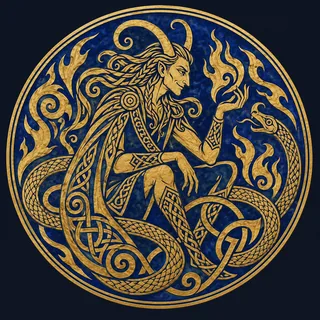
Loki
LoptrLaufeyjarson
- trickery
- shape-changing
- doom
Son of the giant Fárbauti and Laufey, 'fair of face, evil in mind', counted among the Æsir though he brings them into trouble. Father of Fenrir, the World Serpent and Hel by Angrboða and, as a mare, of Sleipnir. He contrives Baldr's death, is bound with his son's guts under Skaði's serpent, and at Ragnarǫk steers against the gods and kills and is killed by Heimdallr. Wormianus ends Gylfaginning by equating him with Ulysses.
See Loki in the interactive atlas
First attested
c. 900 CE (Þjóðólfr of Hvinir, Haustlǫng, quoted in Skáldskaparmál; MS c. 1350) · Skáldsk. (Wormianus 1.553)
In the texts
þungſ var loptr oꝼ ſprunginn
Loptr [Loki] was heavily worn out AI translation
Skáldsk., Haustlǫng (Wormianus 1.553) Read the full text ↗ English (AI)
ꝺꝛiugr var loptr at liuga
Loptr [Loki] was long at lying AI translation
Skáldsk., Eilífr, Þórsdrápa (Wormianus 1.345) Read the full text ↗ English (AI)
ſa er neꝼnꝺꝛ loki eða / loptr ſon ꝼarbauta Iǫtunſ
he who is called Loki or Loptr, son of the giant Fárbauti AI translation
Gylf. 33 (Wormianus 20.8a–10) Read the full text ↗ English (AI)
lægjarns líki / Loka áþekkjan
in the shape of the harm-loving one, like Loki AI translation
Vsp. 35 (Codex Regius) Read the full text ↗ English (AI)
Lineage
- Consorts
- SigynGylf. 33 (Wormianus 20.13)
- Children
- SleipnirGylf. 42 (Wormianus 26.15)FenrirGylf. 34 (Wormianus 20.15)JǫrmungandrGylf. 34 (Wormianus 20.15)HelGylf. 34 (Wormianus 20.16)
Ties
- Defeated
- The master-builder of ÁsgarðrGylf. 42 (Wormianus 26.6)
- Defeated by
- ÞjaziSkáldsk., Haustlǫng (Wormianus 1.540–43)Útgarða-LokiGylf. 46 (Wormianus 29.21)ÞórrGylf. 50 (Wormianus 36.17)
- Helped
- ÞjaziSkáldsk., Haustlǫng (Wormianus 1.556–59)ÞórrGylf. 44 (Wormianus 27.5–6)HǫðrGylf. 49 (Wormianus 34.9)
- Helped by
- SigynGylf. 50 (Wormianus 36.24–25)
- Killed
- HeimdallrGylf. 51 (Wormianus 38.6)
- Killed by
- HeimdallrGylf. 51 (Wormianus 38.6)
- Lovers
- AngrboðaGylf. 34 (Wormianus 20.14–15)
- Wields
- NaglfarVsp. 50–51 (Codex Regius)
The reference after a name is the passage the tie rests on.
In the myths
Passages in the library
Passages of the original-language texts that name Loki, counted by a word index.