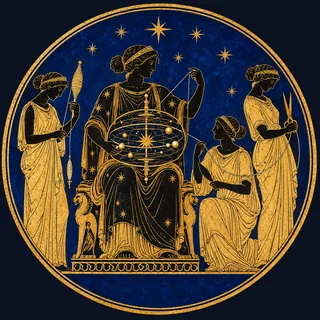
Ananke
Necessity
ἈνάγκηἈνάνκη (tablets)
- necessity
- binding
- fate
Necessity as a power. In Plato's myth of Er the spindle of the heavens turns on her knees and the Moirai are her daughters. Curse tablets of the Roman period address her with Below, Force and Fate (Kenchreai) or have the speaker take her identity ('I am the lord of Necessity ... I am Necessity', Rome); a papyrus love spell binds 'with the unbreakable bonds of chthonic Fate and mighty Necessity', and PGM VIII invokes a headless god 'set over Necessity'.
See Ananke in the interactive atlas
First attested
early 5th c. BCE · Parmenides fr. 8
In the texts
κρατερὴ γὰρ Ἀνάγκη πείρατος ἐν δεσμοῖσιν ἔχει, τό μιν ἀμφὶς ἐέργει
for mighty Necessity holds it in the bonds of the limit, which fences it about AI translation
Parmenides fr. 8 Read the full text ↗ English (AI)
στρέφεσθαι δὲ αὐτὸν ἐν τοῖς τῆς ἀνάγκης γόνασιν
And the spindle turned on the knees of Necessity tr. Paul Shorey
Pl. Rep. 10.617b Read the full text ↗
Κάτω Βία Μοῖρα Ἀνάνκε καταγράφω
Below, Force, Fate, Necessity: I register the one who took my phakiarion (a cloth) AI translation
EDH HD065173 (Kenchreai) Read the full text ↗ English (AI)
Ἐγώ εἰμι ὁ κύριος τῆς Ἀνάνκη- / ς … Ἐγώ εἰμι Ἀνάνκη.
I am the lord of Necessity ... I am Necessity. AI translation
EDH HD042054 (Rome) Read the full text ↗ English (AI)
Lineage
- Children
- The MoiraiPl. Rep. 10.617c
Ties
- Ruled by
- The Headless GodPGM VIII 94–95
The reference after a name is the passage the tie rests on.
In the myths
Passages in the library
Passages of the original-language texts that name Ananke, counted by a word index.