Contents
- Five minutesWhat is really in the Odyssey
- Chapter IThe poem by the numbers
- Chapter IIWhat is not in Homer
- Chapter IIIOdysseus: hero or villain?
- Chapter IVPenelope and Telemachus
- Chapter VCirce: the witch who became a philosopher's question
- Chapter VICalypso and Nausicaa: the women who wanted him to stay
- Chapter VIIThe Cyclops: Nobody's joke
- Chapter VIIISirens, Scylla and Charybdis
- Chapter IXThe Underworld: a conversation with the dead
- Chapter XThe homecoming
- Chapter XIThe poem's ancient readers and critics
- Chapter XIIWhere was it? The ancient geography of the wanderings
- Chapter XIIIAfterwards: the oar, the stingray and the last voyage
- The vasesThe Odyssey in ancient art
- Older sea storiesBefore and after Homer: two shipwrecked sailors
- MethodHow this report was made, and what was checked
The five-minute version
What is really in the Odyssey
The Odyssey most people carry in their heads is a mixture: Homer's poem, plus three thousand years of plays, paintings, schoolbooks and films. This report separates the two. It counts the poem, reads it, and then follows its people and places through the rest of the library, from the Greek stage to Dante. Here it is in brief.
Written by an AI agent (Claude) from the library's texts. A script checked every citation on this page against the library and took each quotation's original wording from it. No specialist has reviewed the report. How it was made · Every passage cited
-
Half the poem is the homecoming
Of the poem's 12,107 lines, 5,896 (48.7 per cent) happen on Ithaca, in books 13 to 24. The adventures on every poster, the Cyclops to the cattle of the Sun, fill books 9 to 12: 2,232 lines, 18.4 per cent. The first four books follow his son Telemachus, and Odysseus does not appear in person until book 5. Aristotle could tell the whole plot in one sentence and called everything else "episodes" (Arist. Poet. 17).
-
The famous monsters are brief
The Sirens get 36 lines, Scylla and Charybdis 59 and the Lotus-eaters 23. The Cyclops gets 462 and Circe 441. Homer never says what the Sirens look like: they sit in a meadow, singing, beside a great heap of rotting men's bones (Od. 12.39–46).
-
Odysseus tells the adventures himself, and the poem says he is a liar
Every monster from the Lotus-eaters to Charybdis reaches us in his own voice, at a dinner party: 2,179 lines, 18 per cent of the poem. The narrator says "he made the many lies he told seem like the truth" (Od. 19.203), and Athena admires his lying as one expert to another (Od. 13.291–299). Later readers took the hint. Lucian made him the founder of the tall tale (Lucian, True History 1.3), and Juvenal imagines Alcinous' guests wanting to throw this "lying storyteller" into the sea (Juv. 15.13–18).
-
One ancient writer imagined Odysseus editing Homer
In Philostratus' Heroicus, written in the third century CE, Homer sails to Ithaca and calls up Odysseus' ghost. The ghost will tell the true story of Troy only for a fee, praise in the poem. Homer agrees. As he leaves, the ghost shouts after him: Palamedes, the clever Greek that Odysseus had done to death, is demanding justice below, so do not bring Palamedes to Troy, do not make him a soldier, do not call him wise (Philostr. Her. 43).
-
Much of what people "know" is not in the Odyssey
The wooden horse appears only in three flashbacks. Achilles' heel is nowhere in Homer, nor in any text in this library. Odysseus pretending to be mad to dodge the war comes from the lost epic Cypria and from tragedy: Aristotle noticed that Homer left it out (Arist. Poet. 8), and Cicero says that in Homer "there is no such suspicion" (Cic. Off. 3.97). The bird-bodied Sirens and the Scylla with dogs at her waist were invented by later poets and painters.
-
The Sirens sell knowledge
Their song promises nothing about love. It promises that the listener will sail home "knowing more", because they know everything that was suffered at Troy and everything that happens on earth (Od. 12.184–191). Cicero saw the point and translated the lines into Latin verse to prove it (Cic. Fin. 5.49). The emperor Tiberius used to test scholars with the question of what song the Sirens sang (Suet. Tib. 70.3).
-
After Homer, Odysseus became a villain, and then a philosopher
Pindar thought Homer had made Odysseus' fame greater than his sufferings (Pind. Nem. 7.20–23). On the Athenian stage he is the sweet-talking crowd-pleaser (Eur. Hec. 131–135), and in Virgil the Trojans' "dread Ulysses" (Aen. 2.261). Yet Sophocles shows him pitying his enemy Ajax (Soph. Aj. 121–126), Horace offers him as a model of virtue and wisdom (Hor. Epist. 1.2.17–26), and Plato has his soul, cured of ambition, choose the quiet life of a private man (Pl. Resp. 620c).
-
Penelope had other stories
Travellers in Arcadia were shown a mound said to be her tomb, with a local story that Odysseus sent her away for bringing the suitors into the house (Paus. 8.12.5–6). Herodotus knew her as the mother of the god Pan (Hdt. 2.145.4). Ovid gave her a letter of her own, which opens: don't write back, come yourself (Ov. Her. 1.1–2).
-
The ancients argued about where it happened, and some laughed at the question
Thucydides would only say that Cyclopes and Laestrygonians were once said to live in Sicily, and let the poets' account do (Thuc. 6.2.1). Eratosthenes said you would find where Odysseus wandered when you found the cobbler who stitched the bag of winds (Strabo 1.2.15). Tacitus heard that he reached Germany (Tac. Germ. 3). Seneca told his readers to stop asking (Sen. Ep. 88.7), and elsewhere suggested that the hero was prone to seasickness (Sen. Ep. 53.4).
-
The story does not end where the poem does
Two Alexandrian editors made the reunion in bed the end of the Odyssey (schol. Od. 23.296). Teiresias foretells a last journey inland with an oar (Od. 11.121–137). In Apollodorus' handbook, Odysseus' son by Circe kills him with a spear tipped with a stingray's spine and then marries Penelope (Apollod. Epit. 7.36–37). Dante sends him out past the edge of the world, where the sea closes over him (Inf. 26.136–142).
Where to read on
The poem
The people
The adventures
Explore
Chapter I
The poem by the numbers
Counted line by line in the library's Greek text, the Odyssey is less an adventure story than a homecoming with an adventure story told inside it, by a narrator the poem warns us about.
In short
Nearly half the poem takes place on Ithaca. The monsters take up less than a fifth, and Odysseus tells all of them himself. Most of the shock of reading the real thing comes from that proportion: it is a slow, suspenseful story about a household, with the voyage folded into four books in the middle.
The opening, and what it promises
The poem names its subject in its first word, andra, "the man", and gives him an adjective that only one other line in the poem uses again: polytropos, "of many turns", which can mean much-travelled or many-minded, and the poem means both.
ἄνδρα μοι ἔννεπε, μοῦσα, πολύτροπον, ὃς μάλα πολλὰ
πλάγχθη, ἐπεὶ Τροίης ἱερὸν πτολίεθρον ἔπερσεν·
πολλῶν δʼ ἀνθρώπων ἴδεν ἄστεα καὶ νόον ἔγνω,
πολλὰ δʼ ὅ γʼ ἐν πόντῳ πάθεν ἄλγεα ὃν κατὰ θυμόν,
ἀρνύμενος ἥν τε ψυχὴν καὶ νόστον ἑταίρων.Tell me, Muse, of the man of many turns, who wandered far and wide after he had sacked the holy citadel of Troy. He saw the cities of many men and came to know their minds, and on the sea he suffered many pains in his heart, fighting for his own life and his companions' return. AI translation
The opening then breaks its own promise. The companions die through their own folly, for eating the cattle of the Sun (Od. 1.6–9), and the man himself does not appear for four books. When he does, he is sitting alone on Calypso's shore, crying: his eyes were never dry, and his sweet life was draining away as he longed for home, "since the nymph no longer pleased him" (Od. 5.151–153).
Where the lines go
The library's edition has 12,107 lines in 24 books. Divided at the obvious breaks, the poem falls into four movements of very different size.
The poem's four movements, then every book. Hover or tab to a bar for its count.
- Telemachus goes looking (books 1–4)
- Calypso to the Phaeacians (books 5–8)
- The wanderings, told by Odysseus (books 9–12)
- Ithaca (books 13–24)
Show the numbers as a table
| Part | Books | Lines | Share |
|---|---|---|---|
| Telemachus goes looking | 1–4 | 2,222 | 18.4% |
| Calypso to the Phaeacians | 5–8 | 1,757 | 14.5% |
| The wanderings, told by Odysseus | 9–12 | 2,232 | 18.4% |
| Ithaca | 13–24 | 5,896 | 48.7% |
| Book | Part | Lines |
|---|---|---|
| Book 1 | Telemachus goes looking | 444 |
| Book 2 | Telemachus goes looking | 434 |
| Book 3 | Telemachus goes looking | 497 |
| Book 4 | Telemachus goes looking | 847 |
| Book 5 | Calypso to the Phaeacians | 493 |
| Book 6 | Calypso to the Phaeacians | 331 |
| Book 7 | Calypso to the Phaeacians | 347 |
| Book 8 | Calypso to the Phaeacians | 586 |
| Book 9 | The wanderings, told by Odysseus | 566 |
| Book 10 | The wanderings, told by Odysseus | 573 |
| Book 11 | The wanderings, told by Odysseus | 640 |
| Book 12 | The wanderings, told by Odysseus | 453 |
| Book 13 | Ithaca | 440 |
| Book 14 | Ithaca | 533 |
| Book 15 | Ithaca | 557 |
| Book 16 | Ithaca | 480 |
| Book 17 | Ithaca | 606 |
| Book 18 | Ithaca | 428 |
| Book 19 | Ithaca | 604 |
| Book 20 | Ithaca | 394 |
| Book 21 | Ithaca | 434 |
| Book 22 | Ithaca | 501 |
| Book 23 | Ithaca | 371 |
| Book 24 | Ithaca | 548 |
The longest book is the fourth, the visit to Menelaus and Helen in Sparta, where Telemachus hears old soldiers' stories of the war and of his father. The shortest is the sixth, Nausicaa on the beach. The four books of wandering together, 2,232 lines, come to less than half of the 4,977 lines between Odysseus' landing on Ithaca and the slaughter of the suitors (books 13 to 22).
Odysseus narrates the wanderings himself, to the Phaeacian court, from 9.2 to 12.453, with one interruption in book 11 when his hosts ask him to go on (11.333–384). That is 2,179 lines, 18.0 per cent of the poem, in the voice of a man the poem twice calls a gifted liar (Chapter III).
The famous scenes are short
Measured by lines, the poem spends its time on two long confrontations at either end of the voyage, the Cyclops and Circe, on the visit to the dead, and above all on the revenge at home.
The famous monsters are the short scenes. Longest first.
Show as a table
| Name | Lines in the poem | Lines |
|---|---|---|
| Bow contest and slaughter | 21.1–22.501 | 935 |
| The Underworld | book 11 | 640 |
| The Cyclops | 9.105–566 | 462 |
| Circe | 10.133–574 | 441 |
| The reunion | book 23 | 371 |
| The cattle of the Sun | 12.260–453 | 194 |
| Aeolus and the bag of winds | 10.1–79 | 79 |
| Scylla and Charybdis | 12.201–259 | 59 |
| The Laestrygonians | 10.80–132 | 53 |
| The Sirens | 12.165–200 | 36 |
| The Lotus-eaters | 9.82–104 | 23 |
The Sirens, one of the most painted scenes from the poem in antiquity and since, take 36 lines, and much of that is Odysseus describing the wax and the ropes. Homer gives no description of the Sirens' bodies at all (Chapter VIII).
Who is in it
Times each name (any grammatical form) occurs in the Greek text.
Show as a table
| Name | Mentions |
|---|---|
| Odysseus (with “son of Laertes”) | 628 |
| Telemachus | 246 |
| the suitors | 232 |
| Athena | 190 |
| Penelope | 83 |
| the Phaeacians | 76 |
| Alcinous | 71 |
| Antinous | 56 |
| Circe | 48 |
| Eumaeus | 42 |
| the Cyclops / Polyphemus | 38 |
| Calypso | 36 |
| Laertes | 31 |
| Eurymachus | 30 |
| Eurycleia | 25 |
| Teiresias | 16 |
| Scylla | 12 |
| Nausicaa | 11 |
| the Sirens | 10 |
| Charybdis | 9 |
The count bears out the shape of the poem. Telemachus is named more often than anyone but his father, and the suitors, collectively, almost as often. Penelope's 83 mentions undersell her: she is usually "she" or "the queen", or "prudent Penelope" (periphrōn Pēnelopeia, 40 times). The 108 suitors are counted out by Telemachus himself: 52 from Dulichium, 24 from Same, 20 from Zacynthus and 12 from Ithaca (Od. 16.245–253).
The formulas
The Odyssey was composed in a tradition of oral poetry, and it repeats ready-made phrases that fit the hexameter line. These are some of the commonest, counted in the Greek.
| Phrase | Meaning | Times |
|---|---|---|
| πολύμητις Ὀδυσσεύς | Odysseus of many wiles | 66 |
| ἔπεα πτερόεντα | winged words | 59 |
| γλαυκῶπις Ἀθήνη | grey-eyed (or owl-eyed) Athena | 50 |
| Τηλέμαχος πεπνυμένος | thoughtful Telemachus | 46 |
| περίφρων Πηνελόπεια | prudent Penelope | 40 |
| πολύτλας δῖος Ὀδυσσεύς | much-enduring, godlike Odysseus | 37 |
| ῥοδοδάκτυλος Ἠώς | rosy-fingered Dawn (20 times in the whole line "when early-born, rosy-fingered Dawn appeared") | 22 |
| Εὔμαιε συβῶτα | "Eumaeus, swineherd" (15 times it is the narrator addressing the swineherd directly; once, at 15.381, it is Odysseus) | 16 |
| οἴνοπα πόντον | the wine-dark sea (this case form only; what colour Homer meant is the subject of The Wine-Looking Sea) | 6 |
| πολύτροπος | of many turns | 2 (1.1 and 10.330) |
The name Odysseus gives the Cyclops, Outis, "Nobody", stands as a subject four times: once as he gives it (Od. 9.364–367), then three times in the Cyclops' own mouth, as he shouts to his neighbours that "Nobody is killing me by trickery, not by force" (Od. 9.408) and as he talks to his ram (9.455, 9.460; Chapter VII).
Chapter II
What is not in Homer
The wooden horse, Achilles' heel, the hero who faked madness to dodge the war, bird-women Sirens and a Scylla with dogs at her waist: most of the best-known images of the story are missing from the Odyssey, or come from somewhere else.
In short
Homer's two poems told only part of the Trojan story. The rest was told in other epics, now lost, and retold by the tragedians, by Virgil and Ovid, and by vase painters. Their versions became so familiar that people now credit them to Homer.
| You may have heard | What the Odyssey says | Where it comes from |
|---|---|---|
| The wooden horse fools the Trojans | Remembered three times, never narrated as it happens (Od. 4.271–289; 8.492–520; 11.523–532) | The lost epics of the Trojan cycle; the version everyone knows is Virgil's, with Laocoon and the lying Greek Sinon (Aen. 2.44; 2.164) |
| Achilles dies from a wound in his heel | Nothing. In book 24 Agamemnon's ghost describes Achilles' death and funeral at length, with no wound named (Od. 24.36–40) | Not found in any text in the library. The nearest is Statius' Achilleid, late first century CE, where Thetis says she dipped her son in the Styx, "and would that I had armed you wholly!" (Achil. 1.268–270) |
| Odysseus faked madness to avoid the war | Nothing; Aristotle and Cicero both noticed (Arist. Poet. 8; Cic. Off. 3.97) | The lost Cypria (Proclus, summary of the Cypria) and the tragedians; told in full by Apollodorus (Epit. 3.7) |
| The Sirens are half woman, half bird | No description of their bodies at all; they sit in a meadow by a heap of bones (Od. 12.39–46) | Painters, and poets from Apollonius on (Argon. 4.891–899; Isidore, Etym. 11.3.30) |
| Scylla is a woman with dogs springing from her waist | Twelve dangling feet, six long necks, six heads with three rows of teeth, and a voice like a puppy's (Od. 12.85–92) | Virgil (Aen. 3.426–428) and Ovid (Met. 14.59–67) |
| Odysseus is "Ulysses" | Always Odysseus (Greek Ὀδυσσεύς) | Latin Ulixes, from a Greek dialect form, gave English "Ulysses" |
The horse, in three flashbacks
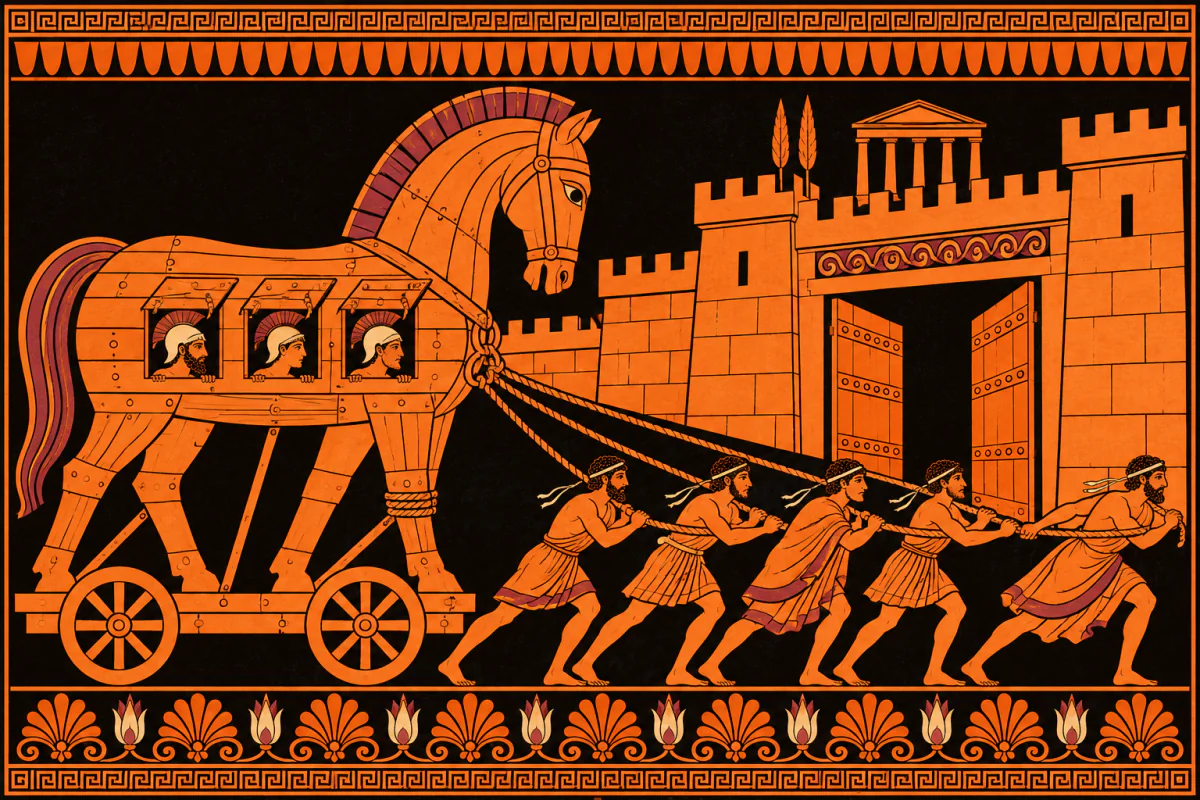
The Odyssey takes place ten years after Troy fell, and it remembers the horse three times, each time to say something about Odysseus. In Sparta, Menelaus recalls how Helen circled the hollow ambush three times, calling the Greek leaders by name in the voices of their wives, and how Odysseus held back the men who wanted to answer.
τρὶς δὲ περίστειξας κοῖλον λόχον ἀμφαφόωσα,
ἐκ δʼ ὀνομακλήδην Δαναῶν ὀνόμαζες ἀρίστους,
πάντων Ἀργείων φωνὴν ἴσκουσʼ ἀλόχοισιν.Three times you walked around the hollow ambush, feeling it all over, and called out the names of the best of the Danaans, making your voice like the voice of each man's wife. AI translation
One of them, Anticlus, was about to reply, and Odysseus clamped his mouth shut with his strong hands until Athena led Helen away, and so saved all the Greeks (Od. 4.285–289). At the Phaeacian court Odysseus himself, still unrecognised, asks the bard Demodocus to sing "the making of the wooden horse, which Epeius built with Athena", and the bard sings how the Trojans debated whether to split it open, throw it off a cliff or keep it as an offering to the gods (Od. 8.492–510). The sack of the city takes a few lines of summary (8.514–520). In the Underworld, Odysseus tells Achilles' ghost that inside the horse, where every other leader was wiping away tears and trembling, his son Neoptolemus never once went pale and kept begging to be let out (Od. 11.523–532).
The scenes most people picture come from Virgil's Aeneid, written seven centuries later. Laocoon warns the Trojans: "Do you think any Greek gift comes without tricks? Is this how well you know Ulysses?" (Aen. 2.44). Sinon, the Greek left behind to talk the Trojans into taking the horse, blames everything on "Ulysses, inventor of crimes" (Aen. 2.164), and he is lying when he says it.
The madness that Homer left out
The story that Odysseus pretended to be mad so that he would not have to sail for Troy, and that Palamedes exposed him by putting the baby Telemachus in danger, is now told in nearly every retelling. Aristotle cited its absence as an example of good plotting.
Ὀδύσσειαν γὰρ ποιῶν οὐκ ἐποίησεν ἅπαντα ὅσα αὐτῷ συνέβη, οἷον πληγῆναι μὲν ἐν τῷ Παρνασσῷ, μανῆναι δὲ προσποιήσασθαι ἐν τῷ ἀγερμῷ…
In making the Odyssey he did not put in everything that happened to the man, for instance his being wounded on Parnassus, or his pretending to be mad at the mustering of the army. AI translation
The story was in the Cypria, a lost epic that told the beginning of the war; a later summary of it says that the envoys gathering the army "caught Odysseus pretending to be mad, because he did not want to join the expedition, when on Palamedes' advice they snatched up his son Telemachus to punish him" (Proclus, summary of the Cypria). Apollodorus' handbook adds the sword: Palamedes took the baby from Penelope's lap and drew his sword as if to kill him, and Odysseus, afraid for his son, confessed (Apollod. Epit. 3.7). Cicero made the same point as Aristotle in a different spirit: the tragic poets accuse Ulysses of faking madness, but "in Homer, the best authority, there is no such suspicion about Ulysses" (Cic. Off. 3.97). The episode matters to the later Odysseus, because it makes the hero's quarrel with Palamedes personal, and because Palamedes' death haunts the ghost in Philostratus (Chapter XI).
No heel
Homer's Achilles is mortal in the ordinary way, and the Iliad foretells that Paris and Apollo will kill him at the Scaean gates (Il. 22.359–360). Achilles' heel does not appear in any text in this library. What comes closest is the late first-century Achilleid of Statius, in which Thetis reproaches her son for wanting to go to war, "if I armed you at your birth in the stern river of the Styx, and would that I had armed you wholly!" (Stat. Achil. 1.268–270), and the seer Calchas asks which other sea-nymph ever carried her child through the Stygian streams and made his limbs proof against iron (1.480–481). The heel itself is not named. Hyginus and Servius, the authors usually cited for it, are not in the library, so this report cannot check them.
Bird-women and dog-women
Homer describes the Sirens only by what they do and where they are: they sit in a meadow, singing, and around them lies a great heap of the bones of rotting men, with the skin shrivelling on them (Od. 12.39–46). Apollonius of Rhodes, in the third century BCE, is the first poet in the library to give them bodies: daughters of the Muse Terpsichore, "in part like birds, and in part like maidens to look at" (Argon. 4.891–899). Isidore of Seville, in the seventh century CE, gives the classic description of three Sirens, part maiden and part bird, with wings and claws, one singing, one playing pipes and one the lyre, and then explains them away (Etym. 11.3.30–31; Chapter VIII).
Homer's Scylla has no woman's body at all (Chapter VIII). The beautiful upper half and the dogs below come from Rome. Virgil gives her "the face of a human being, a girl with a lovely breast down to the groin; below, a sea-monster of huge body, with dolphins' tails joined to a belly of wolves" (Aen. 3.426–428), and Ovid tells how Circe, jealous, poisoned the little pool where Scylla went to cool off and murmured a spell over it twenty-seven times (Met. 14.51–58), so that when Scylla waded in to the waist she found barking dogs where her thighs and feet had been (14.59–67).
And some things that sound invented are there
Going back to the poem can also surprise readers the other way. The old dog Argos, lying neglected on a dung heap and crawling with ticks (Od. 17.296–300), recognises his master after twenty years, and dies (17.326–327). When Odysseus at last strings the great bow, he plucks the string and it sings "like a swallow" (Od. 21.409–411). So are the seven years with Calypso (Od. 7.259–260) and Penelope's last test: she pretends the bed has been moved, and Odysseus, outraged, gives away the secret only the two of them know, that he built it round the trunk of a living olive tree (Od. 23.183–196; 23.205–206).
Chapter III
Odysseus: hero or villain?
Homer's hero is a liar and proud of it, and the gods admire him for it. After Homer the ancients could not agree whether that made him the wisest of the Greeks or the worst: the Athenian stage made him a cynical politician, Virgil's Trojans a monster, and the philosophers a model of endurance.
In short
Every age has had its own Odysseus. Homer's is a clever survivor whose lies keep him alive. The Athenian theatre, in a democracy run by public speakers, saw a man who would say anything to win a vote. Rome, which traced itself back to Troy, saw the enemy. Philosophers saw a man who endured, kept his head and refused easy pleasures. The modern hero-or-villain argument is an ancient one.
A trickster in Homer, and proud of it
When he finally tells the Phaeacians who he is, he introduces himself by his reputation for deceit.
εἴμʼ Ὀδυσεὺς Λαερτιάδης, ὃς πᾶσι δόλοισιν
ἀνθρώποισι μέλω, καί μευ κλέος οὐρανὸν ἵκει.I am Odysseus, son of Laertes, known among all men for my tricks, and my fame reaches heaven. AI translation
Back on Ithaca he spins Athena, disguised as a young shepherd, a long false story about who he is. She smiles, strokes him with her hand, and takes the shape of a tall, beautiful woman (Od. 13.287–289) to praise him as one artist to another.
κερδαλέος κʼ εἴη καὶ ἐπίκλοπος ὅς σε παρέλθοι
ἐν πάντεσσι δόλοισι, καὶ εἰ θεὸς ἀντιάσειε.
σχέτλιε, ποικιλομῆτα, δόλων ἆτʼ, οὐκ ἄρʼ ἔμελλες,
οὐδʼ ἐν σῇ περ ἐὼν γαίῃ, λήξειν ἀπατάων
μύθων τε κλοπίων, οἵ τοι πεδόθεν φίλοι εἰσίν.
ἀλλʼ ἄγε, μηκέτι ταῦτα λεγώμεθα, εἰδότες ἄμφω
κέρδεʼ, ἐπεὶ σὺ μέν ἐσσι βροτῶν ὄχʼ ἄριστος ἁπάντων
βουλῇ καὶ μύθοισιν, ἐγὼ δʼ ἐν πᾶσι θεοῖσι
μήτι τε κλέομαι καὶ κέρδεσιν· οὐδὲ σύ γʼ ἔγνωςHe would have to be crafty and a cheat who could get past you in tricks of every kind, even if a god came up against you. You stubborn man, full of wiles, never sated with deceit: even in your own country you were not going to give up your lies and the thieving stories you love from the bottom of your heart. But come, let us talk no more of this. We both know cunning, since you are by far the best of all mortals in counsel and in words, and I am famous among all the gods for wit and cunning. AI translation
The narrator says the same in a single line, when the disguised Odysseus tells Penelope a false history of himself: "he made the many lies he told seem like the truth" (Od. 19.203). The poem does not hold this against him. In the Odyssey lying is a survival skill. The one time he tells the truth out of pride, shouting his name, his father's name and his home at the blinded Cyclops (Od. 9.502–505), the giant passes them on to his father Poseidon in a prayer: let Odysseus come home late and in misery, on someone else's ship, having lost all his companions, and find trouble in his house (9.528–535). The rest of the poem is that prayer coming true.
"Homer made him bigger than he was"
The first doubts in the library come from Pindar, in an ode of the early fifth century BCE. He is thinking of Ajax, who killed himself after losing Achilles' armour to Odysseus: if the blind crowd had seen the truth, Pindar goes on, mighty Ajax would never have driven the sword through his heart (Nem. 7.24–27).
ἐγὼ δὲ πλέονʼ ἔλπομαι λόγον Ὀδυσσέος ἢ πάθαν διὰ τὸν ἁδυεπῆ γενέσθʼ Ὅμηρον· ἐπεὶ ψεύδεσί οἱ ποτανᾷ τε μαχανᾷ σεμνὸν ἔπεστί τι· σοφία δὲ κλέπτει παράγοισα μύθοις…
I think that the story of Odysseus has become greater than what he suffered, because of sweet-voiced Homer. For on his falsehoods and his winged contrivance there lies a kind of majesty, and skill deceives, leading men astray with stories. AI translation
On the Athenian stage
Fifth-century Athens was a democracy run by men who could persuade an assembly, and its playwrights saw in Odysseus the type of the clever speaker. In Sophocles' Philoctetes, staged in 409 BCE, he explains his philosophy to the young son of Achilles.
ἐσθλοῦ πατρὸς παῖ, καὐτὸς ὢν νέος ποτὲ
γλῶσσαν μὲν ἀργόν, χεῖρα δʼ εἶχον ἐργάτιν·
νῦν δʼ εἰς ἔλεγχον ἐξιὼν ὁρῶ βροτοῖς
τὴν γλῶσσαν, οὐχὶ τἄργα, πάνθʼ ἡγουμένην.Son of a noble father, when I was young I too had a slow tongue and a hand that worked. But now that I have gone out and been put to the test, I see that for mortals it is the tongue, not deeds, that leads in everything. AI translation
Euripides is harsher. In Hecuba the chorus describes how the army was evenly divided on whether to sacrifice the Trojan princess Polyxena at Achilles' tomb, until "the subtle-minded, chattering, honey-tongued crowd-pleaser, the son of Laertes" persuaded them not to slight the best of the Greeks to spare a slave (Eur. Hec. 131–135). In Iphigenia at Aulis, Agamemnon calls him "the seed of Sisyphus", repeating the slander that his real father was that famous cheat, and the brothers agree that he is "always shifty, and on the side of the mob", in the grip of ambition (Eur. IA 524–527). In Trojan Women the old queen Hecuba learns she has been allotted as a slave to Odysseus and tears her cheeks: she will serve "a loathsome, treacherous man" (Eur. Tro. 277; 282).
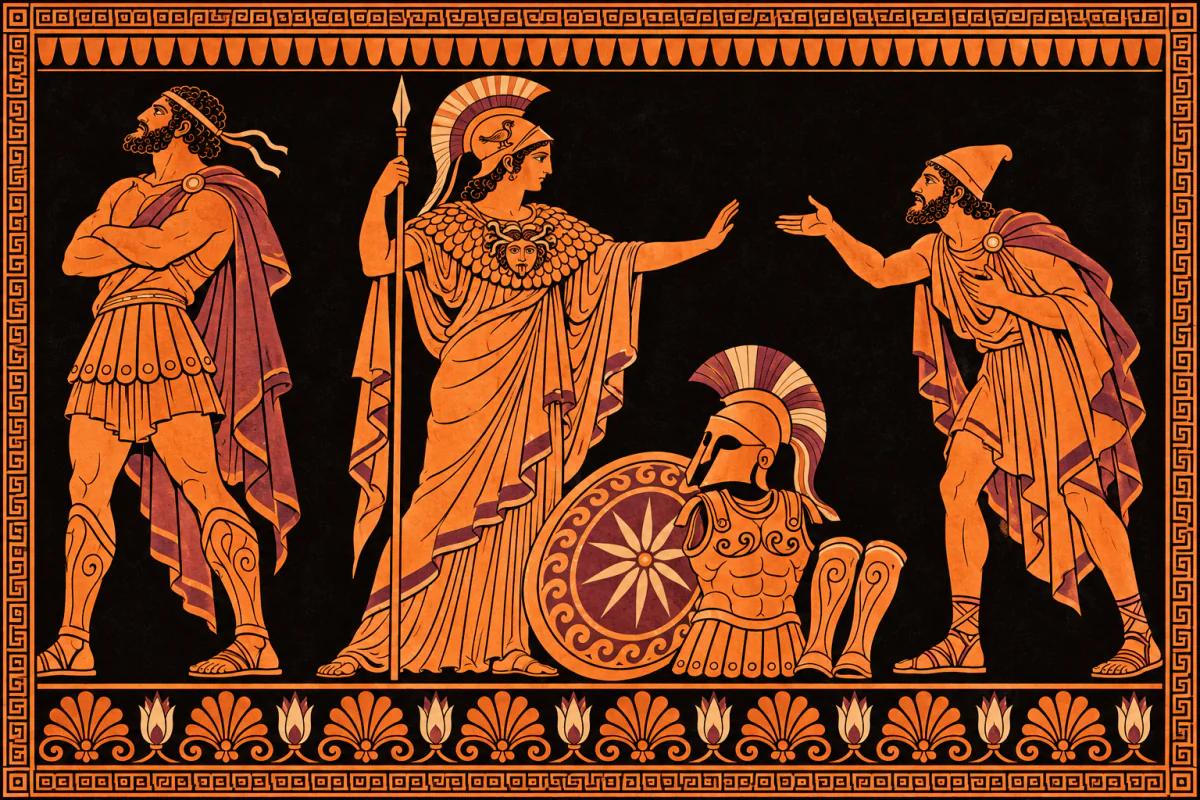
Yet the same theatre could show him at his best. In Sophocles' Ajax, Athena has driven Ajax mad, and she invites Odysseus to enjoy it: "is not laughing at your enemies the sweetest laughter?" (Aj. 79). When she asks if he has ever seen a better man brought so low (118–120), he answers with pity.
ἐγὼ μὲν οὐδένʼ οἶδʼ· ἐποικτίρω δέ νιν
δύστηνον ἔμπας, καίπερ ὄντα δυσμενῆ,
ὁθούνεκʼ ἄτῃ συγκατέζευκται κακῇ,
οὐδὲν τὸ τούτου μᾶλλον ἢ τοὐμὸν σκοπῶν·
ὁρῶ γὰρ ἡμᾶς οὐδὲν ὄντας ἄλλο πλὴν
εἴδωλʼ ὅσοιπερ ζῶμεν ἢ κούφην σκιάν.I know of no one. But I pity him, wretched as he is, though he is my enemy, because he is yoked to a terrible ruin; I am thinking of my own lot no less than his. For I see that all of us who live are nothing but phantoms, or a weightless shadow. AI translation
The judgement of the arms
The quarrel in the picture above was the hinge of Odysseus' later reputation. Homer touches it only once, when Ajax's ghost refuses to speak to him (Od. 11.543–551; 11.563–564). Athenian painters loved it. A cup now in Malibu shows the two men pulled apart by their friends on one side, and on the other the vote itself: the catalogue counts fifteen pebbles for Odysseus, standing with Athena, and fourteen for Ajax, alone behind a tree with his hand to his head; inside the cup, Ajax lies dead on his own sword (Malibu 86.AE.286). A cup in Vienna shows the quarrel and the vote in the same way (Vienna 3695). Aristotle lists "The Judgement of the Arms" among the many tragedies drawn from the lost Little Iliad, against one or two from the Odyssey (Arist. Poet. 23). For Ovid the verdict said everything about the world: after the two men's speeches, "the assembly of chiefs was moved, and it became plain what eloquence could do: the man who could speak carried off the brave man's arms" (Met. 13.382–383). Cicero, sympathetic to both, set them side by side: Ulysses put up with serving women, Circe and Calypso among them, and with insults from his own slaves, to get what he wanted, while Ajax would rather have died a thousand times (Cic. Off. 1.113).
Rome: "dread Ulysses"
The Romans traced their ancestry to Troy, through Aeneas, and their poets saw Odysseus from the walls. In the Aeneid Aeneas, telling the fall of the city, names among the Greeks who climb out of the horse "Thessandrus and Sthenelus, the leaders, and dread Ulysses" (Aen. 2.261). The famous phrase "inventor of crimes" (Aen. 2.164) is spoken by the Greek spy Sinon in a speech designed to deceive the Trojans, so it is Virgil's portrait of a liar describing Ulysses, not a verdict. Seneca's Ulysses, in his Trojan Women, hunts down Hector's son and warns his mother that she will not fool him: "we have beaten the tricks of mothers, even of goddesses" (Sen. Tro. 568–570), meaning Thetis, who had tried to hide Achilles from the war.
The philosophers' Odysseus
Plato's Lesser Hippias stages the argument directly. The sophist Hippias says Homer made Achilles the best man and Odysseus the wiliest (polytropos). Socrates asks whether Homer's Achilles is not wily too, and Hippias insists that Achilles is "the simplest and most truthful" of men, which makes the wily man the liar (Pl. Hp. Mi. 364; 365). The historian Polybius saw in him the model of the man of affairs, quoting the poem's third line, "he saw the cities of many men and came to know their minds" (Polyb. 12.27.10–11), and praised Homer for showing him reading the stars to plan both voyages and actions on land (9.16.1). For Horace he was simply the pattern of virtue.
Rursus, quid virtus et quid sapientia possit,
utile proposuit nobis exemplar Ulixen,
qui domitor Troiae multorum providus urbes
et mores hominum inspexit, latumque per aequor,
dum sibi, dum sociis reditum parat, aspera multa
pertulit, adversis rerum immersabilis undis.Again, what virtue and wisdom can do he has set before us in Ulysses, a useful example: the tamer of Troy, who looked with foresight into the cities and ways of many men, and on the wide sea, while he worked for his own return and his companions', endured many hardships, never drowned by the waves of adversity. AI translation
Plato gave him the strangest ending of all. In the myth that closes the Republic, the souls of the dead choose their next lives, and Odysseus' soul happens to draw the last lot.
κατὰ τύχην δὲ τὴν Ὀδυσσέως λαχοῦσαν πασῶν ὑστάτην αἱρησομένην ἰέναι, μνήμῃ δὲ τῶν προτέρων πόνων φιλοτιμίας λελωφηκυῖαν ζητεῖν περιιοῦσαν χρόνον πολὺν βίον ἀνδρὸς ἰδιώτου ἀπράγμονος, καὶ μόγις εὑρεῖν κείμενόν που καὶ παρημελημένον ὑπὸ τῶν ἄλλων, καὶ εἰπεῖν ἰδοῦσαν ὅτι τὰ αὐτὰ ἂν ἔπραξεν καὶ πρώτη λαχοῦσα, καὶ ἁσμένην ἑλέσθαι.
By chance the soul of Odysseus drew the last lot of all and came forward to choose. Remembering its former labours, it had recovered from ambition, and it went about for a long time looking for the life of a private man who minds his own business. With difficulty it found one lying somewhere, ignored by the others, and when it saw it, it said it would have done the same if it had drawn the first lot, and chose it gladly. AI translation
Odysseus across the library
| Writer | Date | Odysseus is… | Passage |
|---|---|---|---|
| Homer | c. 700 BCE | a gifted liar, admired by Athena for it | Od. 13.291–299 |
| Pindar | early 5th c. BCE | overrated, thanks to Homer | Nem. 7.20–23 |
| Sophocles, Ajax | mid 5th c. BCE | the one man who pities his enemy | Aj. 121–126 |
| Euripides, Hecuba | c. 424 BCE | a honey-tongued crowd-pleaser | Hec. 131–135 |
| Euripides, Trojan Women | 415 BCE | "a loathsome, treacherous man" | Tro. 282 |
| Sophocles, Philoctetes | 409 BCE | a believer in words over deeds | Phil. 96–99 |
| Euripides, Iphigenia at Aulis | 405 BCE | Sisyphus' son, shifty, on the mob's side | IA 524–527 |
| Plato, Republic | 4th c. BCE | a soul cured of ambition | Resp. 620c |
| Polybius | 2nd c. BCE | the model man of affairs | Polyb. 12.27.10 |
| Cicero | 44 BCE | patient where Ajax was proud | Off. 1.113 |
| Horace | c. 20 BCE | the pattern of virtue and wisdom | Epist. 1.2.17–26 |
| Virgil | 19 BCE | "dread Ulysses", the enemy of Troy | Aen. 2.261 |
| Ovid | c. 8 CE | the speaker who beat the fighter | Met. 13.382–383 |
| Seneca, Trojan Women | 1st c. CE | a hunter who cannot be fooled | Tro. 568–570 |
| Juvenal | early 2nd c. CE | a "lying storyteller" | Juv. 15.13–18 |
| Dante | c. 1310 | in Hell, yet admired for his burning wish to know the world | Inf. 26.97–99 |
| Shakespeare, 3 Henry VI | c. 1591 | the benchmark of deceit: "Deceive more slily than Ulysses could" | 3H6 3.2 |
Shakespeare's other Ulysses, in Troilus and Cressida, is the Greeks' political philosopher, lecturing the generals on order and "degree" (Tro. 1.3). By then the trickster and the sage had become two halves of one stock figure.
Chapter IV
Penelope and Telemachus
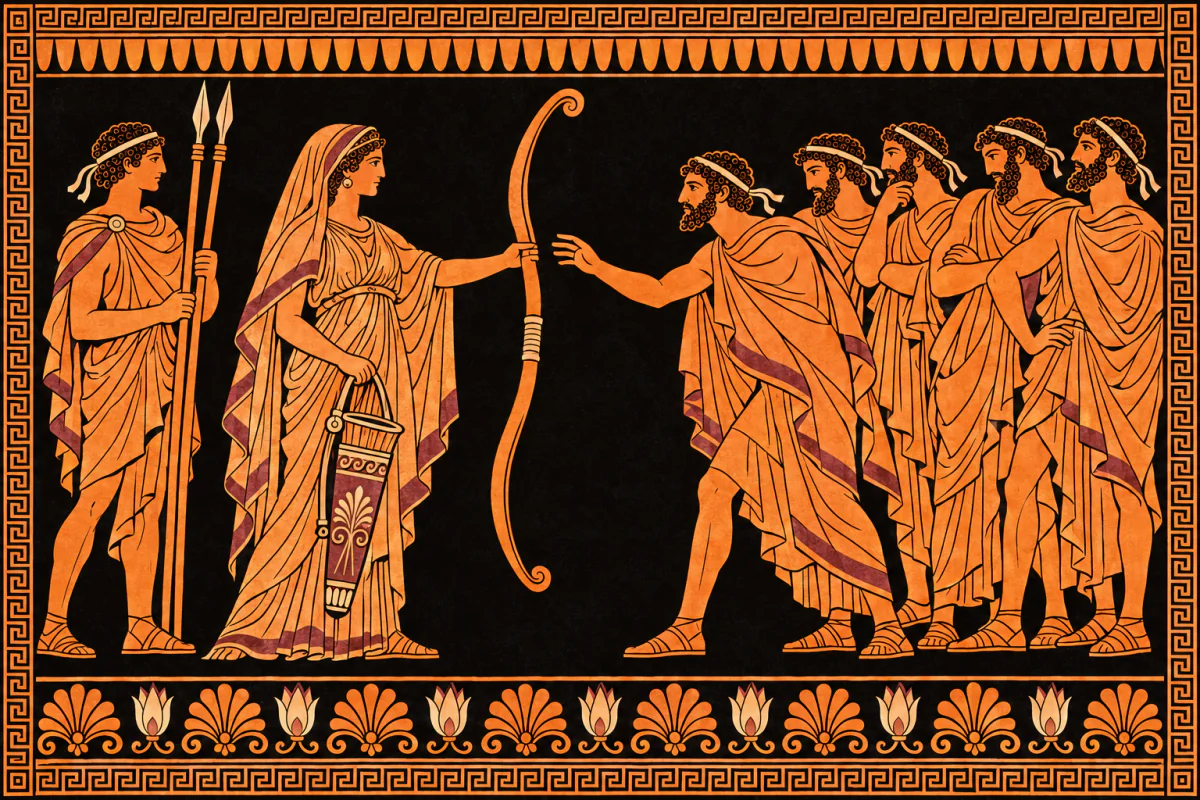
Homer's Penelope is her husband's equal in cunning, and the poem gives her the last trick. Outside Homer she had other, darker stories: a tomb in Arcadia, a divorce, even a son who was a god.
In short
The poem opens with a teenage son who is not sure his father ever existed, and closes with a wife who will not believe her husband is home until he passes her test. The modern retellings that put Penelope at the centre are following a lead the ancients gave them: she was the subject of rival local legends, of a letter by Ovid and of philosophers' jokes.
A son looking for his father
The first four books belong to Telemachus, about twenty years old, in a house full of men who want his mother and his inheritance. Asked by a stranger (Athena in disguise) whether he is really Odysseus' son, he answers with a shrug that every reader remembers.
μήτηρ μέν τέ μέ φησι τοῦ ἔμμεναι, αὐτὰρ ἐγώ γε
οὐκ οἶδʼ· οὐ γάρ πώ τις ἑὸν γόνον αὐτὸς ἀνέγνω.My mother says I am his son; but I do not know. No one has ever known his own father for himself. AI translation
He sails to Pylos and Sparta for news, and hears old soldiers' stories of a father he cannot remember, including Menelaus' account of the horse (Chapter II). By the end of the poem he can count the suitors out for his father, 108 of them, with their servants (Od. 16.245–253), and he nearly strings the great bow himself. Three times he strains at it, and on the fourth pull he would have done it, "but Odysseus shook his head and stopped him, eager as he was" (Od. 21.125–129). Then he arms himself with sword, spear and bronze helmet and takes his stand beside his father (Od. 21.431–434).
Penelope's three tricks
The poem's most famous ruse is hers. She told the suitors she would choose one of them once she had woven a shroud for her father-in-law Laertes, so that the women of Ithaca could not reproach her if he died without one.
ἔνθα καὶ ἠματίη μὲν ὑφαίνεσκεν μέγαν ἱστόν,
νύκτας δʼ ἀλλύεσκεν, ἐπεὶ δαΐδας παραθεῖτο.
ὣς τρίετες μὲν ἔληθε δόλῳ καὶ ἔπειθεν Ἀχαιούς·So by day she would weave at the great loom, and by night she would unpick it, with torches set beside her. For three years she fooled the Achaeans with her trick and kept them persuaded. AI translation
It is Antinous, the leading suitor, who tells the story, in the assembly, as a complaint: in the fourth year one of her women gave her away, and they caught her unpicking it (Od. 2.93–110). Her second trick is the contest. She takes down Odysseus' bow, weeps over it, and carries it into the hall with the quiver (Od. 21.53–60), offering herself to the man who can string it and shoot through twelve axes (21.73–79). It is the one thing in the house that only Odysseus can do. Her third trick tests the husband himself. With the suitors dead she still will not accept him, until she tells a servant to move the bed out of their bedroom; Odysseus, outraged, reveals that it cannot be moved, because he built it round the trunk of a living olive tree, and at that "her knees and her heart went slack" (Od. 23.183–196; 23.205–206).
Odysseus had already said what she was worth to him. When Calypso offers him immortality if he stays, he answers carefully.
πότνα θεά, μή μοι τόδε χώεο· οἶδα καὶ αὐτὸς
πάντα μάλʼ, οὕνεκα σεῖο περίφρων Πηνελόπεια
εἶδος ἀκιδνοτέρη μέγεθός τʼ εἰσάντα ἰδέσθαι·
ἡ μὲν γὰρ βροτός ἐστι, σὺ δʼ ἀθάνατος καὶ ἀγήρως.
ἀλλὰ καὶ ὣς ἐθέλω καὶ ἐέλδομαι ἤματα πάντα
οἴκαδέ τʼ ἐλθέμεναι καὶ νόστιμον ἦμαρ ἰδέσθαι.Mighty goddess, do not be angry with me for this. I know very well myself that prudent Penelope is less than you to look at, in beauty and in stature; she is mortal, and you are immortal and ageless. Even so, I want and long every day to go home and see the day of my return. AI translation
Penelope's other lives
Homer's version was not the only one. The travel writer Pausanias, in the second century CE, collected what Greek towns said about her, and some of it is startling.
Μαντινέων δὲ ὁ ἐς αὐτὴν λόγος Πηνελόπην φησὶν ὑπʼ Ὀδυσσέως καταγνωσθεῖσαν ὡς ἐπισπαστοὺς ἐσαγάγοιτο ἐς τὸν οἶκον, καὶ ἀποπεμφθεῖσαν ὑπʼ αὐτοῦ, τὸ μὲν παραυτίκα ἐς Λακεδαίμονα ἀπελθεῖν, χρόνῳ δὲ ὕστερον ἐκ τῆς Σπάρτης ἐς Μαντίνειαν μετοικῆσαι, καί οἱ τοῦ βίου τὴν τελευτὴν ἐνταῦθα συμβῆναι.
The story the Mantineans tell about her says that Odysseus condemned Penelope for bringing the suitors into the house and sent her away. She went first to Lacedaemon, and later moved from Sparta to Mantinea, and the end of her life came to her there. AI translation
They showed her tomb, a high mound beside the road, and Pausanias notes that their story contradicts a lost epic, the Thesprotis, in which Penelope bore Odysseus a son, Ptoliporthes, after he came home (Paus. 8.12.5–6). In Sparta he heard how her father Icarius made her suitors run a race for her, which Odysseus won (Paus. 3.12.1). Outside the city stood a statue of Modesty, which Icarius set up where his daughter, asked whether she would stay with her father or leave with her husband, said nothing and drew her veil over her face; he understood, and let her go (Paus. 3.20.10–11).
Herodotus, in the fifth century BCE, mentions as common knowledge that the Greeks made the god Pan the son of Penelope and Hermes (Hdt. 2.145.4). The mythographer Apollodorus lists the darker versions side by side: that Penelope was seduced by Antinous and sent home to her father, and at Mantinea bore Pan to Hermes; that Odysseus killed her for the sake of the suitor Amphinomus (Apollod. Epit. 7.38–39); or that after Odysseus' death she married Telegonus, his son by Circe (Chapter XIII).
Penelope's voice
Ovid gave her the voice Homer had kept short. The first of his Heroides, letters from heroines to the men who left them, is hers, and its opening couplet is a masterpiece of impatience.
Haec tua Penelope lento tibi mittit, Ulixe;
Nil mihi rescribas attinet: ipse veni!This letter your Penelope sends to you, slow Ulysses. Don't write back: come yourself! AI translation
By its end she has done the arithmetic of twenty years: "I, who was a girl when you left, will seem an old woman, even if you come at once" (Her. 1.115–116). Propertius, flattering a friend's wife, promised that her husband would be "a second Ulysses, with a wife to marvel at" (Prop. 3.12.23). The philosophers were less romantic. Seneca includes "whether Penelope was chaste, or fooled her generation" and whether she suspected the beggar was Ulysses before she knew it, in a list of scholars' questions that teach nothing about how to live (Sen. Ep. 88.8). Lucian, in his comic True History, has Calypso, reading a letter from Odysseus' ghost, ask anxiously what Penelope looks like and whether she is really so virtuous as Odysseus used to boast (Lucian, True History 2.36).
Penelope across the library
| Source | Penelope is… | Passage |
|---|---|---|
| Homer | the weaver who outwits the suitors and tests her own husband | Od. 2.93–110; 23.183–196 |
| Herodotus | the mother of Pan, by Hermes | Hdt. 2.145.4 |
| Ovid, Heroides 1 | an impatient, ageing wife writing to "slow Ulysses" | Her. 1.1–2 |
| Propertius | the model wife of a Roman's flattery | Prop. 3.12.23 |
| Seneca | a pedant's question: was she chaste? | Ep. 88.8 |
| Pausanias | sent away by Odysseus, buried at Mantinea; won in a footrace; the bride who veiled herself | Paus. 8.12.5–6; 3.12.1; 3.20.10–11 |
| Lucian | the rival Calypso is still jealous of | VH 2.36 |
| Apollodorus | seduced, sent home, killed, or remarried to Circe's son, depending on whom you believe | Epit. 7.37–39 |
Chapter V
Circe: the witch who became a philosopher's question
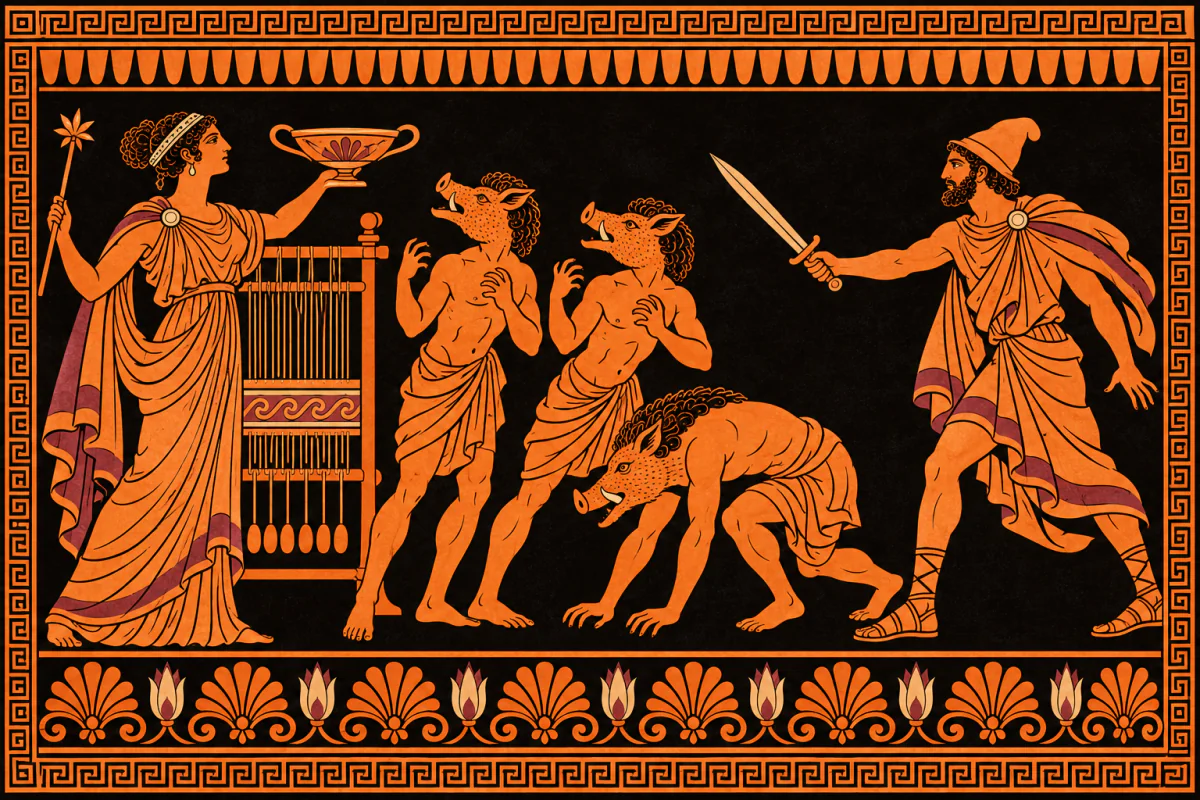
Circe turns men into pigs, then becomes Odysseus' lover and his guide to the Underworld. Later writers made her island a test of character: Socrates joked that overeating made the swine, and Plutarch gave one of the pigs the best lines.
In short
The magic itself, the drugged cheese and wine, the wand, the herb moly that Hermes gives Odysseus, is told in full in our companion report, Magic in the Ancient Texts (Chapter IV, "Circe's cup"). This chapter follows what happened next, in the poem and after it.
A year on Aiaia
Once Odysseus has mastered her, Circe swears not to harm him, restores his men, and keeps them all. They stay a full year, feasting on meat and sweet wine, until the seasons have turned (Od. 10.467–470), and it is the crew, not their captain, who have to remind him of home: "Man, it is time now to remember your own country" (Od. 10.471–474). He asks Circe to keep her promise and send him on (10.483–486), and she sends him first to the dead (Chapter IX), then tells him exactly how to pass the Sirens and Scylla (Chapter VIII).
The oldest text in the library to go beyond Homer gives the year a result. Hesiod's Theogony, in lines that may have been added to it later, says that Circe "bore to patient Odysseus, in love, Agrius and Latinus, blameless and strong", and Telegonus (Hes. Th. 1011–1014), and the name Latinus already ties her to Italy, where the Romans later placed her island. Apollodorus' handbook, retelling the episode, ends it with a child: Odysseus sleeps with her, "and a son, Telegonus, is born to him" (Apollod. Epit. 7.16). That son will kill his father (Chapter XIII).
What does it feel like to become a pig?
Homer tells the change from outside. Ovid, in the Metamorphoses, gives it to one of the crew, Macareus, to tell from inside.
Quae simul arenti sitientes hausimus ore,
et tetigit summos virga dea dira capillos,
(et pudet et referam!) saetis horrescere coepi
nec iam posse loqui, pro verbis edere raucum
murmur et in terram toto procumbere vultu;
osque meum sensi pando occallescere rostro,
colla tumere toris, et qua modo pocula parte
sumpta mihi fuerant, illa vestigia feci,As soon as we had drunk it down with thirsty, parched mouths, and the dread goddess touched the tops of our heads with her wand, I began (I am ashamed, but I will tell it) to bristle with hair, and could no longer speak: instead of words I let out a hoarse grunting and pitched forward with my whole face to the ground. I felt my mouth harden into a broad snout, my neck swell with muscle, and with the hand that had just taken the cup I made footprints. AI translation
Circe as a moral fable
Philosophers read the island as a picture of appetite. Xenophon remembers Socrates saying, as a joke, that Circe made her pigs by serving people too much dinner, and that Odysseus escaped because, thanks to Hermes' advice and his own self-control, he would not touch more than he needed (Xen. Mem. 1.3.7). For Horace the lesson is in the cup: "you know the Sirens' voices and Circe's cups; if he had drunk them, foolish and greedy like his companions, he would have lived under a harlot's rule, ugly and mindless, a filthy dog or a pig that loves the mud" (Hor. Epist. 1.2.23–26).
Plutarch turned the fable inside out. In his dialogue Gryllus, Odysseus asks Circe to restore the Greeks among her animals. She tells him to ask them first, gives one of the pigs the power of speech, and names him Gryllus, "Grunter" (Plut. Gryllus 1). The pig is not interested.
Παῦε, Ὀδυσσεῦ, καὶ περαιτέρω μηδὲν εἴπῃς ὡς καὶ σοῦ πάντες ἡμεῖς καταφρονοῦμεν, ὡς μάτην ἄρα δεινὸς ἐλέγου καὶ τῷ φρονεῖν πολὺ τῶν ἄλλων ἀνθρώπων ἐδόκεις διαφέρειν, ὃς αὐτὸ τοῦτʼ ἔδεισας, τὴν μεταβολὴν ἐκ χειρόνων εἰς ἀμείνω, μὴ σκεψάμενος·
Stop, Odysseus, and say no more. We all despise you too. It seems you were called clever for nothing, and only thought to be far wiser than other men, if you are afraid of this very thing, the change from worse to better, without even thinking about it. AI translation
Like children afraid of the doctor's medicine, the pig goes on, Odysseus is afraid of becoming something else; and he lives with Circe in fear that she will turn him too into a pig or a wolf (Gryllus 2). The rest of the dialogue is the pig's argument that animals are braver, more temperate and more sensible than men.
Christian writers kept the story as a warning. Augustine cites the Roman scholar Varro on "that most famous witch Circe, who also changed the companions of Ulysses into beasts", as one of the stories of transformation he finds incredible (Aug. Civ. 18.17). Boethius, writing in prison in the sixth century, ends his poem about Circe's island with the sharpest reading of all.
O leuem nimium manum
Nec potentia gramina.
Membra quae ualeant licet.
Corda uertere non ualent!
Intus est hominum uigor
Arce conditus abdita.
Haec uenena potentius
Detrahunt hominem sibi
Dira quae penitus ineant
Nec nocentia corpori
Mentis uulnere saeuiunt.O hand too weak, herbs without power! They may change the body, but they cannot change the heart. The strength of man is within, hidden in a secret citadel. The poisons that drag a man out of himself are stronger: they sink deep inside, and do no harm to the body, but rage with a wound to the mind. AI translation
Dante's Ulysses, in Hell, still remembers her as the woman "who kept me more than a year there near Gaeta" (Inf. 26.90–93), the Italian coast where the Romans had come to place her island.
Chapter VI
Calypso and Nausicaa: the women who wanted him to stay
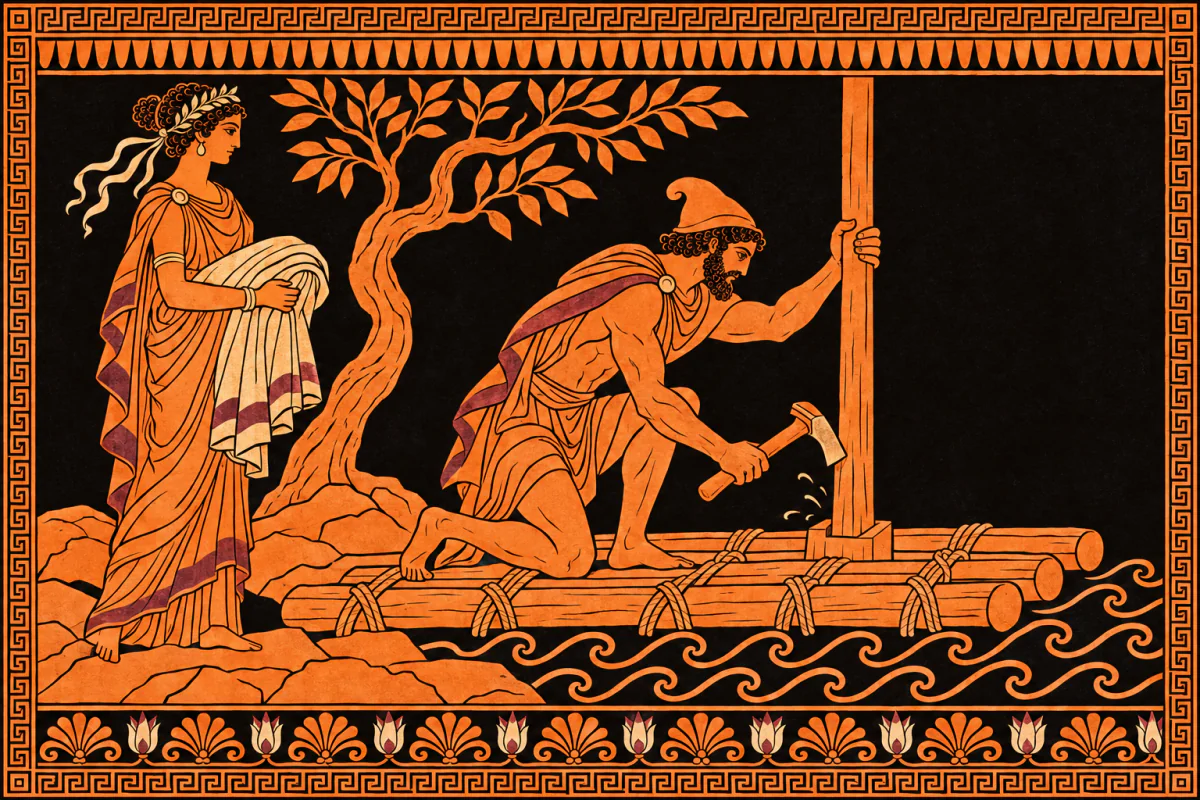
A goddess offers him immortality, a princess half-hopes he will marry her, and he turns both down for an ageing wife on a rocky island. Later writers could not leave the refusals alone.
In short
Odysseus spends seven of his ten lost years with the nymph Calypso, far longer than with any monster, and the poem's first sight of him is of a man crying on her beach. On the way home he is washed up naked among the Phaeacians and rescued by their princess, Nausicaa. Homer treats both women with sympathy, and both scenes became favourites of later poets, playwrights and comedians.
Seven years with a goddess
Calypso, "the concealer", keeps Odysseus on her island of Ogygia. He tells the Phaeacians: "there I stayed seven years without a break, and always wet with my tears the immortal clothes Calypso gave me" (Od. 7.259–260). The gods finally send Hermes to order her to let him go, and she obeys, though she offers him one last chance: stay and be immortal. His answer, that Penelope is less beautiful but that he longs for home all the same (Od. 5.215–220; Chapter IV), is one of the poem's quietly decisive moments. She gives him a great double-edged bronze axe with an olive-wood handle and a polished adze to build the raft (Od. 5.234–237), and when it is done she brings him cloth for the sail (5.258–259).
Hesiod's Theogony gives the seven years children: "Calypso, bright among goddesses, bore to Odysseus Nausithous and Nausinous, joined with him in love" (Hes. Th. 1017–1018). Both names are built on the Greek word for a ship, fitting sons for a sailor.
The goddess who was right?
Ancient comedians loved the idea that Odysseus made the wrong choice. In Lucian's True History the narrator, leaving the Isle of the Blessed, is taken aside by Odysseus, who slips him a letter for Calypso without Penelope seeing (Lucian, True History 2.29). On the voyage the narrator opens it.
Ὀδυσσεὺς Καλυψοῖ χαίρειν. ἴσθι με, ὡς τὰ πρῶτα ἐξέπλευσα παρὰ σοῦ τὴν σχεδίαν κατασκευασάμενος, ναυαγίᾳ χρησάμενον μόλις ὑπὸ Λευκοθέας διασωθῆναι εἰς τὴν τῶν Φαιάκων χώραν, ὑφʼ ὧν ἐς τὴν οἰκείαν ἀποπεμφθεὶς κατέλαβον πολλοὺς τῆς γυναικὸς μνηστῆρας ἐν τοῖς ἡμετέροις τρυφῶντας· ἀποκτείνας δὲ ἅπαντας ὑπὸ Τηλεγόνου ὕστερον τοῦ ἐκ Κίρκης μοι γενομένου ἀνῃρέθην, καὶ νῦν εἰμι ἐν τῇ Μακάρων νήσῳ πάνυ μετανοῶν ἐπὶ τῷ καταλιπεῖν τὴν παρὰ σοὶ δίαιταν καὶ τὴν ὑπὸ σοῦ προτεινομένην ἀθανασίαν. ἢν οὖν καιροῦ λάβωμαι, ἀποδρὰς ἀφίξομαι πρὸς σέ.
Odysseus to Calypso, greetings. You should know that as soon as I sailed away from you on the raft I had built, I was shipwrecked and barely saved by Leucothea, who brought me to the land of the Phaeacians. They sent me home, where I found a crowd of suitors living in luxury at my house. I killed them all, and was later killed by Telegonus, my son by Circe. Now I am on the Island of the Blessed, very sorry that I left my life with you and the immortality you offered. If I get the chance, I will run away and come to you. AI translation
Calypso weeps over it, entertains the visitors, and asks what Penelope looks like, and whether she is as virtuous as Odysseus used to boast (Lucian, True History 2.36). Plutarch gives the same reproach to Circe: Odysseus has thrown away an ageless, immortal life with her for a mortal wife, "and an old woman by now" (Plut. Gryllus 1).
Nausicaa on the beach
Washed up on the Phaeacians' island, Odysseus falls asleep in a thicket by a river mouth. The princess Nausicaa has come down with her maids to do the palace washing; when it is spread to dry, they throw off their veils and play ball, and Nausicaa leads the song (Od. 6.99–101). The princess throws the ball to a maid, misses, and it lands in the deep river; the girls shriek, and Odysseus wakes (Od. 6.115–117). He comes out of the bushes naked and caked in brine, holding a leafy branch "to cover his manhood" (Od. 6.127–129); he is a fearsome sight, fouled with brine, and the maids scatter along the shore; only Nausicaa, given courage by Athena, stands her ground (Od. 6.137–141). His speech to her is a model of tact.
οὐ γάρ πω τοιοῦτον ἴδον βροτὸν ὀφθαλμοῖσιν,
οὔτʼ ἄνδρʼ οὔτε γυναῖκα· σέβας μʼ ἔχει εἰσορόωντα.
Δήλῳ δή ποτε τοῖον Ἀπόλλωνος παρὰ βωμῷ
φοίνικος νέον ἔρνος ἀνερχόμενον ἐνόησα·I have never seen anyone like you with my own eyes, man or woman; awe holds me as I look at you. Once, on Delos, beside the altar of Apollo, I saw something like you: the young shoot of a palm tree springing up. AI translation
Bathed and dressed, and made taller and sturdier by Athena, with curls like hyacinth flowers (Od. 6.229–231), he looks so fine that Nausicaa tells her maids: "if only such a man might be called my husband, living here, and be pleased to stay" (Od. 6.244–245). Nothing comes of it. When they meet again before he sails, she asks him only to remember her, since he owes her his life, and he promises to pray to her as to a goddess for the rest of his days (Od. 8.461–468).
The scene became one of the most loved in Greek culture. Sophocles wrote a play called Nausicaa, now lost, and Athenaeus records that the playwright, a fine dancer and musician, "played ball superbly when he put on his Nausicaa", taking the part himself (Athenaeus, Deipnosophists 1). A woman grammarian of Corfu, Agallis, gave Nausicaa the credit for inventing ball games, "to please her fellow citizen", since Corfu claimed to be the Phaeacians' island (Athenaeus 1). The Phaeacian king's garden, with its fruit that never fails, was still proverbial in Milton, who compares Eden to "those Gardens feign'd ... of renownd Alcinous, host of old Laertes Son" (Paradise Lost 9.440–442; also 5.341–342).
Chapter VII
The Cyclops: Nobody's joke
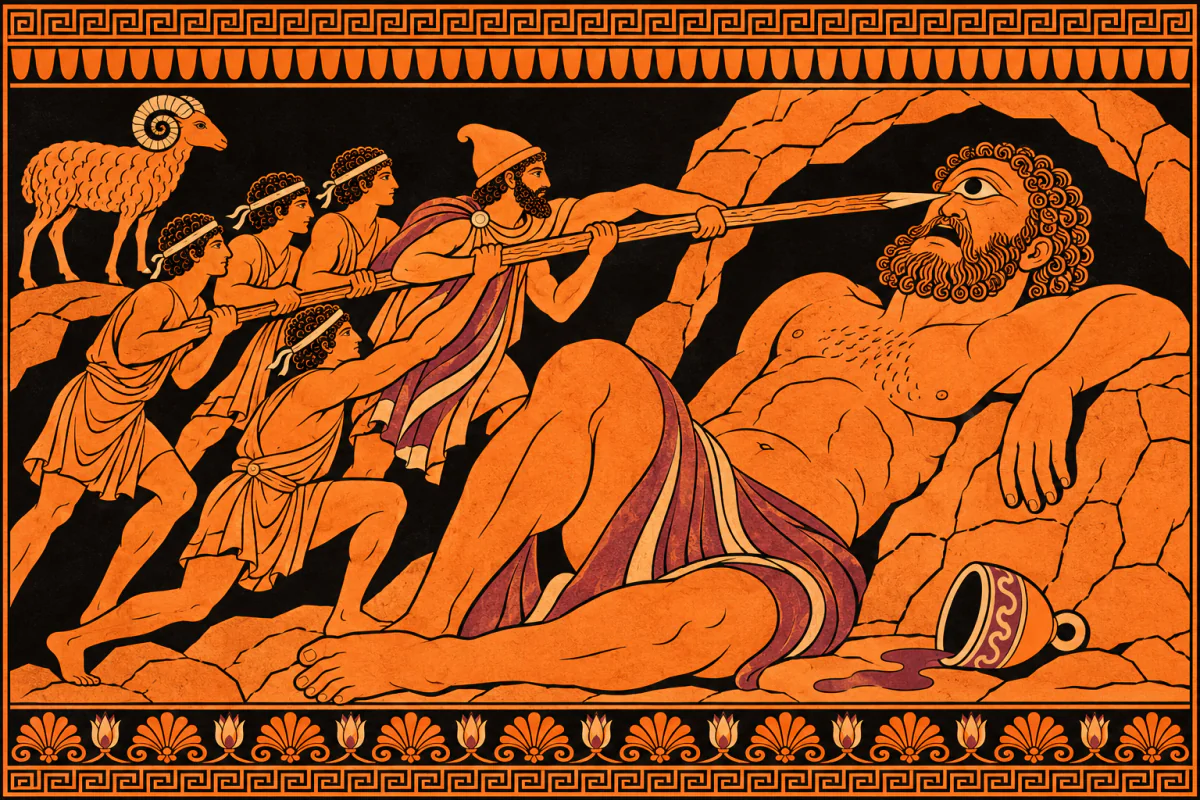
The longest monster story in the poem is a trickster tale built on a pun. The ancients retold it as farce, as a love story, as a mangled after-dinner anecdote, and as the monster's own complaint to his father.
In short
Trapped in the cave of the one-eyed giant Polyphemus, who eats six of his men, two at a time (Od. 9.288–290; 9.311; 9.344), Odysseus gets him drunk, tells him his name is "Nobody", blinds him with a heated stake, and escapes clinging under a ram. Then he ruins it by shouting his real name, and the Cyclops' father, Poseidon, pursues him for the rest of the voyage. At 462 lines it is the longest of the monster adventures, and the one ancient artists painted most.
The pun
When the drunken Cyclops asks his name, Odysseus gives him one.
Κύκλωψ, εἰρωτᾷς μʼ ὄνομα κλυτόν, αὐτὰρ ἐγώ τοι
ἐξερέω· σὺ δέ μοι δὸς ξείνιον, ὥς περ ὑπέστης.
Οὖτις ἐμοί γʼ ὄνομα· Οὖτιν δέ με κικλήσκουσι
μήτηρ ἠδὲ πατὴρ ἠδʼ ἄλλοι πάντες ἑταῖροι.Cyclops, you ask me my famous name, and I will tell it to you; and you give me a guest-gift, as you promised. Nobody is my name. Nobody my mother and father call me, and all my companions too. AI translation
Blinded, the giant bellows for help, and the other Cyclopes come running to ask who is hurting him. "Friends, Nobody is killing me by trickery, not by force," he shouts (Od. 9.408). They reply: if nobody (mē tis) is harming you, you must be ill, so pray to your father Poseidon.
ὣς ἄρʼ ἔφαν ἀπιόντες, ἐμὸν δʼ ἐγέλασσε φίλον κῆρ,
ὡς ὄνομʼ ἐξαπάτησεν ἐμὸν καὶ μῆτις ἀμύμων.So they spoke as they went away, and my heart laughed, how my name and my flawless cunning had fooled him. AI translation
The joke works twice in Greek. Outis means "nobody", and the neighbours' mē tis, "if no one", sounds exactly like mētis, "cunning", Odysseus' signature quality. Odysseus and four men chosen by lot had driven the stake in (Od. 9.331–335); now he ties each of his men under three rams and clings to the belly of the best ram himself, "twisted round, hanging on with patient heart" (Od. 9.431–435). The blind Cyclops, feeling the backs of his sheep at the door, speaks tenderly to his favourite: "Dear ram, why are you the last of the flock to leave the cave today?" (Od. 9.446–449).
Then comes the mistake. Safe on his ship, Odysseus shouts back his real name, his father's and his home (Od. 9.502–505), and the Cyclops uses them to curse him by name (9.528–535). The trickster beaten by his own vanity is the episode's real ending.
Farce, love song and complaint
No episode of the poem was rewritten more freely. Euripides' Cyclops, the only complete satyr play to survive, puts the cave on stage with a chorus of drunken satyrs. The Cyclops asks the stranger's name, and gets "Nobody"; and what favour, Odysseus asks, will he receive in return? "I shall eat you last of all your companions," says the Cyclops, and the old satyr Silenus remarks that it is a fine gift for a guest (Eur. Cyc. 548–551). After the blinding the satyrs milk the joke dry.
Οὖτίς μ’ ἀπώλεσ’.
οὐκ ἄρ’ οὐδεὶς ἠδίκει.
Οὖτίς με τυφλοῖ βλέφαρον.
οὐκ ἄρ’ εἶ τυφλός.
ὡς δὴ σύ—
καὶ πῶς σ’ οὔτις ἂν θείη τυφλόν;
σκώπτεις. ὁ δ’ Οὖτις ποῦ ’στιν;CYCLOPS: Nobody has destroyed me! — CHORUS: Then no one wronged you. — CYCLOPS: Nobody is blinding my eye! — CHORUS: Then you are not blind. — CYCLOPS: As if you… — CHORUS: And how could nobody make you blind? — CYCLOPS: You mock me. But where is Nobody? AI translation
Aristophanes reused the gag in Wasps (422 BCE). An old man trying to escape from his own house under a donkey, like Odysseus under the ram, is caught and asked who he is: "Nobody, by Zeus." "Nobody? From where?" "From Ithaca, son of Runaway-horse" (Ar. Vesp. 184–186).
The Hellenistic poet Theocritus, a Sicilian, rewound the story to make the monster a lovesick teenager. In his eleventh Idyll "the Cyclops of our parts, old Polyphemus", his beard just coming in, loves the sea-nymph Galatea "with downright madness": his sheep wander home by themselves while he sits on the seaweedy shore singing to her from dawn (Theoc. Id. 11.7–16). He finds the only cure for love, which is song (11.17–18): "so Polyphemus shepherded his love with music, and got through more easily than if he had paid out gold" (11.80–81). In the sixth Idyll Galatea pelts his flock with apples to get his attention (Id. 6.6–7).
Virgil gave the cave a survivor. In the Aeneid the Trojans, landing in Sicily, find a starving Greek, Achaemenides: "I am from Ithaca, a companion of unlucky Ulysses", left behind in the Cyclops' vast cave when his comrades fled (Aen. 3.613–618). Lucian, in his Dialogues of the Sea-Gods, lets Polyphemus tell his father his side: he came home from the pasture to find "a crowd of men in my cave, plotting against my flocks, obviously", so naturally he ate some of them, "since they were robbers" (Luc. DMar. 2). The stranger "at first called himself Nobody, but once he had got away and was out of range, he said his name was Odysseus" (DMar. 2).
By Nero's time the story was common enough to mangle. In Petronius' Satyricon the vulgar millionaire Trimalchio asks his guests whether they know "the story of Ulysses, how the Cyclops twisted his thumb off with pincers? I used to read these things in Homer when I was a boy" (Petr. Sat. 48). Later in the novel the narrator hides his boyfriend Giton under a bed, tied to the bed-straps, "as Ulysses once clung to the Cyclops' ram" (Sat. 97). The allegorists, meanwhile, read the giant as savage anger, which Odysseus cauterised with reason; Heraclitus even derives the name Cyclops from a word for one who "steals away" the reasoning mind (Heraclit. All. 70).
Sindbad's giant
The same story turns up, more than a thousand years later, in Sindbad's third voyage in the Arabian Nights. Sindbad's crew are trapped in a giant's palace; he roasts the ship's captain on a spit and eats him; that night, while he snores, they heat two iron spits red-hot and drive them into his eyes, "so that his eyeballs burst and he became stone blind", and he gropes after them and finds the door (Arabian Nights, night 547, tr. Burton). Nobody knows how the tale travelled, but it travelled; see also Older sea stories.
The Cyclops across the library
| Source | Date | What they did with it | Passage |
|---|---|---|---|
| Homer | c. 700 BCE | the trickster tale, the pun, the curse | Od. 9.364–367 |
| Euripides, Cyclops | late 5th c. BCE | a satyr-play farce with a drunken chorus | Cyc. 672–675 |
| Aristophanes, Wasps | 422 BCE | an old man escaping under a donkey: "Nobody, son of Runaway-horse" | Vesp. 184–186 |
| Theocritus | 3rd c. BCE | the young Cyclops in love with Galatea | Id. 11.7–16 |
| Virgil | 19 BCE | Achaemenides, the sailor left behind in the cave | Aen. 3.613–618 |
| Petronius | 1st c. CE | Trimalchio's garbled version; Giton under the bed like Ulysses under the ram | Sat. 48; 97 |
| Heraclitus | 1st c. CE | allegory: the Cyclops as savage anger | All. 70 |
| Lucian | 2nd c. CE | the Cyclops complains to Poseidon about robbers | DMar. 2 |
| Arabian Nights | medieval | Sindbad blinds a man-eating giant with red-hot spits | night 547 |
| Vases | 6th–5th c. BCE | the drunken giant, the stake, the escape under the ram | Louvre F 342; Toledo 1927.97; more |
Chapter VIII
Sirens, Scylla and Charybdis
The most famous scenes in the poem are among its shortest, and Homer never says what the Sirens looked like. What he does say is stranger than the paintings: their song is an offer of knowledge, and his Scylla is no woman at all.
In short
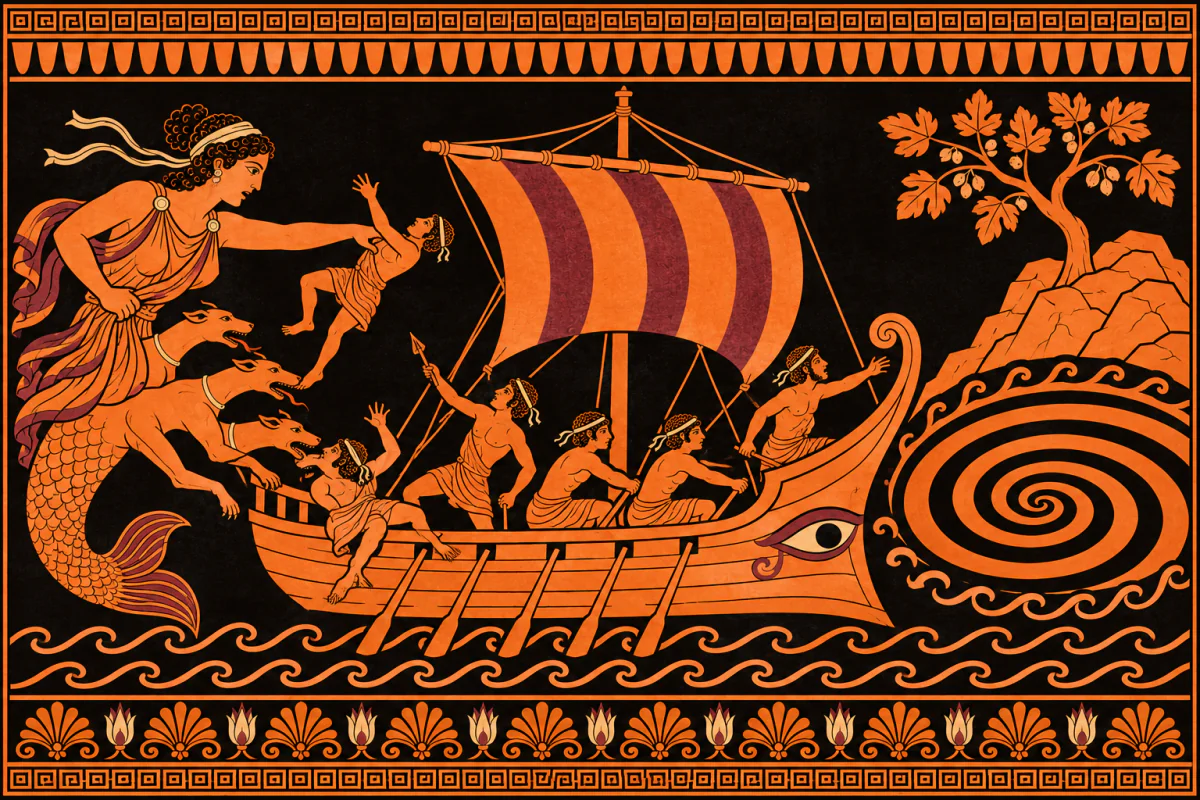
Circe warns Odysseus of three dangers on the way home. The Sirens, whose song lures sailors to their deaths: he stops his men's ears with wax and has himself tied to the mast so that he alone can hear it. Then a choice between two rocks: Scylla, who will take six men, or the whirlpool Charybdis, which will take the ship. He chooses Scylla. Together the three scenes take 95 lines.
The song
Homer gives the Sirens no bodies and no names. He never says how many there are, though twice the Greek uses the form of their name that means two (12.52 and 12.167). Circe says only where they are and what they leave behind: they sit in a meadow and enchant every man who comes near with their clear song, and around them lies a great heap of men's bones, rotting, with the skin shrivelling on them (Od. 12.39–46). Odysseus softens wax in the sun, stops his men's ears, and has them tie him upright to the mast-step, hand and foot (Od. 12.173–180). Then the Sirens sing, and their song is not what a modern reader expects.
δεῦρʼ ἄγʼ ἰών, πολύαινʼ Ὀδυσεῦ, μέγα κῦδος Ἀχαιῶν,
νῆα κατάστησον, ἵνα νωιτέρην ὄπ ἀκούσῃς.
οὐ γάρ πώ τις τῇδε παρήλασε νηὶ μελαίνῃ,
πρίν γʼ ἡμέων μελίγηρυν ἀπὸ στομάτων ὄπʼ ἀκοῦσαι,
ἀλλʼ ὅ γε τερψάμενος νεῖται καὶ πλείονα εἰδώς.
ἴδμεν γάρ τοι πάνθʼ ὅσʼ ἐνὶ Τροίῃ εὐρείῃ
Ἀργεῖοι Τρῶές τε θεῶν ἰότητι μόγησαν,
ἴδμεν δʼ, ὅσσα γένηται ἐπὶ χθονὶ πουλυβοτείρῃ.Come here, much-praised Odysseus, great glory of the Achaeans: stop your ship, so that you can hear our voice. No one has ever sailed past here in his black ship before he heard the honey-sweet voice from our lips; he goes home delighted, and knowing more. For we know everything that the Argives and Trojans suffered in wide Troy by the will of the gods, and we know everything that happens on the much-nourishing earth. AI translation
Odysseus signals with his eyebrows to be untied; two of his men get up and tie him tighter (Od. 12.192–196). The Sirens offer the hero of the Trojan War the one thing he cannot resist, his own story, and the knowledge of everything.
Cicero saw this and thought it the key to the passage. The Sirens, he says, did not hold sailors back by sweet voices or novel songs, "but because they professed to know many things, so that men clung to their rocks out of desire to learn", and he translated Homer's lines into Latin verse to prove it (Cic. Fin. 5.49). The emperor Tiberius, who tormented scholars with mythological trivia, used to ask them "what song the Sirens used to sing" (Suet. Tib. 70.3).
From voices to bird-women
Once painters began showing the scene, the Sirens needed a shape, and they got the body of a bird with a woman's head. The earliest Odyssey vase in this report, a small oil flask in Boston of about 570–550 BCE, already shows Odysseus tied to the mast of a ship with a boar's-snout prow, and two Sirens with raised wings on the cliffs ahead (Boston 01.8100). The poets followed. In Apollonius' Argonautica the Sirens are daughters of the Muse Terpsichore, once companions of Persephone, "now in part like birds and in part like maidens" (Argon. 4.891–899), and Jason's crew is saved because Orpheus strikes up his lyre and drowns their song with a faster one (4.903–909).
Later readers tamed them. For Horace the Sirens' voices sit beside Circe's cup as temptations the wise man refuses (Hor. Epist. 1.2.23). Seneca made the image his own: wax is not enough for the wise man's ears, because today's siren voice "sounds not from one rock but from every part of the world" (Sen. Ep. 31.2); flattering voices must be sailed past as Ulysses sailed past his (Ep. 123.12); and at the end of his famous letter about trying to read above a noisy bathhouse, he gives up and moves out, since Ulysses found such an easy remedy for his men even against the Sirens (Ep. 56.15). Isidore of Seville, in the seventh century, explained them away entirely: "in truth they were prostitutes", who brought travellers to poverty and so were said to bring shipwreck, and they had wings and claws "because love both flies and wounds" (Isid. Etym. 11.3.31).
The Greeks of southern Italy took them literally. Strabo reports that some placed the Sirens at Cape Pelorias in Sicily and others on the little islands of the Sirenussae (Strabo 1.2.12–13), off the cape near Sorrento that some called the Sirens' promontory (5.4.8), and that at Naples the tomb of one Siren, Parthenope, was shown, with athletic games held in her honour at an oracle's command (Strabo 5.4.7).
Scylla and Charybdis
Homer's Scylla lives in a misty cave halfway up a cliff as smooth as if it had been polished (Od. 12.79–81), and Circe describes her in a passage that no painting has followed.
ἔνθα δʼ ἐνὶ Σκύλλη ναίει δεινὸν λελακυῖα.
τῆς ἦ τοι φωνὴ μὲν ὅση σκύλακος νεογιλῆς
γίγνεται, αὐτὴ δʼ αὖτε πέλωρ κακόν· οὐδέ κέ τίς μιν
γηθήσειεν ἰδών, οὐδʼ εἰ θεὸς ἀντιάσειεν.
τῆς ἦ τοι πόδες εἰσὶ δυώδεκα πάντες ἄωροι,
ἓξ δέ τέ οἱ δειραὶ περιμήκεες, ἐν δὲ ἑκάστῃ
σμερδαλέη κεφαλή, ἐν δὲ τρίστοιχοι ὀδόντες
πυκνοὶ καὶ θαμέες, πλεῖοι μέλανος θανάτοιο.There Scylla lives, yelping terribly. Her voice is only as loud as a new-born puppy's, but she herself is an evil monster: no one would be glad to see her, not even a god who met her. She has twelve feet, all dangling, and six very long necks, and on each a fearsome head, with three rows of teeth, close-set and thick, full of black death. AI translation
Across the strait, a bowshot away, is a lower rock with a great fig tree on it, and under it Charybdis sucks down the black water (Od. 12.101–104). Three times a day she spews it up and three times she sucks it down, and not even Poseidon could save a ship caught there. So Circe advises the cruel arithmetic: hug Scylla's rock, "since it is far better to mourn six companions in your ship than all of them together" (Od. 12.105–110). Odysseus does not tell his crew about Scylla, for fear they will stop rowing and hide (Od. 12.223–225). Scylla takes six men, the strongest, and he watches their hands and feet lifted high as they call his name "for the last time" (Od. 12.245–250).
The woman with the dog-belly is Roman. Virgil has a lovely girl to the groin, behind her a sea-monster's body with dolphins' tails and a belly of wolves (Aen. 3.426–428); Ovid explains that Circe made her so out of jealousy, and lets Scylla discover the barking dogs where her legs had been (Met. 14.59–67; Chapter II).
On the vases
The library's catalogue holds three Siren scenes: the Boston flask of about 570–550 BCE (Boston 01.8100); the famous red-figure jar in London of about 500–480 BCE (London E 440); and a later piece in Berlin (Berlin V.I. 4532). Their descriptions are summarised with the other vases below.
Chapter IX
The Underworld: a conversation with the dead
Odysseus does not go down into Hades. He sails to the edge of the world, digs a pit, fills it with blood and waits for the dead to come up and drink. What they tell him is the bleakest picture of death in Greek poetry, and later writers kept answering it.
In short
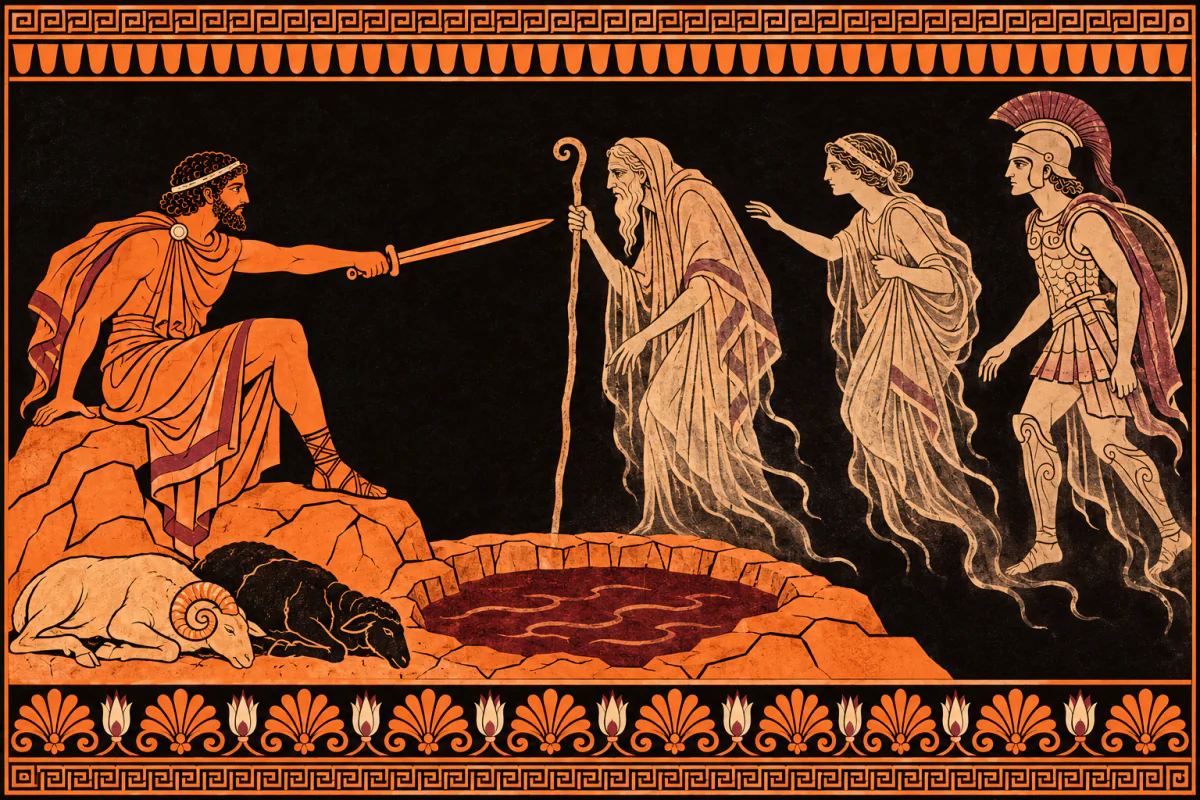
Circe sends Odysseus to consult the dead prophet Teiresias about the way home. At the far edge of the world he sacrifices a ram and a black ewe, and the ghosts crowd up to the blood: his drowned crewman, his mother, Teiresias, a parade of famous women, his old comrades from Troy, and the great sinners. Book 11 is 640 lines, the longest episode of the wanderings.
Blood for the ghosts
The ship reaches the limits of deep-flowing Ocean, the land of the Cimmerians (Od. 11.13–14), and Odysseus digs a pit a cubit square with his sword (11.24–25). Circe has given precise instructions: a ram and a black ewe for the dead, and a black ram for Teiresias alone (Od. 10.524–527). The dead are witless shadows until they drink, so Odysseus sits by the pit with his sword drawn and lets none of them near until the prophet has spoken (Od. 11.48–50). The first to come is Elpenor, a young crewman who had slept off too much wine on Circe's roof, forgot to come down by the ladder and fell, breaking his neck (Od. 11.61–64); "we had left his body in Circe's hall, unwept and unburied, since another task pressed on us" (Od. 11.51–54). Then his mother, Anticleia, whom he had left alive when he sailed for Troy: he weeps, but holds her off from the blood (Od. 11.84–89). Then Teiresias, with a golden staff (11.90–91), who tells him how he will get home, what he will find there, and how he will die (Chapter XIII).
When his mother has drunk and spoken, and told him that it was longing for him, his counsel and his gentleness that took her life (Od. 11.202–203), Odysseus tries to hold her.
ὣς ἔφατʼ, αὐτὰρ ἐγώ γʼ ἔθελον φρεσὶ μερμηρίξας
μητρὸς ἐμῆς ψυχὴν ἑλέειν κατατεθνηυίης.
τρὶς μὲν ἐφωρμήθην, ἑλέειν τέ με θυμὸς ἀνώγει,
τρὶς δέ μοι ἐκ χειρῶν σκιῇ εἴκελον ἢ καὶ ὀνείρῳ
ἔπτατʼ. ἐμοὶ δʼ ἄχος ὀξὺ γενέσκετο κηρόθι μᾶλλον,So she spoke, and I pondered in my heart and longed to take hold of the ghost of my dead mother. Three times I sprang towards her, and my heart urged me to hold her, and three times she flew from my hands like a shadow or a dream; and the pain grew sharper in my heart. AI translation
Virgil reused the gesture almost word for word when Aeneas meets his father in the Underworld: "three times he tried to put his arms around his neck; three times the image, clasped in vain, fled from his hands, like the light winds, most like winged sleep" (Aen. 6.700–702).
"Better to be a hired hand"
The most quoted moment is Achilles'. Odysseus, trying to console him, says that the Greeks honoured him like a god in life and that he is a great lord among the dead (Od. 11.482–486). Achilles will have none of it.
μὴ δή μοι θάνατόν γε παραύδα, φαίδιμʼ Ὀδυσσεῦ.
βουλοίμην κʼ ἐπάρουρος ἐὼν θητευέμεν ἄλλῳ,
ἀνδρὶ παρʼ ἀκλήρῳ, ᾧ μὴ βίοτος πολὺς εἴη,
ἢ πᾶσιν νεκύεσσι καταφθιμένοισιν ἀνάσσειν.Do not try to console me for death, glorious Odysseus. I would rather be a labourer on the land, working for another man, some poor man with no land of his own and little to live on, than be king over all the dead who have perished. AI translation
The greatest warrior of the Iliad, who chose a short, glorious life, takes it back. The meeting ends better than it began: Achilles asks after his son (Od. 11.492–493), and Odysseus can tell him that Neoptolemus never once went pale inside the horse (Od. 11.523–532). Ajax, still angry about the armour, will not speak at all and walks off into the dark (Od. 11.543–551; 11.563–564; Chapter III).
The sinners
At the end of the book Odysseus sees the famous punishments, and two of them gave European languages their names for frustration. Tantalus stands in a lake up to his chin, thirsty; every time the old man stoops to drink, the water vanishes and black earth appears at his feet (Od. 11.582–587). Sisyphus pushes a huge stone uphill with hands and feet, and just as he is about to heave it over the top, its weight turns it back, and "then down to the plain rolled the shameless stone" (Od. 11.593–598).
Later visits
The ancients went on sending people to talk to Homer's dead. Horace imagined a sequel to the consultation in which Ulysses, worried that he will come home to an empty larder, asks Teiresias how to get rich again. The prophet's answer is to hunt legacies: "I said it and I say it again: cunningly hunt down old men's wills, everywhere" (Hor. Sat. 2.5.1–10; 2.5.23–24), until the old man, awake and in his right mind, writes "let Ulysses be heir to a quarter" (2.5.100). Plato, in the myth that ends the Republic, turned the Underworld into a place of choice, where Odysseus' soul, cured of ambition, chooses the life of a quiet private man (Pl. Resp. 620c). Lucian's comic Isle of the Blessed has the heroes feasting to Homer's poetry, with the poet himself reclining at dinner in the place above Odysseus (Lucian, True History 2.15). And in Philostratus, it is at a pit of blood on Ithaca that Homer himself calls up Odysseus' ghost to hear the real story (Chapter XI).
Two vases in the library's catalogue show the consultation: one with Odysseus and the ghost of Elpenor (Boston 34.79), and one, of about 380–360 BCE, with Odysseus consulting the ghost of Teiresias (Paris, Cab. Méd. 422).
Chapter X
The homecoming
Half the poem is spent on Ithaca, and it is built on recognitions: a son, a dog, a nurse, a bow, a wife and a father, each in turn seeing through the beggar's rags. Aristotle thought this was what made the Odyssey the more complex of Homer's poems.
In short
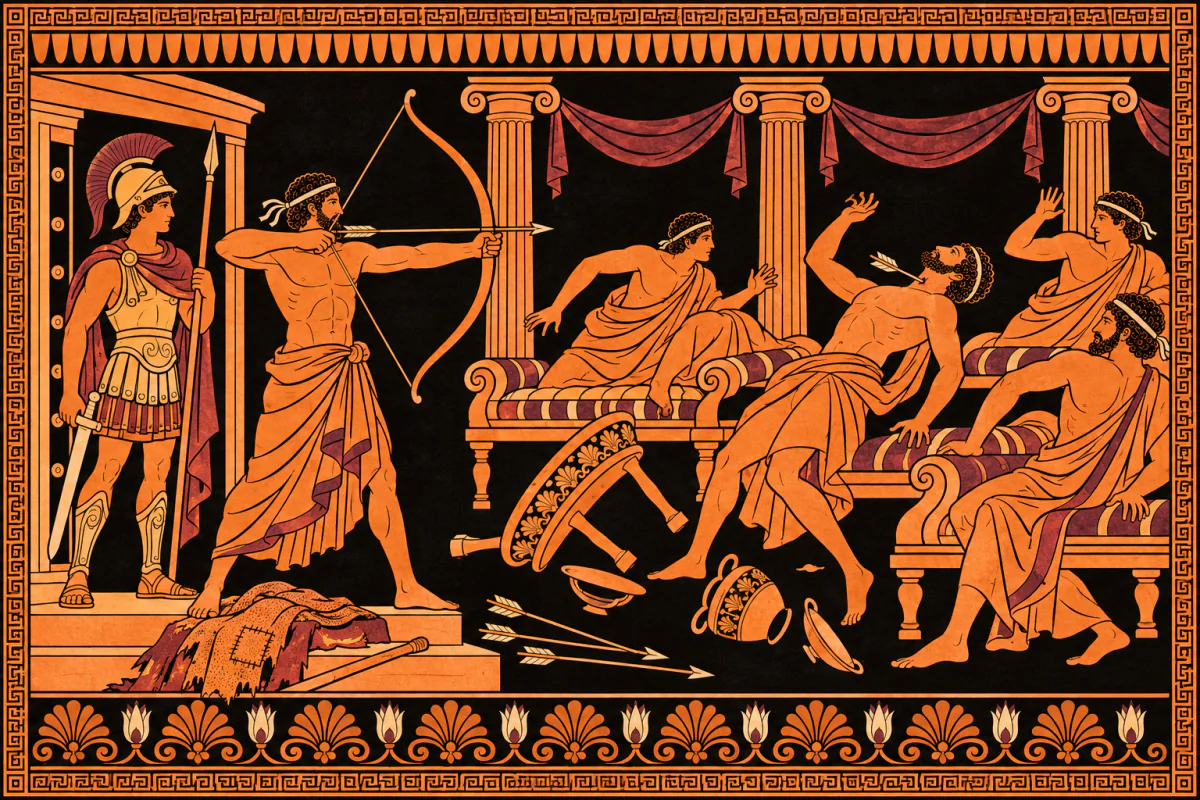
Odysseus comes home disguised by Athena as an old beggar, and spends the last twelve books on Ithaca, much of that time in his own house, insulted by the men eating his food. He reveals himself to his son, is recognised by his dog and his old nurse, wins the archery contest no suitor can, and kills them all. His wife makes him prove who he is. The violence is total, and the poem stops it only by divine command.
A poem of recognitions
Aristotle, looking for the secret of good plots, summed up the Odyssey in one sentence: a man away from home for many years, watched by Poseidon and alone, while at home suitors waste his property and plot against his son, comes home storm-tossed, reveals himself to some, attacks, and is saved while he destroys his enemies. "That much is the story proper; the rest is episodes" (Arist. Poet. 17). He called the Iliad simple and full of suffering, and the Odyssey complex, "for it is recognition throughout", and a poem of character (Poet. 24). He also noted its double ending, in which the good and the bad meet opposite fates (Poet. 13), and remarked drily that such plots seem best only because of the weakness of audiences, whom poets follow, writing to please them (Poet. 13).
The recognitions come one by one. To his son, in the swineherd's hut, Odysseus says: "I am no god; why do you liken me to the immortals? I am your father", and kisses him, and lets fall the tears he had held back (Od. 16.186–191). The dog Argos, neglected on a dung heap, knows him at once, and dies (Od. 17.296–300; 17.326–327). The old nurse Eurycleia, washing the beggar's feet, feels the scar a boar gave him as a boy.
τὴν γρηῢς χείρεσσι καταπρηνέσσι λαβοῦσα
γνῶ ῥʼ ἐπιμασσαμένη, πόδα δὲ προέηκε φέρεσθαι·
ἐν δὲ λέβητι πέσε κνήμη, κανάχησε δὲ χαλκός,
ἂψ δʼ ἑτέρωσʼ ἐκλίθη· τὸ δʼ ἐπὶ χθονὸς ἐξέχυθʼ ὕδωρ.
τὴν δʼ ἅμα χάρμα καὶ ἄλγος ἕλε φρένα, τὼ δέ οἱ ὄσσε
δακρυόφι πλῆσθεν, θαλερὴ δέ οἱ ἔσχετο φωνή.
ἁψαμένη δὲ γενείου Ὀδυσσῆα προσέειπεν·
ἦ μάλʼ Ὀδυσσεύς ἐσσι, φίλον τέκος· οὐδέ σʼ ἐγώ γε
πρὶν ἔγνων, πρὶν πάντα ἄνακτʼ ἐμὸν ἀμφαφάασθαι.The old woman took the leg in the flat of her hands, and knew the scar as she touched it, and let the foot fall. His shin dropped into the basin, the bronze rang, and the basin tipped over and the water spilled on the ground. Joy and grief seized her heart together, her eyes filled with tears and her strong voice was stopped. She touched his chin and said to Odysseus: "You really are Odysseus, dear child! I did not know you until I had touched my master all over." AI translation
A marble relief of about 350–300 BCE in Athens shows this scene, with Odysseus seated in his traveller's cap, his foot over the basin, the nurse bending to him and Penelope behind (Athens, NM 1914), and a vase at Chiusi pairs it with Penelope and Telemachus (Chiusi 1831).
The bow and the slaughter
Penelope sets the contest (Od. 21.73–79); the suitors cannot string the bow; Telemachus nearly can, until his father stops him (21.125–129). The beggar asks to try, and strings it "as a man skilled at the lyre and at song easily stretches a string round a new peg" (Od. 21.405–408), and plucks it, "and it sang sweetly under his hand, like a swallow's voice" (Od. 21.409–411). Then he strips off his rags and leaps onto the threshold.
αὐτὰρ ὁ γυμνώθη ῥακέων πολύμητις Ὀδυσσεύς,
ἆλτο δʼ ἐπὶ μέγαν οὐδόν, ἔχων βιὸν ἠδὲ φαρέτρην
ἰῶν ἐμπλείην, ταχέας δʼ ἐκχεύατʼ ὀϊστοὺς
αὐτοῦ πρόσθε ποδῶν, μετὰ δὲ μνηστῆρσιν ἔειπεν·
οὗτος μὲν δὴ ἄεθλος ἀάατος ἐκτετέλεσται·
νῦν αὖτε σκοπὸν ἄλλον, ὃν οὔ πώ τις βάλεν ἀνήρ,
εἴσομαι, αἴ κε τύχωμι, πόρῃ δέ μοι εὖχος Ἀπόλλων.Then Odysseus of many wiles stripped off his rags and sprang onto the great threshold, holding the bow and the quiver full of arrows, and poured out the swift arrows there before his feet, and spoke among the suitors: "This contest, that so harmed you, is over. Now I will try another mark, which no man has ever hit, if I can hit it, and Apollo gives me glory." AI translation
The first arrow takes Antinous, the leading suitor, through the throat as he lifts a golden cup to drink: "who would have thought, among men at a feast, that one man, alone among many, however strong, would bring him evil death?" (Od. 22.8–21). The slaughter fills the rest of book 22. Plato's rhapsode Ion names this very moment, Odysseus "leaping onto the threshold, revealing himself to the suitors and pouring out the arrows before his feet", as one of the passages that most moved his audiences (Pl. Ion 535b). A vase in Berlin shows the killing (Berlin F 2588).
It ends with an act the modern retellings have not let pass. Of the fifty women who serve in the house, the nurse names twelve who sided with the suitors (Od. 22.421–425). Telemachus, ordered to kill them with the sword, refuses them "a clean death" (Od. 22.461–464) and hangs them from a ship's cable stretched across the courtyard, "as thrushes with long wings, or doves, fall into a net set in a thicket", and "their feet twitched for a little while, not long" (Od. 22.465–473).
Where does it end?
After the test of the bed (Chapter IV), husband and wife go to bed, and the poem reaches a line that some ancient scholars thought was its last: "and gladly they came to the rite of their old bed" (Od. 23.296). A note in the medieval manuscripts reports: "Aristophanes and Aristarchus make this the end of the Odyssey" (schol. Od. 23.296). Aristophanes of Byzantium and Aristarchus were the two greatest Homer scholars of Alexandria, and nobody now knows exactly what they meant: that the rest was added later, or that the main story is complete at that point. The poem as we have it goes on for another 600 lines, to the ghosts of the suitors arriving in Hades, Odysseus' reunion with his old father Laertes, and a battle with the suitors' families. It stops only when Zeus throws a thunderbolt and Athena orders Odysseus to end "the strife of common war" (Od. 24.539–545). The last lines are a peace treaty, sworn by Athena "in the likeness of Mentor, in body and in voice" (Od. 24.546–548).
Chapter XI
The poem's ancient readers and critics
The Greeks and Romans performed the Odyssey, taught it, edited it, allegorised it and argued about it for a thousand years. They asked the same questions modern readers ask: who wrote it, whether it is true, and whether its hero deserved it.
In short
The ancients heard the Odyssey before they read it, from professional reciters who could make an audience weep. Philosophers worried that it lied; critics ranked it below the Iliad; scholars counted its lines and argued about where it ended; allegorists turned its monsters into vices. And one third-century writer imagined Odysseus himself bribing Homer.
Odysseus bribes Homer
The strangest piece of ancient Homer criticism in the library is a ghost story. Philostratus' Heroicus, written in the third century CE, is a dialogue between a traveller and a vinegrower who claims to talk with the ghost of Protesilaus, the first Greek killed at Troy, and to know from him what really happened in the war. Homer, the vinegrower explains, learned the truth in an unusual way: hearing that Odysseus' soul still had its wits, he sailed to Ithaca and called it up by the rites of necromancy (Philostr. Her. 43). The ghost drove a bargain.
ὁ δὲ εἰδέναι μὲν πάντα ἔλεγε καὶ μεμνῆσθαι αὐτῶν, εἰπεῖν δʼ ἂν οὐδὲν ὧν οἶδεν, εἰ μὴ μισθὸς αὐτῷ παρʼ Ὁμήρου γένοιτο εὐφημίαι τε ἐν τῇ ποιήσει καὶ ὕμνος ἐπὶ σοφίᾳ τε καὶ ἀνδρείᾳ. ὁμολογήσαντος δὲ τοῦ Ὁμήρου ταῦτα καὶ ὅ τι δύναιτο, χαριεῖσθαι αὐτῷ ἐν τῇ ποιήσει φήσαντος, διῄει Ὀδυσσεὺς πάντα ξὺν ἀληθείᾳ τε καὶ ὡς ἐγένετο, ἥκιστα γὰρ πρὸς αἵματι καὶ βόθροις αἱ ψυχαὶ ψεύδονται.
He said he knew everything and remembered it, but would tell nothing of what he knew unless Homer paid him a fee: praise in the poem, and a hymn to his wisdom and courage. When Homer agreed, and said he would do him every favour he could in the poem, Odysseus told him everything, truthfully and as it happened. For souls tell fewest lies at the blood and the pit. AI translation
Then, as the poet left, the ghost called after him.
ἀπιόντος δὲ ἤδη τοῦ Ὁμήρου βοήσας ὁ Ὀδυσσεὺς Παλαμήδης με ἔφη δίκας ἀπαιτεῖ τοῦ ἑαυτοῦ φόνου καὶ οἶδα ἀδικῶν καὶ πάντως μὲν πείσομαί τι, οἱ γὰρ θεμιστεύοντες ἐνταῦθα δεινοί, Ὅμηρε, καὶ τὰ ἐκ Ποινῶν ἐγγύς, εἰ δὲ τοῖς ἄνω ἀνθρώποις μὴ δόξω εἰργάσθαι τὸν Παλαμήδην ταῦτα, ἧττόν με ἀπολεῖ τὰ ἐνταῦθα· μὴ δὴ ἄγε τὸν Παλαμήδην ἐς Ἴλιον, μηδὲ στρατιώτῃ χρῶ, μηδέ, ὅτι σοφὸς ἦν, εἴπῃς. ἐροῦσι μὲν γὰρ ἕτεροι ποηταί, πιθανὰ δὲ οὐ δόξει μὴ σοὶ εἰρημένα. αὕτη, ξένε, ἡ Ὀδυσσέως τε καὶ Ὁμήρου ξυνουσία, καὶ οὕτως Ὅμηρος τὰ ἀληθῆ μὲν ἔμαθε, μετεκόσμησε δὲ πολλὰ ἐς τὸ συμφέρον τοῦ λόγου, ὃν ὑπέθετο.
As Homer was already going away, Odysseus shouted: "Palamedes is demanding justice from me for his murder. I know I did wrong, and I will certainly suffer for it, for the judges here are terrible, Homer, and the Furies are near. But if people up above do not think I did this to Palamedes, what awaits me here will destroy me less. So do not bring Palamedes to Troy, do not make him a soldier, and do not say that he was wise. Other poets will say it, but it will not be believed if you have not said it." That, stranger, was the meeting of Odysseus and Homer. And so Homer learned the truth, but rearranged much of it to suit the story he had planned. AI translation
Palamedes was the clever Greek who exposed Odysseus' faked madness (Chapter II), and in the later legend Odysseus took his revenge: he forced a Trojan prisoner to write a letter as if from Priam to Palamedes about betraying the Greeks, buried gold in Palamedes' tent and dropped the letter in the camp, and Agamemnon had Palamedes stoned as a traitor (Apollod. Epit. 3.8). Homer never mentions him. Philostratus turns that silence into evidence: the most famous poem about Odysseus is, in his story, an authorised biography, paid for with praise, with the murder edited out.
Performers
For centuries most Greeks met the Odyssey as a performance by a rhapsode, a professional reciter. Plato's Ion is a conversation between Socrates and a prize-winning rhapsode, and Socrates asks him what he feels when he performs Odysseus "leaping onto the threshold, revealing himself to the suitors and pouring out the arrows before his feet" (Pl. Ion 535b). Ion admits that at sad passages his eyes fill with tears and at frightening ones his hair stands on end, and that he watches his audience closely.
καθορῶ γὰρ ἑκάστοτε αὐτοὺς ἄνωθεν ἀπὸ τοῦ βήματος κλάοντάς τε καὶ δεινὸν ἐμβλέποντας καὶ συνθαμβοῦντας τοῖς λεγομένοις. δεῖ γάρ με καὶ σφόδρʼ αὐτοῖς τὸν νοῦν προσέχειν· ὡς ἐὰν μὲν κλάοντας αὐτοὺς καθίσω, αὐτὸς γελάσομαι ἀργύριον λαμβάνων, ἐὰν δὲ γελῶντας, αὐτὸς κλαύσομαι ἀργύριον ἀπολλύς.
Every time, I look down on them from the platform, weeping, staring terribly and amazed at what is said. I have to pay close attention to them: if I set them crying, I shall laugh as I take the money, and if they laugh, I shall cry as I lose it. AI translation
Critics
Aristotle admired the Odyssey's construction: it tells one action, leaving out whatever did not belong to it (Poet. 8), it is complex where the Iliad is simple (Poet. 24), and it is too unified to cut up into tragedies, yielding "one tragedy, or two at most", where the lost epics of the cycle yielded many (Poet. 23). He was less impressed by a contemporary, the orator Alcidamas, who called the Odyssey "a fine mirror of human life": Aristotle quotes the phrase as an example of a metaphor so poetic that it falls flat (Rhet. 3.3.4).
The author of On the Sublime, probably of the first century CE, thought the Odyssey the work of Homer's old age. The Iliad, written at the height of his powers, is all drama and conflict; the Odyssey is mostly storytelling, "which is characteristic of old age".
ὅθεν ἐν τῇ Ὀδυσσείᾳ παρεικάσαι τις ἂν καταδυομένῳ τὸν Ὅμηρον ἡλίῳ, οὗ δίχα τῆς σφοδρότητος παραμένει τὸ μέγεθος.
So in the Odyssey one might compare Homer to the setting sun: the size remains, without the force. AI translation
Horace, in his Art of Poetry, praised Homer for beginning the Odyssey with its hero, not with the origins of the war, "not from the twin egg", and for sweeping the listener "into the middle of things" (in medias res), and he gave the poem's wonders their list: "Antiphates and Scylla, and Charybdis with the Cyclops" (Hor. Ars 140–152). He also left us a line usually misquoted: not "even Homer nods", but "I am annoyed whenever good Homer nods off" (Ars 359).
Scholars and pedants
In Alexandria, from the third century BCE, scholars edited Homer line by line, marking verses they suspected. The two greatest, Aristophanes of Byzantium and Aristarchus, are reported to have called 23.296 the end of the Odyssey (Chapter X; schol. Od. 23.296). The Romans found the questions they raised irresistible and slightly absurd. Seneca calls it "the Greek disease" to ask "how many rowers Ulysses had, whether the Iliad or the Odyssey was written first, and whether they were by the same author" (Sen. Brev. 13.2). He reports the grammarian Apion's theory that Homer wrote the first line of the Iliad last, so that its first two letters, read as numbers, would give the total of books in both poems (Ep. 88.40). Lucian answered all such questions at once: in the True History his narrator meets Homer on the Isle of the Blessed and asks him where he came from, which everyone still argues about. Homer says he is really a Babylonian called Tigranes, and that he wrote every one of the lines the scholars reject (Lucian, True History 2.20).
Allegorists
Philosophers who were embarrassed by Homer's gods read the poem as allegory. Heraclitus, the author of the Homeric Problems (first century CE), argues that "if you look closely, you will find that the whole wandering of Odysseus is allegory": Homer made Odysseus an instrument of every virtue, so the Lotus-eaters are pleasure, which he sailed past with self-control, and the Cyclops is savage anger, which he cauterised with reason, the name itself meaning one who "steals away the reasoning mind" (Heraclit. All. 70). He lands a joke on the philosophers he dislikes, calling Epicurus "the Phaeacian philosopher, the farmer of pleasure in his own gardens" (All. 75). The tradition ran on into Boethius' Circe (Chapter V) and beyond.
Others simply did not believe a word. Juvenal imagined Odysseus' audience at Alcinous' court growing angry or laughing at the "lying storyteller" and his man-eating giants (Juv. 15.13–18), and Lucian named Homer's Odysseus as the founder of all the travel liars, telling the Phaeacians "about winds kept as slaves, one-eyed men, cannibals and wild people, many-headed animals and his companions changed by drugs" (Lucian, True History 1.3).
Chapter XII
Where was it? The ancient geography of the wanderings
Modern readers trace Odysseus' route on maps of the Mediterranean. So did the ancients, and they disagreed just as much: Sicily, Italy, Spain, even Germany claimed him, and the best geographer of antiquity said the search was hopeless.
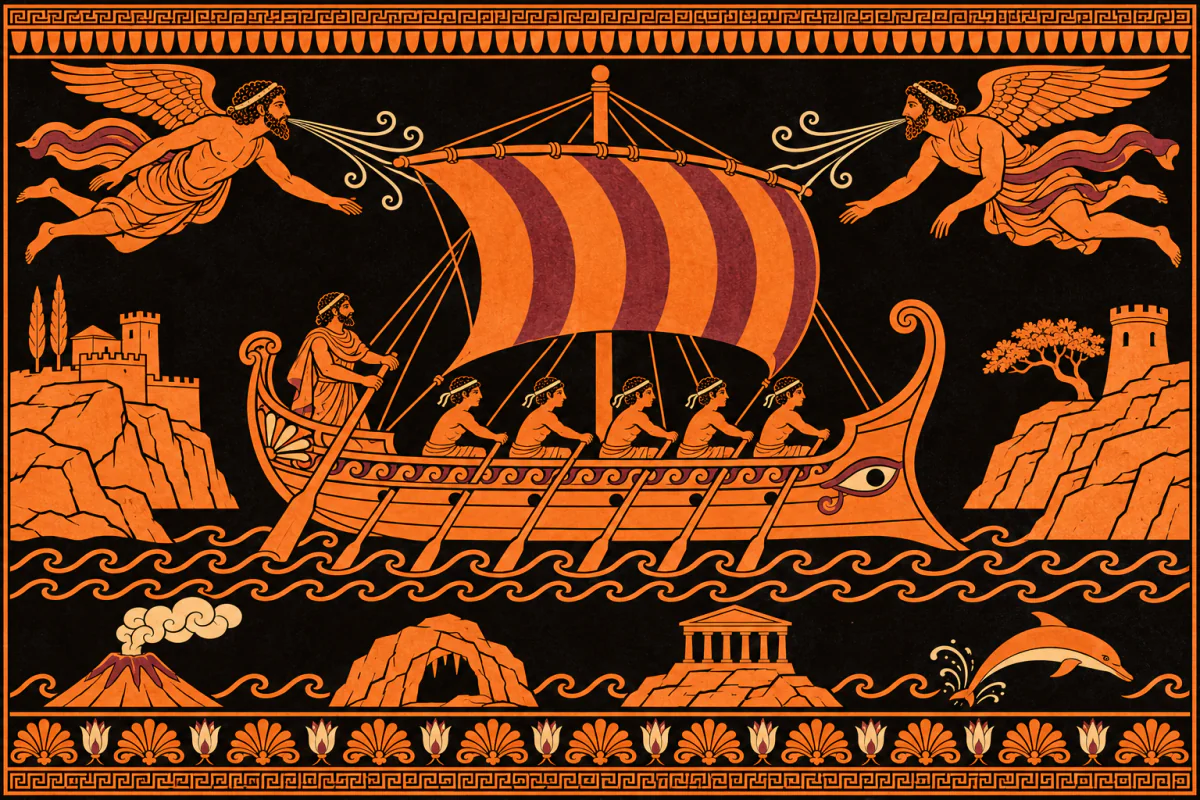
In short
Homer's geography is vague once Odysseus leaves the known Greek world. That did not stop anyone. Greek colonists in Sicily and Italy pointed to the Cyclopes' land, the Sirens' rocks and the tombs of Odysseus' crewmen; historians tried to find the real coasts behind the poetry; and a few writers laughed at the whole exercise.
Homer's map
Homer gives the world beyond Greece in poetic signposts: Calypso's island, "where the navel of the sea is" (Od. 1.50), the Cimmerians at the limits of Ocean (Od. 11.13–14), a bag of winds from Aeolus that should have blown the ship straight home (Od. 10.19–27). Whole stretches pass in a formula, "from there I was carried for nine days by deadly winds" (Od. 9.82), and directions are rare. The poem is precise only about home.
The historians shrug
Thucydides, describing Sicily before the Athenian invasion of 415 BCE, starts with its oldest inhabitants and declines to vouch for them.
παλαίτατοι μὲν λέγονται ἐν μέρει τινὶ τῆς χώρας Κύκλωπες καὶ Λαιστρυγόνες οἰκῆσαι, ὧν ἐγὼ οὔτε γένος ἔχω εἰπεῖν οὔτε ὁπόθεν ἐσῆλθον ἢ ὅποι ἀπεχώρησαν· ἀρκείτω δὲ ὡς ποιηταῖς τε εἴρηται καὶ ὡς ἕκαστός πῃ γιγνώσκει περὶ αὐτῶν.
The oldest people said to have lived in a part of the country are the Cyclopes and the Laestrygonians. I cannot say what race they were, where they came from or where they went. Let it be enough, what the poets have said and what each person knows about them. AI translation
Yet the poem's places were part of the living map. Thucydides notes that the people of Corcyra (Corfu), proud of their navy, boasted that their island had been home to the Phaeacians, the great seafarers of the Odyssey (Thuc. 1.25.4), and the islands north of Sicily were already called "the islands of Aeolus" (3.88). Herodotus placed the Lotus-eaters on a headland of the Libyan coast, living only on the fruit of the lotus, "about the size of a mastic berry and as sweet as a date", from which they also make wine (Hdt. 4.177).
The cobbler of the winds
The great argument of antiquity is preserved by Strabo, the geographer of the Augustan age, who devoted much of his first book to it. On one side stood Eratosthenes, the Alexandrian scholar who measured the earth: he held that "every poet aims at entertainment, not instruction" (Strabo 1.2.3), and Strabo reports his famous gibe that you would find where Odysseus wandered when you found the cobbler who stitched the bag of winds (Strabo 1.2.15). On the other stood the historian Polybius, who argued that Homer built on fact: Aeolus was a real man who taught sailors how to read the winds in the treacherous straits of Messina, and so was called the steward of the winds (Strabo 1.2.15), and the wandering as a whole took place around Sicily, with only a little myth added, as with the Trojan War (Polyb. 34.2). Strabo agreed with much of this. He believed Odysseus' expedition really reached Spain and that Homer turned the facts into poetry, and he lists the evidence: a city called Odysseia in the mountains of southern Spain, with a temple of Athena (Strabo 3.2.13), where, according to a local scholar, shields and ships' figureheads hung on the walls as memorials of Odysseus' wanderings (3.4.3).
Tombs, shrines and a ghost
Southern Italy was full of Odyssean sites. Strabo records that some put the Sirens at Cape Pelorias in Sicily and others on the Sirenussae islands (1.2.12–13), that near Sorrento stood a temple of Athena founded by Odysseus (5.4.8), and that Naples showed the tomb of the Siren Parthenope (5.4.7). The best story is from Temesa, in the toe of Italy. Near the town was a shrine, shaded by wild olives, of Polites, one of Odysseus' companions, who had been murdered there by the locals. His ghost was so vengeful that the people of the district paid him tribute on an oracle's orders, and it became a proverb, said of disagreeable people, that "the hero of Temesa is on them", until the champion boxer Euthymus went down to fight the ghost, beat him, and freed the town from paying (Strabo 6.1.5).
The Romans pushed the wanderings further. Tacitus reports, as the opinion of some, that Ulysses was carried on his long and legendary wandering into the northern Ocean and founded Asciburgium on the Rhine, where an altar dedicated to Ulysses, with his father Laertes' name added, had once been found, along with monuments inscribed in Greek letters (Tac. Germ. 3).
"Stop asking where Ulysses wandered"
Seneca had the last word, and turned the question back on his reader.
Quaeris, Vlixes ubi erraverit, potius quam efficias, ne nos semper erremus? Non vacat audire, utrum inter Italiam et Siciliam iactatus sit an extra notum nobis orbem, neque enim potuit in tam angusto error esse tam longus;
You ask where Ulysses wandered, rather than making sure that we ourselves stop wandering for ever? I have no time to hear whether he was tossed between Italy and Sicily or beyond the world we know; and indeed so long a wandering could not have happened in so narrow a space. AI translation
The storms that matter, he goes on, toss our minds every day, and he wants to be taught how to love his country, his wife and his father, and how to sail towards these even when shipwrecked (Ep. 88.7). Elsewhere he observes that "no one loves his country because it is great, but because it is his", and that Ulysses hurries home to the rocks of his Ithaca just as Agamemnon does to the noble walls of Mycenae (Ep. 66.26). And after a miserable short voyage of his own, he offers a theory of the ten-year delay: Ulysses was not born under such an angry sea that he was shipwrecked everywhere; "he was prone to seasickness" (Ep. 53.4).
Chapter XIII
Afterwards: the oar, the stingray and the last voyage
The Odyssey ends with Odysseus home, but it has already told him he must leave again. The ancients filled in the rest in a dozen ways, and Dante, two thousand years later, sent him out past the edge of the world.
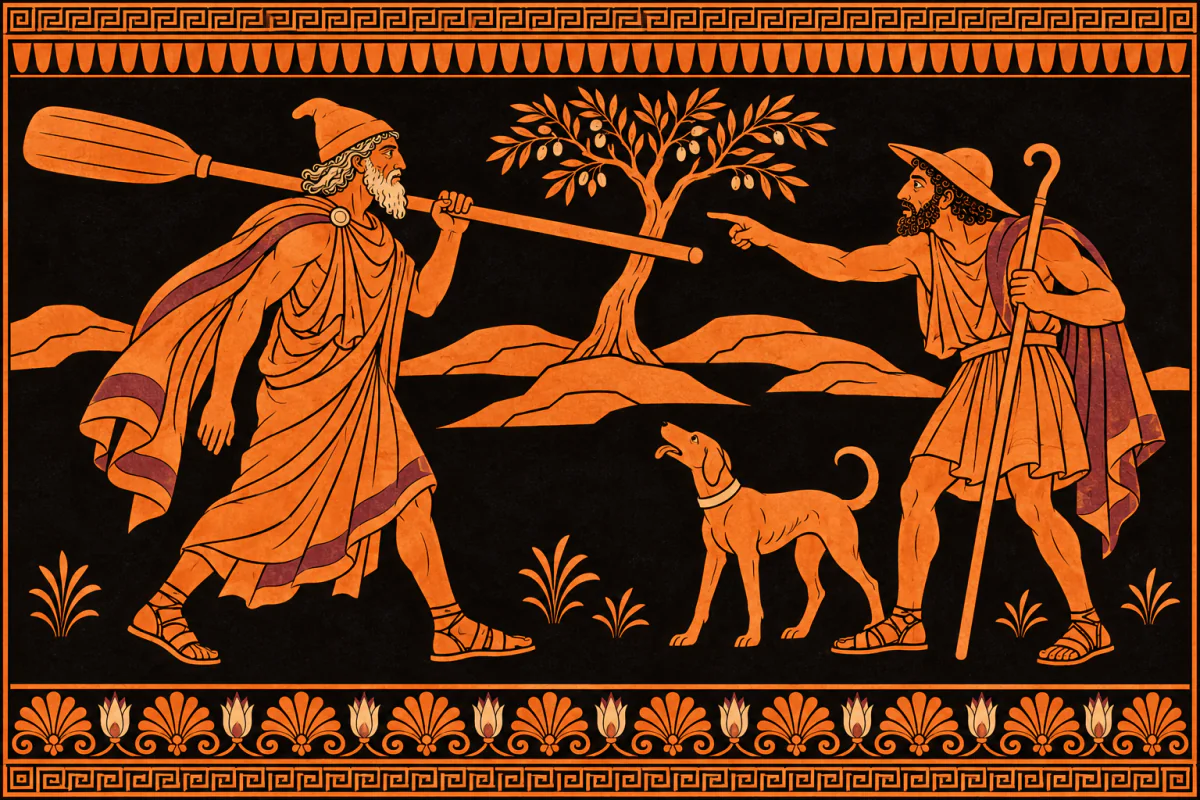
In short
Homer's prophet foretells a last journey inland and a gentle death in old age, in words that can also mean a death "from the sea". A lost sequel, summarised in later handbooks, took the second meaning: Odysseus' son by Circe kills him by mistake with a spear tipped with a stingray's spine. Other versions exiled him, remarried him or sent him to the Isles of the Blessed. Dante's Ulysses dies at sea, still searching.
Teiresias' prophecy
In the Underworld, after telling him how he will get home and what he will find there, Teiresias gives Odysseus one more task.
ἔρχεσθαι δὴ ἔπειτα λαβὼν ἐυῆρες ἐρετμόν,
εἰς ὅ κε τοὺς ἀφίκηαι οἳ οὐκ ἴσασι θάλασσαν
ἀνέρες, οὐδέ θʼ ἅλεσσι μεμιγμένον εἶδαρ ἔδουσιν·
οὐδʼ ἄρα τοί γʼ ἴσασι νέας φοινικοπαρῄους
οὐδʼ ἐυήρεʼ ἐρετμά, τά τε πτερὰ νηυσὶ πέλονται.
σῆμα δέ τοι ἐρέω μάλʼ ἀριφραδές, οὐδέ σε λήσει·
ὁππότε κεν δή τοι συμβλήμενος ἄλλος ὁδίτης
φήῃ ἀθηρηλοιγὸν ἔχειν ἀνὰ φαιδίμῳ ὤμῳ,
καὶ τότε δὴ γαίῃ πήξας ἐυῆρες ἐρετμόν,
ῥέξας ἱερὰ καλὰ Ποσειδάωνι ἄνακτι,
ἀρνειὸν ταῦρόν τε συῶν τʼ ἐπιβήτορα κάπρον,
οἴκαδʼ ἀποστείχειν ἔρδειν θʼ ἱερᾶς ἑκατόμβας
ἀθανάτοισι θεοῖσι, τοὶ οὐρανὸν εὐρὺν ἔχουσι,
πᾶσι μάλʼ ἑξείης. θάνατος δέ τοι ἐξ ἁλὸς αὐτῷ
ἀβληχρὸς μάλα τοῖος ἐλεύσεται, ὅς κέ σε πέφνῃ
γήραι ὕπο λιπαρῷ ἀρημένον· ἀμφὶ δὲ λαοὶ
ὄλβιοι ἔσσονται. τὰ δέ τοι νημερτέα εἴρω.Then go, taking a well-made oar, until you come to men who do not know the sea and eat no food mixed with salt, who know nothing of ships with crimson cheeks or of well-made oars, which are the wings of ships. I will tell you a sign, very clear, and you will not miss it. When another traveller meets you and says that you have a winnowing fan on your shining shoulder, then fix the well-made oar in the ground, make fine sacrifices to lord Poseidon, a ram, a bull and a boar that mounts sows, and go home and offer sacred hecatombs to the immortal gods who hold the wide heaven, to all of them in order. And death will come to you yourself away from the sea, so very gentle, and take you worn out with sleek old age, and around you your people will be prosperous. This I tell you truly. AI translation
Two words in that last sentence, ex halos, can mean "away from the sea" or "out of the sea" (Od. 11.134). A man carrying an oar inland until someone takes it for a farm tool is going as far from the sea as a Greek could go. But a death "out of the sea" is also possible, and that is the version a lost epic told.
The stingray
A lost epic, the Telegony, continued the story. Its ancient summary is not in the library, but the mythographer Apollodorus tells the ending it is known for as his main version. After the slaughter Odysseus sacrifices to Hades, Persephone and Teiresias, walks inland through Epirus to the Thesprotians, and there makes the sacrifices Teiresias ordered and appeases Poseidon. Callidice, queen of the Thesprotians, asks him to stay and offers him the kingdom; he marries her, has a son, Polypoetes, and wins a war for her; when she dies he hands the throne to their son and goes home to Ithaca, where he finds that Penelope has borne him another son, Poliporthes (Apollod. Epit. 7.34–35). Then his son by Circe arrives.
Τηλέγονος δὲ παρὰ Κίρκης μαθὼν ὅτι παῖς Ὀδυσσέως ἐστίν, ἐπὶ τὴν τούτου ζήτησιν ἐκπλεῖ. παραγενόμενος δὲ εἰς Ἰθάκην τὴν νῆσον ἀπελαύνει τινὰ τῶν βοσκημάτων, καὶ Ὀδυσσέα βοηθοῦντα τῷ μετὰ χεῖρας δόρατι Τηλέγονος τρυγόνος κέντρον τὴν αἰχμὴν ἔχοντι τιτρώσκει, καὶ Ὀδυσσεὺς θνήσκει. ἀναγνωρισάμενος δὲ αὐτὸν καὶ πολλὰ κατοδυράμενος, τὸν νεκρὸν καὶ τὴν Πηνελόπην πρὸς Κίρκην ἄγει, κἀκεῖ τὴν Πηνελόπην γαμεῖ. Κίρκη δὲ ἑκατέρους αὐτοὺς εἰς Μακάρων νήσους ἀποστέλλει.
Telegonus, learning from Circe that he is the son of Odysseus, sails off to look for him. Arriving at the island of Ithaca, he drives off some of the cattle, and when Odysseus comes to their defence, Telegonus wounds him with the spear in his hands, whose point was the spine of a stingray, and Odysseus dies. Recognising him, and with many laments, Telegonus takes the body and Penelope to Circe, and there he marries Penelope. Circe sends them both to the Isles of the Blessed. AI translation
The death "out of the sea" thus came on a spear tipped with a sea creature, from a son born on an island on the voyage home. Apollodorus adds the rival versions that circulated: that Penelope, seduced by a suitor, was sent home and bore Pan at Mantinea; that Odysseus killed her; and that, accused by the suitors' families, Odysseus accepted Neoptolemus as judge, was sent into exile, married a king's daughter in Aetolia, left a son called Leontophonus ("Lion-killer") and died an old man (Epit. 7.38–40). Hesiod's Theogony had already given him three sons by Circe and two by Calypso (Hes. Th. 1011–1018). By the time of Lucian, Odysseus' ghost on the Isle of the Blessed was sending secret letters to Calypso about how much he regretted leaving her (Chapter VI), and in Plato his soul chose to be reborn as a nobody (Chapter III).
Dante: "you were not made to live like brutes"
The most famous ending is medieval. In the eighth circle of Dante's Inferno, among the fraudulent counsellors, Ulysses and Diomedes burn together in a single flame divided at the top (Inf. 26.52–57), and Virgil asks one of them to tell where he went to die (26.79–84). Ulysses tells a story found in no ancient text in this library. When he left Circe, "who kept me more than a year near Gaeta", neither love for his son, nor pity for his old father, nor the love he owed Penelope could overcome his burning wish "to become expert of the world, and of human vice and worth" (Inf. 26.90–99). He set out on the open sea with one ship and the small company that had never deserted him (Inf. 26.100–102), and they were old and slow when they reached the narrow strait where Hercules set up his markers "so that men should go no further" (Inf. 26.106–111). There he spoke to his crew.
O frati”, dissi, “che per cento milia
perigli siete giunti a l'occidente,
a questa tanto picciola vigilia
d'i nostri sensi ch'è del rimanente
non vogliate negar l'esperienza,
di retro al sol, del mondo sanza gente.
Considerate la vostra semenza:
fatti non foste a viver come bruti,
ma per seguir virtute e canoscenza”."Brothers," I said, "who through a hundred thousand dangers have reached the west, to this so brief vigil of our senses that remains, do not deny the experience of the world without people, beyond the sun. Consider your origin: you were not made to live like brutes, but to pursue virtue and knowledge." AI translation
Turning the stern to the sunrise, "of our oars we made wings for the mad flight" (Inf. 26.124–126), an echo of Teiresias' oars, "the wings of ships". They sailed on until the night showed all the stars of the southern pole, and five months had passed (26.127–132), when a mountain appeared, dark with distance, higher than any he had ever seen. "We rejoiced, and soon it turned to weeping": a whirlwind rose from the new land and struck the ship, spun it three times with all the waters, and at the fourth lifted the stern and drove the prow down, "as pleased Another, until the sea closed over us" (Inf. 26.133–142). Readers of the Purgatorio know the mountain as the mountain of Purgatory.
Dante's Ulysses condenses both ancient Odysseuses into one man: the deceiver, damned for the tricks of Troy, and the seeker of knowledge whom the Sirens tempted and the Stoics admired. Teiresias had promised a death away from the sea, in a quiet old age among a happy people. Dante gave him the opposite, and it is Dante's version that most modern retellings remember.
How did Odysseus die?
| Source | The end | Passage |
|---|---|---|
| Homer (Teiresias' prophecy) | a gentle death in sleek old age, "away from" or "out of" the sea, among a prosperous people | Od. 11.121–137 |
| The lost Telegony, as Apollodorus tells it | killed by his son Telegonus with a stingray-tipped spear; Penelope marries Telegonus; both go to the Isles of the Blessed | Epit. 7.36–37 |
| Another version in Apollodorus | exiled by Neoptolemus, remarried in Aetolia, dies old | Epit. 7.40 |
| Plato | his soul chooses to be reborn as a quiet private man | Resp. 620c |
| Lucian | on the Isle of the Blessed, regretting he left Calypso | VH 2.35 |
| Dante | drowned within sight of an unknown mountain, beyond the Pillars of Hercules | Inf. 26.133–142 |
The vases
The Odyssey in ancient art
Greek painters were the poem's first illustrators, and they did not always follow the text. The library's museum catalogue describes seventeen Odyssean scenes, from an oil flask of about 570 BCE to a marble relief of the late fourth century. Their descriptions are summarised here; no museum photographs are reproduced.
In short
The painters' favourites were the scenes with a strong picture: the blinding of the Cyclops, the escape under the ram, the Sirens and Circe. They gave the Sirens bird bodies and Circe's victims animal heads, and their versions shaped how later artists, including the AI that drew the pictures in this report, imagine the story.
- 570–550 BCE
Odysseus and the Sirens. A small oil flask: Odysseus tied to the mast of a ship with a boar's-snout prow, rowed by helmeted warriors; two Sirens with raised wings stand on the cliffs ahead. Boston 01.8100 · Chapter VIII
- 550–525 BCE
Circe and the crew; the Cyclops. Circe stirs a cup among men turning into a boar, a ram, a wolf and a lion, as Odysseus comes at her with his sword; on the other side, the drunken Polyphemus. Boston 99.518 · Chapter V
- 530–520 BCE
Under the ram. A ram walks with Odysseus clinging beneath it, his feet sticking out under its tail. Toledo 1927.97 · Chapter VII
- 510–490 BCE
The blinding. The bearded giant, nude and drunk, cradles his club while Odysseus and two men aim a long sharpened stake at his forehead. Louvre F 342 · Chapter VII
- 500–480 BCE
Odysseus and the Sirens. The celebrated red-figure jar; on the other side, winged Loves fly over the sea. London E 440 · Chapter VIII
- 500–475 BCE
The escape. Polyphemus, propped on one arm, reaches out towards the ram and almost touches the man hidden underneath. London B 502 · Chapter VII
- Late Archaic
The arms of Achilles. Odysseus and Ajax pulled apart; the vote, fifteen pebbles to fourteen; inside the cup, Ajax dead on his sword. Malibu 86.AE.286 · Chapter III
- Early 5th c. BCE
The arms of Achilles. The quarrel and the vote, with Odysseus and Neoptolemus inside. Vienna 3695 · Chapter III
- 450–440 BCE
Nausicaa. A naked Odysseus, holding branches, steps out towards the fleeing girls whose ball game woke him; the washing hangs drying on a tree, and Athena stands by to encourage him. Munich 2322 · Chapter VI
- 450–400 BCE
Circe as comedy. A woman offers a cup to a squatting man beside a loom, painted in the grotesque Boeotian style that may reflect comic performances. Mississippi 1977.3.116 · Chapter V
- Classical
Elpenor. Odysseus and the ghost of his drowned crewman. Boston 34.79 · Chapter IX
- High Classical
Penelope; the nurse. Penelope and Telemachus on one side, Odysseus recognised by his nurse on the other. Chiusi 1831 · Chapter X
- High Classical
The suitors. Odysseus killing the suitors. Berlin F 2588 · Chapter X
- 410–400 BCE
The Cyclops as satyr play. Polyphemus asleep beside a cup while Odysseus and his men prepare behind a tree, surrounded by bald satyrs; the catalogue suggests a scene from a satyr play such as Euripides' Cyclops. London 1947.7-14.18 · Chapter VII
- 380–360 BCE
Teiresias. Odysseus consulting the ghost of the prophet. Paris, Cab. Méd. 422 · Chapter IX
- Late Classical
Odysseus and the Sirens. Berlin V.I. 4532 · Chapter VIII
- 350–300 BCE
The nurse washes his feet. A marble relief: Odysseus seated in his traveller's cap, his foot over a basin, the nurse bending to him, Penelope behind. Athens, NM 1914 · Chapter X
Older sea stories
Before and after Homer: two shipwrecked sailors
The Odyssey was not the first sea story and not the last. An Egyptian tale more than a thousand years older shares its shape, and a medieval Arabic one shares its giant.
The Shipwrecked Sailor
The library holds an Egyptian story from the Middle Kingdom, preserved on a papyrus in St Petersburg, in a German translation. A follower tells it to cheer up his anxious master as their ship comes home safely from an expedition to the south (Shipwrecked Sailor 1–13). He had sailed for the king to the mines in a great ship with a hundred and twenty of the best sailors in Egypt, men who could foretell a storm before it came. A storm broke at sea; a wave eight cubits high struck; the ship sank and not one of the others survived (Shipwrecked Sailor 30–37). "Then I was laid on an island by a wave of the sea." He spent three days alone, "my heart my only companion", sheltering under a tree, and found it an island of plenty, with figs and grapes, fish and birds (38–47).
Then the trees splintered and the earth shook, and a serpent thirty cubits long came towards him, with a beard of more than two cubits, its body covered in gold and its eyebrows of true lapis lazuli (50–59). It asked who had brought him to the island, and threatened to turn him to ashes if he hesitated to answer (61–63). He told his story, and the serpent, instead of eating him, comforted him, and told him that a ship would come for him in four months.
Wenn du aber tapfer bist und dein Herz ist fest, dann wirst du deine Kinder (wieder) umarmen (wörtl. "deine Umarmung füllen mit ..."); du wirst deine Frau küssen und du wirst dein Haus (wieder) sehen. Das ist besser als irgend etwas.
If you are brave and your heart is firm, you will hold your children in your arms again, you will kiss your wife, and you will see your house again. That is better than anything. AI translation, after the library's German translation
The serpent, who calls itself the ruler of the fabulous land of Punt (128), is the survivor of a family of seventy-five serpents killed by a falling star (102–109). It warns the sailor that once he leaves, the island will vanish into the waves (131); the ship arrives as foretold, and he goes home laden with myrrh, incense and giraffes' tails, and is promoted by the king (132–158). His master is not consoled: "Don't play the clever one, friend! Who gives water to a bird at dawn, when it is to be slaughtered in the morning?" (162–164). The resemblances to the Odyssey are of shape, not of borrowing: the lone survivor, the island outside the world, the monster who becomes a host, the voyage home, a story told after dinner, and a magical land punished or lost once the hero has gone home, as Poseidon turns the Phaeacians' ship to stone on its way back from carrying Odysseus to Ithaca, fulfilling a prophecy that also threatened to bury their city under a mountain (Od. 13.161–164; 13.175–178). Nobody claims Homer knew this tale; the comparison shows how old the story pattern is.
Sindbad
The Arabian Nights go the other way: Sindbad's third voyage contains what is plainly a version of the Cyclops episode, with a man-eating giant in a palace, a captain roasted on a spit, and red-hot iron spits driven into the sleeping giant's eyes (Arabian Nights, night 547; Chapter VII).
Method
How this report was made, and what was checked
AI agents did the research, the counting and the writing, and a script checked every reference against the library. No specialist has reviewed the report, so read its translations and interpretations as a well-sourced first draft that anyone can check.
Who did what
The agents were Claude models, made by Anthropic, working read-only on the Classica Codex library.
| Stage | Done by | What it produced |
|---|---|---|
| Survey | An AI agent (Claude) and its scripts | A list of 141 passages across the library on the Odyssey, its characters and its afterlives, each checked by a script to exist at the reference given, with a short note on what it says. |
| Counts | The same agent's scripts | The line, episode, name and formula counts in Chapter I, made on the library's Greek text of the poem (the Perseus edition) and spot-checked by reading. |
| Reading and writing | A second Claude session | The chapters. Every passage quoted or closely paraphrased was printed from the library and read before it was used. Reading corrected several of the survey's notes and added further passages found along the way: the finished page cites 263 passages and 17 museum objects, all listed in the appendix. |
| Translations | Claude | Every English translation on this page, from the Greek, Latin and Italian, and from the library's German translation of the Egyptian Shipwrecked Sailor. Each is labelled "AI translation". |
| Citation check | A script | The page is assembled by a script that looks up every citation in the library and refuses to produce the page if any reference does not exist. The original-language text of every block quotation and epigraph is taken from the library by the same script, not typed. |
| Illustrations | An AI image generator (OpenAI's, through Codex) | The cover and thirteen chapter pictures, in the manner of Attic red-figure vase painting of about 480 BCE. The prompts were checked against Homer's text before the pictures were made, and four were corrected (for example, the brief had Odysseus shoot the suitors in his rags; in the poem he strips them off first). They are modern images, not ancient ones. |
| Direction and publication | Skirnir Studios | Chose the subject and published the result. |
What the checks establish, and what they do not
The script establishes two things: every reference on this page names a passage that exists in the library, and every block quotation's original text is the library's text of the passage cited. It does not show that a reference names the right line for the sentence citing it, or that the passage says what that sentence says; those were checked by reading, not by script. Short phrases quoted inside the running text were translated by the agent from passages it had read, but were not compared by script.
Nor do the checks establish that the translations are right. They are an AI agent's, made for this report; no one has checked them against a specialist's reading. Interpretations, dates and the remarks about modern scholarship are the agent's own and have not been checked against published work.
References use the library's own numbering. For Homer and most verse this is the usual line numbering. For prose, the library's section numbers sometimes differ from the conventional ones; where the report gives a conventional reference such as a Stephanus page for Plato, it is a guide only, and the citation's copied identifier is the authority.
What the library does not have
Several authors that modern books on the Odyssey rely on are not in the library, and this report does not cite them: Hyginus, Servius, Macrobius, Aulus Gellius, Dictys of Crete, Eustathius' commentary on Homer and Tzetzes, nor the ancient summary of the lost Telegony. That is why, for instance, the report says that Achilles' heel is not found in the library, rather than naming its first appearance. The museum objects are known only from their catalogue descriptions.
The numbers
The counts in Chapter I were made by scripts on the library's Greek text and can be re-run. Name counts include every grammatical form of a name, and Odysseus' includes "son of Laertes". Some counts are sensitive to how one searches: "wine-dark sea" is counted only in one case form, and counts for gods who are also common nouns or places (Zeus, Helios, Troy) were judged unreliable and left out.
Appendix
Every passage cited
414 citations to 263 distinct passages in 60 editions, and to 17 museum objects. Each line gives the author and work, the edition's identifier in the library and the passage references used, so any of them can be opened in Classica Codex. Click any citation in the report to copy its identifier.
- Apollodorus, Epitome
tlg0548.tlg002.perseus-grc27.36.1–7.37.1; 3.7.1; 7.38.1–7.39.1; 7.37.1–7.39.1; 7.16.1; 3.8.1; 7.34.1–7.35.1; 7.38.1–7.40.1; 7.40.1 - Apollonius Rhodius, Argonautica
tlg0001.tlg001.perseus-grc24.891–4.899; 4.903–4.909 - Aristophanes, Wasps
tlg0019.tlg004.perseus-grc2184b–186 - Aristotle, Poetics
tlg0086.tlg034.perseus-grc28.3.1; 17.10.1–17.11.1; 23.7.1; 24.3.1; 13.11.1; 13.12.1 - Aristotle, Rhetoric
tlg0086.tlg038.perseus-grc23.3.4.1 - Athenaeus of Naucratis, Deipnosophistae
tlg0008.tlg001.perseus-grc31.37.1; 1.25.1 - Augustine, Saint, De civitate dei
stoa0040.stoa003.opp-lat318.17.2 - Boethius, De consolatione philosophiae
stoa0058.stoa001.perseus-lat24.M3.29–4.M3.39 - Cicero, Marcus Tullius, de Finibus Bonorum et Malorum
phi0474.phi048.perseus-lat25.49.1 - Cicero, Marcus Tullius, De Officiis
phi0474.phi055.perseus-lat23.97.1; 1.113.1 - Dante Alighieri, Commedia I: Inferno
urn:dante:commedia:inferno:petrocchi26.119–26.120; 26.112–26.120; 26.136–26.142; 26.97–26.99; 26.90–26.93; 26.52–26.57; 26.79–26.84; 26.90–26.99; 26.100–26.102; 26.106–26.111; 26.124–26.126; 26.127–26.132; 26.133–26.142 - Euripides, Cyclops
tlg0006.tlg001.perseus-grc2672–675; 548–551 - Euripides, Hecuba
tlg0006.tlg007.perseus-grc2131–135 - Euripides, Iphigenia in Aulis
tlg0006.tlg018.perseus-grc2524–527 - Euripides, The Trojan Women
tlg0006.tlg011.perseus-grc2277; 282 - Heraclitus, Allegoriae (= Quaestiones Homericae)
tlg1414.tlg001.1st1K-grc170.1; 75.1 - Herodotus, Histories
tlg0016.tlg001.perseus-grc22.145.4.1; 4.177.1.1 - Hesiod, Theogony
tlg0020.tlg001.perseus-grc21011–1014; 1017–1018; 1011–1018 - Homer, Iliad
tlg0012.tlg001.perseus-grc222.359–22.360 - Homer, Odyssey
tlg0012.tlg002.perseus-grc219.203; 1.1–1.5; 4.277–4.279; 9.19–9.20; 13.291–13.299; 1.215–1.216; 2.104–2.106; 5.215–5.220; 6.160–6.163; 9.364–9.367; 9.413–9.414; 12.184–12.191; 12.85–12.92; 11.204–11.208; 11.488–11.491; 19.467–19.475; 22.1–22.7; 11.121–11.137; 12.39–12.46; 1.6–1.9; 5.151–5.153; 16.245–16.253; 9.408; 9.455; 9.460; 4.271–4.289; 8.492–8.520; 11.523–11.532; 24.36–24.40; 4.285–4.289; 8.492–8.510; 8.514–8.520; 17.296–17.300; 17.326–17.327; 21.409–21.411; 7.259–7.260; 23.183–23.196; 23.205–23.206; 13.287–13.289; 9.502–9.505; 9.528–9.535; 11.543–11.551; 11.563–11.564; 21.125–21.129; 21.431–21.434; 2.93–2.110; 21.53–21.60; 21.73–21.79; 10.467–10.470; 10.471–10.474; 10.483–10.486; 5.234–5.237; 5.258–5.259; 6.99–6.101; 6.115–6.117; 6.127–6.129; 6.137–6.141; 6.229–6.231; 6.244–6.245; 8.461–8.468; 9.288–9.290; 9.311; 9.344; 9.331–9.335; 9.431–9.435; 9.446–9.449; 12.173–12.180; 12.192–12.196; 12.79–12.81; 12.101–12.104; 12.105–12.110; 12.223–12.225; 12.245–12.250; 11.13–11.14; 11.24–11.25; 10.524–10.527; 11.48–11.50; 11.61–11.64; 11.51–11.54; 11.84–11.89; 11.90–11.91; 11.202–11.203; 11.482–11.486; 11.492–11.493; 11.582–11.587; 11.593–11.598; 16.186–16.191; 21.405–21.408; 22.8–22.21; 22.421–22.425; 22.461–22.464; 22.465–22.473; 23.296; 24.539–24.545; 24.546–24.548; 1.50; 10.19–10.27; 9.82; 11.134; 13.161–13.164; 13.175–13.178 - Horace, Ars Poetica
phi0893.phi006.perseus-lat2140–152; 359 - Horace, Epistulae
phi0893.phi005.perseus-lat21.2.17–1.2.22; 1.2.17–1.2.26; 1.2.23–1.2.26 - Horace, Satires
phi0893.phi004.perseus-lat22.5.1–2.5.10; 2.5.23–2.5.24; 2.5.100 - Isidorus Hispaliensis, Etymologiarum Libri Viginti
stoa0159.stoa004.opp-lat511.251; 11.251–11.252; 11.252 - John Milton, Paradise Lost (1674, twelve books)
urn:eebo:a50924:tcp9.440–9.442; 5.341–5.342 - Juvenal, Saturae
phi1276.phi001.perseus-lat25.15.13–5.15.18 - Literary texts, pPetersburg 1115
urn:egy:tla:sawlit:ppetersburg-1115:deu1.110–1.113; 1.1–1.13; 1.30–1.37; 1.38–1.47; 1.50–1.59; 1.61–1.63; 1.128; 1.102–1.109; 1.131; 1.132–1.158; 1.162–1.164 - Longinus, On the Sublime
tlg0560.tlg001.perseus-grc29.13.1 - Lucian of Samosata, Dialogi Marini
tlg0062.tlg067.perseus-grc22.2.1; 2.1.3 - Lucian of Samosata, Verae historiae
tlg0062.tlg012.perseus-grc22.35.2; 1.3.1; 2.36.1; 2.29.1; 2.15.1; 2.20.1 - Ovid, Epistulae
phi0959.phi002.perseus-lat21.1–1.2; 1.115–1.116 - Ovid, Metamorphoses
phi0959.phi006.perseus-lat214.277–14.284; 14.59–14.67; 14.51–14.58; 13.382–13.383 - P. Vergilius Maro (Virgil), Aeneid
phi0690.phi003.perseus-lat22.261; 2.44; 2.164; 3.426–3.428; 3.613–3.618; 6.700–6.702 - Pausanias, Description of Greece
tlg0525.tlg001.perseus-grc28.12.6.1; 8.12.5.1–8.12.6.1; 3.12.1.1; 3.20.10.1–3.20.11.1 - Petronius Arbiter, Satyricon
phi0972.phi001.perseus-lat248.ab1; 97.ab1 - Philostratus the Athenian, Heroicus
tlg0638.tlg004.perseus-grc2728.1; 727.1–728.1; 727.1 - Pindar, Nemean
tlg0033.tlg003.perseus-grc27.20–7.23; 7.24–7.27 - Plato, Ion
tlg0059.tlg027.perseus-grc2535.11; 535.6 - Plato, Lesser Hippias
tlg0059.tlg026.perseus-grc2364.7; 365.1 - Plato, Republic
tlg0059.tlg030.perseus-grc210.620.1 - Plutarch, Bruta animalia ratione uti
tlg0007.tlg130.perseus-grc22.5; 1.12; 1.6 - Polybius, Histories
tlg0543.tlg001.perseus-grc212.27.10.1–12.27.11.1; 9.16.1.1; 12.27.10.1; 34.2.9.1 - Proclus, Chrestomathy
tlg4036.tlg023.cypria-grc11.ab10 - Propertius, Sextus, Elegiae
phi0620.phi001.perseus-lat33.12.23 - Scholia in Homerum, Scholia in Odysseam
tlg5026.tlg007.1st1K-grc12.23.3.84 - Seneca, Lucius Annaeus, De Brevitate Vitae
stoa0255.stoa004.perseus-lat210.13.2.1 - Seneca, Lucius Annaeus, Epistulae
phi1017.phi015.perseus-lat211_13.88.7.1; 6.53.4.1; 11_13.88.8.1; 4.31.2.1; 20.123.12.1; 6.56.15.1; 11_13.88.40.1; 7.66.26.1 - Seneca, Lucius Annaeus, Troades Furens
phi1017.phi002.perseus-lat2568–570 - Sophocles, Ajax
tlg0011.tlg003.perseus-grc2121–126; 79; 118–120 - Sophocles, Philoctetes
tlg0011.tlg006.perseus-grc296–99 - Statius, P. Papinius (Publius Papinius), Achilleis
phi1020.phi003.perseus-lat21.268–1.270; 1.480–1.481 - Strabo, Geography
tlg0099.tlg001.perseus-grc21.2.15.1; 1.2.12.1–1.2.13.1; 5.4.8.1; 5.4.7.1; 1.2.3.1; 3.2.13.1; 3.4.3.1; 6.1.5.1 - Suetonius, Tiberius
phi1348.abo013.perseus-lat270.3.1 - Tacitus, Cornelius, Germania
phi1351.phi002.perseus-lat13.3.1 - The Thousand and One Nights, The Book of the Thousand Nights and a Night
urn:nights:burton:eng547.1 - Theocritus, Εἰδύλλια
tlg0005.tlg001.perseus-grc211.7–11.16; 11.17–11.18; 11.80–11.81; 6.6–6.7 - Thucydides, History of the Peloponnesian War
tlg0003.tlg001.perseus-grc26.2.1.1; 1.25.4.1; 3.88.1.1 - William Shakespeare, King Henry VI. Part III.
engLit:renaissance:shakespeare:3h6:opensource3.2.81 - William Shakespeare, Troilus and Cressida
engLit:renaissance:shakespeare:tro:opensource1.3.76 - Xenophon, Memorabilia
tlg0032.tlg002.perseus-grc21.3.7.1 - Museum object (Perseus Art & Archaeology catalogue)
artifact:Malibu 86.AE.286Malibu 86.AE.286 - Museum object (Perseus Art & Archaeology catalogue)
artifact:Vienna 3695Vienna 3695 - Museum object (Perseus Art & Archaeology catalogue)
artifact:Louvre F 342Louvre F 342 - Museum object (Perseus Art & Archaeology catalogue)
artifact:Toledo 1927.97Toledo 1927.97 - Museum object (Perseus Art & Archaeology catalogue)
artifact:Boston 01.8100Boston 01.8100 - Museum object (Perseus Art & Archaeology catalogue)
artifact:London E 440London E 440 - Museum object (Perseus Art & Archaeology catalogue)
artifact:Berlin V.I. 4532Berlin V.I. 4532 - Museum object (Perseus Art & Archaeology catalogue)
artifact:Boston 34.79Boston 34.79 - Museum object (Perseus Art & Archaeology catalogue)
artifact:Paris, Cab. Md. 422Paris, Cab. Md. 422 - Museum object (Perseus Art & Archaeology catalogue)
artifact:Athens, NM 1914Athens, NM 1914 - Museum object (Perseus Art & Archaeology catalogue)
artifact:Chiusi 1831Chiusi 1831 - Museum object (Perseus Art & Archaeology catalogue)
artifact:Berlin F 2588Berlin F 2588 - Museum object (Perseus Art & Archaeology catalogue)
artifact:Boston 99.518Boston 99.518 - Museum object (Perseus Art & Archaeology catalogue)
artifact:London B 502London B 502 - Museum object (Perseus Art & Archaeology catalogue)
artifact:Munich 2322Munich 2322 - Museum object (Perseus Art & Archaeology catalogue)
artifact:Mississippi 1977.3.116Mississippi 1977.3.116 - Museum object (Perseus Art & Archaeology catalogue)
artifact:London 1947.7-14.18London 1947.7-14.18
Sources and licences
- Perseus Digital Library: canonical-greekLit, canonical-latinLit and canonical-engLit: CC BY-SA 4.0
- Open Greek and Latin: First1KGreek: CC BY-SA 4.0 (declared per file)
- Dante's Commedia (Petrocchi's text, via DanteSearch): Universal Dependencies UD_Italian-Old, release 2.18: CC BY-SA 4.0
- Thesaurus Linguae Aegyptiae (Berlin-Brandenburg and Saxon Academies of Sciences): the Shipwrecked Sailor in the German translation by Peter Dils and Heinz Felber: CC BY-SA 4.0
- Early English Books Online, Text Creation Partnership: Milton, Paradise Lost: CC0
- Shakespeare, and the Arabian Nights in Richard F. Burton's translation: public domain, as held in the library
- Museum objects: descriptions from the Perseus Art & Archaeology catalogue, cited by museum number; no museum photographs are reproduced
This report's own text is shared under CC BY-SA 4.0, as its sources require. The texts were read in Classica Codex, a free, open-source reading library.
Compiled on 16 November 2026.