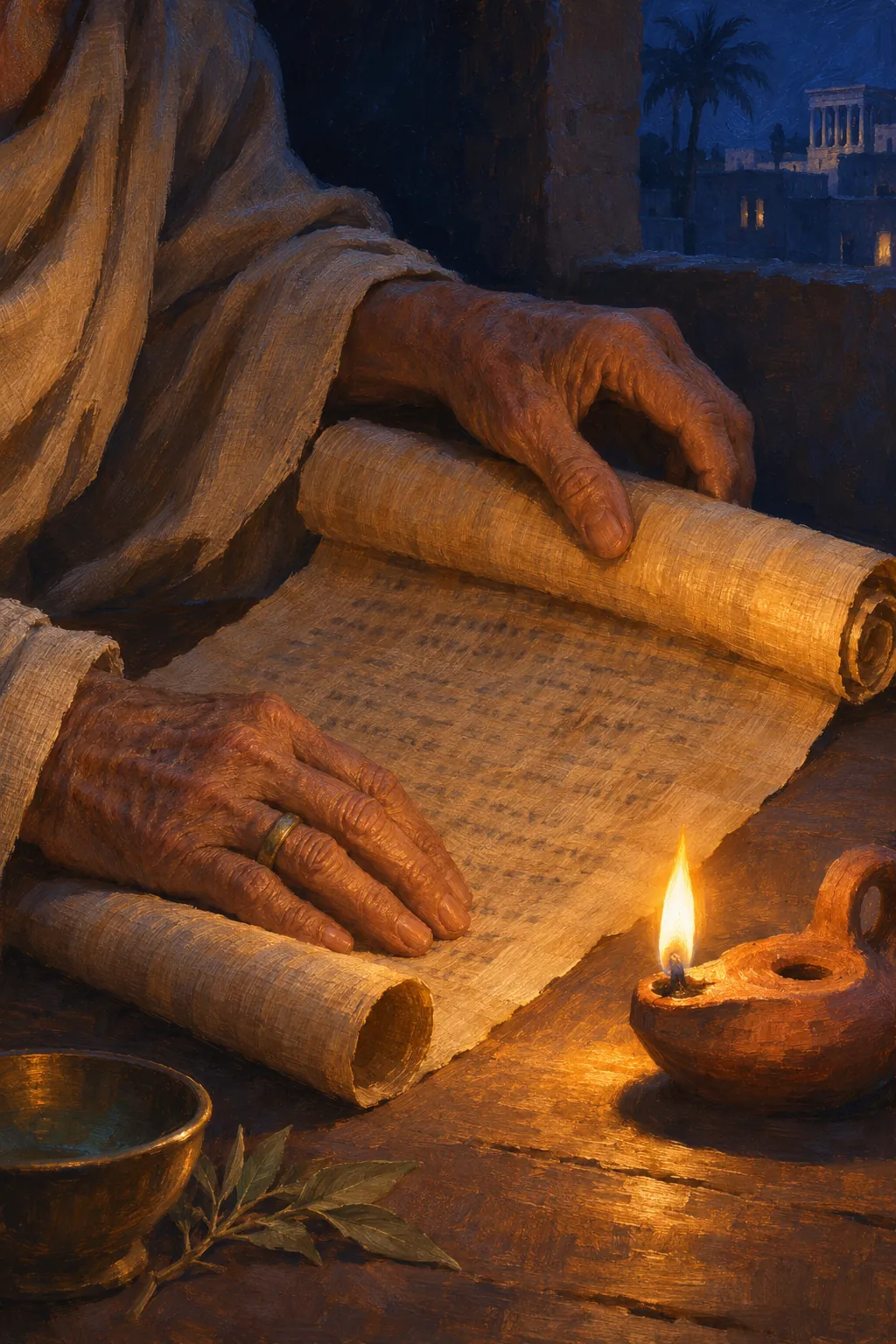
Evening, in a town on the Nile. Lamps are burning in the shrine, and the keeper of the oracle has a papyrus roll of Homer and a die. Bring a question. The poet will answer with one line.
Three throws of a die and 216 lines of the Iliad and the Odyssey, as written on papyri from Roman Egypt.
First, the day
The keeper checks the calendar
The oracle may not be asked on every day. The instructions that travel with it list each day of the month, and say whether the god may be consulted and at what hour.
The keeper looks for today.
The rules come from the Oxyrhynchus copy of the oracle, which numbers the days of a month without naming its calendar. This page matches them to today in the Alexandrian calendar of Roman Egypt, which the Coptic Church still keeps; that is our choice, not the papyrus’s. The London roll has a different list, which scholars take to be lunar.
all daypart of the daynot at allnot known
Second, the question
Hold your question in mind
The instructions say to pray silently for what you want to know. Ask about a journey, a love, a quarrel, a choice, a worry.
Second, the prayer
Pray to Apollo
Apollo, lord of Lycia and of oracles, is asked to listen. The prayer is made of Homer: three lines that Glaucus prays to Apollo in the Iliad, and two from the Odyssey, the last turned to speak for you.
κλῦθι ἄναξ ὅς που Λυκίης ἐν πίονι δήμῳHear me, lord, who are somewhere in the rich land of LyciaIliad 16.514
εἲς ἢ ἐνὶ Τροίῃ· δύνασαι δὲ σὺ πάντοσʼ ἀκούεινor in Troy: from anywhere you can hearIliad 16.515
ἀνέρι κηδομένῳ, ὡς νῦν ἐμὲ κῆδος ἱκάνει.a man in trouble, as trouble has come upon me now.Iliad 16.516
καί μοι τοῦτʼ ἀγόρευσον ἐτήτυμον, ὄφρʼ ἐὺ εἰδῶ,And tell me this truly, so that I may know it well,Odyssey 1.174
ὅττι μάλιστʼ ἐθέλω καί μοι φίλον ἔπλετο θυμῷ.what I most desire, and what is dear to my heart.Odyssey 18.113, turned from “you” to “I”
Third, the die
Throw the die three times
Each throw gives a number, written as a Greek letter, from α for one to ϛ for six. The three letters together name one line on the roll.
Three throws to go.
Tap the table to throw.
Homer answers
What the line means for you is yours to judge. The papyri give only the verses: the person asking, or someone they trusted, decided how the line applied.
All 216 lines in the order of the London papyrus, each with its number. A short stroke marks off every six lines, as the scribe drew them. Choose a line to read it as an answer.
αααIliad 24.369to fight a man off, when he is the first to turn hostile.
ααβIliad 5.124Take heart now, Diomedes, and fight the Trojans.
ααγIliad 10.401Truly your heart was set on great gifts.
ααδIliad 8.176victory and great glory, but ruin for the Danaans.
ααεIliad 8.154But the Trojans and the Dardanians will not believe it.
ααϛIliad 1.524Come, I will nod my head to you, so that you can be sure.
αβαIliad 8.414The son of Kronos will not let you help the Argives.
αββIliad 10.324I will be no useless scout for you, and I will not fall short of your hopes.
αβγIliad 10.159Wake up, son of Tydeus! Why sleep the whole night through?
αβδOdyssey 4.801might put an end to weeping and tearful grief.
αβεOdyssey 1.216I do not know. No one has ever known his own begetting for himself.
αβϛIliad 24.92I will go, and whatever I say will not be said in vain.
αγαIliad 21.111A dawn will come, or an evening, or a midday,
αγβIliad 2.247Hold back, and do not try to quarrel with kings on your own.
αγγIliad 5.256I will go to meet them. Pallas Athena does not let me flee.
αγδIliad 9.378I hate his gifts, and I rate him at a straw.
αγεIliad 9.482an only son, late-born, heir to great possessions,
αγϛOdyssey 17.217Now truly one scoundrel leads another along,
αδαIliad 3.41I would wish it so, and it would have been far better
αδβOdyssey 17.244then he would scatter all your fine airs to the winds,
αδγIliad 22.512But I will burn all these things in blazing fire,
αδδIliad 9.386Not even so would Agamemnon win my heart over
αδεOdyssey 17.66speaking fair words, while they plotted evil deep in their hearts.
αδϛIliad 3.65The glorious gifts of the gods are not to be thrown away,
αεαOdyssey 18.406You fools, you are raving, and no longer keep hidden in your hearts
αεβOdyssey 14.162as one month wanes and the next begins,
αεγIliad 11.387It would not help you…
αεδOdyssey 18.416Do not mistreat the stranger, or anyone else
αεεIliad 2.298It is shameful to wait so long and go home empty-handed.
αεϛIliad 6.432Do not make your child an orphan and your wife a widow.
αϛαIliad 21.223It shall be so, Zeus-nurtured Scamander, as you command.
αϛβIliad 3.51your enemies' delight and your own shame?
αϛγOdyssey 14.161Before this year is out, Odysseus will be here.
αϛδIliad 22.513They are no good to you, since you will never be laid out in them,
αϛεIliad 3.255and the woman and the wealth would go with the winner.
αϛϛIliad 2.204Many masters are no good. Let there be one master,
βααOdyssey 20.355The porch is full of phantoms, and the courtyard too,
βαβIliad 22.393We have won great glory: we have slain noble Hector,
βαγOdyssey 14.66so this work of mine prospers too, the work I stay with.
βαδIliad 9.385not even if he gave me as much as there is sand and dust,
βαε
βαϛSo he spoke, praying…
ββαIliad 7.279Dear sons, fight no longer, do battle no more.
βββ
ββγ
ββδ
ββε
ββϛSoul…
βγαOdyssey 1.302Be brave, so that those born after you will speak well of you.
βγβIliad 11.371leaning on a pillar, on a burial mound that men had heaped,
βγγIliad 9.43Go! The road lies open, and your ships stand by the sea
βγδIliad 19.107You will prove false, and you will not make your words come true.
βγεIliad 22.79And on the other side his mother wept, shedding tears
βγϛOdyssey 3.115not even if you stayed five years, or six,
βδαIliad 5.899So he spoke, and told Paeëon to heal him.
βδβOdyssey 11.80This, poor wretch, I will carry out and do for you.
βδγIliad 4.26How can you wish to make my labour vain and fruitless,
βδδIliad 2.325late in coming, late fulfilled, but its fame will never die.
βδεOdyssey 3.117You would grow weary first and go back to your own country.
βδϛOdyssey 2.329to go, so as to bring back deadly poisons from there,
βεαIliad 24.725Husband, you were young when you lost your life, and you leave me a widow
βεβIliad 9.310how I will bring it about, and how it will come to pass,
βεγIliad 6.264Do not bring me honey-sweet wine, my lady mother,
βεδ
βεε
βεϛ
βϛα
βϛβ
βϛγOdyssey 4.685may they dine here now for the last and final time.
βϛδIliad 2.24A man who gives counsel should not sleep all night long
βϛεIliad 6.326Strange man, it is not right to nurse this anger in your heart,
βϛϛOdyssey 3.216Who knows whether he will come one day and make them pay for their violence,
γααOdyssey 21.214I will find wives for you both and give you property
γαβOdyssey 21.180Let us try the bow and finish the contest.
γαγIliad 14.80There is no shame in running from disaster, even by night.
γαδIliad 22.268Remember all your prowess. Now you truly must
γαεIliad 22.484a widow in the house; and the child is still only a baby,
γαϛIliad 18.134But do not plunge into the toil of war just yet
γβαOdyssey 19.360For in hardship mortals soon grow old.
γββOdyssey 6.201That man does not live, and he will never be born,
γβγIliad 18.128Yes, child, that is true: it is no bad thing
γβδIliad 22.219There is no escaping us for him now,
γβεIliad 22.50we will ransom them with bronze and gold, for it is there in the house.
γβϛOdyssey 21.310Drink up, and do not compete with younger men.
γγαIliad 8.94Where are you running, turning your back like a coward in the crowd?
γγβOdyssey 6.244If only such a man could be called my husband
γγγIliad 4.443her head is fixed in the sky while she walks on the earth.
γγδIliad 18.328But Zeus does not fulfil every plan men make.
γγεIliad 8.246and he nodded to him that the army would be saved and not destroyed.
γγϛIliad 9.698I wish you had never pleaded with the peerless son of Peleus
γδαOdyssey 21.293Honey-sweet wine is doing you harm, as it does to others
γδβIliad 22.185Do as your mind is set on, and hold back no longer.
γδγIliad 18.329For it is fated that we both redden the same earth
γδδIliad 8.282Keep shooting like that, and you may yet be a light to the Danaans
γδεIliad 22.348so there is no one who will keep the dogs from your head,
γδϛIliad 22.13You will not kill me. I am not fated to die by you.
γεαOdyssey 5.208you would stay here with me and keep this house
γεβOdyssey 18.10Get away from the door, old man, before you are dragged off by the foot.
γεγIliad 14.81Better to run and escape disaster than to be caught by it.
γεδOdyssey 13.308and tell no one at all, neither man nor woman,
γεεIliad 11.69of wheat or barley, and the handfuls fall thick and fast.
γεϛIliad 20.250As you speak, so will you be spoken to.
γϛαIliad 11.125would not allow Helen to be given back to fair-haired Menelaus,
γϛβIliad 15.203Or will you change your mind? The hearts of good men can be turned.
γϛγOdyssey 13.339But I never doubted it; in my heart
γϛδOdyssey 21.257Eurymachus, it will not be so, and you know it yourself.
γϛεOdyssey 21.288Wretched stranger, there is not a scrap of sense in you.
γϛϛIliad 16.250The Father granted him one thing, and refused him the other.
δααIliad 6.490Go back into the house and see to your own work,
δαβOdyssey 8.548So now, you too must not tell these things to your wife.
δαγIliad 3.57you would have put on a tunic of stones for all the evil you have done.
δαδOdyssey 18.176you prayed to the gods that you might see him with his beard grown.
δαεIliad 4.101and pray to Lycian-born Apollo, the famous archer,
δαϛIliad 22.263and wolves and lambs are never of one mind,
δβαIliad 4.62Come then, let us give way to each other in this,
δββIliad 18.535Strife and Tumult joined the throng, and deadly Doom,
δβγOdyssey 11.366making up lies about things no one could ever have witnessed.
δβδIliad 14.62if thinking can do anything. But I do not urge us into battle
δβεOdyssey 12.120There is no defence. Flight from her is best.
δβϛIliad 21.474Fool, why carry a bow to no purpose?
δγαIliad 24.602For even lovely-haired Niobe thought of food,
δγβOdyssey 5.38giving bronze and gold in plenty, and clothing,
δγγOdyssey 2.273Then your journey will not be in vain, nor left undone.
δγδIliad 12.243One omen is best: to fight for your country.
δγεIliad 10.294I will sacrifice her to you, with gold laid round her horns.
δγϛIliad 4.95you would win thanks and glory from all the Trojans,
δδαOdyssey 11.456bring your ship in, for women can no longer be trusted.
δδβIliad 14.212It is not possible, nor right, to refuse what you ask.
δδγIliad 15.52would soon turn his mind to follow your heart and mine.
δδδIliad 11.789and guide him; he will listen, and it will be for his good.
δδεIliad 5.654will give me glory, and your soul to Hades of the famous horses.
δδϛIliad 9.137let him load his ship to the brim with gold and bronze
δεαOdyssey 11.443Say one part, and let the other part stay hidden.
δεβIliad 10.71Zeus laid heavy hardship on us at our birth.
δεγOdyssey 10.495he alone has his wits; the rest flit about as shadows.
δεδIliad 9.598giving way to his own heart; and so they never paid him the gifts
δεεIliad 19.185I am glad, son of Laertes, to hear what you say.
δεϛIliad 20.242Zeus makes men's prowess grow or shrink
δϛαIliad 11.654a fearsome man. He might readily blame even the blameless.
δϛβIliad 2.66in full force. Now you could take the city of broad streets
δϛγOdyssey 20.18Bear it, my heart. You once bore worse than this.
δϛδIliad 2.200Strange man, sit still and listen to what others say,
δϛεIliad 16.282had thrown off his anger and chosen friendship.
δϛϛOdyssey 3.196how good it is for a man who dies to leave a son behind
εααOdyssey 5.346Here, take this veil and stretch it under your chest
εαβOdyssey 22.412It is not holy to gloat over slain men.
εαγIliad 24.363through the ambrosial night, when other mortals sleep?
εαδIliad 10.243How then could I forget godlike Odysseus,
εαεIliad 5.83dark death took him, and mighty fate.
εαϛOdyssey 11.427so there is nothing more dreadful, nothing more shameless, than a woman
εβαIliad 12.216Let us not go to fight the Danaans by the ships.
εββIliad 24.369to fight a man off, when he is the first to turn hostile.
εβγIliad 5.408and no children at his knees call him papa
εβδOdyssey 21.207Here I am, home, myself; after many hardships
εβεIliad 5.218Do not talk like that. Nothing will change before
εβϛIliad 19.189let him wait here for now, however eager for war.
εγαIliad 16.91And do not, glorying in war and slaughter,
εγβIliad 9.133that he never went up into her bed or lay with her,
εγγIliad 22.495it wets his lips, but does not wet his palate.
εγδIliad 18.463Take heart. Do not let these things trouble your mind.
εγεIliad 8.299but this mad dog I cannot hit.
εγϛIliad 4.412Friend, sit quiet, and do as I say.
εδαOdyssey 8.329Bad deeds do not prosper. The slow catch up with the swift,
εδβOdyssey 21.236to bolt the hall's close-fitting doors,
εδγIliad 17.201Poor wretch, death is nowhere in your thoughts,
εδδOdyssey 23.7Odysseus has come, he is home, though he came late.
εδεIliad 4.161he fulfils it in full, though late, and they pay a heavy price,
εδϛIliad 5.740on it are Strife, and Valour, and chilling Rout,
εεαOdyssey 12.342but to die of hunger and meet one's fate that way is the most pitiful.
εεβIliad 18.121I will lie still when I am dead; but now let me win great glory,
εεγIliad 4.264Rise and go to war, as brave as you always claimed to be.
εεδOdyssey 23.26I am not mocking you, dear child, nor am I deceiving you.
εεεIliad 19.119She stopped Alcmene's labour, and held back the goddesses of birth.
εεϛIliad 4.362But come, we will make amends for this later, if anything wrong has now
εϛαIliad 8.413Where are you two going? What madness has seized your hearts?
εϛβOdyssey 13.421Do not let him weigh too heavily on your mind.
εϛγIliad 4.320But the gods do not give men everything at once.
εϛδIliad 5.218Do not talk like that. Nothing will change before
εϛεIliad 12.173So he spoke, but his words did not move the mind of Zeus.
εϛϛOdyssey 21.129But Odysseus shook his head and held him back, eager as he was.
ϛααIliad 24.203How can you want to go alone to the Achaean ships
ϛαβOdyssey 7.65a bridegroom in his hall, leaving one child only, a daughter
ϛαγIliad 5.127And I have taken from your eyes the mist that was on them before,
ϛαδOdyssey 21.180Let us try the bow and finish the contest.
ϛαεOdyssey 21.209I know that I have come to you two, as you longed for me to do
ϛαϛOdyssey 16.79I will dress him in a cloak and tunic, fine clothes,
ϛβαOdyssey 11.278tying a noose high from a lofty roof-beam,
ϛββOdyssey 8.244remembering our skill, the kind that even to us
ϛβγOdyssey 7.35they cross the great gulf of the sea, for the Earth-shaker gave them this gift.
ϛβδOdyssey 21.369Father, take the bow onward. Obeying everyone will soon do you no good.
ϛβεIliad 19.139Rise and go to war, and rouse the rest of the army.
ϛβϛIliad 18.117Not even mighty Heracles escaped his doom,
ϛγαIliad 9.120I want to make amends and give boundless recompense.
ϛγβIliad 19.175Let him stand up among the Argives and swear you an oath
ϛγγIliad 14.110The man is near. We shall not search long, if you are willing
ϛγδOdyssey 21.196so very suddenly, if some god should bring him?
ϛγεIliad 14.53Truly this is done and settled, and could not be otherwise
ϛγϛIliad 12.412Follow me! Work goes better with more hands.
ϛδαIliad 7.360Then surely the gods themselves have destroyed your wits.
ϛδβIliad 10.383Take heart, and let death be far from your thoughts.
ϛδγIliad 5.413may wake her dear household from sleep with her wailing
ϛδδOdyssey 7.30Come, quietly like this, and I will lead the way,
ϛδεIliad 15.129You have ears to hear, but your sense and your shame are gone.
ϛδϛIliad 17.197when he had grown old; but the son did not grow old in his father's armour.
ϛεαOdyssey 3.233to come home and see the day of my return,
ϛεβOdyssey 7.64Apollo of the silver bow struck him down while he still had no son,
ϛεγOdyssey 7.76then there is hope that you will see your loved ones and reach
ϛεδOdyssey 21.212To you two I will tell the truth, how it will be.
ϛεεIliad 1.212For this I declare, and it will be fulfilled.
ϛεϛOdyssey 16.81and I will send him wherever his heart and spirit bid him.
ϛϛαOdyssey 21.363you madman? Soon the swift dogs will eat you among the pigs
ϛϛβOdyssey 20.237you would learn what strength is mine, and how my hands obey.
ϛϛγOdyssey 21.322We do not think this man will marry you; that would not be fitting.
ϛϛδOdyssey 21.156we keep company here, waiting day after day.
ϛϛεIliad 1.542to plot in secret and decide things. And never yet to me
ϛϛϛIliad 10.447Do not think of escape, Dolon.
τέλος ἔχει τῶν ἐπῶν Ὁμηρομαντείου ἐπʼ ἀγαθῷHere end the verses of the Homer oracle. For good fortune.
Notes
About the oracle
The oracle
The Homeromanteion, “Homer oracle”, is a list of 216 lines of the Iliad and the Odyssey, each numbered with three Greek numerals from ααα to ϛϛϛ. A die thrown three times gives one of 6 × 6 × 6 = 216 results, and so one line.
Three copies survive from Roman Egypt. The fullest opens a book of spells on a papyrus roll now in the British Library (P.Lond. 121, known as PGM VII), copied in the fourth century AD or a little later. A page from a pocket book found at Oxyrhynchus (P.Oxy. 56.3831) keeps the instructions and the first eighteen lines, and a codex in Bologna (P.Bon. 3) keeps three short runs. Where the copies overlap they agree line for line, so all three go back to one list.
The first letters of the first five lines spell ΑΘΗΝΑ, Athena. Following Maltomini’s edition, ten answers are left unresolved here: eight are lost where the London roll is torn and no other copy survives, and two keep only a few letters. A later study proposes identifications for two of the damaged lines; this page does not use them. Three more answers survive only in part and could belong to more than one line of Homer.
Did people really do this?
Yes. The papyri are working copies, with the numbering, the prayer and the list of days. Writers knew the habit too. A Life of Homer once credited to Plutarch says that some people use his verses for divination, like the oracles of a god.
Plutarch tells how Brutus, at his birthday dinner, recited out of nowhere a line of the Iliad, “But I am slain by baleful Fate and Leto’s son” (16.849). At Philippi his watchword was Apollo, Leto’s son, and the line was remembered as an omen of his defeat (Brutus 24). In Plato’s Crito (44a–b) Socrates dreams of a woman in white who greets him with a reworked line of the Iliad, and takes it to name the day of his death.
How this page was made
The order of the lines follows Franco Maltomini’s 1995 edition, which he checked against the London roll after its fragments were restored. Older editions put the torn first columns together differently, and so does the English translation most websites copy, so many of the first eighty answers found online are wrong.
The Greek is the standard text of Homer from the Perseus Digital Library, with a few of the oracle’s own readings where they change the sense; notes point out these and some other differences from the papyri. The English is an AI translation by Claude, made from the Greek one line at a time. A second AI model, OpenAI's Codex, then read every line against the Greek in three passes, and checked the notes and this page. It raised 29 objections; all were applied except a change of tense in Iliad 17.197, where the page keeps Homer's past tense. No specialist has reviewed it.
The paintings were made for this page with an AI image model. They imagine the scene; they are not reconstructions of a real shrine. The days come from the Oxyrhynchus copy; matching them to today in the Alexandrian calendar is this page’s choice, since the papyrus names no calendar. Throws use your browser’s secure random numbers, and nothing you write or throw leaves the page.
Sources and credits
F. Maltomini, “P.Lond. 121 (= PGM VII), 1–221: Homeromanteion,” Zeitschrift für Papyrologie und Epigraphik 106 (1995) 107–122.
P. J. Parsons, “3831. Homer Oracle,” The Oxyrhynchus Papyri 56 (1989) 44–48.
Typefaces: Gentium Book Plus (SIL International) and Marcellus (Astigmatic), both under the SIL Open Font License (Gentium licence, Marcellus licence).