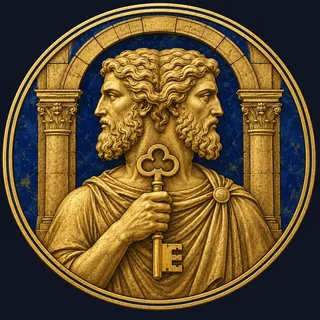
Janus
IanusIanus GeminusἸανός
- doors and gateways
- beginnings
- war and peace
- first in every prayer
The two-faced god of doors and beginnings, named first in Cato's prayers and in Varro's list. Ovid's Janus says Greece has no god like him and that the ancients called him Chaos; he ruled the Janiculum, received the exiled Saturn, and stopped the Sabines with a scalding spring. Numa made his shrine the index of war and peace.
See Janus in the interactive atlas
First attested
c. 160 BCE · Cato Agr. 134
In the texts
Iano struem commoveto sic: 'Iane pater, te hac strue ommovenda bonas preces precor
Offer the cake to Janus thus: 'Father Janus, in offering you this cake I pray good prayers'. AI translation
Cato Agr. 134 Read the full text ↗ English (AI)
quem tamen esse deum te dicam, Iane biformis? / nam tibi par nullum Graecia numen habet,
But what god shall I say you are, two-shaped Janus? For Greece has no deity to match you. AI translation
Ov. Fast. 1.89–90 Read the full text ↗ English (AI)
me Chaos antiqui (nam sum res prisca) vocabant:
The ancients called me Chaos (for I am a thing of old). AI translation
Ov. Fast. 1.103 Read the full text ↗ English (AI)
Ianum ad infimum Argiletum indicem pacis bellique fecit, apertus ut in armis esse ciuitatem, clausus pacatos circa omnes populos significaret.
He made the Janus at the foot of the Argiletum the index of peace and war: open, it showed the city was in arms; closed, that all the peoples around were at peace. AI translation
Liv. 1.19 Read the full text ↗
Lineage
- Children
- CanensOv. Met. 14.333–334
Ties
The reference after a name is the passage the tie rests on.
In the myths
Passages in the library
Passages of the original-language texts that name Janus, counted by a word index.