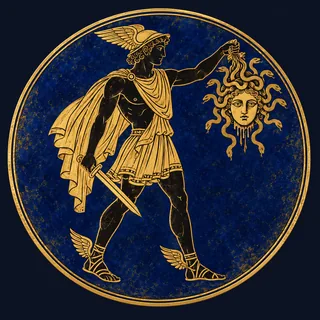
Medusa
ΜέδουσαΓοργώ
- petrifying gaze
- gorgon
- beheading
- Gorgon
- snakes
The one mortal Gorgon, who lay with Poseidon; when Perseus cut off her head, Chrysaor and the horse Pegasus sprang out (Hes. Th. 276-281). Apollodorus gives the Gorgons snake-scaled heads, tusks and golden wings and a look that turns men to stone. Ovid makes her a beautiful girl whose hair Minerva turned to snakes after Neptune violated her in the goddess's temple, and Pausanias records an Argive version in which she was a Libyan queen killed in war.
See Medusa in the interactive atlas
First attested
c. 700 BCE · Hes. Th. 276
In the texts
Σθεννώ τʼ Εὐρυάλη τε Μέδουσά τε λυγρὰ παθοῦσα.
Stheno and Euryale and Medusa, who suffered a woeful fate AI translation, after Hugh G. Evelyn-White
Hes. Th. 276 Read the full text ↗
Σθεννώ τʼ Εὐρυάλη τε Μέδουσά τε λυγρὰ παθοῦσα.
Sthenno and Euryale and Medusa, who suffered a woeful fate. tr. Hugh G. Evelyn-White
Hes. Th. 276 Read the full text ↗
ἦσαν δὲ αὗται Σθενὼ Εὐρυάλη Μέδουσα. μόνη δὲ ἦν θνητὴ Μέδουσα
they were Stheno, Euryale, Medusa; Medusa alone was mortal AI translation
Apollod. 2.4.2 Read the full text ↗
Gorgoneum crinem turpes mutavit in hydros.
she changed the Gorgon's hair into foul snakes. AI translation
Ov. Met. 4.801 Read the full text ↗
Lineage
Ties
The reference after a name is the passage the tie rests on.
In the myths
Passages in the library
Passages of the original-language texts that name Medusa, counted by a word index.