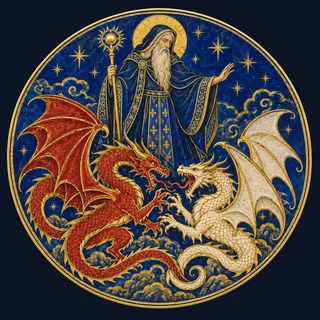
Merlin
MerlînMerlinemerlin
- prophecy
- magic
- Britain
The British prophet, believed to have been begotten by an incubus on a mortal woman. The Rhenish Merlin fragment shows him foretelling a threefold death that comes true; Holinshed records his prophecies, his naming of Uther Pendragon, and doubts his 'monstrous birth'; a fifteenth-century French life of du Guesclin and Shakespeare's Hotspur and Lear's Fool still quote 'the books of Merlin's prophecies'.
See Merlin in the interactive atlas
First attested
c. 1300 (German fragment) · Rheinischer Merlin 9-14
In the texts
hê was lange unkristen / dô wolte hê gerne kristen sîn / daz tete man ime inde nante in Merlîn
he was long unchristened; then he wished to be a Christian; that was done for him and he was named Merlin. AI translation
Rheinischer Merlin 12-14 Read the full text ↗ English (AI)
ir sulet ertrinken sprach Merlîn / hê sâte wie mohte daz sîn / Merlîn dû spræches wâr ie
You shall drown, said Merlin. He said: how could that be? Merlin, you always spoke truth. AI translation
Rheinischer Merlin 89-91 Read the full text ↗ English (AI)
This prophecy Merlin shall make; for I live before his time.
(English original)
King Lear 3.2.83 Read the full text ↗
Lineage
- Parents
- IncubiHolinshed, Scotland, Dongall
Ties
- Helped
- Uther PendragonHolinshed, England 5.10
The reference after a name is the passage the tie rests on.
In the myths
Passages in the library
Passages of the original-language texts that name Merlin, counted by a word index.